


Our goal with The Daily Brief is to simplify the biggest stories in the Indian markets and help you understand what they mean. We won’t just tell you what happened; we’ll tell you why and how too. We do this show in both formats: video and audio. This piece curates the stories that we talk about.
You can listen to the podcast on Spotify, Apple Podcasts, or wherever you get your podcasts and watch the videos on YouTube. You can also watch The Daily Brief in Hindi.
In today’s edition of The Daily Brief:
India’s private banks are growing again, but at a cost
Why are India's major private banks reporting their strongest loan growth in over a year while simultaneously seeing margin compression? Corporate credit has rebounded sharply—reaching up to 38% growth at Axis Bank—as the borrowing cost gap between bank loans and bond markets narrowed. However, this uptick largely reflects working capital requirements rather than new capex. With low-cost CASA deposit ratios declining across the board, banks are turning toward FCNR(B) foreign currency deposits and securitisation to bridge funding gaps.
Plus: The business of Makhana
How did an arduous, labour-intensive wetland crop from Bihar transform into an ₹8,500 crore global wellness snack projected to reach ₹12,000 crore by 2030? Fueled by modern branding and booming exports (with the US absorbing 40% of international supply), average domestic prices rose to ₹1,250/kg in 2025. Yet, with farmers historically capturing under 28% of the final retail price, the newly launched National Makhana Board and a ₹476 crore central scheme seek to establish local processing hubs and farmer cooperatives.
India’s private banks are growing again, but at a cost
We’ve been tracking India’s private banking sector for over a year now, across more than four quarters of results. In Q1FY27, the four largest private banks reported some of their strongest loan growth over this period. At the same time, two of them reported their lowest margins since we started tracking them.
To understand why both are happening together, we need to go back about a year.
Few things we spent last year worrying about
Over the past year, a few themes kept coming up every time we looked at private bank results.
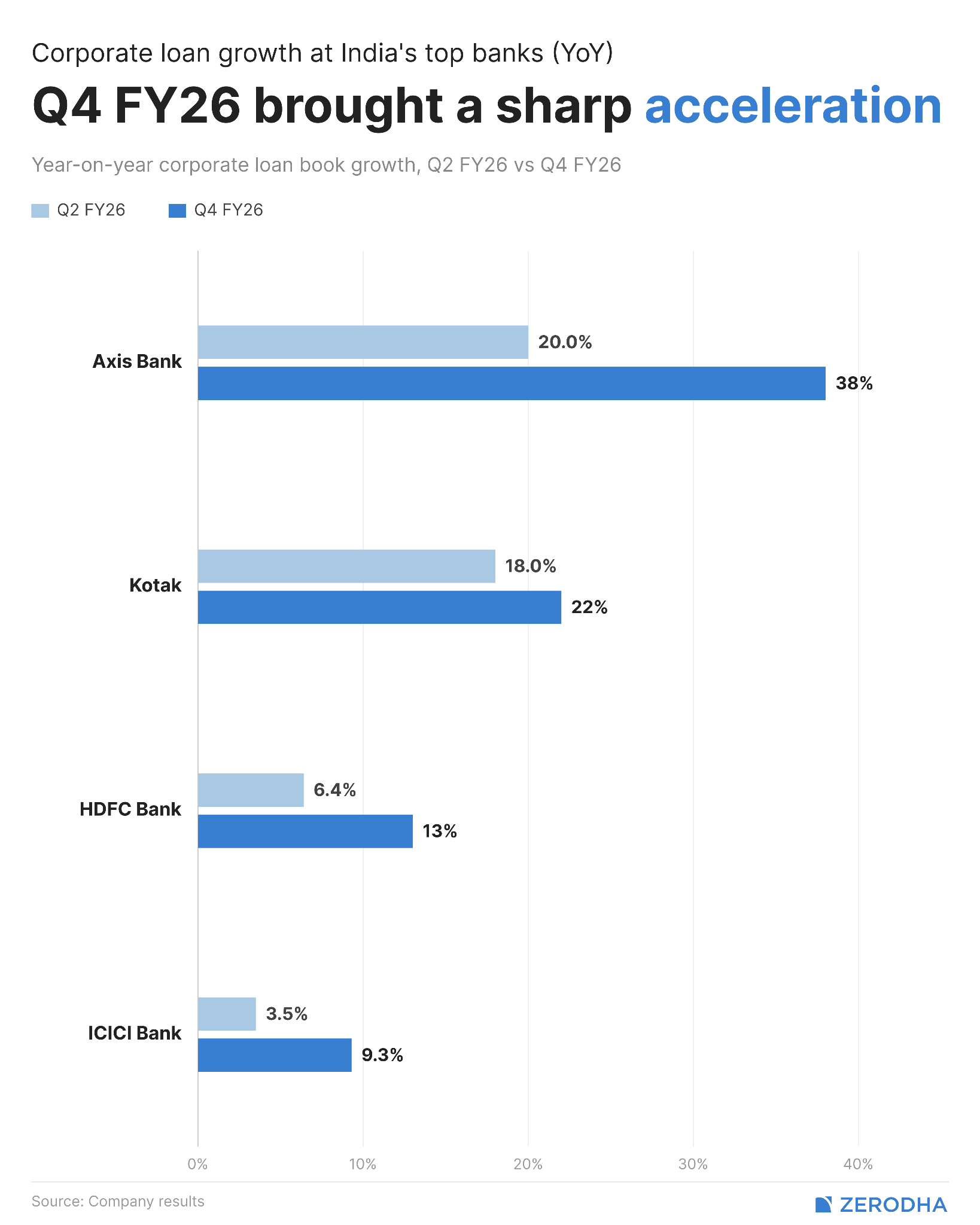
The first was the corporate sit-out. For most of FY26, large Indian companies simply weren’t borrowing much from banks. Corporate loan books grew in the low single digits, while other segments grew much faster.
Part of this was because private capex remained weak. But pricing mattered too. Five years ago, a AAA-rated company could borrow for a year through the bond market at a rate roughly 4.7% lower than what a bank would charge. So companies that could raise money through bonds had little reason to borrow from banks. Banks instead relied on retail and SME loans for much of their loan growth.
By March 2026, that gap had narrowed to about 1.5%. That made bank loans more competitive again, which is why we flagged in the last quarter that corporate borrowing from banks could make a comeback.
The second was the deposit war. Through most of FY26, the problem wasn’t finding people to lend to. It was finding enough money to lend. Banks needed deposits to fund all those loans, so they started offering higher interest rates to attract them. That made deposits more expensive for banks and, in turn, lending less profitable.
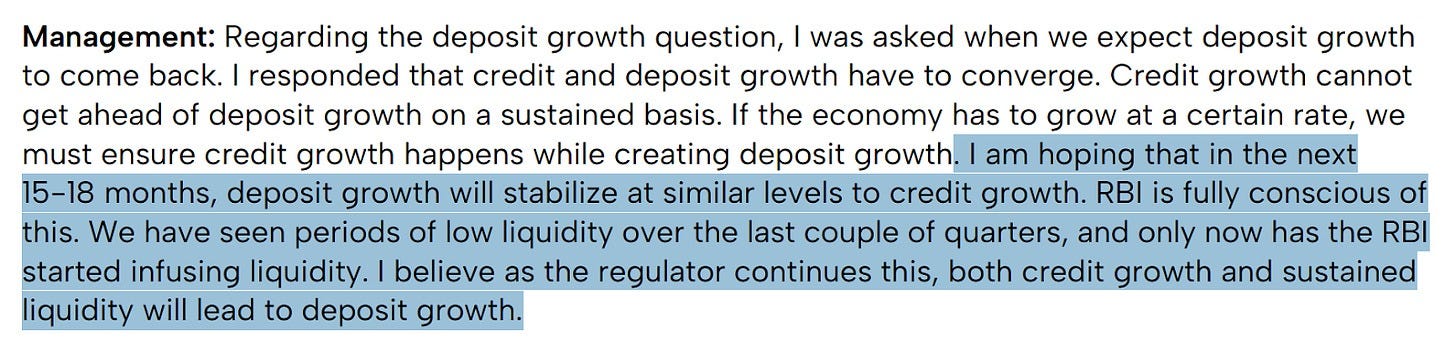
By Q3, Axis was telling analysts that deposit and loan growth wouldn’t converge for another 15 to 18 months. Things improved somewhat in the last quarter, but some of that could simply have been year-end seasonality. Whether the improvement would last was one of the questions we asked last quarter.
The other two concerns were more short-lived. One was unsecured lending. After the RBI raised risk weights on consumer credit in late 2023, banks slowed down personal loans and credit cards. By Q4, that pullback was already starting to ease, as we saw some activity there.
The other was West Asia. Last quarter, bank managements spent a fair bit of time discussing the risks around the Strait of Hormuz, with Axis even setting aside ₹2,001 crore as a precaution. That risk never really materialised and the provision remains unused. Other banks did talk about it, but didn’t give us a number like Axis did, and the issue barely came up this quarter.
Corporate lending is back
That brings us to this quarter. Instead of running through every bank’s headline numbers one by one, we’ll follow the few trends that actually explain what happened. By the end, you should have a pretty good picture of how all four banks did.
Let’s start with the biggest change: corporate lending is back.
ICICI’s domestic corporate book grew 18.5% year-on-year. Two quarters ago, it was growing at 9%, and two quarters before that, just 3.5%. HDFC’s corporate and wholesale book grew about 18%, while Axis maintained wholesale growth of 38%. Kotak’s corporate book grew 15.5%. Its credit substitutes book — basically short-term corporate debt that the bank buys instead of giving out a regular loan — grew 38% in a single quarter.
This helped push overall loan growth to roughly 15–20% across the four banks, among the strongest we’ve seen since we started tracking them.
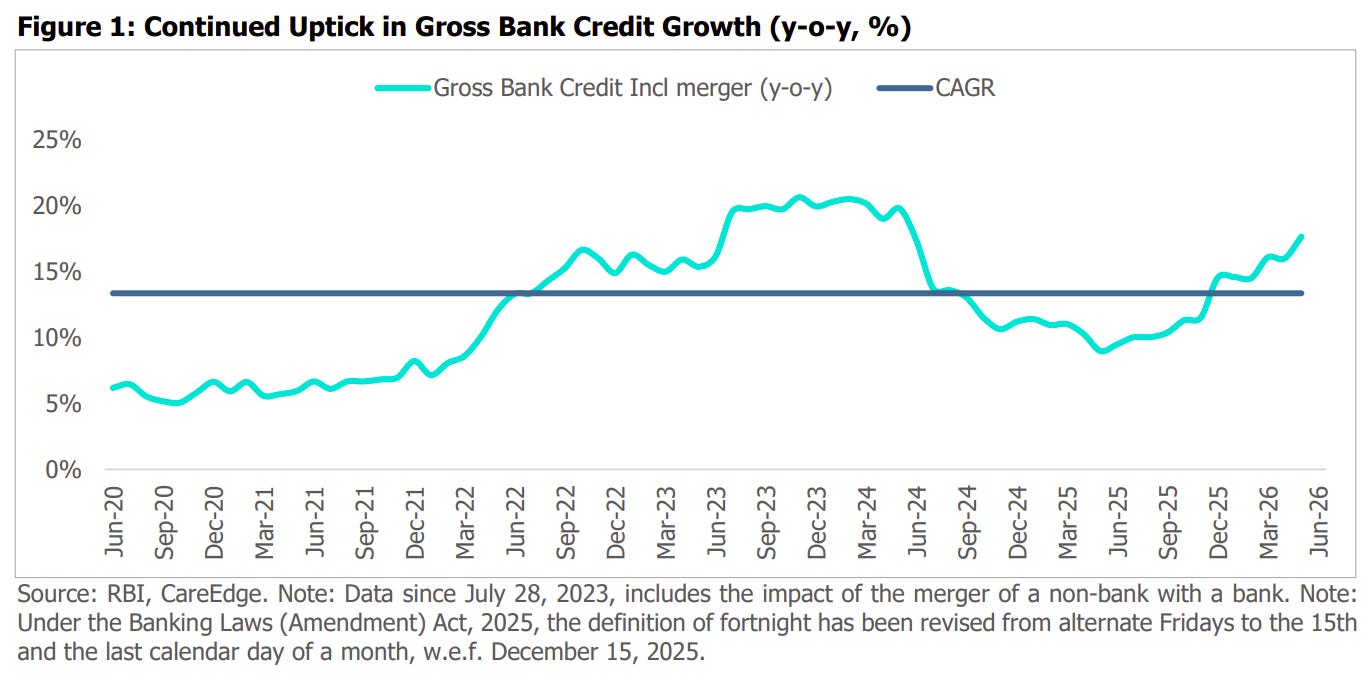
But the more interesting bit is where that growth is coming from. Retail, which was doing much of the work a year ago, is now growing slower than corporate lending at all four banks. ICICI’s retail book grew 12%, HDFC’s 7–8%, and Axis’s just 8%.
In a year, the mix of loan growth has almost flipped.
So, is India’s long-awaited private capex cycle finally showing up? We wouldn’t be so sure about that.
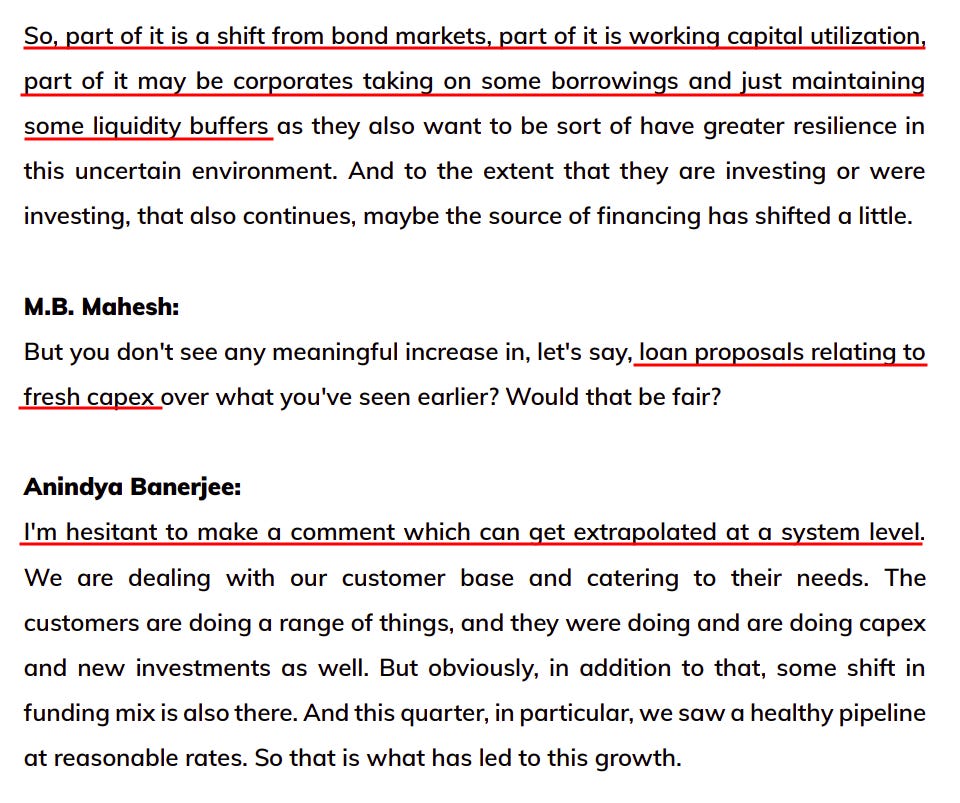
ICICI’s Anindya Banerjee said some of the corporate growth came because bond markets were less attractive this quarter. Some was for working capital, and some may simply have been companies borrowing to keep extra cash on hand. In other words, more bank borrowing doesn’t necessarily mean companies are building new factories.
Kotak adds another wrinkle. Some of its growth came from buying companies’ short-term debt rather than giving them loans, simply because it paid better. It also comes with a regulatory advantage: buying this debt doesn’t increase the base used to calculate the bank’s priority-sector lending requirement next year.
Loan growth was getting expensive
Last quarter we observed that margins (NIMs) had finally stopped falling. Not quite.
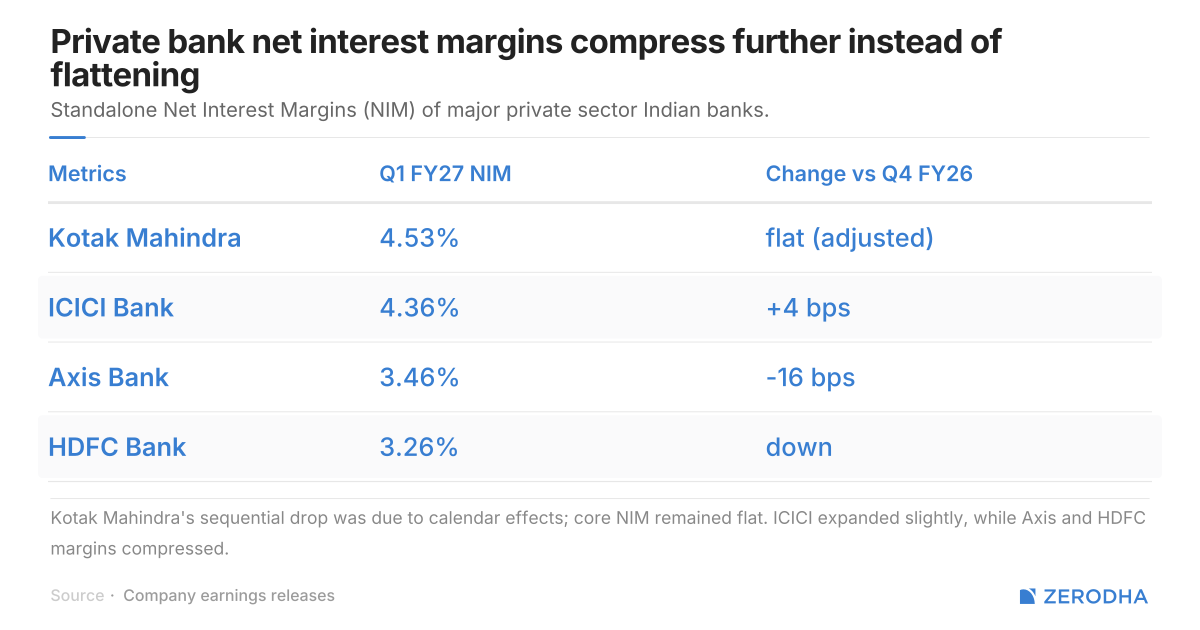
The interesting bit is why we got this wrong.
Margins here refer to net interest margins (NIMs), the difference between what banks earn on loans and what they pay on deposits. When the RBI cut the repo rate, lending rates reset quickly because most loans are linked to external benchmarks. Deposit rates, however, adjust more slowly since they reprice only as older deposits mature. That lag initially squeezed margins.
That dynamic is now reversing. Deposits are finally getting repriced lower, easing funding costs across banks. Axis’s cost of funds fell 35 basis points over the year, HDFC’s by about 40, and ICICI’s cost of deposits declined from 4.85% to 4.41%. The pressure from expensive deposits is therefore gradually fading.
The problem has now moved to the lending side. Corporate loans typically earn banks less than retail loans. So as corporate lending becomes a bigger part of growth, the average yield on the loan book falls.
Axis is the clearest example. Of the 34 basis points of margin it lost year-on-year, nearly half of the lost margin came from this change towards corporate.
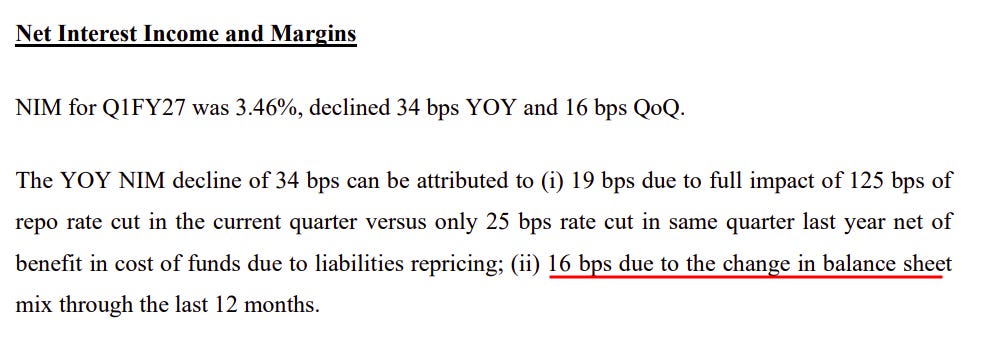
ICICI had an offset. Its corporate book grew 18.5%, but business banking grew 28.2% and rural and gold loans grew 35.4%. These higher-yielding businesses helped cushion the impact.
So the margin problem hasn’t disappeared. It has just changed. Last year, banks were paying more for deposits. This time, they are earning less on the loans they are growing.
The other side of 20% loan growth
There is another problem with growing loans this fast: you need the money to fund them.
While loans across these banks grew roughly 15–20%, deposits grew only 12–14%. That gap explains why one topic kept coming up across all four calls: FCNR(B) deposits.
The RBI recently reopened a window that makes it cheaper for banks to raise foreign currency deposits from NRIs. In simple terms, banks take dollars from NRIs, convert them into rupees and lend that money in India, while largely protecting themselves from currency swings.
And right now, that money is attractive. ICICI said the total cost after hedging works out to around 6.30–6.40%, cheaper than raising similar money in India.
All four banks sounded interested, though none said how much they had actually raised. HDFC said its team was “quite gung-ho”, Axis expects to raise more than its usual market share, and Kotak called the early response encouraging.

There is a catch. More FCNR money expands a bank’s international balance sheet with foreign lending, where margins tend to be lower. So it can help fund loan growth and add to profits, while also putting a little more pressure on margins.
Which brings us back to the same trade-off: banks have found another source of money to fund faster growth. It just isn’t free.
Except the cheapest money is still walking out
Here’s the thing none of the four calls said out loud in this form.
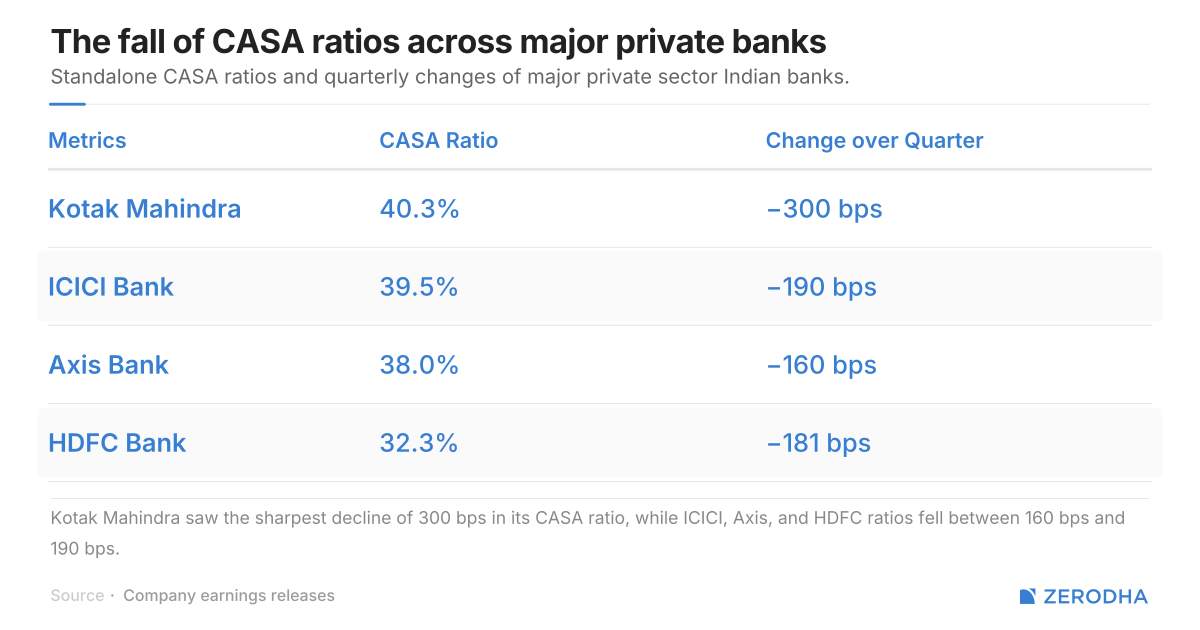
CASA is current and savings account money, the cheapest funding a bank has because it pays little or nothing for it. At all four banks, the CASA ratio fell sequentially this quarter. And at all four, management preferred talking about average CASA balances during the quarter rather than where they ended the quarter. Both figures are accurate, but they tell you different things and the year end figure gives us a scarier picture that no banking CEO was willing to talk about.
This is also where the FCNR excitement needs its caveat. FCNR money is term money. It’s cheaper than wholesale borrowing and it will fund loan growth, but it does absolutely nothing for CASA. Total deposits are growing fine everywhere. It’s the mix that keeps getting worse: term deposits are growing while the cheap CASA money shrinks.
Household deposit growth in India is running slower than any other depositor category the RBI tracks. More pointedly, an analyst on HDFC’s call cited an RBI finding that the old relationship between interest rates and CASA balances appears to have broken down. HDFC’s CFO agreed with the premise. His answer was that the bank isn’t counting on balances per customer rising at all. It’s counting on adding more customers.
If that’s right, the cheap-funding recovery that the entire sector’s margin story is waiting for may not arrive at the end of this cycle. It may not arrive at all.
And there is another constraint. Loans are growing 15–20%, while deposits are growing 12–14%. That gap is pushing loan-to-deposit ratios higher. HDFC’s rose from 94.6% to 95.8% this quarter, while ICICI’s went from 86.6% to 89%. Kotak said it would use some of its excess liquidity to fund growth.
That’s fine for a while. These banks have enough liquidity and capital. But if credit keeps growing faster than deposits, they eventually need other ways to fund loans.
One answer could be securitisation: make a loan, sell it to another investor, and free up the balance sheet to lend again. We discussed this on Subtext with Amit Tripathi, CIO of Fixed Income at Nippon India Mutual Fund, who expects this to become a much more normal part of Indian banking over the next three to five years.
FCNR can help bridge the gap today. It doesn’t solve the longer-term funding problem.
Four other things worth watching
A few other things stood out this quarter.
El Niño replaced the West Asia risk as the bank’s management kept bringing it up in concalls. But it is still too early to know what it does to rural demand or repayments, and the real impact, if any, should show up later in the year.
There is also an unusual churn at the top. Kotak is working through CEO succession, as it has been for years. HDFC has had changes at the board level while its CEO’s reappointment remains pending, and Axis CFO Puneet Sharma is leaving to join HDFC.
Kotak, meanwhile, is buying Deutsche Bank’s India retail, private banking and wealth businesses for ₹281 crore. More interesting than the deal itself was Kotak’s explanation: when judging its growth, investors should look at organic and acquired growth together. In other words, acquisitions are now explicitly part of the plan.
And from April 2027, banks move to expected credit loss provisioning, where they start setting aside money before loans actually default. All four say they have enough buffers for the transition. Kotak is the only one that has quantified the longer-term impact, expecting credit costs to rise by 12–15 basis points.
That leaves us with a fairly simple picture. Corporate loans have replaced retail as the big source of growth, but much of that is working capital, not new capex. Deposits remain stretched, and with CASA under pressure, banks still need to figure out how they fund growth cheaply.
We haven’t talked much about NPAs because there isn’t much to talk about. Asset quality remains pristine. El Niño could change things at the margin, but for now, we wouldn’t read too much into it.

The story of a humble pond-grown crop
This story was scripted because one evening, the team was munching on makhana.
Makhana (or fox nuts) has long been a traditional snack and a staple during fasts. We have consumed them in a variety of ways: cooked into kheer, simply roasted as a snack and, more recently, coated in caramel.

But the makhana we so easily pop into our mouths is anything but easy to produce. Its journey is slow, difficult and one of the most labour-intensive processes in food manufacturing. Demand for this snack is growing, especially overseas, and India is now exporting more makhana than ever before. At the heart of this growing industry is Bihar, which produces nearly 80% of India’s makhana.
The journey from pond to packet
Let’s start with the long road to how makhana is made.
Stage 1
Traditionally, makhana was grown in deep ponds and natural wetlands. But farmers are now also growing it in agricultural fields by recreating the conditions of a pond. Preparing such a field requires months of careful work.

First, farmers choose low-lying land with smooth, loamy soil. They build clay bunds around the field to hold water and maintain it at a shallow depth of around one foot. The water must remain at the right level throughout the season. Too little water can affect the crop, while too much makes it harder for farmers to control weeds.
This shallow field system allows farmers to apply manure and fertilisers more easily than in deep ponds. It also uses far fewer seeds than traditional pond cultivation. But using fewer seeds does not mean less work. Throughout this whole process, farmers must constantly look after the field.
The seeds are sown around December and grow into thorny water lilies that flower by April. As the fruits mature, they soften and burst underwater, releasing seeds that sink to the pond bed by July.
Stage 2

Then comes August and the most difficult part of the entire process.
Farmers must enter the water and collect the seeds manually from the bottom. By now, the pond is covered with large, prickly plants, making it difficult and dangerous to move through. Farmers use a special tool with a long stick and a blade at the end to push the plants aside and make space to wade through the water. Even with this tool, they are often injured by the thorns.
They then feel around at the bottom of the pond, gather the seeds and collect them in a special basket called a Gaaja. It is slow, exhausting work carried out in muddy water among thorny plants.
But pulling the seeds out of the water is still not the end of the process. The collected seeds are cleaned and stomped on carefully to remove their outer husky layer. The shiny black seeds that emerge are then dried for about an hour.
This may seem like a small step, but the temperature has to be carefully controlled. If the seeds are not dried properly, they may not pop later.
Stage 3

Once dried, the seeds are sorted by size and quality into as many as 18 grades. The larger seeds generally produce the white, fluffy makhana preferred for exports. They are half-roasted, left to rest and roasted again the next day, with workers moving them between kadais to carefully control the heat.
The hot seeds are then struck individually with a wooden hammer, bursting the hard black shell into the white makhana we recognise. They are sorted once more to remove broken and low-quality pieces before being packed and sent to businesses for flavouring and packaging.
A perception shift
Makhana did not suddenly become healthy, nor is it something Indians discovered recently. We have been eating it for generations. What changed was the way it was presented to us. As people began looking for healthier alternatives to chips and other fried snacks, businesses found that makhana was light, crunchy, easy to flavour and could be sold as a modern wellness snack.
Until then, makhana was mostly sold loose or in simple packets at local grain markets. That began to change around 2017–18, when brands such as Mr Makhana and Mithila Naturals started packing it in modern formats and selling it in different flavours. Mainstream brands such as Too Yumm soon followed, helping makhana move from local markets to supermarket shelves as a branded, ready-to-eat snack.
Demand abroad also grew as makhana found a place among plant-based and gluten-free snacks. But the boom is not only because people are eating much more of it. Makhana has also become more expensive and premium, with businesses adding value through grading, flavouring, packaging and branding.
The average domestic price of makhana increased from around ₹500 per kg in 2020 to ₹1,250 per kg in 2025. Larger grades, which are preferred for exports and flavoured products, sell at an even higher price. So, while more makhana is being consumed, a large part of the growth in the market’s value has also come from makhana becoming more expensive and more premium.
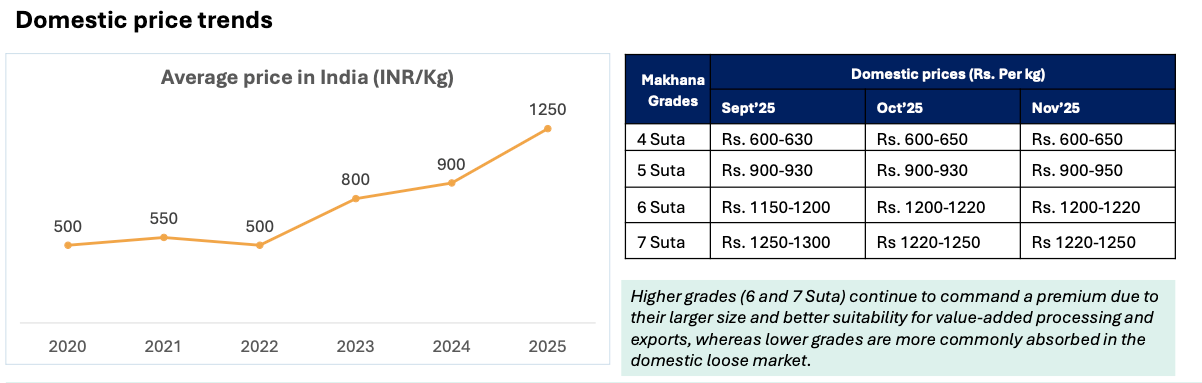
So, there is both a price effect and a volume effect on the market potential of makhana. According to the APEDA-Crisil dashboard, India’s makhana market was worth around ₹5,500 crore in 2021–22. By 2024–25, it had grown to approximately ₹8,500 crore. It is expected to reach ~₹12,000 crore by 2029–30.
India produces almost all the makhana it consumes
India is the world’s largest producer of makhana. The area under makhana cultivation increased from around 27,000 hectares in 2020 to an estimated 40,000 hectares in 2025. Over the same period, seed production increased from around 45,000 tonnes to an estimated 1.2 lakh tonnes.

But all of this does not become the white makhana we eat. Once the seeds are cleaned, graded, roasted and popped, around 1.2 lakh tonnes of seed makhana produces only about 60,000 tonnes of popped makhana.
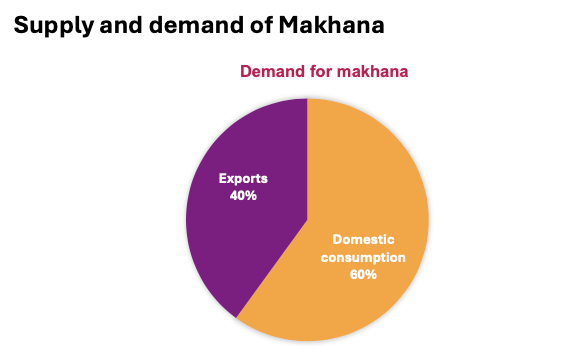
Around 60% of this popped makhana is consumed within India, while the remaining 40% is exported. Domestic consumption is estimated at 3,500 tonnes every month and can rise to around 5,000 tonnes during festive months.
Branded snack companies account for around 2,000 tonnes of monthly demand, while another 1,400 tonnes are sold through unorganised markets. This is still an industry dominated by informal, unbranded players. This shift is also one of the key reasons behind the newfound perception of makhana.
India’s makhana exports have also been supercharged in the last 5 years. We exported around 6,700 tonnes of makhana in 2020, while in 2025, India exported over 18,150 tonnes. The United States is India’s largest makhana buyer, accounting for around 40% of exports in 2025. Canada follows with 20%, while the UAE accounts for another 17%.
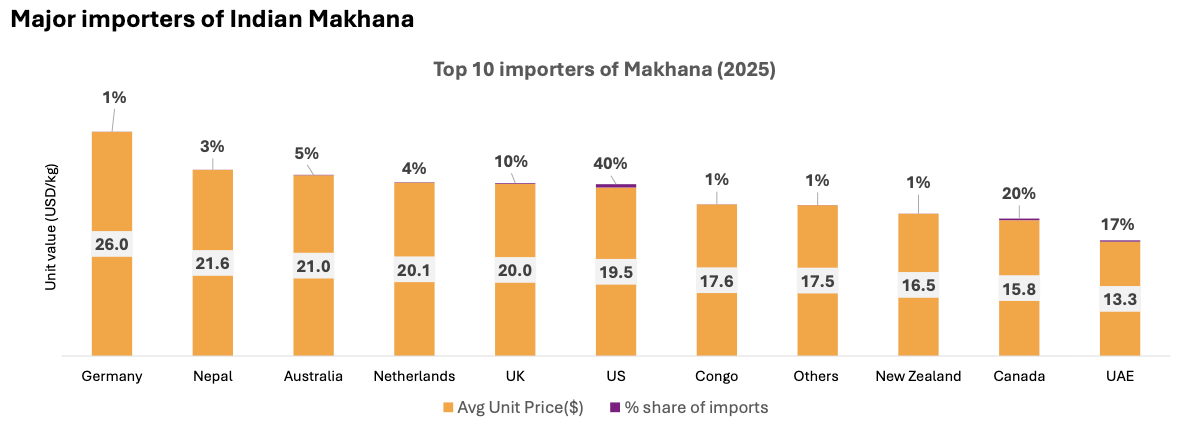
But the largest buyers do not always pay the highest price. The average unit price was around $19.5 per kg in the US, $15.8 in Canada and $13.3 in the UAE. Smaller buyers paid more: Germany paid an average of around $26 per kg, Nepal $21.6 and Australia $21.
One state does the heavy-lifting
The makhana economy is also unusually concentrated in one state. Bihar produces roughly 90% of India’s makhana and around 80% of the world’s supply. Even within Bihar, 8 districts do most of the heavy-lifting. Today, the economics of Indian makhana almost wholly depend on one part of Bihar.
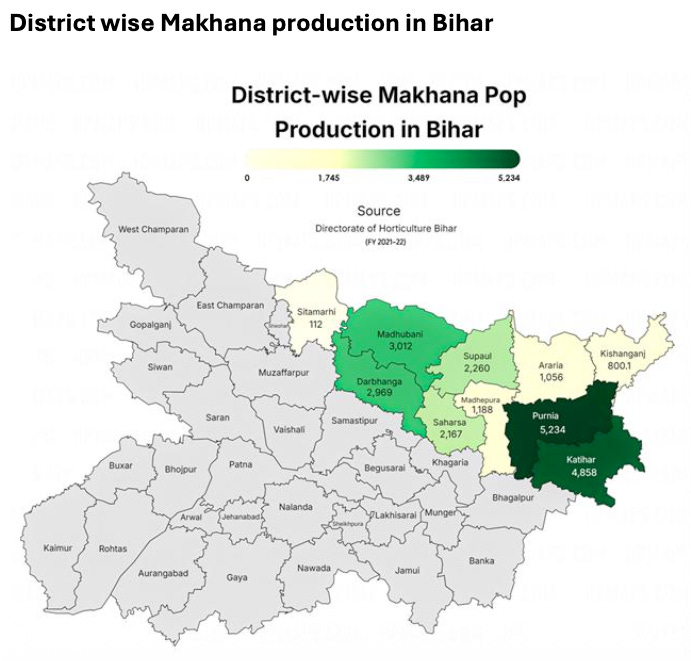
This concentration is not accidental, though. These parts of Bihar have the low-lying wetlands, ponds, soil and climate needed to grow makhana. Generations of farmers and workers here have also developed the skills required to collect the underwater seeds and pop them by hand.
Makhana is also grown in Uttar Pradesh and parts of Chhattisgarh. Other states with similar wetlands may have the potential to cultivate it through field-based farming. But their present contribution is small.
This creates an advantage as well as a risk. Bihar has the knowledge, labour and established supply chain needed to dominate the industry. But when production is concentrated in one region, cold weather, water shortages, floods or a poor harvest can affect the supply and price of makhana across the country.
Which, with climate change, has become common.
Rising temperatures, long dry spells and uneven rainfall are causing water levels to fall across parts of North Bihar, making cultivation more difficult and expensive. Farmers have to shift towards shallow field-based systems for better control, but these require reliable irrigation, leaving the crop increasingly vulnerable to water shortages.
The name “Mithila Makhana” has received a Geographical Indication, or GI, tag too. In this case, it identifies Mithila Makhana with the Mithila region of Bihar. This can help prevent unrelated sellers from using the name freely and gives local producers a way to market the product through its place of origin.
But a GI tag does not automatically increase farmers’ income. Farmers and producer groups must register as authorised users, maintain quality, create traceable supply chains and market the product under the GI identity. Otherwise, the tag may remain only a label while businesses outside the farming region continue to capture most of the value from processing and branding.
The value chain problem
This value capture problem has become even more visible with the growth of the makhana market.
The difficult work remained with farmers and workers in Bihar, while much of the value was created and captured when the makhana was branded and sold through supermarkets or exported. An ICAR study using 2017–18 market data found that the gross price received by farmers represented 27.6% of the final consumer price in the distant Delhi–Kanpur supply chain it examined. Their share was higher in shorter, local supply chains.
The exact share can vary depending on where and how makhana is sold, but the study shows how intermediaries, wholesalers, retailers and businesses capture different parts of the final price. The APEDA-Crisil dashboard also identifies dependence on middlemen and the lack of local processing facilities as major problems for farmers.
This is where the government felt the need to step in. The Union Budget of 2025–26 announced a dedicated Makhana Board in Bihar. The National Makhana Board was officially launched on 15 September 2025, and the government later approved a ₹476.03 crore Central Sector Scheme for the development of the makhana value chain.
The scheme will support research, better seed varieties and modern cultivation methods. It will train farmers, improve harvesting and post-harvest practices, and help build infrastructure for drying, grading, popping and packaging.
It also plans to organise farmers and others working in the industry into Farmer Producer Organisations. In theory, this can give small farmers more bargaining power, help them purchase inputs together and allow them to sell larger quantities directly instead of depending entirely on intermediaries. This is not dissimilar to milk in India, which is dominated by producer cooperatives.
Processing is particularly important. If more processing units are established near the producing districts, farmers and local businesses can participate in flavouring, packaging and branding instead of selling only the raw or popped makhana. This would allow a greater share of its final value to remain in Bihar.
Conclusion
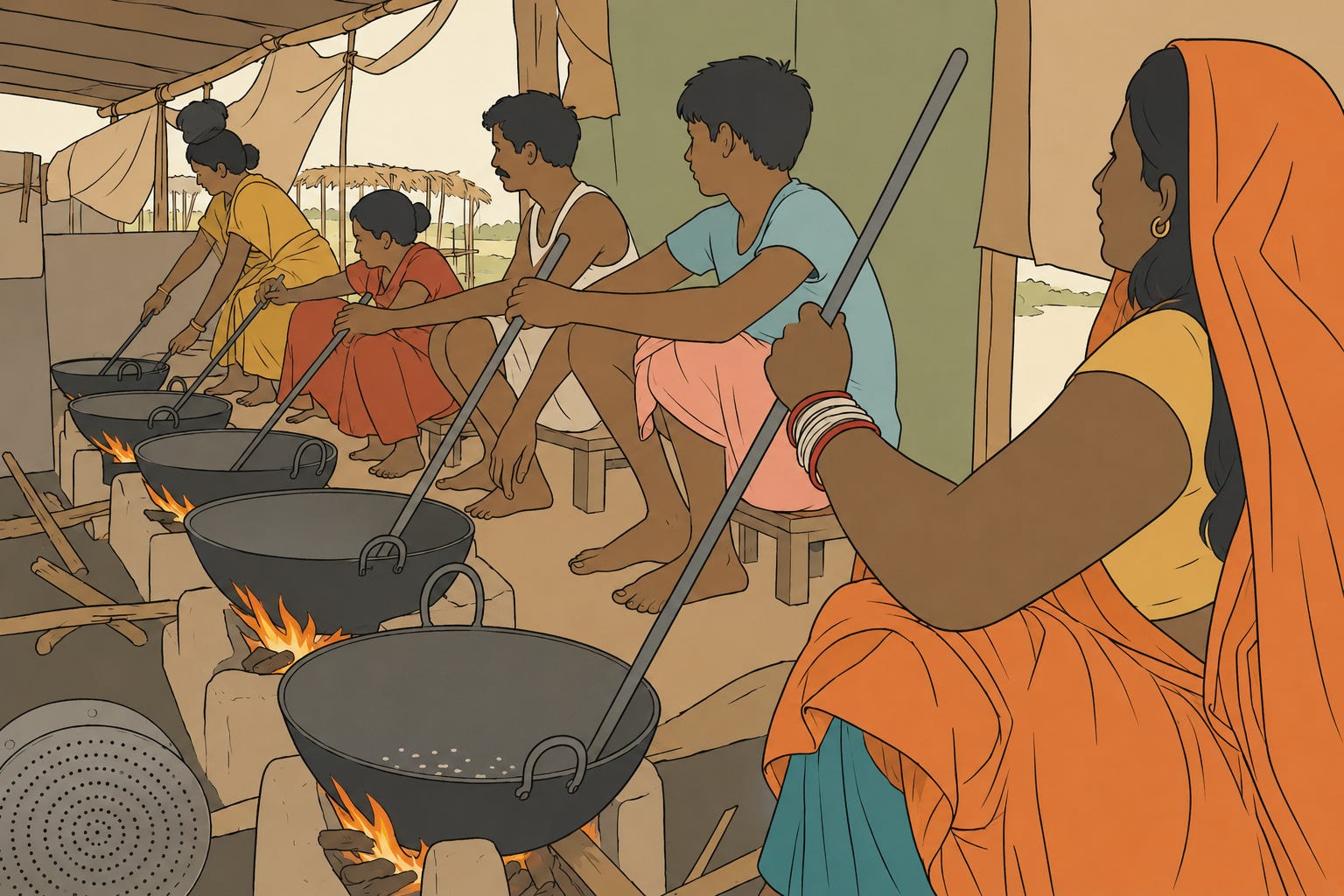
The next time we casually pop a handful of makhana, it may be worth remembering how much work went into making it so light and effortless to eat. It took months of cultivation, farmers wading through thorn-covered water, seeds being collected from the pond bed and skilled workers carefully roasting and popping them one by one.
Makhana has now travelled far beyond the ponds of Bihar. But the industry’s real success will depend on how the value accrues to different parts of the value chain. If this growing demand doesn’t improve the lives of those producing it, the value chain could get unsustainable, especially when climate vagaries hit the crop. The Makhana Board, local processing units and better market access could help keep more of the value in Bihar.
Gold is India’s favourite asset. But what are you really paying for?
Cash & Copium is our new show where we argue about the things that actually move money in and out of your pocket, and what you should do about them.
In Episode 2, Abid and Bhuvan unpack how gold is priced, whether it really hedges inflation, and why Gold ETFs stand out among the ways to own it.
Watch the full episode: The Real Truth About Buying Gold in India! | Cash & Copium Ep 2
Tidbits:
1. Ola Electric Shifts Away from D2C-Only Sales Model
Ola Electric is abandoning its direct-to-consumer(D2C) strategy and will now partner with traditional offline dealerships. This major shift aims to quickly expand the electric scooter maker’s retail footprint and improve customer access to after-sales service.
Source: Financial Express
2. Mahindra Group Appoints Shveta Arya as Chief Strategy Officer
The Mahindra Group has named Shveta Arya as its new Group Chief Strategy Officer to help steer the conglomerate’s future direction. She will be responsible for leading strategic initiatives and driving long-term growth across the company’s diverse business units.
Source: The Hindu BusinessLine
3. Govt to Ensure Social Security for Gig Workers
Union Minister Mansukh Mandaviya stated that the government will ensure social security benefits for gig and platform workers by rolling out the new labour codes. The framework aims to provide essential safety nets like life and health insurance to millions of informal workers.
Source: The Hindu BusinessLine
4. India Plans Support for Local Satcom Companies
The Indian government is working on policies to create a supportive safe space for domestic satellite communication startups. The move is designed to nurture indigenous space technology and help local players compete against deep-pocketed global giants entering the market.
Source: The Economic Times
5. SEBI Deploys AI Tool to Crack Down on Unregistered Finfluencers
Market regulator SEBI has launched a new artificial intelligence tool dubbed “Project Sudarsan” to monitor social media and catch unregistered financial influencers. The AI system will actively track down fake investment tips and stock manipulation schemes to protect retail investors.
Source: India Today
6. MHA Prohibits Renewable Energy Projects Near Borders
The Ministry of Home Affairs has banned the installation of renewable energy projects within a one-kilometre radius of India’s international borders. This strategic move addresses national security concerns, ensuring unobstructed visibility and movement for border guarding forces.
Source: Business Standard
- This edition of the newsletter was written by Kashish & Kulsum.
Beyond Today’s Brief
There’s always more happening at Markets by Zerodha.
The Chatter: What is driving SBI’s expansion into new corporate lending segments like M&A financing? How is Delhivery expanding its freight yields while steering clear of quick-commerce last-mile delivery? And can Titan, Hitachi Energy, and Apollo Micro Systems navigate commodity and geopolitical headwinds to sustain their growth momentum?
Points & Figures: What do India’s factories tell us about the trade-off between jobs, capital and value creation? Why are large factories generating most of the value while contract labour takes a growing share of employment? And what does it take to build a deeper industrial base?
Aftermarket Report: Why is Nifty remaining stuck in a tight 24,500–24,600 range despite stock-specific moves in broader markets? Do liquid MCX commodities actually trend over an 11-year backtest? And why did Bharat Forge report a quarterly loss even as its defence revenue surged 88%?
Watch Tharun on YouTube: If you’re interested in what’s actually happening with AI, and how you can use it to make better money decisions, check out Tharun’s new YouTube channel.
Join us on WhatsApp, where we share interesting soundbites from concalls, articles, and everything else we come across throughout the day. You’ll also get notified the moment a new video or article drops so that you can read or watch it right away.
Thank you for reading. Do share this with your friends and make them as smart as you are 😉
It's really insightful to read about the unknown portions of the market like the Makhana. Please do more deep dives into lesser known unheralded parts of the business world and which is encountered in daily life, instead of usual deep dives analysing quarterly results of listed companies ( which is also great, but more routine)...