

Our goal with The Daily Brief is to simplify the biggest stories in the Indian markets and help you understand what they mean. We won’t just tell you what happened; we’ll tell you why and how too. We do this show in both formats: video and audio. This piece curates the stories that we talk about.
You can listen to the podcast on Spotify, Apple Podcasts, or wherever you get your podcasts and watch the videos on YouTube. You can also watch The Daily Brief in Hindi.
In today’s edition of The Daily Brief:
India might change how it sells its airports
The final frontier of India’s fight against stubble-burning
India might change how it sells its airports
For a third time, a new batch of India’s airports is about to go up for sale.
This is the largest of all three rounds — after all, the third time’s the charm, they say. But this round is charming in more ways than one, because unlike the other times, the government seems to be changing its mind about how to sell them.
The last time India handed airports to private operators, back in 2019, it went out of its way to make bidding easy. You didn’t need to have ever run an airport before. There was no limit on how many you could win. And instead of haggling over a slice of revenue, bidders simply quoted a flat fee per passenger. The whole point was to pull in as many bidders as possible.
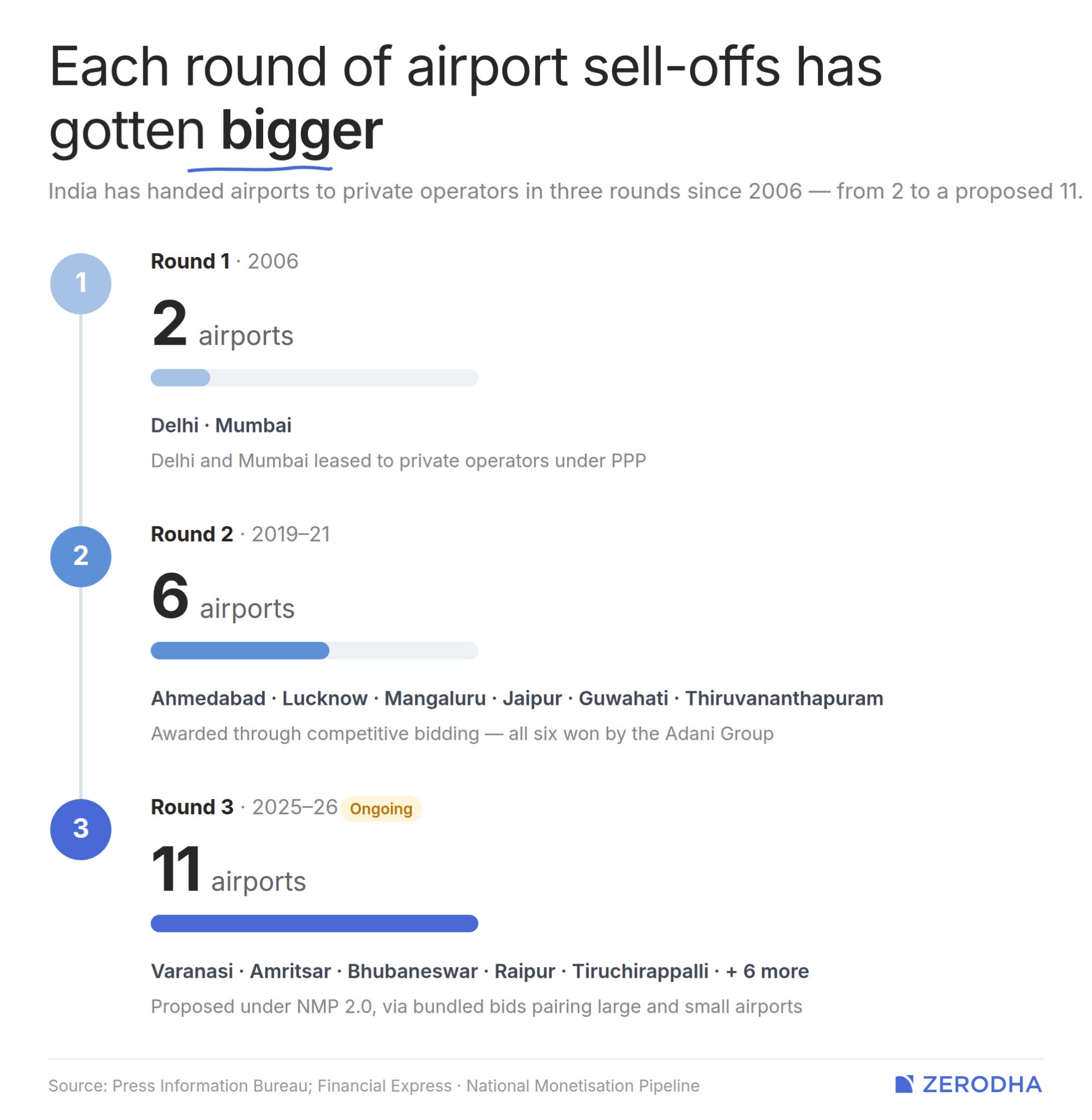
It worked, arguably too well. Adani Group walked away with all six airports on offer, in some cases bidding nearly double its nearest rival.
This time, though, the rulebook looks like it’s moving the other way.
On The Daily Brief, we’ve already walked through how India’s airport business works. Do check it out for the nitty-gritties, but here, we’ll summarize it to set some context.
See, for years, the big airports like Delhi and Mumbai ran on a revenue-share model: the private operator handed the government a cut of everything the airport earned. That gave the state a share of the upside, but it squeezed operators hard. When the government is skimming a large chunk of your gross revenue, a debt-heavy business like an airport can struggle to breathe. One former Mumbai operator, GVK, eventually had to sell out under the weight of its loans.
So the 2019 round switched tack. Bidders competed on a per-passenger fee — a fixed amount paid to the Airports Authority of India (AAI) for every flyer who walks through the doors. It was cleaner to evaluate and more predictable for the government. But it also shifted the risk onto the operator, who now had to wring enough money out of each passenger to justify the fee they’d promised.
That’s the model that has defined the last few years. And that’s the context the third round operates in.
One caveat runs through this entire story, so it’s worth saying plainly up front: none of this is settled. The proposal for all these changes by the Ministry of Aviation is still working its way through the system. So, everything you’ll read below is still subject to change.
Eleven more, in five baskets
Now, comes the next wave. Under the second National Monetisation Pipeline, civil aviation has been handed a target of ₹27,500 crore to raise by FY30. A big chunk of that is meant to come from leasing out more AAI airports.
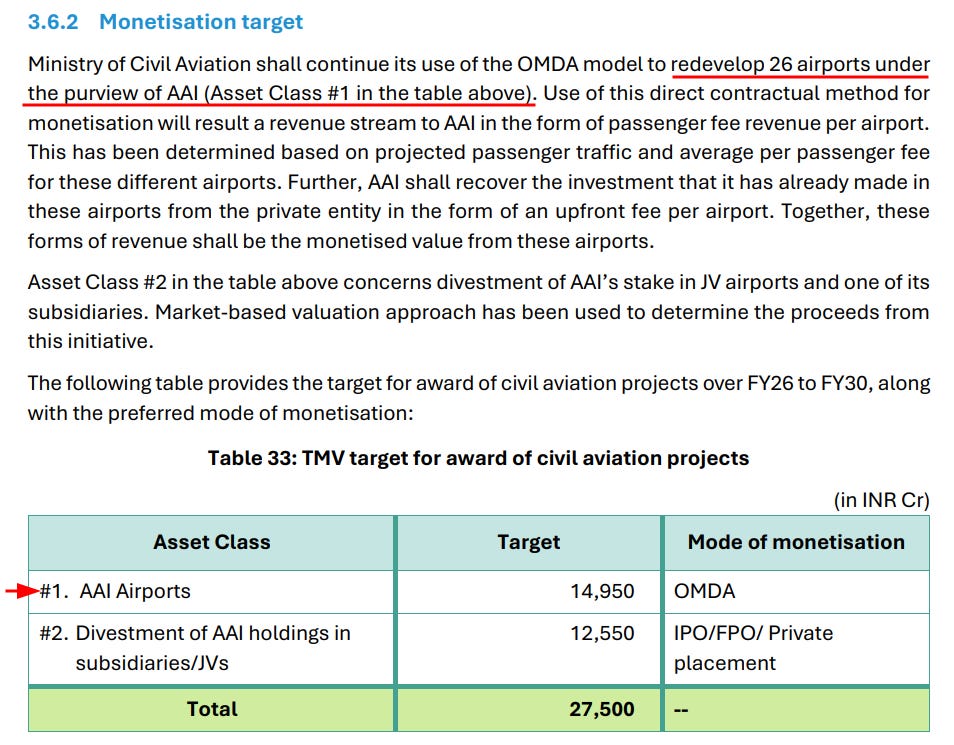
A lease is not a sale, though. AAI stays the owner, and the airport eventually returns to it. What changes hands is the right to run and develop the airport for a fixed stretch, in exchange for a fee to AAI. In return, the operator gets to earn from the airport however it can, be it landing charges, retail, parking, advertising, or real estate.
The first tranche is eleven airports. Unlike the last two rounds, these airports aren’t being auctioned one by one. They’re being grouped into five bundles, each pairing a busier airport with one or two smaller ones nearby. Varanasi, for instance, is reportedly being clubbed with Kushinagar and Gaya.
The logic behind bundling is simple enough. Auction airports individually, and every bidder chases the same handful of profitable ones. Nobody queues up for a sleepy regional airport that barely breaks even. It’s not just a theoretical worry. The first time AAI tried to lease out Ahmedabad and Jaipur, the auctions attracted too few takers and had to be re-run on gentler terms. And those are still reasonably busy airports — smaller ones are much harder to sell. The fear is that handing over just the profitable airports to the private sector would leave AAI stuck running the unviable ones. Bundling fixes that by force.
We’ve seen the same logic playing out inside airports already: the fees you pay to fly are capped by the regulator, kept deliberately low partly because the airport earns so handsomely from everything around the runway. The flip side is that an operator boxed in on flying charges leans hard on the rest. It squeezes its shops and restaurants for every rupee, which is why coffees at airports cost a small fortune.
The profitable bits, in other words, are made to carry the unprofitable ones. Bundling is the same idea moved up a level. That may sound neat as a policy, but its financing is a lot messier.
A bidder is no longer pricing one airport’s future; they’re pricing a small portfolio of very different airports in a single bet, each with its own traffic and its own commercial potential. The bundle also somewhat inflates the size of the cheque, which tends to favour bigger players. This might narrow the field to a few large infrastructure funds and established operators, who often bid as one consortium. That’s a slightly awkward outcome when the original intention was to spread airports around.
On top of that, once an operator owns a bundle, what stops them from lavishing attention on the big airport that makes money and doing the bare minimum at the small one? The entire purpose of bundling was to get the smaller airports developed. But a bundle can just as easily become a place where the weaker airport is still neglected.
If the small airport in a bundle can’t pay its own way, somebody has to cover the gap. Either the operator accepts thinner returns, or AAI accepts a lower bid, or the cost of running smaller airports resurfaces as higher fees at the busier ones.
How much should one player be allowed to win?
The second new idea is a cap on concentration, which may partly address the concern of how the bidding for bundles might work.
The proposal being discussed would let a single company win at most two bundles — roughly four airports. And there’s a clever backstop attached: if the same bidder tops the bidding for a third bundle, the runner-up gets a chance to match that price and take it instead. That keeps the auction competitive.
The principle behind this is simple: after all, an airport is a natural monopoly; a city can usually support just one. If enough of those together come under a single owner, that’s a lot of market power in one entity. This is where Adani comes in, though only as the clearest illustration of what the cap is reacting to. Having swept all six airports last time, in December 2025, the group had said plainly that it plans to bid aggressively for all eleven in the third round.
But the cap cuts both ways, and the government knows it. Restrict bidding too tightly and you risk scaring off aggressive bids, which means lower premiums and less money raised. Let’s now forget that this is the very thing this whole privatization exercise was supposed to do. So the real choice is an uncomfortable one: is the government willing to collect less in order to build a less concentrated airport market?
Nobody’s sure what the bill will look like
There’s a third open question: what will the winning operator actually pay AAI? Will it be the per-passenger fee of the last round, a return to revenue-sharing, or some hybrid of the two? That, too, is still being weighed.
India’s two newest big airports went opposite ways on this question. Navi Mumbai, which opened in December, runs on revenue-sharing. The new Noida airport at Jewar, which began flights in June, runs on a per-passenger fee. Perhaps, this means that the government still treats this choice case by case rather than as a settled formula.
And the two aren’t just accounting trivia, because they hand the risk to different people.
Under revenue-sharing, when an airport does badly, AAI and the operator feel it together as the government’s cut shrinks alongside the operator’s income. Under a per-passenger fee, AAI only cares that a passenger showed up; whether that passenger then spent freely at the shops or not is entirely the operator’s problem. So a fee model loads more of the commercial risk onto the operator. In a bundle of airports with very different traffic profiles, that’s a much harder bet to price correctly.
The harder landing
A cap, if it survives, might stop another single-player sweep. But that only changes the shape of the risk rather than removing it. The danger this round is less about concentration than the winner’s curse: bundles won at aggressive valuations on hopeful traffic forecasts, the kind of overreach that has buried airport operators in debt before.
Each fix tends to expose the next flaw, because the nature of the asset underneath never changes. Airports stay expensive to build, heavily regulated, and monopolies by geography. What’s genuinely new is that the government is trying to decide how many of those monopolies one company should be allowed to hold before the bidding starts, not after. Whether that resolve survives contact with a determined bidder is what to watch for when the tenders finally land.

The final frontier of India’s fight against stubble-burning
Every October, the same thing happens across North India, primarily in Punjab. Farmers who have just harvested their crop face a problem, which is that the ground is covered in leftover stalks, called stubble, that must be cleared before the next crop can be sown. They have 15-18 days to do it. The fastest, cheapest solution available to them is also the most environmentally damaging — setting the stubble on fire.
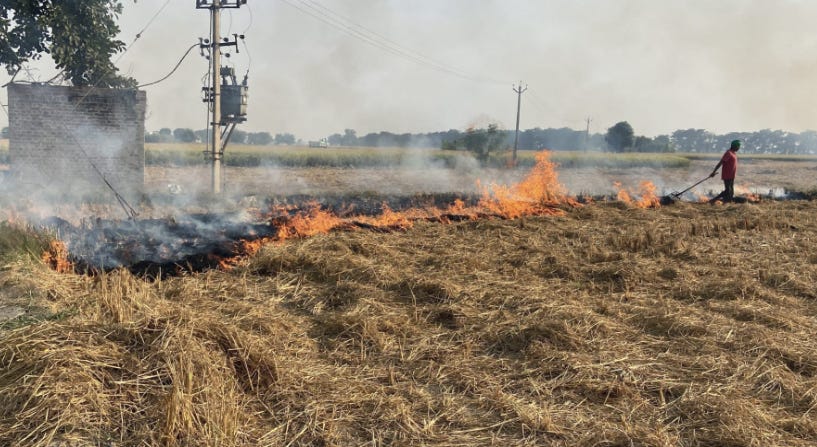
The smoke from these fires drifts south and east. For about 20 days each year, farm fires across northwestern India contribute roughly 30% to 35% of Delhi’s most harmful air pollution. That’s the kind of pollution that causes long-term damage to lungs. Every year, this plays out like clockwork, and every year, there’s outrage.
But what often gets missed in that outrage is that the government has been trying to fix it for seven years. That’s what a new report by CEEW explores. And these fixes have seemed to work to some extent, but there’s a lot of work left to do.
This is not a story of one part of society wronging another, but rather a rational response to constraints faced by farmers. And CEEW’s analysis reveals that the solution to this cannot entirely be technology-driven.
The technology solution
In 2018, the central government launched the Crop Residue Management (CRM) scheme, a programme designed to help farmers deal with stubble without burning it. The basic idea was to subsidise machines that could clear the stubble without burning, giving farmers a way to get ready for the next sowing cycle in time.
These machines handled the stubble in two ways.
The first method involves incorporating the straw back into the soil. Machines like the Super Seeder chop the leftover stalks and mix them into the earth as the next crop is being sown. Or, there’s the Happy Seeder, which cuts the straw and leaves it on the surface as a natural cover for the soil. The stubble becomes compost for the field, which improves soil without burning anything.
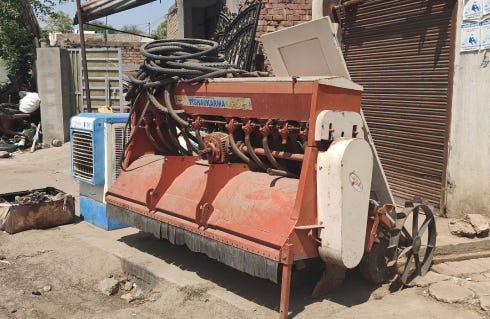
The second method involves collecting the straw and sending it off to industries like power plants, paper mills, and packaging companies that can use it as a raw material. Machines called balers compress the leftover straw into large bundles that can be picked up and transported. Instead of burning waste, you’re selling it.
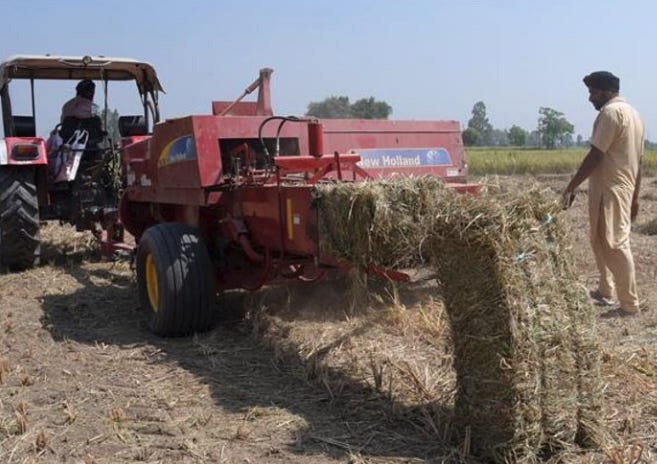
Since neither of these machines is cheap, the government subsidised a large portion of the cost for farmers who wanted to buy them. It also set up what are called Custom Hiring Centres (CHC’s), local rental depots where farmers who couldn’t afford to buy machines could hire them for their fields. The idea was to make the alternative to burning accessible in practice, not just on paper.
In 2024-25, Punjab’s CRM allocation was ₹375 crore. The government tracks progress through satellite-counted fire incidents, and by that measure, the scheme has delivered real results. Reported burning incidents have been declining since 2022. Though the report adds an important caveat. Satellite counts may miss some burning events, especially if farmers shift the timing of when they burn. The decline in reported incidents matters, but it should not be read as the full picture.
This is certainly real progress, but it has now stalled.
The marketing problem
For many of the farmers who haven’t stopped burning, this is no longer only about machines and subsidies.
Structural barriers exist. A small farmer’s tractor is often not powerful enough to operate a Super Seeder. The nearest rental depot might be a few kilometres away. Hiring labour costs money and getting subsidy paperwork processed takes time. All of this has to happen within a 15 to 18 day window before the next crop is sown. For many farmers, burning is simply the fastest, cheapest, and most certain option available.
On top of this, Punjab has also run into a behaviour-change problem. Farmers may know the alternatives exist, but fear, peer pressure, misinformation, and weak communication are still pushing many of them back to burning.
CEEW surveyed 102 farmers across three Punjab districts and spoke to agriculture officials across the state. The results of the survey reveal some interesting attitudes towards the stubble burning problem that reveal how much is lacking on the marketing side of things.
Partial burners
Firstly, 31% of farmers fall into what the report calls the “partial burner” category. These are not farmers who have refused to engage with the programme, but those who are already using the machines. They rent equipment, incorporate part of their stubble into the soil, and then, oddly, burn the rest of the field anyway.
The most common reason, cited by farmers who still burn either partially or completely, is fear of pest attacks. The belief is that when you don’t burn the stubble and instead leave it in the field or mix it into the soil, pests breed in it and attack the next crop, destroying the yield.
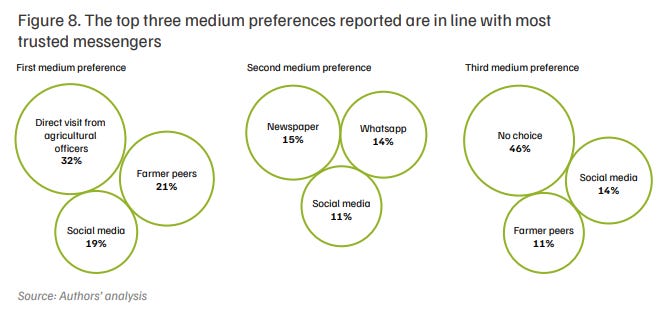
But this fear may not wholly be based on experience. Most of the surveyed farmers admitted, when asked, that they had never personally witnessed a pest attack after switching to machines instead of burning. The fear travels through the informal channels farmers trust most. Neighbours, village conversations, peer networks, and the same digital platforms where farmers already receive agricultural information.
This is a classic case of Chinese whispers. A neighbour has a bad harvest and blames the new method. That story gets told at the local tea stall and then forwarded on WhatsApp. By the time it reaches the farmer two villages away, it has become “everyone who stopped burning had their crop destroyed by pests.” A government pamphlet about soil health has little chance against that.
These farmers are also closest to making the full switch to the machines. They have already overcome the hardest barrier, they are using the machines. They just need specific, credible reassurance that the pest fear isn’t real. But the government’s current communication makes no distinction between a farmer who has never touched a machine and a farmer who is most of the way there. Everyone gets the same generic “don’t burn“ message.
The report found that farmers naturally care most about yield and soil health when making decisions about their fields. But the current messaging focuses on pollution and penalties. Those are not the same thing.
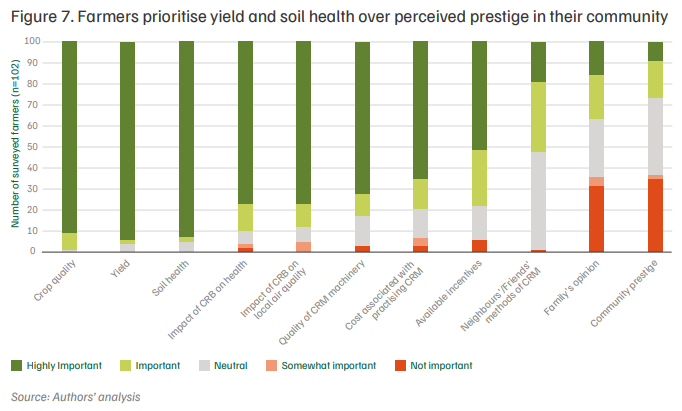
When one field burns, it becomes permission for the next.
Now, 90% of surveyed farmers said they personally disapprove of burning, and 95% said they believe government officials disapprove of it. And yet 73% said they regularly watch their neighbours burning their fields.
One way to understand this dissonance is to take into account how people make decisions under pressure. On one hand, there’s what they believe is right, and on the other, there’s what they observe as normal around them. Usually, the visible behaviour of the people around you tends to win out.
During harvest season, when a farmer is under time pressure and the fields around them are visibly on fire, what they see around them feels like the real rule, regardless of what they privately believe. Each burning field is a signal to everyone nearby that this is the norm of the world around them.
This is why more information doesn’t fix it. The farmer already knows burning is bad. What they need to see is proof-of-concept. Showing farmers that others in their village have switched, through local success stories and public recognition of farmers who’ve stopped could do more to shift behaviour than any national campaign.
But that also creates a chicken-and-egg situation. If everyone is thinking this, and not resorting to better solutions, there aren’t enough success cases to showcase. Who, then, bears the burden of jumping over this cold-start problem?
What the government is spending on
The government’s current approach to the behavioural problem is awareness campaigns, wall paintings in villages, pamphlets, camps, and TV jingles. The idea is that if farmers are given enough information, they will change. But only 1.3% of Punjab’s ₹375 crore CRM allocation in 2024-25 was set aside for communication activities. The rest went to machines and infrastructure.
Even within that allocation, the spending is pointed in misguided directions. The government spent ₹1 crore painting anti-burning messages on village walls and ₹0.3 crore on field demonstrations, sessions where farmers get to physically operate the machines and see how they work. Wall paintings got three times the budget of hands-on learning. Meanwhile, there is zero allocated budget for social media or Whatsapp outreach, even though over half of surveyed farmers said they receive information through both those channels.
To make it easier for farmers to rent machines, Punjab built a mobile app called Unnat Kisan, a booking platform where farmers could find available machines near them and reserve them for their fields.
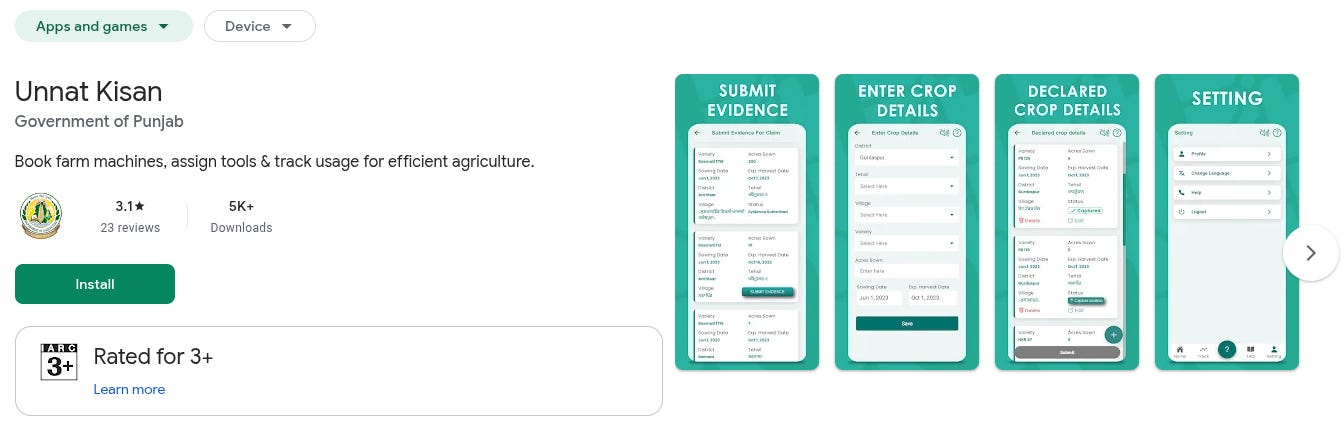
Of the farmers surveyed, 86% had never heard of it.
In fact, a separate CEEW study found that, at many of the Custom Hiring Centres that own the machines and are supposed to be listing them on the app, only a small fraction was even aware that the app existed. The platform built to connect farmers to machines was unknown to both sides of the transaction.
Beyond spend, though, the government also gets the timing of the messaging wrong. A majority of the surveyed farmers say they never receive relevant information at the moment they actually need it — that window is August and September, when the harvest is still weeks away and farmers have time to plan.
This is not a small coordination failure. It means the government’s digital infrastructure for solving this problem is invisible to the people it was built for. Farmers who want to rent machines are still doing it informally: calling someone they know or asking a neighbour. Among farmers who rent machines, the survey found that most get them from other farmers directly rather than from the official depots.
Conclusion
India’s current awareness campaigns are built on a single assumption: give farmers enough information, and they will act on it.
But information doesn’t get them across the finish line when fear, social pressure, and habit are pulling in the other direction. The farmers still burning may know about and align with the objectives of the scheme in principle. But what’s missing is communication designed to address the specific reasons farmers are still burning. The pest fear that spreads through WhatsApp faster than any government advisory.
The report points to Swachh Bharat as proof that India has done behaviour change at scale before. Building toilets was only one part of the mission. Getting people to use them required repeated messaging, trusted local messengers, social pressure, and visible proof that the norm was shifting. Independent surveys found that roughly 93% of rural households ended up with access to toilets, and 97% of those were using them.
Similarly, stubble burning now needs a similar second layer.
Tidbits
Coal Exchange Rules Set Stage for Market-Driven Pricing
The government notified Coal Exchange Rules requiring ₹50 crore minimum net worth for exchanges, capping single-member equity at 5%, with MCX and NSE already approved by SEBI to launch coal exchanges, ending CIL’s administered pricing dominance.Source: BS
Akasa Targets 226-Aircraft Fleet by 2032, Eyes IPO in 2–4 Years
Akasa Air narrowed operating losses in FY26 despite 30% capacity growth to 37 aircraft, with EBITDA positive for six consecutive months; CFO Ankur Goel outlined 30–40% annual growth targets and an IPO timeline of two to four years.
Source: ETCritical Mineral Recycling Commitments Hit 850 Kilotonnes, Triple Target
Under the ₹1,500 crore National Critical Mineral Mission recycling scheme, commitments from 58 approved recyclers reached 850 kilotonnes against a 270-kilotonne target, with India aiming for 300,000 tonnes of annual e-waste recycling capacity by 2030.Source: BS
- This edition of the newsletter was written by Kashish & Vignesh.
What we’re reading
Our team at Markets is always reading, often much more than what might be considered healthy. So, we thought it would be nice to have an outlet to put out what we’re reading that isn’t part of our normal cycle of content.
So we’re kickstarting “What We’re Reading”, where every weekend, our team outlines the interesting things we’ve read in the past week. This will include articles and even books that really gave us food for thought.

Brad Setser on the dollar and the world’s trade imbalance
The role of the dollar, and its influence on global trade, is a complicated story that has constantly changed over time. To make sense of all this, we spoke to Brad Setser, Most of Twitter knows Brad is one of the sharpest voices on all things balance-of-payments. He is a senior fellow at the Council on Foreign Relations. He also served at the US Treasury and the National Economic Council.
We recorded this conversation while the Iran war was unfolding and oil markets were watching the Strait of Hormuz, and not long after Trump and Xi had met in Beijing to negotiate a trade deal. We used the moment to ask him about the things he thinks about most: why the dollar is really strong, what an AI bust would do to it, how the manufacturing surpluses of China, Korea, and Taiwan quietly finance the American deficit, and what China would have to do to rebalance.
Watch the full podcast episode below, where Brad breaks down the sources of dollar demand and the future of global trade imbalances
You can also listen to the full conversation on Spotify and Apple Podcasts. The full transcript of the podcast is below if you prefer to read.
Thank you for reading. Do share this with your friends and make them as smart as you are 😉
Following are three rounds :
1. Adani Round
2. Ambani’s Sons (if interested)
3. Leftovers Sale