


Our goal with The Daily Brief is to simplify the biggest stories in the Indian markets and help you understand what they mean. We won’t just tell you what happened; we’ll tell you why and how too. We do this show in both formats: video and audio. This piece curates the stories that we talk about.
You can listen to the podcast on Spotify, Apple Podcasts, or wherever you get your podcasts and watch the videos on YouTube. You can also watch The Daily Brief in Hindi.
In today’s edition of The Daily Brief:
1. The ebbs and flows of India’s irrigation story
While expanded irrigation has insulated India’s food security from monsoon shocks, it has created severe tradeoffs. Early dam projects left large gaps between created and utilised capacity, driving a shift to tubewells that made India the world’s largest groundwater extractor. Subsidised power fuels aquifer over-extraction and drains state power utilities, while newer delivery systems like drip irrigation fail to address underlying depletion.
2. That teak in your house probably isn’t Indian
Despite holding a fifth of global teak area, India imported 97% of international teak roundwood in 2022 to meet domestic demand. Overseas plantations in Latin America and Africa supply regular bulk timber that Indian mills excel at processing. Meanwhile, strict state felling and transit regulations discourage domestic farmers from planting long-cycle timber, creating an ongoing supply gap.
Cash & Copium #7
In this episode, Abid, Bhuvan, and Aakanksha break down the illusion of regulated trust in banking and why banks should strictly be used for banking. They discuss how relationship managers exploit customer credibility to sell low-return ULIPs and endowment plans, why buying mutual funds from banks creates misaligned incentives, and how to counter illegal loan bundling using the RBI Ombudsman defence.
Check out the episode on YouTube.
The ebbs and flows of India’s irrigation story
Earlier, we covered India’s standoff with a (Super) El Niño. It’s the kind of climate shock that can knock agriculture sideways as monsoons weaken, reservoirs drain, and sowing in the kharif season stalls. When that happens, everything from food prices to rural wages to RBI rate decisions starts trembling.`
But today, while the risks still loom large, especially because of climate change, India isn’t as fragile to these shocks as it used to be.
In 1965, an 18% rainfall deficit wiped out 19% of our foodgrain production. In contrast, in 2015, a comparable deficit shaved off just 0.2%. Both years saw an El Niño.
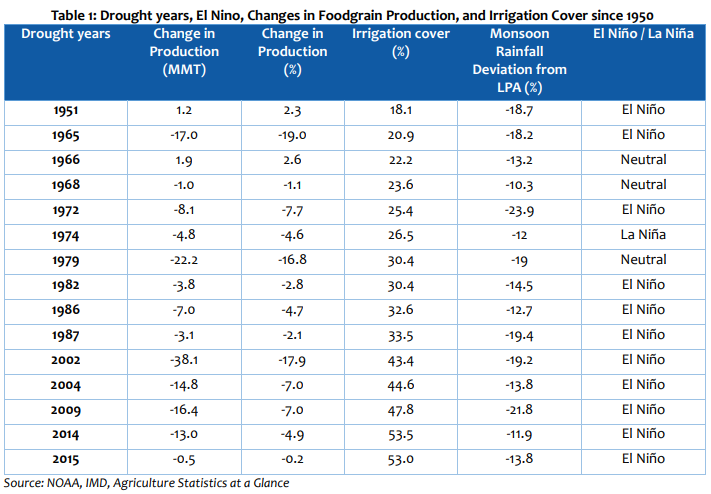
Part of the reason behind this resilience is that we expanded irrigation. The share of India’s farmland that’s irrigated has risen from about ~21% in 1965 to 53% by 2015. As far as insulating our food security from the vagaries of an unpredictable monsoon goes, this is the most important shift in our agriculture.
But the way we got there involved some tradeoffs, which include the technologies we chose, the subsidies we created, and the political incentives we locked in. For one, it made us the world’s largest user of groundwater by far, extracting more than the US and China combined. It also increased the energy consumed by farmers, which has, for a long time, been subsidized by the state. Around 11% of our groundwater assessment units are over-exploited, with many more under some form of critical stress.
This is the first of a two-part story. Today, we trace how India’s irrigation system was built since we became independent, and how every solution created the next crisis. In part two, we’ll look at some of the companies that work in this industry.
The temples that couldn’t deliver
After Independence, India went on a dam-building spree.
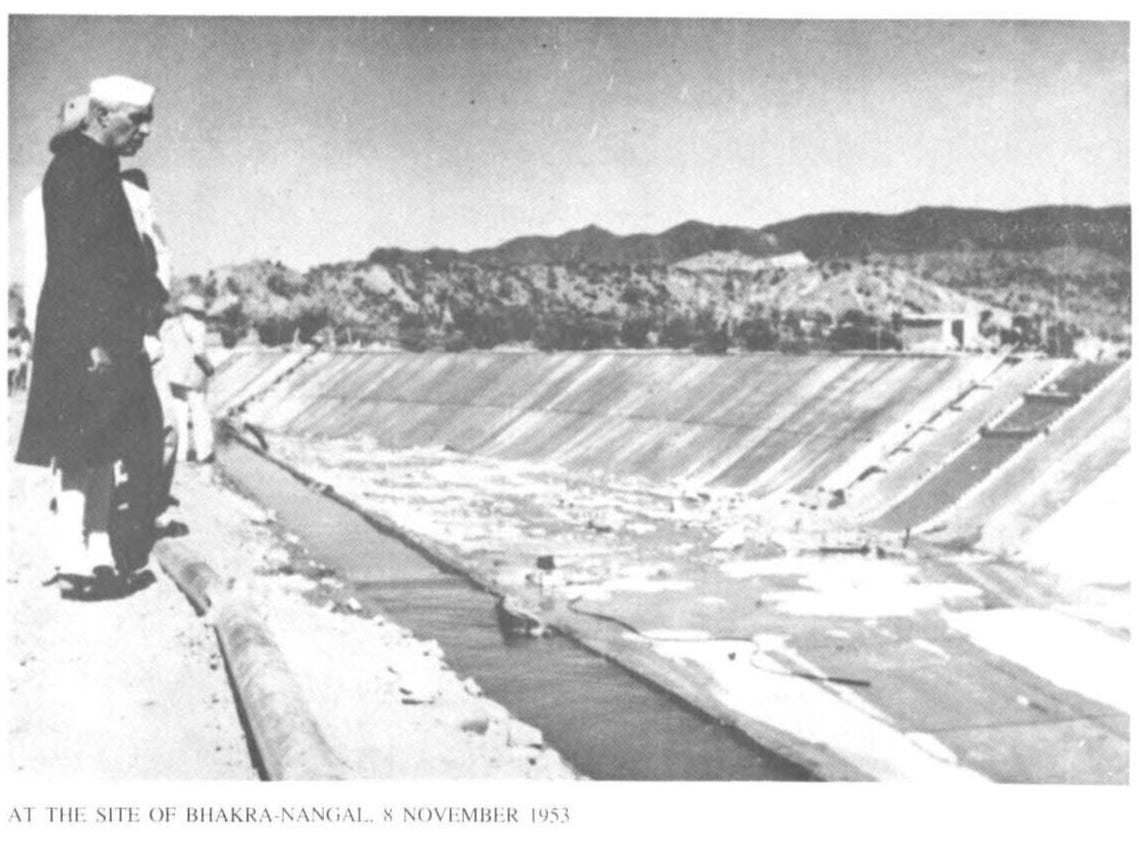
You see, we needed electricity and crop output (or food security) both. The US provided some interesting success cases of having achieved both with multipurpose dams. So, inspired by them, we decided to allocate huge amounts of public capital into huge establishments like dams and canal networks. The largest of them, like the Bhakra-Nangal Dam, were deemed by Jawaharlal Nehru as one of the “temples of modern India” that would drive India’s growth.
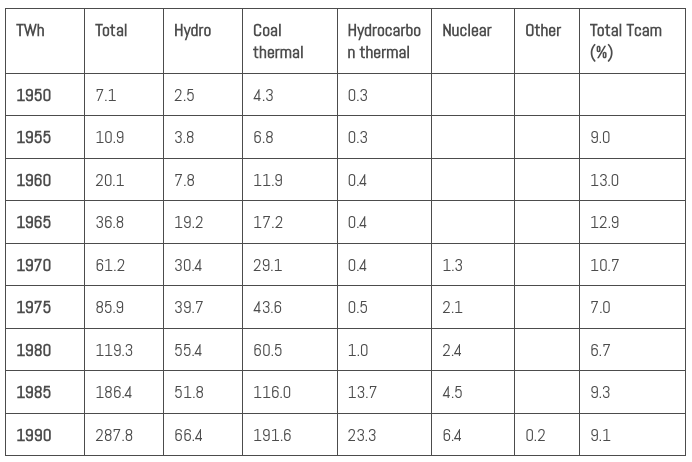
The numbers were impressive on paper. Starting from a baseline of 22.6 million hectares (mha) in 1951, India had created cumulative irrigation potential of about 52 mha by 1978. Plus, by 1965, hydroelectricity made up over half of our electricity production.
But the data hid a gap: that between the potential created and potential actually utilised.
Building a dam and filling a reservoir is one thing, but getting that water to a farmer’s field is something else entirely. State engineering departments spent their budgets on the grand infrastructure while leaving the construction of last-mile channels to individual farmers. Smallholders who could barely afford seeds were expected to build their own watercourses, and predictably, they couldn’t.
In the pre-plan period, 100% of created potential was used, By the Fifth Plan of 1974-78, utilisation had dropped to 93%. This metric was down to 77% by 2011, and that 23% gap represented around 24 mha of land, which is roughly the size of Uttar Pradesh.
This meant that trillions of litres of water sat impounded behind dams with no physical channel to reach fields. And this has only worsened with each passing year.
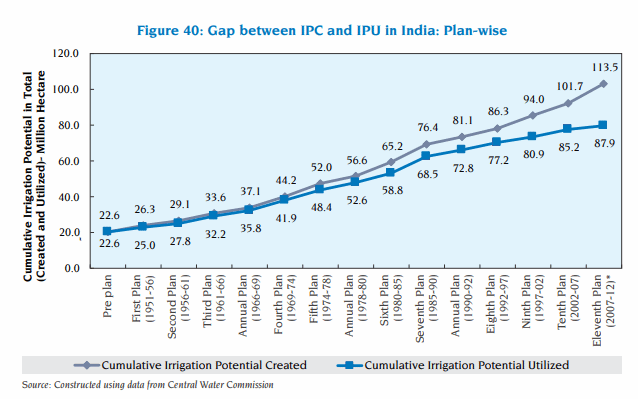
Meanwhile, major irrigation projects in India consistently breached their financial limits by no small margin. They averaged staggering cost overruns of over 1000%, and projects designed to take 15-20 years dragged on for 15-20 more. Delays occurred due to land acquisition issues, environmental clearances and scope changes.
Moreover, many dams were designed around exaggerated river flow assumptions which never came to fruition. The Bhakra Dam, for instance, was over-designed relative to the Sutlej river’s actual flows; even after the Beas River was diverted into the reservoir, it rarely filled to capacity.
There were also problems at the end of the dam where the canal networks started. Farmers who were located closest to the start of the canal network often over-appropriated water to grow water-intensive crops like rice and sugarcane. Once you account for this, as well as seepage and evaporation, farmers who were further downstream would receive little to nothing.
By the 1970s, it was clear that the dam era, while important in the broad context of India’s economic ambitions, had to now give way to a different approach.
The underground revolution
The pivot came just as many other pivots do: because of crisis. And not just one, but several following each other.
For one, India had just suffered severe back-to-back droughts in 1964-66. In 1972, there was also an El Niño that destroyed our monsoon and cleared up our rivers, rendering dams useless. This only increased our already-existing dependence on American food imports, which was politically embarrassing.
Then, India was also hit by a global oil crisis, and the few groundwater pumpsets that we had were using diesel at the time. Now, diesel suddenly became more expensive. We were also attempting a Green Revolution with High-Yielding Variety seeds, but they demanded precise watering that rigid canal systems couldn’t provide.
To get a better sense of how much this overlapping of crises influenced India’s development trajectory, we recommend checking out our Subtext episode with energy expert Rohit Chandra.
One solution to this urgency was tubewells. Unlike a dam that took decades to build and delivered water on a fixed rotation schedule, a tubewell could be drilled in days and operated whenever the farmer needed water.
Unlike large, command-and-control projects like dams, the shift to tubewells was far more decentralized and private-driven. Informal tubewell water markets had already sprung up before government policy caught up, as richer farmers who could afford to drill wells began selling surplus groundwater to their smaller neighbours. Even today, over 95% of tubewells in India are owned privately.
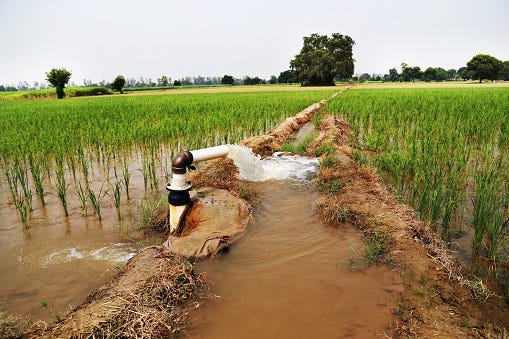
Government policy then turbocharged this trend through three moves. First, the nationalisation of banks in 1969 opened rural credit lines, allowing millions of farmers to borrow for pumps and borewells. Second, State Electricity Boards were directed to electrify rural areas at scale. And lastly (and most crucially), states shifted from metered electricity pricing to flat-rate tariffs based on pump horsepower.
That last move changed everything. Under flat-rate pricing, once a farmer paid a small fixed fee, the marginal cost of pumping an additional litre of groundwater dropped to zero. There was no financial penalty for running the pump longer or extracting more. Within some states like Punjab and Tamil Nadu, political competition eventually drove the flat tariff to zero. Even if power for farmers isn’t completely free today, or is rationed by time even if free, farmers are still the most subsidised set of consumers in the power sector.
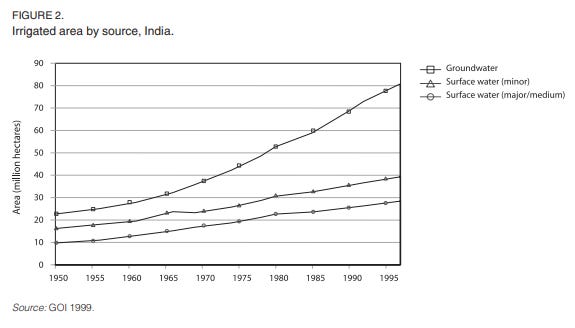
In a past survey by the International Water Management Institute, electric tubewell owners under flat tariffs were found to have pumped 40-150% more than diesel pump owners, who faced real variable fuel costs per hour. By the 1980s, groundwater had overtaken surface water as the primary source of irrigation in India, while making up only a ~30% share before 1967. By 2001, agricultural tubewells consumed nearly one-third of India’s total national electricity.
The tubewell revolution had succeeded in at least delivering food security, converting India into a net exporter of grain. And this went hand-in-hand with the development of a national power grid.
However, this shift also created an energy-water nexus that would prove almost impossible to untangle. And with it came two problems of their own.
The twin crisis
The first problem is the groundwater itself.
Annually, India extracts over 240 billion cubic metres (BCM) of groundwater, and ~90% of it is for irrigation. The national extraction rate is around 60% of annual recharge, which sounds manageable until you look at the state-level picture.
Many states extract over 50% of their groundwater every year. Some, like Punjab, Rajasthan, and Haryana, have already exceeded 100%. These states extract so much groundwater annually that the monsoon rains will probably never be enough to replenish what they pumped.
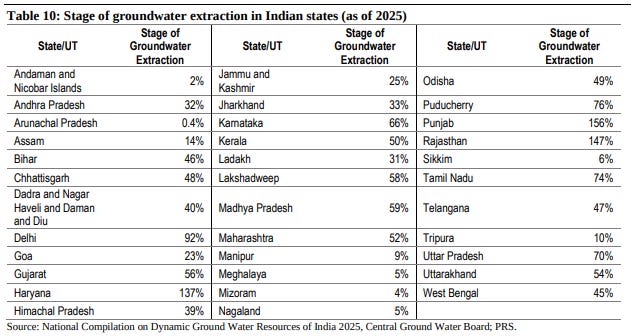
The over-exploited assessment units did improve between 2017 and 2024, thanks to recharge structures, micro-irrigation, and government schemes. But 61% of total groundwater recharge still comes from rainfall. A weak monsoon simultaneously cuts recharge and increases pumping, because farmers compensate for poor surface water by extracting more groundwater. The flat power tariff for farmers only incentivises this further.
Even new technologies don’t solve this. For instance, solar-powered pumps, which are promoted under the PM-KUSUM scheme, may be an improvement over grid electricity in many ways. They reduce DISCOM losses, eliminate diesel costs for smallholders, and work off-grid.
But they also make energy truly free at the point of use. States would often manage groundwater extraction by rationing grid power for farmers. But with off-grid solar power, that constraint goes away. A farmer with a solar pump can run it from sunrise to sunset, every day, extracting far more groundwater than someone waiting for an eight-hour power window.
The second problem is the fiscal crisis of the electricity grid.
Flat-rate and subsidised power to farms has financially gutted state DISCOMs across India, which, as we know already, have historically run into deep losses. Farm subsidies also prevent DISCOMs from investing in rural grid infrastructure, leading to frequent outages. That’s why utilities started rationing farm power to limited hours.
These two crises feed each other. Free power encourages over-extraction, which depletes aquifers. Bad rains only force farmers to drill deeper and install more powerful pumps, consuming more subsidised power. The DISCOMs absorb the losses.
Getting water to the plant
So far, we’ve only spoken about water extraction. But what about how the water is actually delivered to crops? Well, for much of India’s irrigation history, it wasn’t very efficient, either.
The traditional method was surface flooding, where water pumped from a tubewell or released from a canal would flow through unlined earthen ditches which were dug directly into the soil. These channels lost enormous quantities of water to seepage and evaporation. And once there, farmers would simply flood the entire plot instead of a more targeted, conservative approach. Along with the issue of farmers near the head of the canal taking more water than needed, this is why canal efficiency often hovers around 35-40% in India.
Beyond waste, there was a structural problem. Constructing these networks of open channels meant cutting through private farmland, fragmenting holdings and sparking community resistance. Land acquisition became a chronic obstacle for last-mile irrigation infrastructure.
The response, starting in the 1990s, was a shift to underground pressurised pipes. Buried below the soil, PVC and polyethylene pipelines eliminated seepage losses, didn’t consume farmland, and allowed farmers to cultivate directly on top of the pipe route. The adoption doubled from about 4% of farmers in 1994 to 8% by 2001, and has continued expanding since.
More recently, drip and sprinkler systems (or micro-irrigation) have pushed delivery efficiency even further. Instead of flooding a field, drip systems deliver measured water directly to the plant’s root zone through pressurised emitter networks. Drip gained traction first among commercial farmers in Maharashtra, Gujarat, and Tamil Nadu. Recently, micro-irrigation equipment also received a GST cut from 12% to 5%.
That being said, improved application and delivery technologies control where and how efficiently water reaches a plant. They do not control how much water a farmer extracts from the ground in the first place. You can have a perfectly efficient drip system connected to a tubewell that’s draining an over-exploited aquifer. The incentives for over-extraction of groundwater remain unchanged even when delivery has become more efficient.
Conclusion
India’s irrigation story is, at its core, a story about political incentives distorting every technical solution.
The earliest dams built by independent India were grand but couldn’t deliver to the last mile. Tubewells treaded where dams couldn’t, but ended up creating a spiral whose outcome was the depletion of our groundwater reserves. Improved delivery technologies made each drop go further but left extraction ungoverned. Solar pumps offer to free farmers from the grid, but don’t inherently provide a check against over-pumping.
The question for Part 2 is a different one: within this landscape of subsidies, aquifer stress, and misaligned incentives, what are private companies actually building? That’s where we’ll go next.

That teak in your house probably isn’t Indian
Walk into a furniture shop in India and ask for a dining table that will last. The shopkeeper will probably point you to teak. It resists rot and termites, and handles moisture well. You’ll find it in doors, bed frames and cupboards too. But the tree it came from may have grown a very long way from India.

It may have grown in Colombia, Ecuador or Ghana. Teak is native to India, and we hold roughly a fifth of the world’s natural and planted teak area. Yet we buy an extraordinary amount of it from overseas.
In 2022, India accounted for about 97% of internationally reported teak roundwood imports by volume. Roundwood simply means unprocessed logs. We imported more than 950,000 cubic metres of teak logs, worth about $292 million, that year.
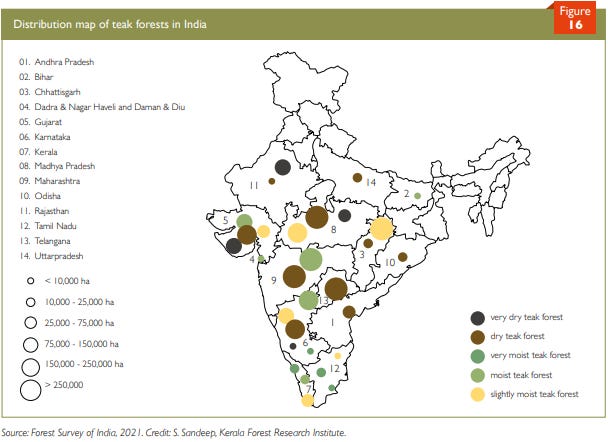
Part of the explanation lies in how we manage forests and the rules farmers face when growing trees for sale. Maharashtra tried to ease one of those rules in June 2026, only for a court to pause the change. But first, it helps to understand what made overseas teak such a good fit for Indian buyers.
How the overseas supply took shape
Teak’s natural range stretches across parts of South and Southeast Asia. Growers introduced it to Africa and Latin America and established plantations: trees deliberately planted and managed to produce timber.
Latin America had only about 33,000 hectares of teak plantations in 1995. That area has grown many times over since, creating a source of timber just as Indian buyers were looking beyond their traditional suppliers.
India had long bought mature “Burma teak” from Myanmar. But West African teak was already reaching India in the 1990s, well before Myanmar banned raw-log exports in 2014. The ban reinforced a shift that was already underway.
Today, most of India’s imported teak logs come from Latin America and Africa. Colombia, Ecuador and Ghana supplied about two-thirds of its teak roundwood imports in 2022. Other major sources included Panama, Brazil, Costa Rica, Benin and Nigeria.
These plantations offered a different kind of log. Conventional Indian teak plantations often follow harvest cycles of 50–80 years to produce larger timber. Many overseas growers harvest after roughly 20–30 years, accepting smaller, younger logs. This is a difference in how trees are managed and when they are cut; Indian plantations can also follow shorter cycles. Indian mills are particularly good at using these thinner logs, including sizes some processors elsewhere would reject. That gave overseas growers a ready market.
A lot of teak but very little timber to buy
Supplying that market from within India is more complicated. Our teak comes from natural forests, plantations and private farms. Those sources serve different purposes and face different rules.
Much of India’s natural teak is in government-managed forests. These forests protect habitats as well as supply wood, so harvesting follows forest management plans that limit where and how much can be cut. Public plantations are deliberately planted and may be managed for timber production, but their harvests are also planned. A large area under teak therefore does not tell us how much wood is available to buy in any given year.
The global teak assessment records about 1.69 million hectares of public teak plantations in India. Privately grown teak adds to that resource, but its area and harvest are poorly measured. That makes it difficult to put a reliable figure on the country’s total production.
For a mill, the practical problem is getting a steady supply. Buying from scattered farms means finding sellers, checking individual trees and arranging harvests and transport. Overseas plantations can supply fairly uniform logs in bulk on a regular schedule. Indian mills already have the skills to process younger timber; imports offer an organised way to keep it coming.
Why farmers hesitate to grow teak
More teak grown on farms could help fill that gap. But the decision looks different from a farmer’s side.
Even the shorter plantation cycle means waiting two or three decades for the main timber harvest. Farmers can grow other crops between young teak trees, while there is enough light and space. Still, growing teak means committing land and money for years before most of the return arrives.
Then comes permission to harvest. Felling and transport rules for farm-grown timber vary by state. In Maharashtra, one of India’s major teak-growing states, teak was listed under the Maharashtra Felling of Trees (Regulation) Act, 1964. On land covered by that law, cutting a teak tree required written permission from a forest official. Moving the wood required a separate transit permit. Owning the land did not, by itself, mean a farmer could harvest the tree whenever it was ready.
The Union environment ministry has acknowledged that difficult felling rules discourage farmers from growing timber and has urged states to simplify them. Farmers also have to weigh the quality of seedlings, access to credit, uncertain prices and the difficulty of finding buyers. For someone making such a long investment, uncertainty about the eventual sale is another reason to hesitate.
Maharashtra tried to make harvesting easier
That was the requirement Maharashtra tried to remove on 9 June 2026. The state took teak off the list of trees requiring prior felling permission under its 1964 Act. A senior forest official said the existing rule had discouraged planting on private land.
Teak had been added to the list in January 1968. The state was reversing a restriction nearly six decades old.
Transit permits would still be needed to move the wood. But conservationists worried that removing the check before a tree was cut would make it easier to pass illegally felled forest teak off as farm timber. Illegal teak felling has been reported in Maharashtra, so that concern needs to be taken seriously.
On 19 June 2026, ten days after the change, the Bombay High Court’s Aurangabad Bench put the notification on hold. The court had taken up the matter on its own. Its interim order meant the earlier felling requirement continued to apply.
Give farmers a reason to plant
Demand for teak does not disappear because supplying it locally is difficult. Furniture makers still need wood, and overseas plantations are ready to sell it. India’s $292 million teak-log import bill in 2022 shows the size of that business, though rules alone do not explain it.
Protecting natural forests matters. But farmers also need a clear, workable route to harvest trees they have grown for sale. Registering plantations and tracing timber back to its source can help distinguish farm-grown wood from illegal forest timber. That gives regulators a way to check where the wood came from while making a legal harvest easier.
Easier rules would take years to translate into more timber, and growers would still need good seedlings, finance and buyers. But those investments become harder to justify if the eventual right to harvest remains uncertain. India has the tree, the buyers and the mills. Giving farmers confidence that they can grow, harvest and replant teak responsibly would give them a reason to supply more of that demand themselves.
- This edition of the newsletter was written by Manie & Vignesh.
Tidbits:
1. Inox Clean Energy prepares for ₹10,000-crore IPO
Inox Clean Energy is preparing to file draft papers with SEBI for a ₹10,000-crore initial public offering, targeting a valuation of around ₹1 lakh crore. The fresh proceeds are expected to fund acquisitions and reduce debt as the company expands its renewable power and solar manufacturing businesses.
Source: The Economic Times
2. SEBI approves new mutual fund investment route for portfolio managers
The Securities and Exchange Board of India has approved the Portfolio Managers Route for Investing in Mutual Fund units (PRIM). The new framework allows portfolio managers to invest client funds into direct mutual fund plans, exchange-traded funds, and Specialised Investment Funds (SIFs), requiring a minimum investment ticket of ₹25 lakh.
Source: The Economic Times
3. Bentley joins Ferrari in ultra-luxury electric vehicle push
Bentley has unveiled the Torcal, its first fully electric model, joining Ferrari in bringing battery-powered vehicles to the ultra-luxury automotive market. Ferrari’s first electric vehicle, the €550,000 Luce, was unveiled earlier this year.
Source: CNBC
4. Adani Group outlines ₹1 lakh crore investment roadmap for West Bengal
The Adani Group has announced plans to invest over ₹1 lakh crore in West Bengal by 2035 across sectors including ports, logistics, power generation, and hyperscale data centres. The roadmap includes an immediate ₹4,000-crore commitment to build a 2,000-bed multi-speciality hospital and medical college in Kolkata’s New Town.
Source: The Hindu
5. FSSAI proposes restrictions on selling non-dairy substitutes as paneer
The Food Safety and Standards Authority of India has issued draft rules barring products made from non-milk ingredients from being manufactured or sold as “paneer”. If finalised, existing analogue products would also be required to drop the term from their names, labels, and marketing.
Source: The Hindu BusinessLine
Want more tidbits? Catch up on last week’s recap!

Beyond Today’s Brief
There’s always more happening at Markets by Zerodha.
The Chatter: What do top corporate leaders and regulators say about macroeconomic resilience and market shifts? How is NSE navigating derivatives regulation while rebalancing its revenue mix, and how are firms like ONGC, Hero Motors, Bikaji, and Pearl Global managing deepwater gas exploration, raw material inflation, and global supply chain expansion?
Points & Figures: What is driving India’s record vehicle registrations across two-wheelers, cars, and commercial fleets? How are recent tax cuts and surging rural RTO demand reshaping auto sales, and where does EV adoption stand across different vehicle segments?
Aftermarket Report: How did the Nifty recover from intraday lows to close near 23,150 after a volatile session? And what do the latest trends in sector performance, FII shorting, and option positioning reveal as market sentiment remains in fear?
Join us on WhatsApp, where we share interesting soundbites from concalls, articles, and everything else we come across throughout the day. You’ll also get notified the moment a new video or article drops so that you can read or watch it right away.
Thank you for reading. Do share this with your friends and make them as smart as you are 😉