


Our goal with The Daily Brief is to simplify the biggest stories in the Indian markets and help you understand what they mean. We won’t just tell you what happened; we’ll tell you why and how too. We do this show in both formats: video and audio. This piece curates the stories that we talk about.
You can listen to the podcast on Spotify, Apple Podcasts, or wherever you get your podcasts and watch the videos on YouTube. You can also watch The Daily Brief in Hindi.
In today’s edition of The Daily Brief:
1. A not-so-festive season for electronic appliances
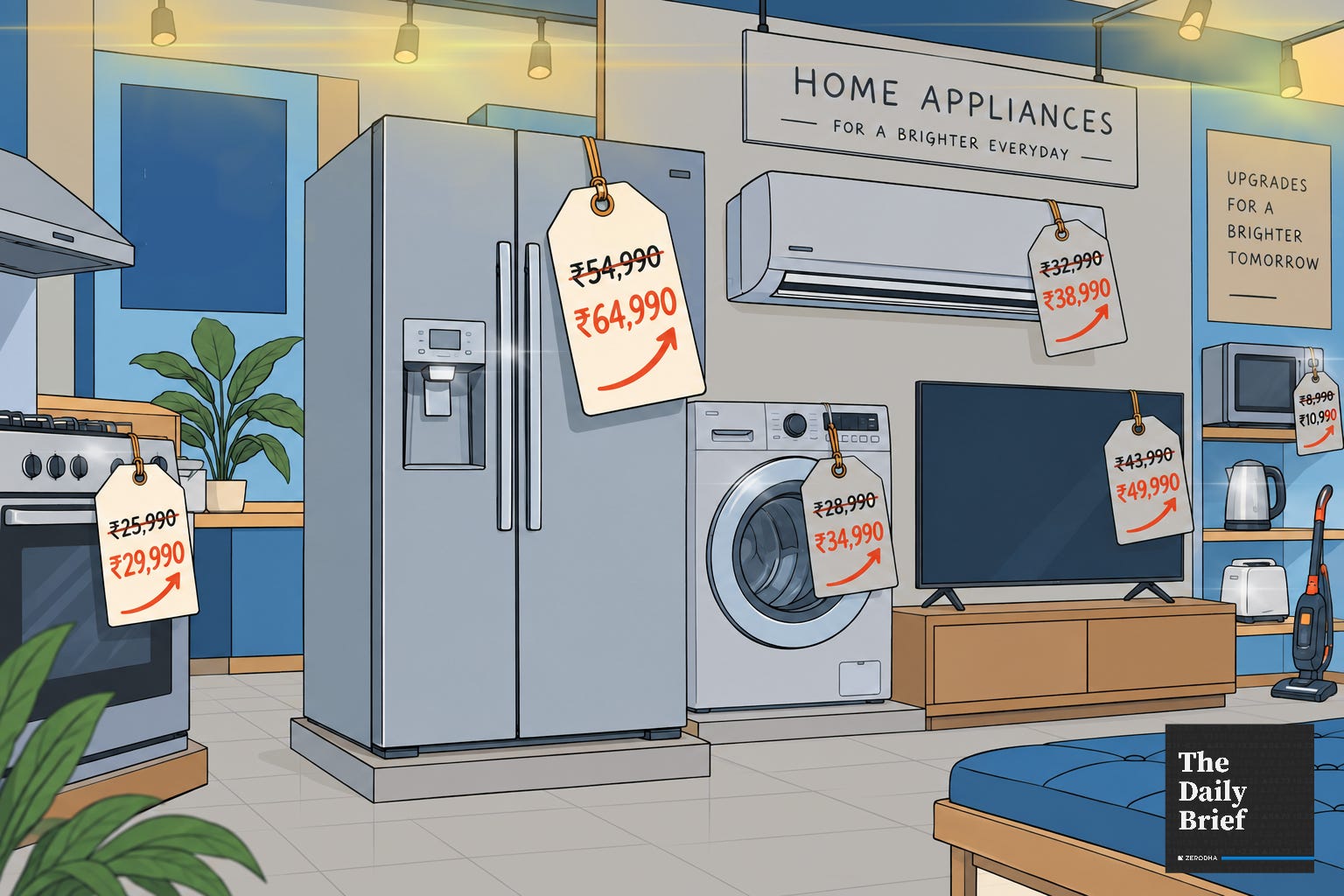
Ahead of the festive shopping season, prices for home appliances like ACs, refrigerators, and TVs have surged by 5% to 17% due to rising input costs for copper, aluminium, memory chips, and ocean freight. While festive discounts appear larger, manufacturers are using varying strategies—such as reducing channel schemes or offering zero-cost EMIs—meaning consumers may pay higher effective prices.
2. What’s behind the recovery of India’s golden fibre?
After two years of shrinking demand, India’s jute industry is set for a 15% volume recovery as higher minimum support prices (MSPs) boosted raw crop supply and lowered fibre costs. While mandatory government procurement for foodgrain packaging provides a steady demand floor, it also disincentivizes modernization into higher-value applications like geotextiles.
A not-so-festive season for electronic appliances
Earlier this year, ACs, refrigerators and TV became more expensive in India. The increases did not stop after one round.
As per Haier, prices had risen by around 10–12% since January over the previous few months.

LG raised prices by a cumulative 16–17% in two rounds during the April-June quarter, while Blue Star increased AC prices by about 5%.
These were not uniform increases across every company and model. Some companies passed on most of their higher costs quickly, while others absorbed a larger part of the increase through lower margins.
The timing makes this more interesting. Durga Puja, Dussehra and Diwali are approaching, bringing the usual discounts, exchange bonuses and EMI offers. But does a large festive discount necessarily mean an appliance has become cheaper?
What’s inside your appliance?
First, let’s look at what each appliance contains inside.
An AC works by absorbing heat from a room and releasing it outside. Copper tubes carry refrigerant between the indoor and outdoor units, while aluminium fins help transfer the heat. The machine also contains a compressor, fan motors and electronic controllers.
As per CEEW’s estimates, in a non-inverter 1.5-ton split AC, the compressor accounted for around 30% of manufacturing cost. Copper and aluminium tubes made up another 20%, printed circuit boards and controllers 20%, and fan motors around 8–10%. So ACs are exposed to copper and aluminium prices, and by virtue of that, also those of PCBs and controllers.
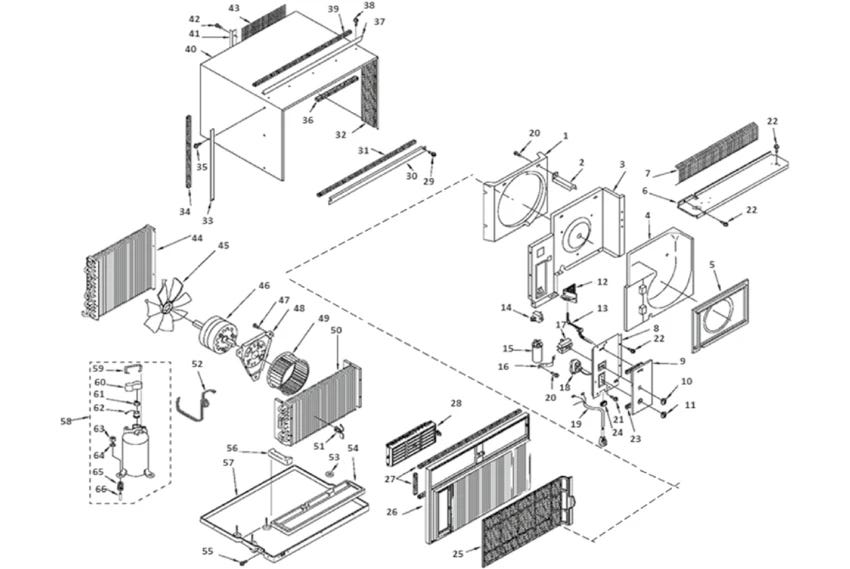
Refrigerators share many of these pressures, even if the precise cost mix differs between a small single-door refrigerator and a large frost-free model. Their outer bodies are generally made of steel, while the inner lining, shelves and drawers use plastic. Foam between these layers provides insulation. The compressor contains steel, copper wiring and a motor, while copper or aluminium tubes carry the refrigerant.
TVs, meanwhile, are more exposed to electronics than either. Display panels, processors and memory chips form a larger part of their cost. Indian TV manufacturers warned that rising memory-chip prices and the weaker rupee could push prices higher.

As we’ve covered before, the AI boom is the primary reason memory markets have tightened. Chipmakers have been directing more investment and production towards higher-value memory used by AI servers. But AI is not the only factor: inventories, production decisions and demand across the wider electronics industry also influence chip prices.
As we’ve covered before, copper and aluminium have both become very expensive. Industry estimates cited in August placed copper around 45% higher than a year earlier and aluminium around 25% higher.
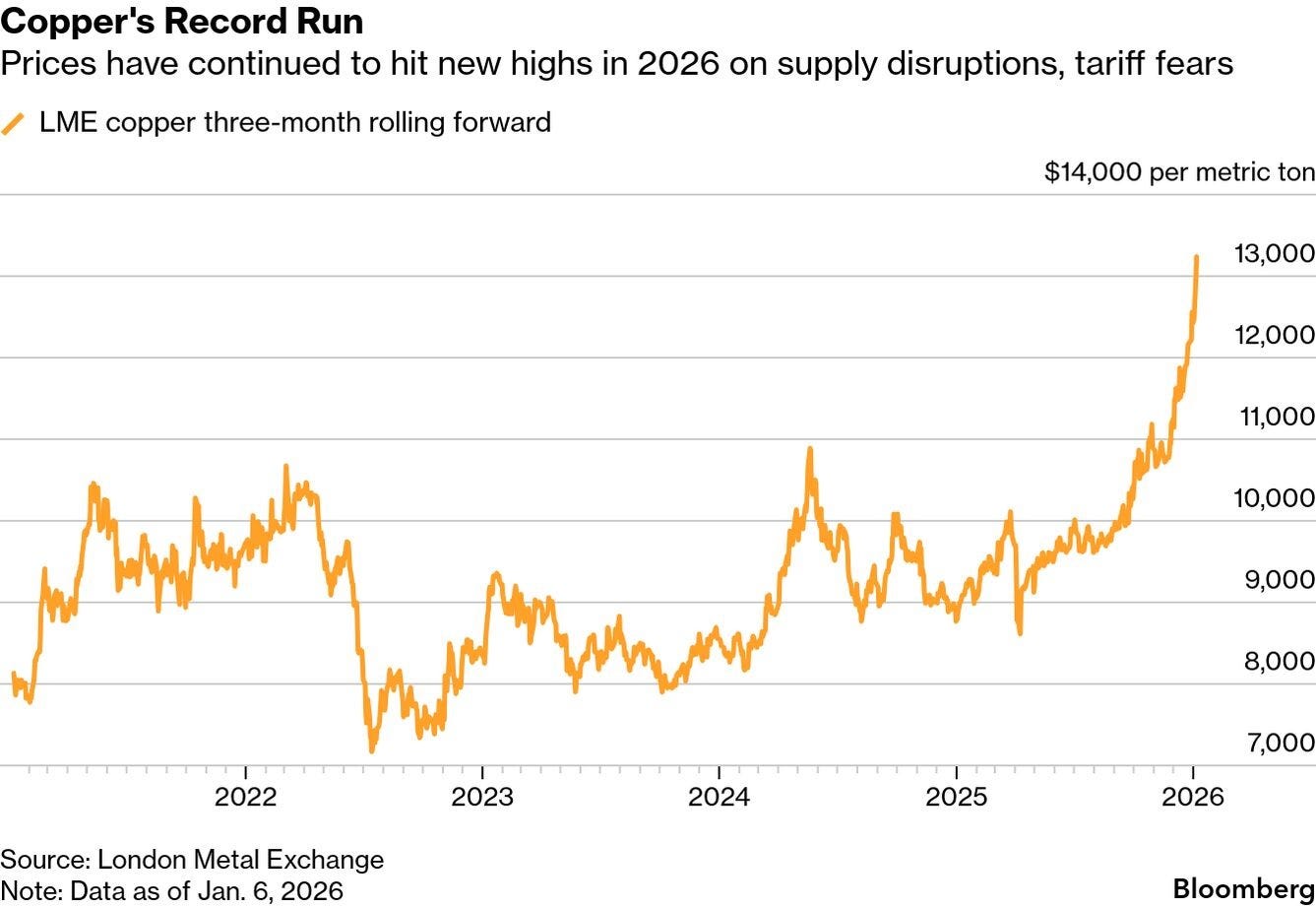
India is import-reliant for more than half of its copper needs, leaving manufacturers exposed to both international copper prices and currency movements.
Then, there are plastics, whose rising costs have been affecting various industries beyond electronics. The Strait of Hormuz blockade has disrupted the flow of crude oil, which is what plastics are ultimately derived from. In its latest earnings call, Voltas included higher plastic costs among the pressures affecting AC prices.

Shipping costs have also increased. For Voltas, cost pressures faced included higher ocean-freight charges. Globally, higher fuel costs and disruption from the conflict in West Asia have pushed container rates sharply higher on some major routes.
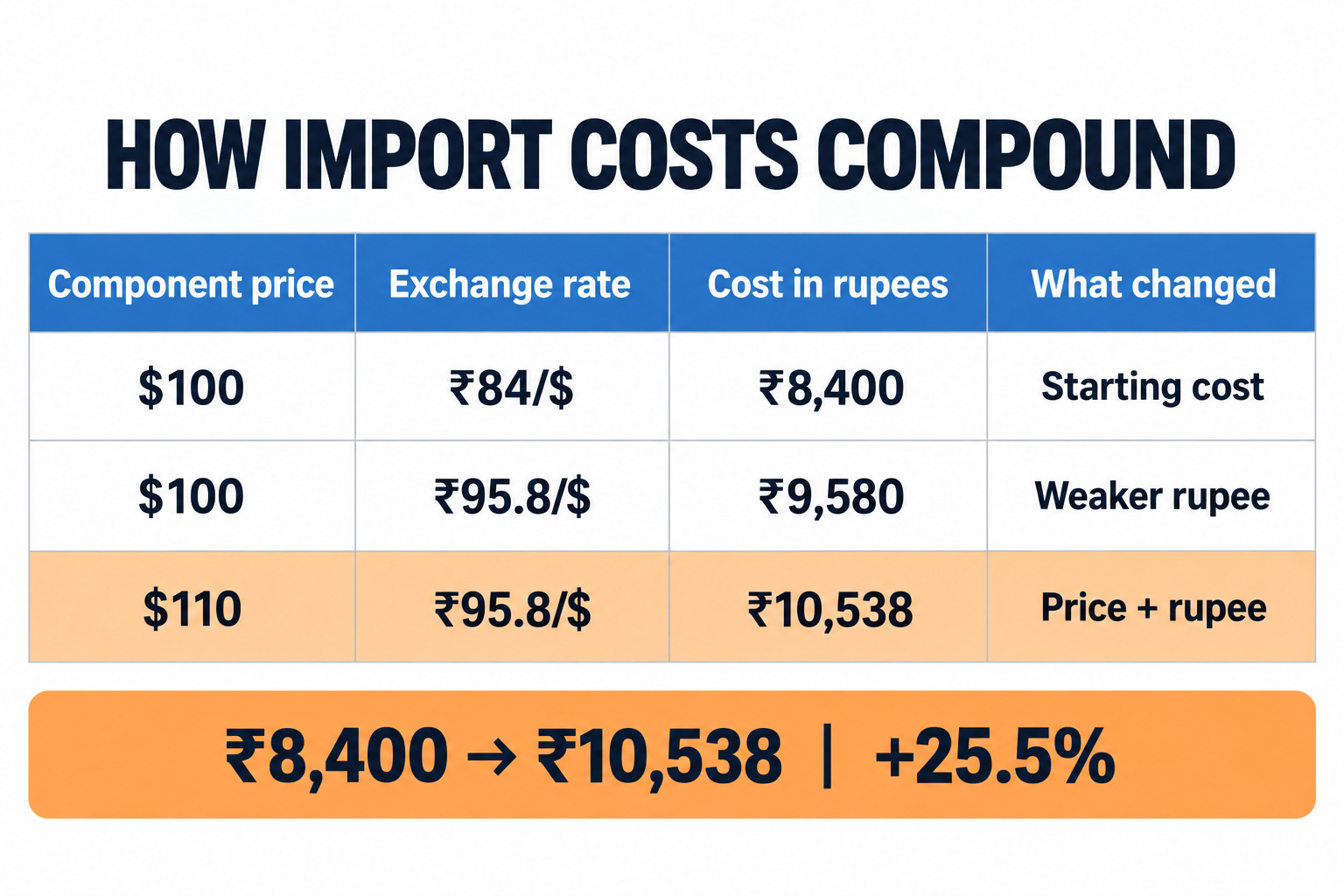
Many of these commodities are benchmarked in the dollar. As the rupee depreciates more against the dollar, another layer of cost pressure is created.
The story behind repeated increases
When raw-material costs rise, a manufacturer has a limited number of choices. It can absorb the increase through a lower margin, negotiate with suppliers, substitute materials, reduce other expenses or pass the increase on to customers. Rarer still, companies may redesign the product altogether.
Recent earnings calls show that companies have made different choices.
Blue Star entered the financial year hoping to pass on a total cost increase of around 13%. But by the June quarter, it had managed to pass on only about 5%. The company’s revenue grew 13.3% during the quarter, but its profit before tax and exceptional items fell ~24%. Management attributed the pressure to higher commodity prices, the weaker rupee, the delayed summer and its inability to raise prices by the full amount it had planned.
This does not mean Blue Star absorbed exactly eight percentage points of cost directly through its profit margin. Its calculation included several pressures, and the relationship between price and profit is not one-for-one. But it does show that the entire increase had not reached customers.
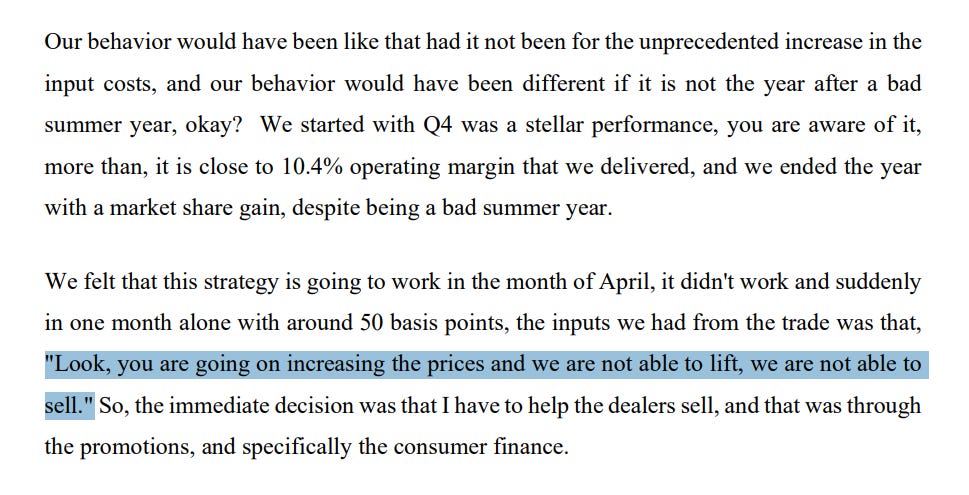
On the other hand, Blue Star also spent more on advertising, trade promotions and consumer-finance schemes. Dealers had told the company that repeated price increases were making its products difficult to sell. Management said the additional schemes helped it recover market share, but also contributed to weaker margins.
The company is now working on taking costs out of its products, reconsidering what it manufactures and outsources, and building a more competitive entry-level portfolio.
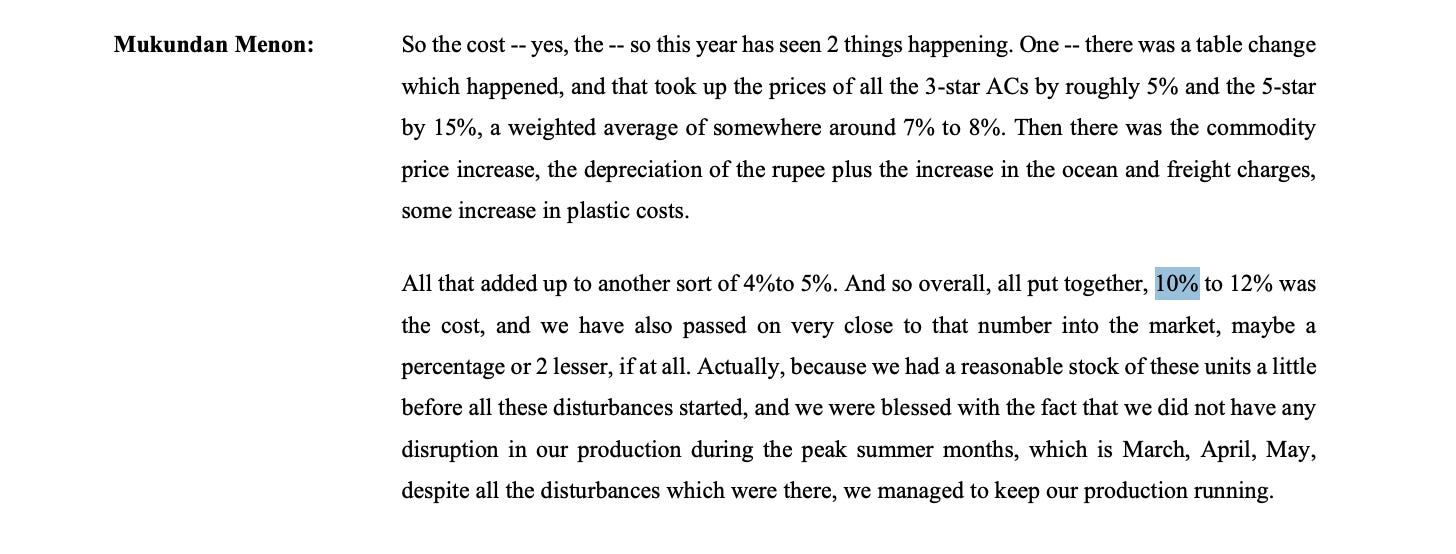
Voltas handled the increase differently. Management estimated that the new AC energy-efficiency standards had added around 7–8% to costs on a weighted-average basis. Commodities, the weaker rupee, freight and plastics added another 4–5%, taking the total impact to around 10–12%.
Voltas said it had passed on almost the entire 10-12% increase, retaining perhaps one or two percentage points. It was helped by having some inventory that had been purchased or imported before the full cost increase arrived. The company also said that if costs did not rise enough to require another price increase, it could reduce channel schemes to rebuild its margins.
This gives us two different examples. Blue Star passed on only part of the increase and absorbed pressure through its margins and promotional spending. Voltas passed on most of its estimated cost increase and kept open the option of reducing schemes later.
It also explains why price increases arrive in rounds. A company may initially sell inventory purchased at older prices. It may wait to see how competitors respond, or delay an increase because demand is weak. If costs remain high, another part of the increase may be passed on later.
Sometimes the increase is gradual. At other times, companies pass it on more quickly. There is no fixed industry formula.
Where does premiumisation fit?
This cost shock has crossed a trend that has been running for long across the economy: premiumisation.
Premiumisation was already underway before the current cost shock. Customers with larger budgets have been moving towards bigger televisions, high-capacity refrigerators, front-load washing machines and more energy-efficient ACs.

Now, this can cushion inflation because premium products generally give companies more room on pricing. But premiumisation does not make the inflation disappear. The higher cost of metals, chips and freight can instead eat into the additional margin earned from those products.
Financing in installments helps customers bridge the difference significantly. Haier’s India CEO said some buyers who would earlier pay an EMI of ₹2,000 were willing to pay ₹2,500 for a better appliance. They were okay choosing a more efficient or more feature-rich product by accepting a slightly-higher monthly installment. In fact, an Amazon India survey found that nearly half of large-appliance buyers considered no-cost EMI the most important pricing offer.
This does not mean every customer is comfortable paying more. More price-sensitive households may choose a smaller model, move to a cheaper brand or delay the purchase. Retailers have already reported that some purchases of large-screen televisions and side-by-side refrigerators were postponed ahead of the festive season.
Separately, usually, building many of these components in-house makes a big difference to the price. And the components inside these goods have been the target of our “Make in India” program.
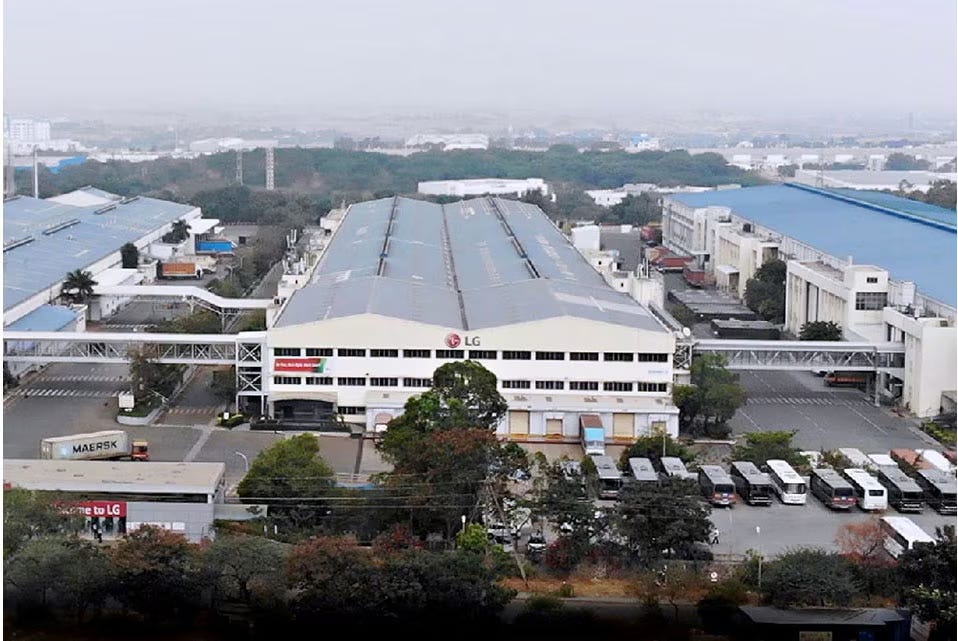
For instance, LG currently manufactures rotary and reciprocating compressors in India for ACs and refrigerators. Samsung also lists India as one of its global manufacturing locations for reciprocating compressors. Value addition has made in-roads in fridges and ACs.

But localisation is still incomplete. LG says around 95% of the products it sells in India are manufactured here, but 56% of its raw materials are locally sourced. In fact, in TVs, we’re still very import-dependent for key parts, for instance, we have a big trade deficit in open-cell display panels, which make up 70% of a TV’s cost.
This is not always determined by whether the company itself is Indian or foreign, either. Blue Star and Voltas are Indian, but they still buy components and materials whose prices are influenced by international markets.
Of course, a similar distinction appears in smartphones. A device may be assembled in India while high-value parts such as its memory, display and processor continue to come from overseas. We’ve covered how India is, slowly but surely, climbing up the Apple value chain in the past.
The festive season
The festive season makes the pricing decision more complicated. Companies want to recover their higher costs, but Durga Puja, Dussehra and Diwali are also important sales periods. But raising prices too much can hurt demand.

This can create what appears to be a contradiction: the product’s underlying price can rise while the advertised festive discount becomes larger.
Consider an illustrative product with an MRP of ₹50,000. A 20% discount brings its selling price to ₹40,000. If its MRP later rises to ₹55,000, the seller can advertise a larger discount of around 27% and still sell it for roughly ₹40,000. The discount looks better, but the customer is not paying less than before.
The same effect can happen without changing the MRP. A company can reduce its usual channel scheme, offer a smaller exchange bonus or remove a service that was previously free. The visible price may remain unchanged even though the effective deal has become weaker.
This is not only a theoretical possibility. Voltas told analysts that it could reduce channel schemes instead of taking another immediate price increase, while Blue Star increased its spending on promotions and consumer finance when higher prices began affecting sales.
This is why a festive discount should not be judged only against the MRP printed beside it. The more useful comparison is with the previous selling price of the exact same model.
Conclusion
The story is not simply that every AC, refrigerator and television will become 10% or 15% more expensive.
Companies are exposed to different components, hold different amounts of older inventory and have different room to absorb costs. Blue Star could pass on only part of its estimated increase. Voltas said it passed on nearly all of its own. LG, Samsung and other manufacturers are producing more appliances and components locally, but they have not eliminated their exposure to imported technology, globally priced materials and the dollar.
When those costs rise, they must eventually land somewhere.
For a while, the manufacturer may absorb them through lower margins, product redesign or higher spending on promotions and consumer finance. Later, they can reach the customer through a higher price, a smaller discount, a reduced scheme or a larger monthly installment.
So, during the festive sales, the biggest discount percentage may not be the best deal. The number that matters is the final amount payable for the same model: after including the bank offer, exchange value, installation, accessories and any EMI-related charges.

What’s behind the recovery of India’s golden fibre?
For India, jute has long been called the “golden fibre“, partly for its colour and partly because of the wealth it once created across Bengal. India remains the world’s largest producer of raw jute and, as of July 2026, accounted for roughly three-fourths of estimated global jute-goods production.
This month, that industry got some good news. After two years of shrinking sales, Crisil expects India’s jute mills to rebound with a 15% jump in volume this year, lifting operating margins close to 9%.
That is quite a turnaround. Only a few months ago, mills along the Hooghly river were struggling with expensive and scarce raw jute. By April, the Jute Commissioner had ordered traders to reduce their stocks to zero and sell the fibre onward.
So how does an industry move from scrambling for raw material to expecting double-digit volume growth in a single crop cycle?
The arithmetic of a crop shock
In the jute industry, raw fibre alone accounts for around 60 to 65% of a jute manufacturer’s operating expenses. Even a modest change in the price of the crop can completely alter the economics of a mill.
That is what happened over the last two years. Raw-jute prices rose by more than 10% last financial year because supply was tight. Mills passed some of those higher costs on to customers, finished jute products became more expensive, and buyers shifted towards cheaper packaging alternatives. Crisil estimates that domestic demand fell by roughly 20% cumulatively in this time span.
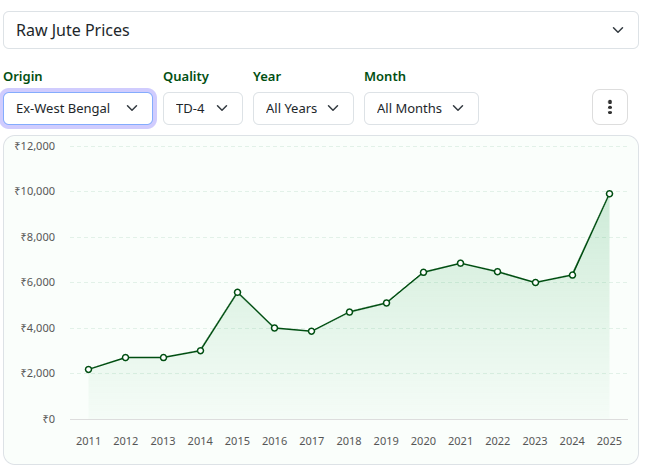
Now, the cycle is reversing. Higher minimum support prices (MSPs) encouraged farmers to increase the area under jute. That, in turn, improved crop output, which increased supply and softened fibre prices, even though imports remain subdued.
That is why Crisil expects domestic demand to rebound by around 20% this year. Lower fibre prices reduce mills’ manufacturing costs, softer product prices make jute more competitive with alternative packaging again, and some of the demand that disappeared over the previous two years can return. Exports may also improve, helped by demand for home textiles, lifestyle products and other higher-value applications.
So this year’s comeback is not exactly a story about normal consumers suddenly wanting more jute. But part of the answer lies in one entity that controls a huge chunk of not just pricing for jute, but many other agricultural commodities.
The captive buyer in the room
The Jute Packaging Materials Act of 1987 allows the government to reserve certain commodities for jute packaging. Under the current framework, 100% of foodgrains and 20% of sugar are required to be packed in jute.
What does that imply? See, the Indian government buys, stores and moves enormous quantities of grain for public procurement every year. So, the Food Corporation of India and state procurement agencies need equally enormous quantities of sacks. Since the JUTE-SMART procurement system was introduced in 2016, more than ₹1 lakh crore worth of B.Twill jute bags had been procured through it by August 2026.
In essence, the government gives the industry a demand floor that ordinary manufacturers rarely enjoy.
The dependence is visible in what jute mills actually make. In 2022-23, around 75% of total jute-industry production was sacks, and roughly 85% of those sacks went straight to public procurement agencies. The same mandatory packaging system consumed around 65% of India’s domestic raw-jute production that year.

That does not mean demand cannot fall. The last two years prove that it can.
Outside the mandatory procurement system, jute still competes with cheaper plastic and synthetic packaging. When jute became expensive, commercial customers switched. Furthermore, the 1987 Act carries a statutory dilution clause: if mills fail to deliver because fibre is scarce or dear, the government can dilute the quota by up to 30% and buy plastic instead. During a supply crunch in late 2021, the government switched 4.81 lakh bales to synthetic bags, costing mills a notional ₹1,500 crore.
So, the law does not eliminate demand risk. What it does is create a large, protected core underneath the industry. And that protection exists because jute’s problems started long before today’s mills began worrying about margins.
The Partition hangover
Before 1947, Bengal’s jute farms and jute mills belonged to the same economic system, but Partition split them apart. Nearly 75-80% of the region’s jute-growing area ended up in East Pakistan — today’s Bangladesh — while most of the mills remained in India. India suddenly had a large manufacturing base but nowhere near enough fibre to keep it supplied.
The government responded by rebuilding cultivation. It launched the “Grow More Jute” and Jute packaging materials act in the late 90’s. These campaigns encouraged farmers to switch land towards the crop. Over time, another layer of support emerged: farmers got a minimum support price, while mills got a captive market through mandatory packaging.
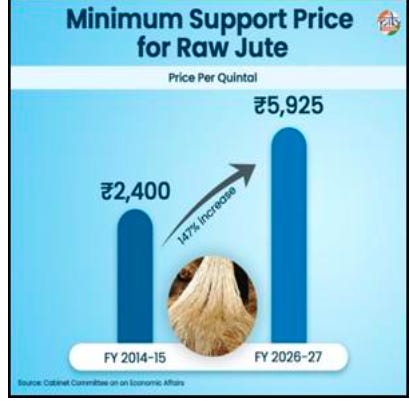
The scale of that support is still growing. The minimum support price for raw jute has risen from ₹2,400 per quintal in 2014-15 to around ₹5,900 per quintal for 2026-27, an increase of roughly 147%. When market prices fall below that level, the Jute Corporation of India steps in to procure directly from farmers.
That protects the grower. But it also creates an unusual tension, because the mill wants exactly the opposite thing. For the farmer, a high fibre price is good news. For the mill, it is a direct cost shock. The government is trying to support both, and that becomes even more complicated when Bangladesh enters the picture.
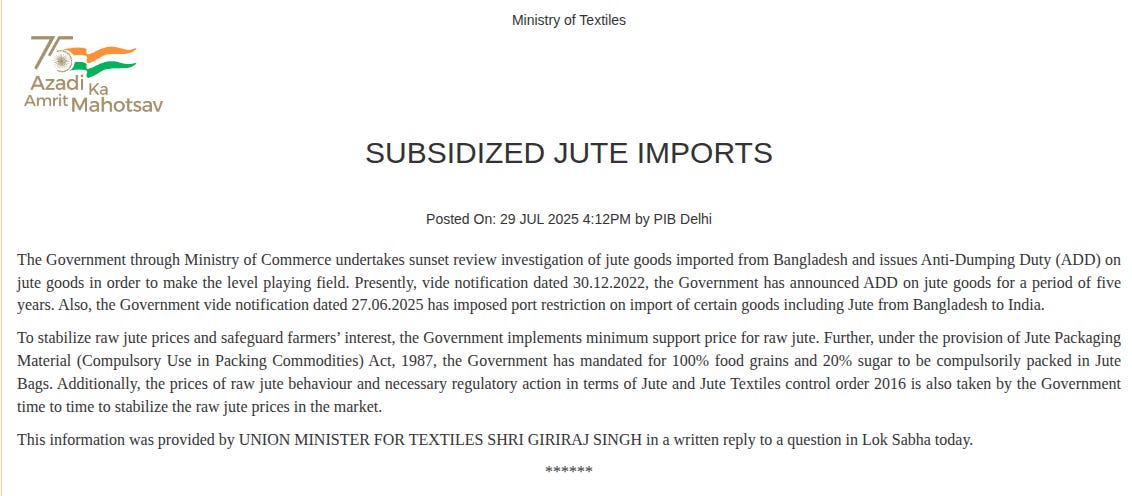
Bangladesh is one of the obvious places an Indian mill can turn to when domestic raw jute becomes expensive. India has increasingly restricted these imports to protect our industry. In June 2025, the government barred specified categories of Bangladeshi raw jute, yarn and fabrics from entering through eastern land ports and required them to come instead through Nhava Sheva in Maharashtra.
But there is a clear trade-off. A measure that protects the farmer simultaneously makes life harder for the mill. This episode exposed the tension inside the system. There is no single price that makes both sides happy.
The bigger opportunity
Jute has one advantage that matters far more today than it did when the packaging law was written in 1987: it biodegrades. That makes it pretty well-suited to a world trying to use less plastic.
Jute can already be used in shopping bags, composites and technical textiles. One of the more interesting applications is jute geotextiles: sheets of fibre laid along roads, riverbanks and embankments to stabilise soil and control erosion before decomposing into the earth. The government is trying to expand these markets through diversification programmes that provide machinery subsidies and support technical applications.

Yet, the commercial base of this use-cases remains tiny. Crisil estimates that value-added applications contribute only around 12% of industry revenue.
For decades, jute’s great advantage was that the government guaranteed a market for its most basic product. Now governments and companies around the world are trying to reduce their reliance on synthetics, creating demand for a reusable and biodegradable material like jute.
A guaranteed customer keeps the mills alive, but it also gives them little reason to modernise. Since the government simply covers their costs, investing in better machines makes little financial sense. That is why a ₹100 crore machinery fund saw barely ₹2.4 crore used.
This year’s cheaper harvest will restore operating margins. But it likely doesn’t change the incentive structure that the government demand floor creates.
- This edition of the newsletter was written by Kulsum & Mridula.
Tidbits
1. ONGC strikes gas in deepwater Mahanadi Basin off Odisha coast
ONGC has discovered gas in a deepwater exploration well about 43 km off the Konark coast in Odisha under its Samudra Manthan campaign. The find could support future cluster development using shared infrastructure, though commercial viability still needs to be established.
Source: Financial Express
2. MoSPI details methodology behind new 2022–23 GDP series
MoSPI has released a detailed explanation of the sources and methods used in India’s new national accounts series with 2022–23 as the base year. Key changes include double deflation for manufacturing using granular producer-price data and revised treatment of items such as government pension liabilities.
Source: Business Standard
3. Petrol pump dealers in MP to stop high-value UPI payments; Punjab warns of similar move
Petrol pump dealers in Madhya Pradesh say they will stop accepting UPI payments above ₹2,000 from October 16, citing a proposed 0.4% merchant discount rate. Punjab dealers have warned they may take similar action unless fuel retailers are exempted from the charge.
Source: The Economic Times
4. Ireland fines Google $463 million over user location data privacy breaches
Ireland’s Data Protection Commission has fined Google €403 million ($463 million) for violating EU data privacy rules regarding its location-data practices. The regulator cited issues with transparency, user consent, and data retention across its Web & App Activity and location settings between 2018 and 2020.
Source: Business Standard
5. Paramount settles with US states, clearing major hurdle for Warner Bros. Discovery deal
Paramount Skydance has settled with California and 11 other states that sued to block its acquisition of Warner Bros. Discovery. The agreement includes independent editorial boards for CNN and CBS and a $30 million penalty for each film by which Paramount falls short of its annual 30-movie commitment. We have covered one part of this story here.
Source: Livemint
Want more tidbits? Catch up on last week’s recap!


Beyond Today’s Brief
There’s always more happening at Markets by Zerodha.
The Chatter: What new regulatory measures is SEBI introducing to deepen India’s corporate bond and AIF markets? How is Mazagon Dock navigating its ₹15,000 crore expansion alongside high-value naval bids? And how are firms like Mphasis, Redington, and TVS Supply Chain adapting to IT, AI, and global supply chain shifts?
Points & Figures: How severe is the synchronised global supply shock across energy, metals, and freight? What does India’s 510-basis-point WPI-CPI gap reveal about margin compression, and how are rising sovereign yields reshaping global rates?
Aftermarket Report: How did the Nifty struggle to sustain its opening gap-up despite strong global markets and cooling oil prices? What do the latest trends in foreign institutional shorting, delivery spikes, and options positioning reveal about market sentiment?
Subtext: How do developing nations navigate the impossible balance between industrialisation and decarbonisation? In our conversation with Avantika Goswami and Trishant Dev from CSE, we explore the power dynamics behind Western climate mandates and what a truly just green transition looks like. Watch the full episode here.
Join us on WhatsApp, where we share interesting soundbites from concalls, articles, and everything else we come across throughout the day. You’ll also get notified the moment a new video or article drops so that you can read or watch it right away.
Thank you for reading. Do share this with your friends and make them as smart as you are 😉