

Our goal with The Daily Brief is to simplify the biggest stories in the Indian markets and help you understand what they mean. We won’t just tell you what happened; we’ll tell you why and how too. We do this show in both formats: video and audio. This piece curates the stories that we talk about.
You can listen to the podcast on Spotify, Apple Podcasts, or wherever you get your podcasts and watch the videos on YouTube. You can also watch The Daily Brief in Hindi.
In today’s edition of The Daily Brief:
Is China slowly changing how it finances itself?
China’s booming AI and semiconductor IPOs signal a gradual shift from bank-led financing towards capital markets, but the state continues to play a central role in directing capital and shaping the country’s growth model.
Why did IEA change its mid-year electricity outlook?
The IEA’s revised electricity outlook shows how the Strait of Hormuz disruption reshaped global power markets, highlighting that countries with resilient energy systems absorbed the shock far better than those reliant on imported fuels.
Is China slowly changing how it finances itself?
On Monday, China’s largest chipmaker, CXMT, debuted on Shanghai’s STAR Market and surged 466% in a single session. Its market capitalisation hit 3.3 trillion yuan (~ $488 billion), making it the most valuable listed company in mainland China overnight. Chinese retail investors oversubscribed CXMT’s offering 212 times.
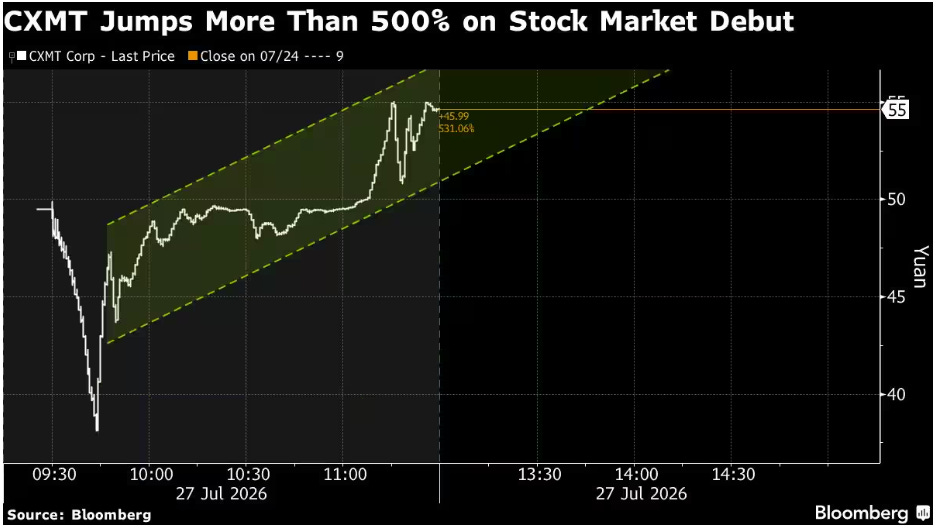
Perhaps, to those of you who may have checked out our recent story on memory chips, this IPO may not be a surprise.
But what’s interesting is the stock it displaced from the top: the state-owned Industrial and Commercial Bank of China. It is the world’s largest bank by assets, and also the biggest symbol of how China has financed itself.
Over the past year, several of China’s largest IPOs have been in the AI value chain — chipmakers, GPU designers, robotics firms. Tech now accounts for more than 30% of the A-share market’s capitalisation, up from well under 20% just a few years ago. Among listed companies worth more than 100 billion yuan (~$15 billion), technology firms are 45% of the count.
This is a dramatic departure from the system that built modern China. For most of its economic miracle, China’s financing ran through a very different pipeline that didn’t involve any sort of private financing at all. At the core of it were state-owned banks like ICBC, that directed credit at extremely cheap interest rates that weren’t set by markets, but by the state.
So, what’s changed? What does this say about China’s capital market? Is it genuinely opening up, or is this the same state-directed machinery wearing a new hat?
The machine that built China
The story starts with understanding the state financing system itself, and the nature of its double-edged sword.
China’s economic reforms began in 1978, but while the economy seemed to open up, one key part of its economy was deliberately not: finance. Banks were wholly considered instruments of state policy. Their job was to channel the nation’s capital towards whatever the state deemed strategically important — steel mills, highways, real estate, toys, smartphones — that too at extremely cheap rates.
They complemented this with very low returns on the bank deposit that an average Chinese citizen would have. China deliberately suppresses deposit rates, which aren’t set by a market. While China’s nominal GDP would grow at 16-20% a year, the nominal deposit rate would sit at 3-4%, hardly budging. In fact, often, due to inflation, the real return earned from this deposit would be negative.
Well, Chinese households could go for other asset classes that give them better returns, right? Nope, and that’s where China’s capital controls come into play.
Not long ago, Chinese citizens were restricted from investing in stocks and bonds that were denominated in foreign currencies. While the rule isn’t as blunt today, restrictions on investing outside (especially the US) continue to exist. The state also makes it difficult for people to buy foreign currencies. China has cracked down heavily on wealthy individuals who tried to use the Hong Kong exchange to send money out.
On the company side, until the 2000s, the state made it extremely difficult to issue corporate bonds. There were strict quotas on IPOs — the central government literally assigned how many companies each Chinese province could list publicly, and an opaque “merit review“ process meant regulators could freeze IPOs at will. A large chunk of shares in listed companies were held by the state and couldn’t be traded.
Additionally, local governments, which play a key role in China’s economic development, have historically been prevented from creating their own financial instruments. Until 2009, they couldn’t raise their own bonds, either.
In essence, the state was making the low-rated deposit the only game in town, trimming other asset classes that could give it competition.
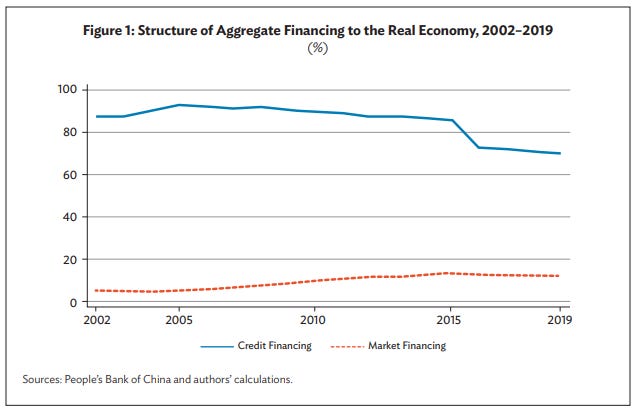
In economic-speak, this combination of low interest rates and capital controls is called financial repression. And it was done in service of China’s own state-owned enterprises, local governments, and eventually, private companies. This is what funded China’s behemoth industrial economy that we see today. India has also had a history of undertaking similar policies.
But every economic policy comes with trade-offs. And financial repression is no exception.
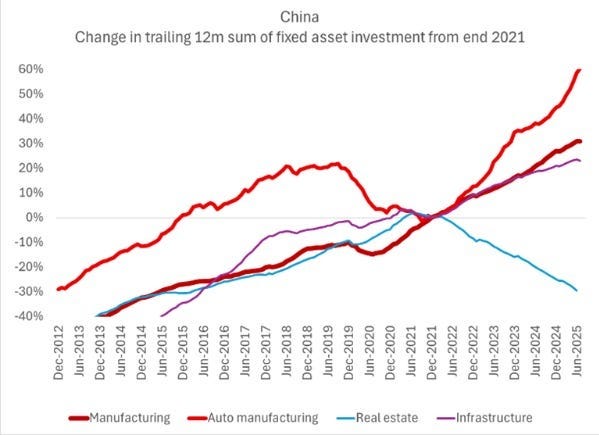
We’ve covered before how China’s economy is suffering from a problem of overcapacity and extremely-heated competition. The financing system is where those side-effects come from.
Cheap capital can result in the construction of an extraordinary amount of industrial capacity built fast. But without any disciplining factor, this can quickly turn into too many factories. That, in turn, creates too much supply, which results in bloody price wars, and eventually, diminishing returns.
Where Chinese savers went looking
Now, China’s household savings rate is one of the highest in the world, primarily because, as you might have guessed, the options for deploying those savings were severely limited. In the wake of that, the two biggest asset classes that Chinese people put money in are liquid bank deposits and real estate.
And the second one is where we’ll train our eyes on.
Chinese families bought second and third apartments the way Indian middle-class families buy gold (or, well, apartments). And why wouldn’t they? They saw it as their ticket to godly returns. Property prices in major cities kept rising as private developers like Evergrande and Country Garden built at a staggering pace, racking up incredulous levels of debt on the way.
We now know how that story ended. China is now going through a historic, prolonged real estate crash that has wiped out asset values overnight and continues to weigh on the economy today. It built too much, and now many units sit idle today.
The equity market, meanwhile, was always considered volatile and unreliable. And for good reason: excess competition meant corporate earnings were often poor, while quotas on IPOs prevented better alternatives from emerging.
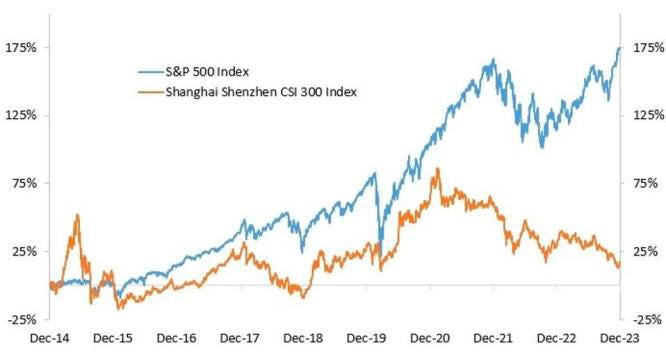
Then, in response to China’s financial repression emerged the weird world of shadow banking.
While the debt incurred by various stakeholders in China became unsustainable, China began trimming its state credit. So, state-owned commercial banks began partnering with trust companies to create “wealth management products“ (WMPs) that offered higher yields by lending to riskier borrowers like property developers or local governments, which now found themselves cut-off from state-directed finance. Those yields, of course, were more attractive for Chinese people than the simple bank deposit.
The shadow banking system eventually grew to trillions of dollars. It filled a real gap, but it was far riskier and more opaque. It’s hard to gain information about the asset pools underlying these WMPs — they can be far weaker than advertised. Shadow banking also often props up unproductive firms.
What does Beijing want?
But it’s not like China hasn’t known about these problems. In the last 2 decades, they’ve recognized in public that the stock market will have an important role to play in the country’s development.
After the 2008 financial crisis, the state actively encouraged households to invest in stocks. A big reason for why they did so was also what gave rise to shadow banking: the debt levels of companies had become too big, and the government didn’t want to lend to them anymore, and demanded them to deleverage. But, these companies still needed capital.
The state created this idea of a “Chinese dream“, which was to be achieved partly through a booming stock market. Official state media ran editorials celebrating rising share prices as a sign of economic strength.
But the gains were built on sand. Much of the 2014-15 rally was fuelled by retail investors borrowing to invest in stocks. The source of their borrowing was the same shadow banking channels. Many retail investors bought in late.
When the bubble burst in mid-2015, the Shanghai Composite lost more than a third of its value in three weeks. The government’s response was extraordinary: it ordered brokerages to buy, banned major shareholders from selling, and urged citizens to support stocks in the name of national duty.
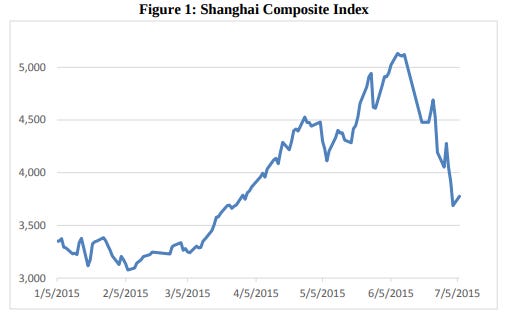
In fact, Beijing created a “national team” of state-backed funds that buy equities when markets fall sharply. The state props up the market when it falls and clamps down on margin lending when it rises too fast. But this is still an artificial means of propping up a company’s value.
An AI boom and a financing rethink
So, in light of all this, how do we make sense of China’s current stock market boom?
The AI wave has done something that many of the previous Chinese industrial booms didn’t: it was kickstarted primarily by private companies, not state-owned ones. DeepSeek was built by a hedge fund’s research lab. So is Moonshot, the AI lab that broke out the frontier model Kimi K3 recently.
This, in turn, has implications for the financing question.
A report by the RAND Corporation puts it clearly: state-directed bank lending works well for industries where the government has a clear view of what needs to be built — highways, power plants, steel mills. But AI is an industry where the trajectory of technology is genuinely uncertain, and where the difference between a world-changing model and an expensive failure is often unknowable in advance.
To its credit, Beijing has known this to be true of high-tech industries in general. Which is why it’s been trying to reform the stock market since 2015.
For instance, in 2019, it launched the STAR Market reforms in Shanghai, under which, for the first time, technology firms which were yet unprofitable but were growing extremely fast could list publicly. In 2021, the Beijing Stock Exchange was opened specifically to serve small and medium enterprises. In 2023, China implemented a package of rules which effectively shifted the listing review process from bureaucrats to the stock exchanges themselves. In the last year alone, the STAR Market has received further sets of changes.
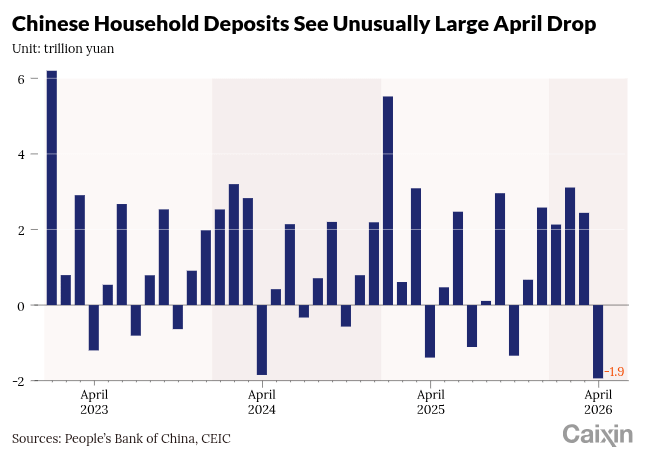
Meanwhile, the deposit-to-equity rotation is accelerating from the household side. China’s bank deposits have contracted 17% from last quarter, especially since Chinese banks have continued to cut deposit rates. Billions of dollars worth of time deposits are expiring this year alone, and depositors are unlikely to put that back into a bank. And that money is decidedly landing up with brokerages, with deposits by non-bank institutions rising significantly in China this year.
Winds of change
From Xi Jinping’s speeches to real policy announcements, China does look serious about its stock market. But financial repression is nowhere close to being retired, especially as nominal interest rates continue to be pushed closer to zero.
Additionally, the stock market might also represent a new form of state control. The same week that CXMT debuted, the national team fueled $9 billion to prevent markets from crashing after an AI selloff. The CSRC was holding investor symposiums to discuss “imported risks from abroad”. Regulators were telling brokerages to stop promoting aggressive market views.
Some of this is certainly business-as-usual. It’s much like an SEC or a SEBI would do. But national development through state power has always been priority #1 for China. A new channel in IPOs may have emerged, but the logic of strongly steering household savings where the state wants them to go has not. Many governments have tried to do so, too, and China is no unique exception to financial repression. But none have matched their scale and intensity.
It is not necessary that any of this means that China’s growth model is exhausted. It’s extremely likely that China’s unique model of fusing state direction with private-led innovation continues to work.
But what’s also very possible is that the same forces that created overcapacity in steel, solar panels and real estate will eventually create overcapacity in AI labs and chip companies that will become difficult to manage. While history doesn’t repeat, it certainly could have a high-tech way of rhyming.

What surprised the IEA in 2026?
Back in February, the International Energy Agency (IEA) had just published its annual electricity outlook. We covered that report on The Daily Brief as the arrival of the “age of electricity“, because it painted a fairly calm picture of the year ahead. But when the IEA returned with its Electricity Mid-Year Update 2026 in July, the tone had changed dramatically. Electricity markets across countries were suddenly behaving in very different ways and telling a story that the IEA itself had not expected to be telling at the start of the year.
According to the February outlook, Electricity demand was expected to grow around 3.6% a year through 2030 — roughly two and a half times as fast as overall energy demand. In other words, our economies were steadily becoming more electrified.
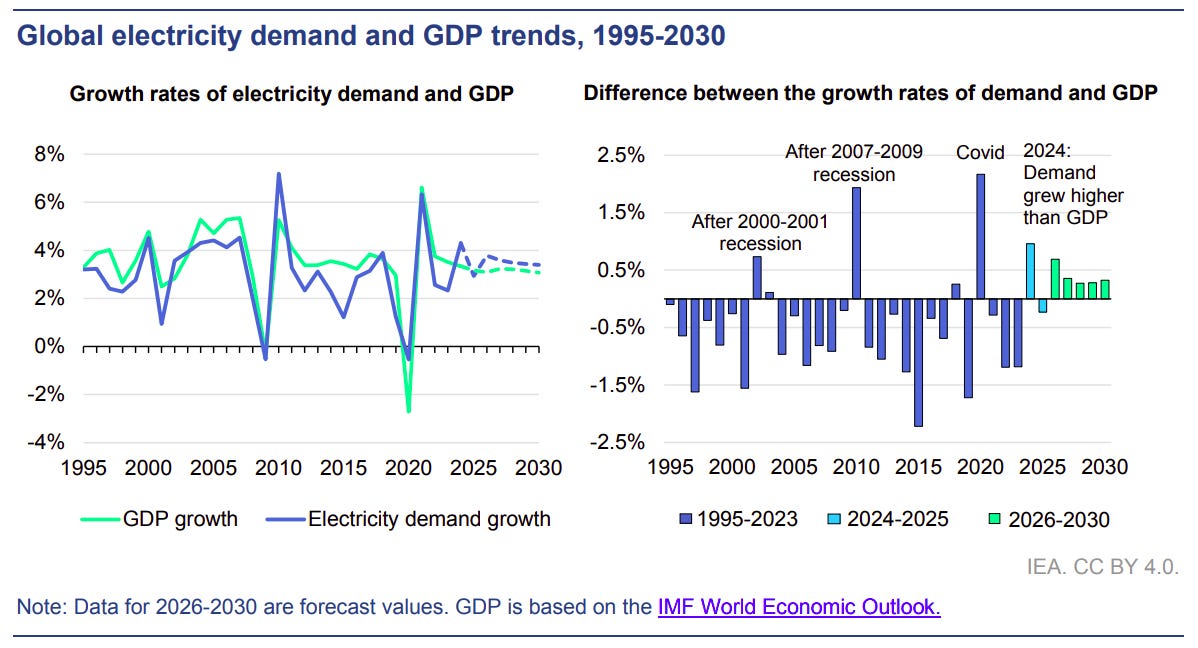
Meeting that demand also looked manageable. Clean energy was expanding fast enough to cover most of the growth and gradually eat into fossil fuels’ share. Gas would play the role of the flexible backup, stepping in whenever renewable generation dipped when the wind wasn’t blowing or the sun wasn’t shining.
In that world, coal use would continue to decline. In 2025, both China and India saw coal-fired generation fall at the same time, which was a rare occurrence. That gave the IEA confidence that power-sector emissions would stay broadly flat through the end of the decade, even as electricity demand kept rising.
But that picture was built on annual averages. A shock in late February exposed what those averages couldn’t show.
Hostilities in the Gulf disrupted shipments through the Strait of Hormuz. A large share of the world’s liquefied natural gas has to pass through this channel. For much of the spring, close to a fifth of global LNG supply stopped moving. Gas prices in Asia and Europe climbed to their highest levels since the 2022 energy crisis. Asian spot prices averaged more than 65% above pre-crisis levels, while Europe’s benchmark rose more than 50%.
The consequences showed up very differently across electricity markets. While in some countries the prices rose, in others they nearly halved, and finally a few countries actually imposed outright cuts in electricity use. So, the same fuel shock hit different economies differently, and that’s the story the IEA’s latest update tells.
What the update showed
With a fifth of global LNG off the market and its price up by half or more, running a gas plant to generate electricity suddenly cost more in every country that relied on imported gas. The July update traces this development through the rest of the year.
Gas-fired generation, which the IEA had expected to keep growing, is now forecast to stay broadly flat in 2026. That would make this only the third year this decade without meaningful growth, after the disruptions of 2020 and 2022.
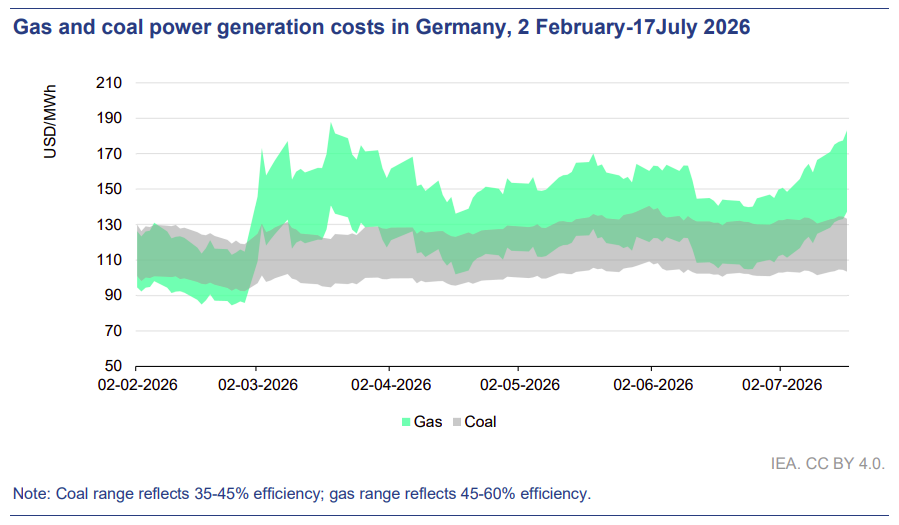
Coal, meanwhile, is now expected to grow by about 1.4%, instead of declining as the IEA had projected earlier. Part of that is simply because gas became too expensive. When running gas plants costs more than coal plants, utilities switch wherever they can. That was particularly visible in countries like Germany and Poland, where expensive gas reversed coal’s expected decline.
Running a gas plant got costlier than running a coal plan in Germany
But expensive gas wasn’t the only reason. Weather-driven increases in coal generation in China and India also pushed the global forecast higher.
As a result, power-sector emissions, which the IEA had expected to plateau, are now forecast to rise by a little over 1% to a record high. The agency still expects emissions to flatten again in 2027, suggesting this is a one-year bump rather than the start of a lasting reversal.
Why did every country experience the shock differently?
The same LNG shock hit every country that relied on imported gas. But whether it showed up as higher electricity prices, more coal, or simply less electricity depended on four things.
First, how much imported gas a country actually needs.
Second, whether gas gets to decide the electricity price. In many competitive electricity markets, power plants are switched on from the cheapest to the most expensive as demand rises. The last plant needed to meet demand sets the wholesale price for every unit of electricity sold during that period. So if that last plant happens to run on expensive imported gas, even a relatively small amount of gas generation can push up electricity prices across the entire market.
Renewables change this equation. Every hour that solar, wind or hydro can meet demand is another hour gas never gets called upon to set the price. That’s one reason this shock hurt less than the one in 2022. And even then, consumers don’t always see the full increase. Many governments cap retail tariffs, regulate prices or simply delay passing higher costs on to households.
Third, what alternatives a country has when gas turns expensive. It could be coal, domestic gas, nuclear, imported power, batteries, or the ability to shift demand to another time of day. And fourth, how governments choose to respond: let prices rise, cap them, suspend the market, or simply ask people to use less.
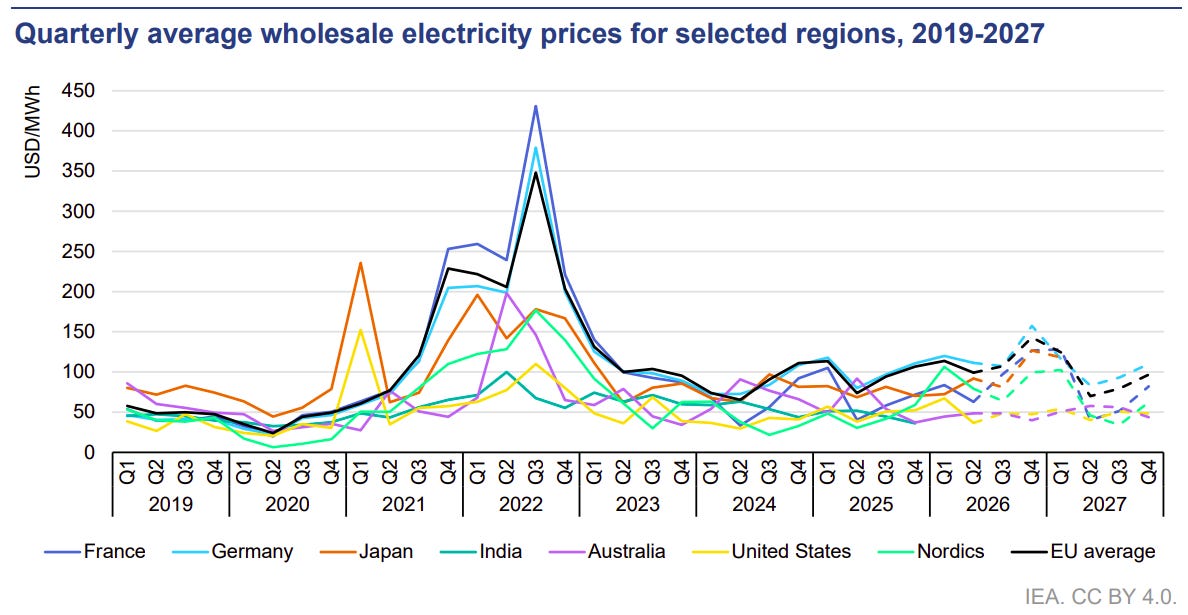
Europe and Japan were among the most exposed. Both rely heavily on imported gas, both let gas set wholesale electricity prices, and both largely pass those prices on to consumers. So the shock showed up mainly as higher electricity prices. Wholesale prices rose more than 30% year-on-year in the second quarter, while Japanese power averaged close to $90 per megawatt-hour.
Bangladesh and Pakistan were just as exposed, but had far fewer options. Both rely on imported spot LNG, have limited substitutes, and couldn’t absorb such a sharp increase in fuel costs. So instead of letting prices surge, both governments imposed conservation measures that reduced electricity consumption, eventually causing some blackouts. The Philippines chose a different route altogether, suspending its wholesale electricity market for five weeks and replaced it with market prices that were administered.
The United States barely noticed. Wholesale electricity prices were broadly flat year-on-year in the second quarter. Earlier price increases came from Winter Storm in January, not the LNG shock. Because the US produces abundant domestic gas, it was largely insulated from what happened in global LNG markets.
Australia went the other way. Wholesale electricity prices fell about 45% year-on-year in the second quarter, averaging $47 per megawatt-hour over the first half of the year. This happened in spite of the shock. How come? Well, because strong renewable generation and a rapidly growing battery fleet kept expensive gas and coal out of the system, making sure they weren’t relied on. New batteries tripled the amount of midday solar that could be shifted into the evening. In effect, Australia had built its insulation before the crisis arrived.
What about India?
India’s wholesale electricity prices actually fell about 10%, which sounds wonderful, but there’s a caveat. Imported LNG barely sets the price on India’s grid because it plays a very minor role in the country’s overall power generation mix. So the jump in global gas prices had little influence on wholesale electricity prices.
But that doesn’t mean we weren’t affected.
Because most of the gas used for power generation in India comes from domestic fields, regular electricity prices were protected from the global shock. However, factories that rely on imported gas couldn’t afford the new high prices. As a result, overall gas-fired generation dropped by 15%—meaning the crisis hurt industrial plants instead of consumer power bills.
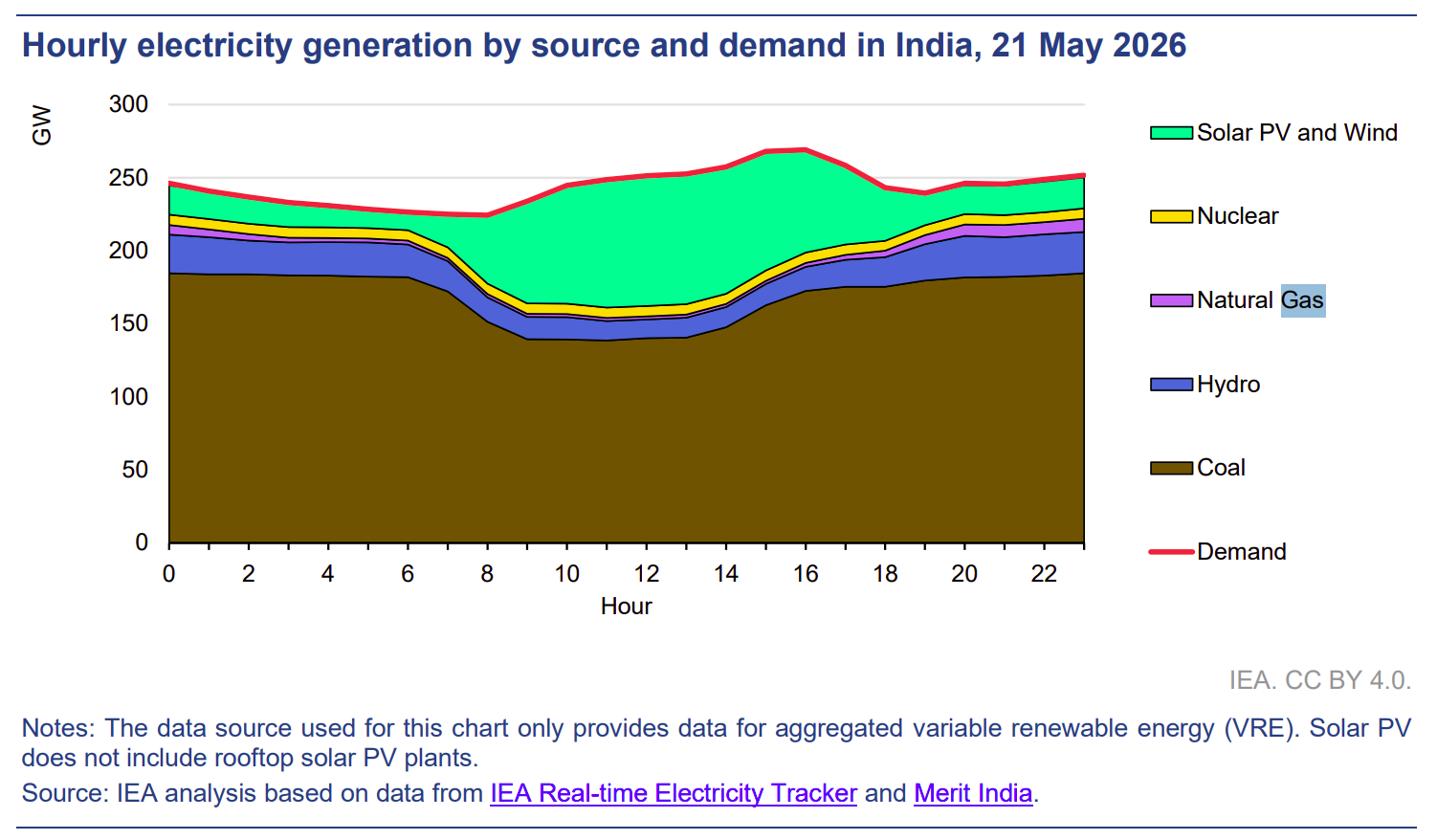
The bigger challenge, however, wasn’t gas. It was heat. Electricity demand rose about 6% in the first half of the year and jumped 11% in May, when a severe heatwave drove cooling demand to record levels. On 21 May, peak demand touched an all-time high of 270.8 gigawatts — and the grid met it, with solar supplying nearly a quarter of afternoon demand.
The real test came after sunset. Solar generation faded just as demand stayed high, forcing the grid to lean much harder on coal and gas. At times, even that wasn’t enough. Power shortfalls more than doubled during the first five months of the year, and in April, states such as Punjab and Haryana saw up to 2% of their monthly electricity demand go unmet.
To hold the summer together, the Ministry of Power ordered imported-coal plants to run at full capacity from April to June, as it has done in recent summers. Coal generation rose 3.5%, nuclear output increased by more than 11% as a new reactor came online, and power-sector emissions are expected to rise about 3%. This wasn’t a response to expensive imported gas. It was how India managed extreme summer demand once the sun had set.
Where the cost is paid
A solid power system still can’t make the fuel problems go away, but only decide who pays the prices.
Europe and Japan paid through higher electricity prices. India paid through more coal and higher emissions. Bangladesh and Pakistan paid in electricity that never reached consumers. Australia paid long before the crisis began, by investing in renewables and batteries that reduced its dependence on expensive gas.
But not every country has the same choices. If a country depends heavily on imported fuel and doesn’t have many alternatives or much money to absorb the shock, something has to give. Often, it’s the electricity supply itself.
The IEA still believes this is a temporary setback. It expects gas markets to ease, weather conditions to normalize, and power-sector emissions to flatten again in 2027. But that outlook assumes the next shock is kinder than this one.
One comparison captures the lesson. Australian wholesale electricity averaged about $47 per megawatt-hour this year. India’s averaged about $48. Almost the same price. But Australia got there by investing ahead of time in a grid that could lean on renewables and batteries. India got there because imported LNG barely sets the price in its power market.
Nearly the same price, resting on two very different kinds of insurance.
None of this means the broader energy transition has gone off track. Renewables are still expected to grow by more than 8% this year, solar is still headed for another record year, and electricity continues to become cleaner. The IEA’s message isn’t that electrification has stalled. It’s that building a resilient electricity system isn’t just about producing cheap power in normal years. It’s about deciding where the pain goes when the abnormal ones arrive.
Tidbits
1. The Centre has permitted the Reserve Bank of India to print 2 billion polymer banknotes in ₹10 and ₹20 numbers for initial field testing. This move aims to test the increased durability and lifespan of the notes.
Source: Business Standard
2. Hindalco Industries has submitted the first and sole proposal to the Nuclear Power Corporation of India (NPCIL) to set up 220 MW small nuclear reactors. This allows the company to secure clean, captive nuclear energy to power its heavy industrial and metal manufacturing operations.
Source: The Economic Times
3. Nvidia is discussing a $250 billion financing guarantee to help OpenAI lease a massive 10-gigawatt data center in Ohio. This move would allow OpenAI to control its own computing infrastructure while securing long-term demand for Nvidia’s advanced chips.
Source: The Indian Express
4. South Korean chipmaker SK Hynix is seeking to recover from a $470 billion market selloff triggered by investor doubts over the longevity of the AI boom. As a top memory supplier for Nvidia, the company’s stock turnaround relies on big tech companies maintaining high levels of spending on AI infrastructure.
Source: Bloomberg
5. Piramal Finance and Muthoot Fincorp have announced a co-lending partnership to provide affordable housing and property loans to underserved borrowers. The collaboration aims to boost formal credit access for small business owners and self-employed professionals across India’s smaller Tier 2 and Tier 3 cities.
Source: ET BFSI
- This edition of the newsletter was written by Manie & Kashish
Beyond Today's Brief
There’s always more happening at Markets by Zerodha.
The Chatter: We dig through every major earnings call and management interview to bring you the sharpest insights into what India's biggest companies are saying.
Aftermarket Report: A quick, noise-free wrap-up of the day’s biggest market moves, key sector trends, and global developments delivered every evening.
Subtext by Zerodha: Finance is full of noise. Through conversations with investors, economists, traders, and founders, Subtext helps you understand why things happen, not just what happened.
Join us on WhatsApp, where we share interesting soundbites from concalls, articles, and everything else we come across throughout the day. You’ll also get notified the moment a new video or article drops so that you can read or watch it right away.
Thank you for reading. Do share this with your friends and make them as smart as you are 😉
Excellent article about Energy. The nuances of the varying effects of a common source of problem are quite interesting. The Australia-India comparison took home the message. 👍
Hi, I had Missed china story previously, could you please help me with which story to begin reading to understand more about the china. Thanks in advance