



Our goal with The Daily Brief is to simplify the biggest stories in the Indian markets and help you understand what they mean. We won’t just tell you what happened; we’ll tell you why and how too. We do this show in both formats: video and audio. This piece curates the stories that we talk about.
You can listen to the podcast on Spotify, Apple Podcasts, or wherever you get your podcasts and watch the videos on YouTube. You can also watch The Daily Brief in Hindi.
In today’s edition of The Daily Brief:
1. Breaking down the Nobel Prize for Economics 2026
The 2026 Nobel Memorial Prize in Economic Sciences was awarded to Robert E. Hall and Michael Woodford for laying the microeconomic foundations of macroeconomic stabilisation. Hall’s landmark research showed that forward-looking households base their spending on expected lifelong income rather than temporary current earnings, while Woodford built the modern central banking framework—demonstrating how managing interest rate expectations and forward guidance can stabilise inflation and aggregate demand.
2. IDBI’s long road to privatisation
In a landmark deal, the Union Cabinet named Prem Watsa’s Fairfax Financial Holdings as the strategic buyer for a 60.72% controlling stake in IDBI Bank for roughly ₹53,000 crore. The transaction—set to become the largest foreign direct investment in India’s financial sector—marks the culmination of a decade-long turnaround for the formerly non-performing lender, though binding agreements remain subject to stringent RBI ownership and voting rights regulations.
Breaking down the Nobel Prize for Economics 2026
You may already know that the Nobel Prize for Economics is not a real Nobel Prize. It’s really awarded by the Swedish Central Bank. And this year, they’ve awarded the prize to economists Robert Hall and Michael Woodford.

Their work provided much of the intellectual foundation to the policies pursued by most central banks in the world, from the RBI to the US Federal Reserve.
Well…maybe the Federal Reserve is having second thoughts about that now.
You see, Kevin Warsh, the new chairman of the US Federal Reserve, has spent his first months in office dismantling one of Michael Woodford’s signature ideas: forward guidance, which refers to the practice of telling markets what the central bank plans to do with interest rates in the future. Warsh explicitly said that, unlike most of his peers, he “doesn’t believe in it”.
This tension is what makes this prize — and the criticisms it’s already under — worth understanding.
The rule that rewrote macroeconomics
To understand why the Nobel committee picked these two, we need to start with a problem that nearly destroyed mainstream economics in the 1970s.
In the 1970s, Western economies got hit by a one-two punch of high inflation and high unemployment simultaneously, primarily due to the oil crisis of the 1970s. At the time, one of the long-standing beliefs in the economic profession was that there was a trade-off between inflation and unemployment. To curb one, you sacrificed the other. But the new crisis broke that relationship entirely.
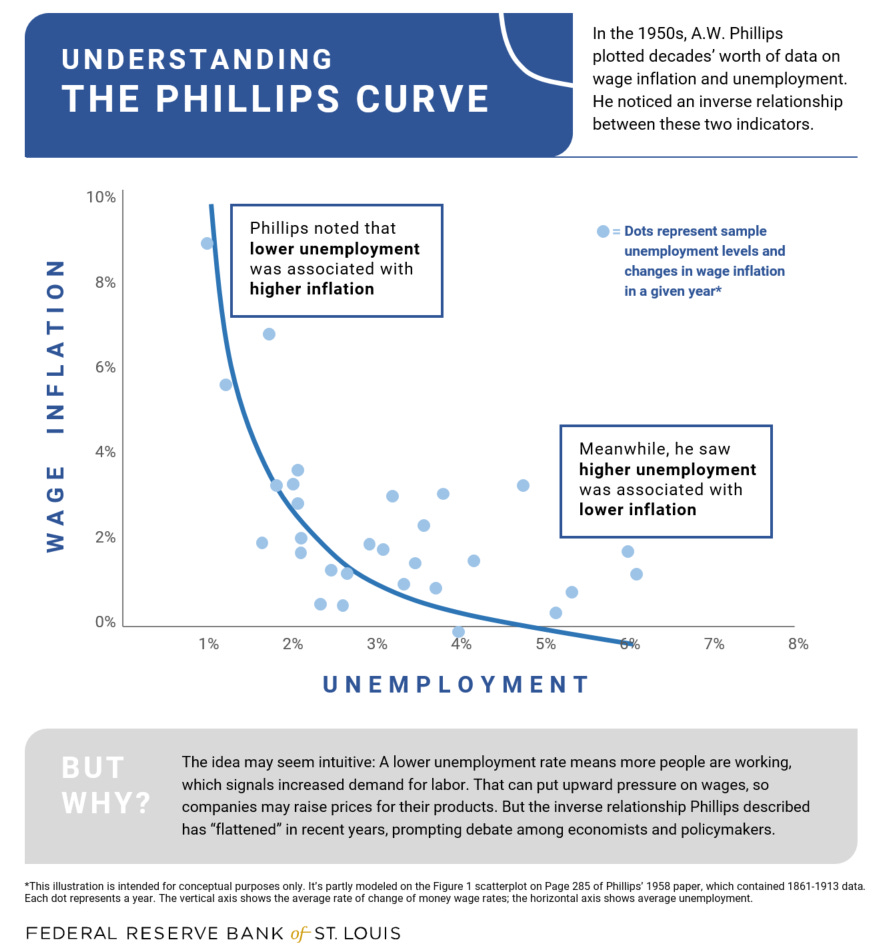
Robert Lucas, an economist who would later win his own Nobel Prize, famously critiqued that economic models of the time treated relationships between economic variables as fixed rules, only because past information said so. But people aren’t particles. When the government changes its policies, people change their behaviour in response, and a relationship that held true earlier could fully fall apart.
Another such relationship was that if your income goes up by ₹100, you’ll spend some predictable, large fraction of it (like ₹80) and save the rest. This “consumption function“ was the engine of the policy toolkit of the time. If the government wanted to stimulate the economy, it could put money in people’s hands (like a stimulus or a tax cut), and they would spend a predictable share of it, creating a multiplier effect that rippled through the economy.
But there’s just one hitch with this tale. What if households aren’t just people relying on historical data, but also forward-looking?
Suppose you find out today that you’re getting a big raise in April 2027. If you can borrow against that future income, you start spending more now without waiting for the future paycheck. When you stretch it over a longer horizon, you come to the idea that people spend not on the basis of what they earn today, but what they expect to earn over their whole lifetime. You’d also make such a prediction based on what you earned in the past.
Now, if true, it would mean that the old idea of giving people money today and they’ll spend a predictable chunk of it didn’t stand up to scrutiny, even if it sounded legitimate in theory. If, say, a government cuts interest rates, the spending boost would get spread out over a lifetime of spending, rather than being immediate.
That’s where Robert Hall enters the story.
In a landmark 1978 paper, Hall said that if consumers are rational and forward-looking, and can borrow and save freely, what they spend today contains all the information you need about what their future consumption looks like. Past information about their paychecks is not necessary, and if there’s a difference between tomorrow and today’s consumption, it would only be because of an unforeseen event.
Hall and his colleague Fredric Mishkin tested this theory on actual household data in 1982, they found that it described about 80% of households well. The remaining 20%, which were predominantly lower-income families without access to savings or credit, spent what they got, when they got it. The old model wasn’t entirely wrong, but Hall and Mishkin’s results seemed to have severely undermined it.
Eventually, there were critiques of these results, and we’ll come to that. But in the short run, Hall’s 1978 result gave macroeconomics what it desperately needed after the stagflation crisis. Hall had many contributions to economics, but this was the most influential one.
The question that arises now is, keeping Hall’s hypothesis in mind, how should a central bank navigate rate hikes or cuts, or how should a government decide when to announce a tax cut or raise to influence household expenditure?
A couple of decades later, Hall’s co-winner, Michael Woodford — who actually never wrote a paper with Hall — would provide a model for that.
The operating system for central banks
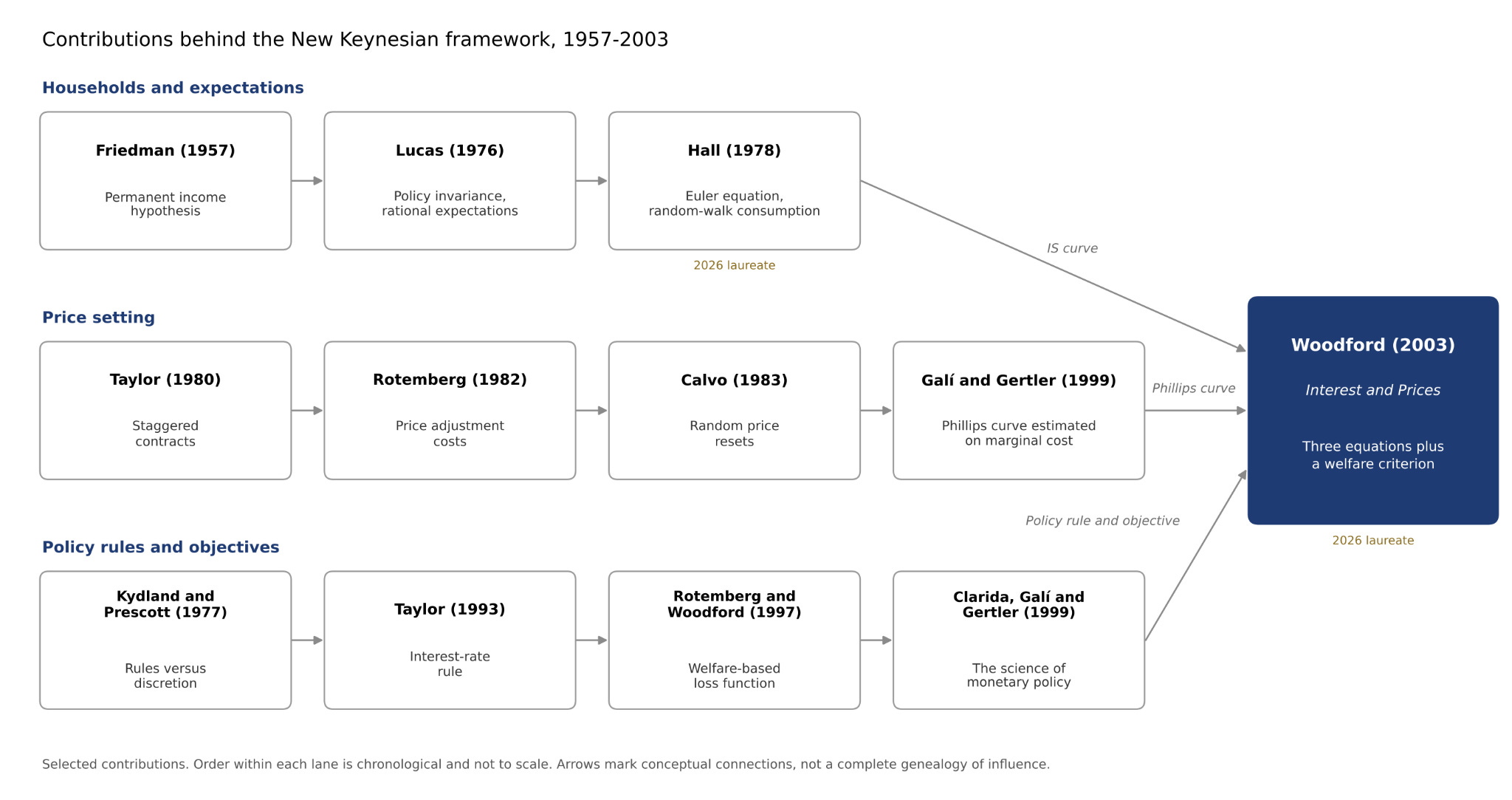
In 2003, Michael Woodford published a book called Interest and Prices. It revived an old economic idea which said that there exists a “natural rate of interest“ (r*) at which the economy is neither overheating nor cooling down. If the central bank can find this rate and park its policy rate there, prices stay stable, and the economy hums along.

What Woodford built was a three-part model that gave central banks a complete operating manual.
The first part was Hall’s 1978 contribution. Woodford turned Hall’s spending rule into the demand side of his model: after all, changes in the interest rate affect consumption significantly. When the central bank raises interest rates above r*, households save more and spend less, cooling the economy. When it cuts rates below r*, spending heats up.
The second part connected this to the supply side. In a perfectly flexible economy, interest rate changes would just move prices around without affecting jobs or output. But in the real world, prices are “sticky“. A restaurant, for instance, doesn’t reprice its menu every time input costs change. This stickiness means that when the central bank changes interest rates, it changes real spending and real production in the short run, not just inflation. Woodford formalised this rigorously.
The third part was the policy rule itself. Woodford showed that a central bank doesn’t need to control the physical supply of currency to control inflation. It just needs to follow a simple rule: when inflation rises, raise interest rates by more than inflation rises. It incentivises people to save rather than spend, cooling inflation.
Put together, these three components gave central banks a unified framework for deciding what interest rate to set and why it should work. But how do you communicate all of this effectively to households?
That’s where Woodford’s forward guidance comes in.
If people are truly forward-looking, as Hall’s theory assumes, then what the central bank says it will do in the future should be almost (if not equally) as powerful as what it actually does today. A credible promise to keep rates low for the next two years should stimulate spending right now, because households and businesses will make decisions today based on where they expect rates to be tomorrow.
This idea became central bank orthodoxy, especially after the 2008 crisis when interest rates hit zero. Promising to keep rates at zero for an extended period became one of the primary tools through which central banks like the Fed tried to stimulate the economy. It was Woodford’s theory, turned into policy, deployed at a global scale.
However, Woodford’s framework fell extremely short of predicting the devastating 2008 crisis, and not because of any accidental error, either.
The fallibility of rational expectations
The model was built in a way that made it impossible to see the crisis coming, even in principle. We’ll address three of the many criticisms of the model on those lines.
Not so creditworthy?
Start with the most basic issue. Woodford’s model has just three actors: households, firms, and a central bank. But where are commercial banks? Where are credit markets? In Woodford’s model, credit is just a transfer of existing resources from savers to borrowers.
But real-world commercial banks don’t operate like that.
Say you want a home loan of ₹50 lakh. A bank loans that out to you, but it doesn’t really depend on lending out someone else’s savings to do so. Mostly, it allows you to avail that new loan by crediting your account with deposits that didn’t exist before. No transfer of money from another account was involved.

Commercial banks can’t do so without limit; they need to meet certain statutory requirements. But they’re not merely middlemen.
This problem extends further back to Hall’s hypothesis. Remember, it started with the assumption that “consumers are rational and forward-looking, and can borrow and save freely”. But credit markets are never frictionless in the real world, and that’s not a bug either. Credit limits and collateral requirements are based on income levels. Hall and Woodford’s work is often accused of focusing less on income and wealth levels compared to abstract things like household expectations (which are derivative of income and wealth levels).
On top of this, Woodford’s model assumes what economists call “complete contingent markets“, which means every possible risk in the economy can be hedged through some financial instrument. In this world, risk is always correctly priced, which is much, much easier said than done.
Think about what all of this means. There is no way for a credit market to freeze or go bust. This means there is no mechanism in the model through which a bank can fail. There is no channel through which excessive lending can build up into a bubble that bursts. Consequently, the cascade of events that defined the 2008 crisis — too much mortgage lending, securitisation of bad debt, interconnected bank balance sheets — is all defined out of existence.
In fact, Hall’s own empirical test of his hypothesis was supposedly a bit fragile. In 1989, economists John Campbell and Greg Mankiw tested it on aggregate US data and found that the share of hand-to-mouth consumers wasn’t 20% as Hall and Mishkin had estimated, but closer to 50%. Half of all consumption in the American economy behaved as if people simply spent their current income, not future income. One reason why these results were so different was because the authors didn’t assume consumers could access credit freely.
The natural rate of interest
Secondly, there’s the natural rate of interest itself.
Claudio Borio, the head of the monetary department at the Bank for International Settlements (whose work we love quoting), has been the most prominent institutional critic of r*. In a speech on the dangers of navigating by r*, Borio said simply that the natural rate is supposed to be the central bank’s compass, but what if the compass itself is moving? What if the central bank’s own past decisions change the financial cycle, which in turn changes where the natural rate sits?
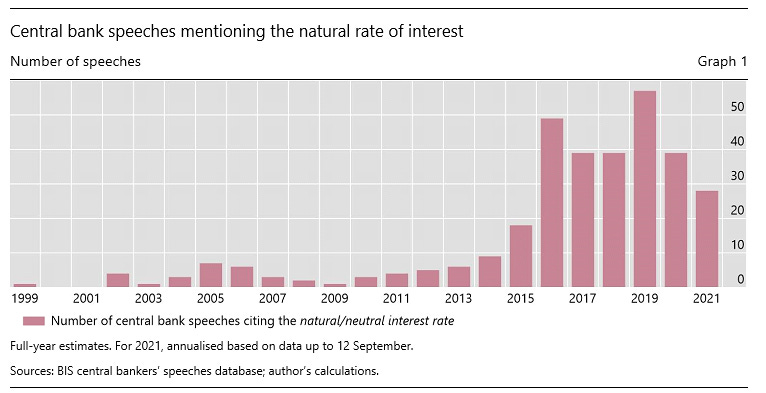
In that case, the central bank is chasing a target it is simultaneously shifting. But there is no neutral benchmark independent of what you’ve already done. It’s partly why no one can agree on the actual value of r*. Some say that r* doesn’t even exist, but we’ll address that another time.
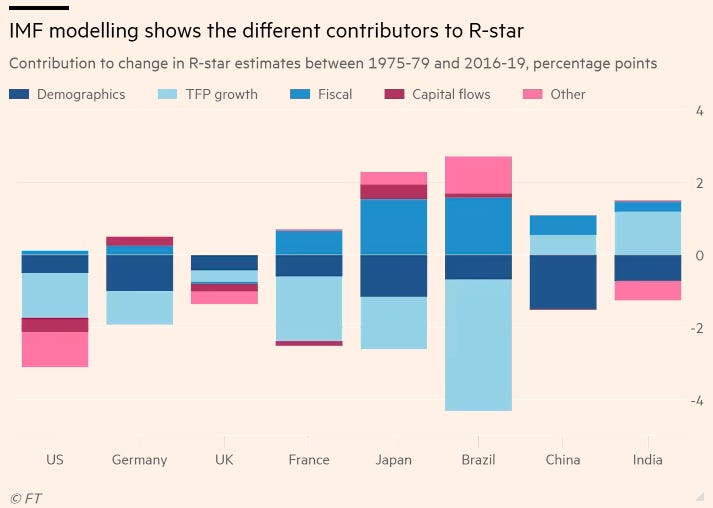
Borio also points out that the standard monetary policy framework treats inflation as the primary signal that something is wrong with the economy. But in the years before 2008, the models said everything was fine because inflation is low and stable. What the models couldn’t see was that low inflation can coexist with a massive credit bubble.
Forward guidance
Lastly, there’s forward guidance itself, Woodford’s most famous policy prescription.
There is empirical research to show that consumers are often most influenced by everyday prices of groceries and gas. They also don’t pay much attention to central bank announcements and they shouldn’t be expected to, either — Woodford himself recognized this limitation later.
Moreover, a promise made by a central bank today about interest rates 3 years from now is hard to make credible, because future central bank committees can simply change their minds when conditions shift. It was easier to maintain this line when the global economy was in a long lurch in 2008 even when rates were at zero, but not otherwise. This is why Kevin Warsh even advised that the Fed should scale back their reliance on it.
Conclusion
Hall and Woodford truly transformed how we think about how expectations shape consumption and how that flows into monetary policy. As a result, central banks are obviously measurably better at fighting inflation today than in the 1970s.
But the prize also honours a framework at a moment where monetary policy as a whole is being deemed inadequate to solve economic crises. Can you really build a reliable theory of economic stability on a model that has little room for financial instability?
The framework’s architects say yes, as long as you keep improving the model. Indeed, Woodford and Hall’s work has seen improvements that account for these situations. But these are bolt-ons, which, the critics say, is like renovating a house whose foundations are cracked.

IDBI’s long road to privatisation
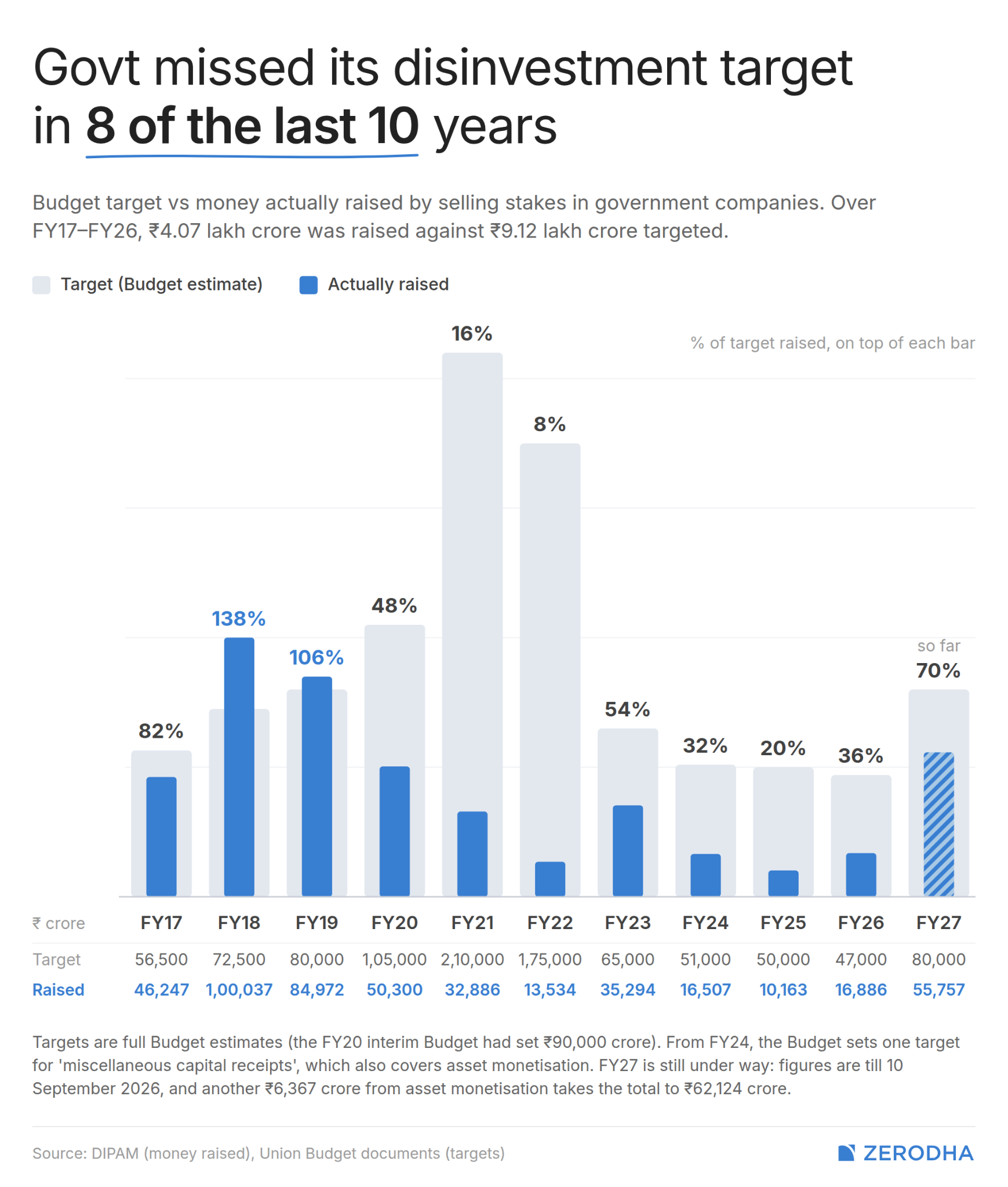
Every February, the finance minister pencils in how much the government will raise by selling stakes in state-owned companies. And almost every year, it misses. The last time the Centre beat its original target was 2018-19. This year, a single deal could finally break that streak.
On October 14, the Cabinet Committee on Economic Affairs named a subsidiary of Prem Watsa’s Fairfax Financial Holdings the “strategic buyer” for 60.72% of IDBI Bank. The price is ₹81 a share, or ~₹53,000 crore. The government sells 30.48% and LIC sells 30.24%. If it goes through, it will be the largest foreign direct investment ever made into India’s financial sector. The government’s share alone is enough to carry this year’s ₹80,000 crore disinvestment target across the line.
That “if” matters. The government has accepted Fairfax’s offer, but that doesn’t mean Fairfax owns IDBI. By Fairfax’s own admission, no binding agreement has been signed yet. And as we’ll see, the Reserve Bank of India still has a lot to say.
From factory financier to fixer-upper
IDBI wasn’t born a bank. It started life in 1964 as the Industrial Development Bank of India. It was a development finance institution, or DFI, much like ICICI. It was a long-term lender built to fund the factories and power plants of a young economy. It began as an RBI subsidiary and passed to the government in 1976. Once liberalisation dried up the cheap funding DFIs relied on, Parliament repealed the IDBI Act, and in 2004 IDBI became a commercial bank under the Companies Act.
Through all of this, the government remained IDBI’s promoter and majority owner. Its stake only grew over time as it kept pumping in capital, reaching around 80%.
Then came the bad loans. In 2015, RBI’s asset quality review forced banks to stop hiding stressed loans, and IDBI’s turned out to be among the worst. In 2017 it became the first bank put under RBI’s Prompt Corrective Action framework, effectively a regulatory ICU that restricts lending until the bank recovers. By around 2018, nearly a third of its loans had gone bad.
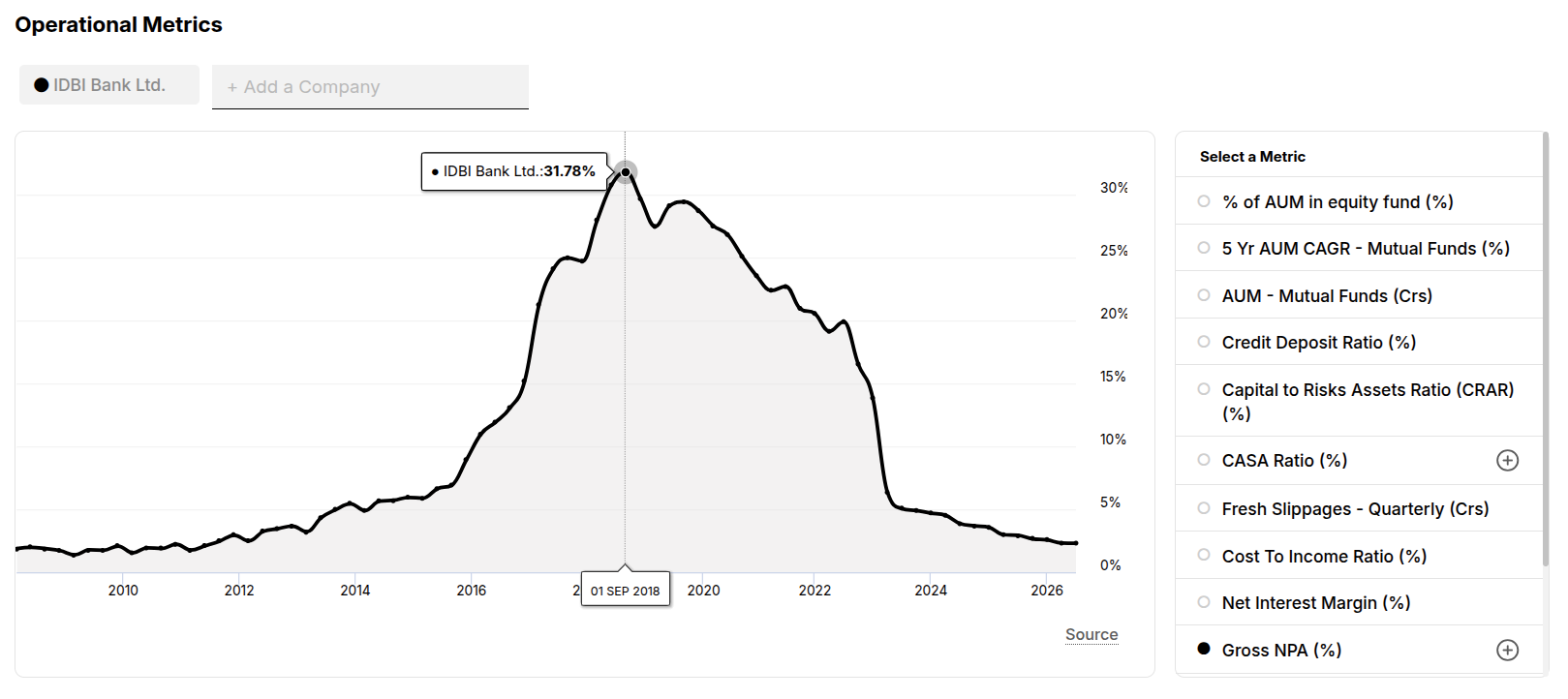
The government leaned on LIC, which paid ₹21,624 crore for a 51% stake in January 2019. Because LIC isn’t technically the government, RBI then reclassified IDBI as a private-sector bank. That quirk becomes very important later. More capital went in, and the bank exited PCA in March 2021.
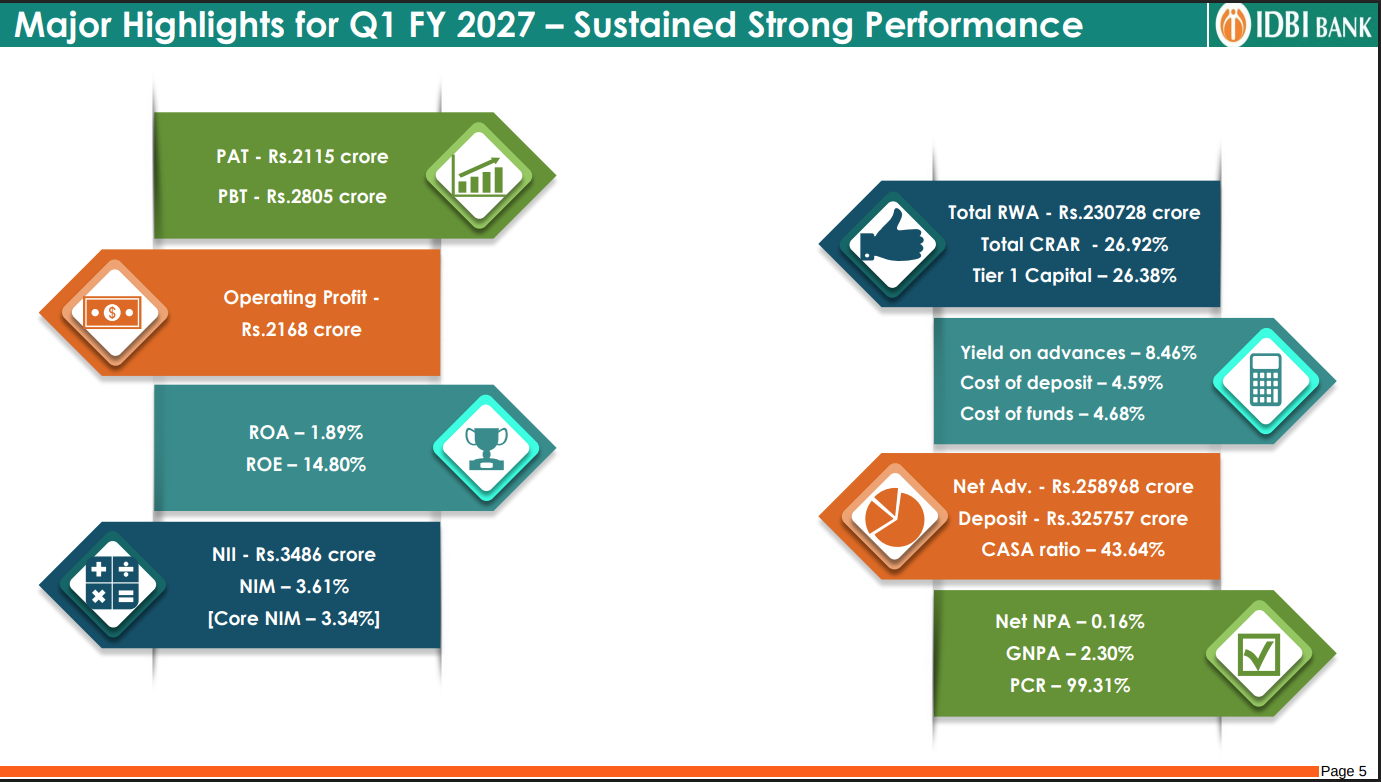
Today, it’s almost unrecognisable. In Q1 FY27, IDBI had gross NPAs of 2.30%, net NPAs of 0.16%, and loans growing 22% year-on-year.
Selling it, though, was another matter. The Cabinet approved a sale in May 2021, and bids were invited in October 2022. Kotak Mahindra Bank, Emirates NBD and Fairfax all cleared RBI’s checks and were in the line. But in the February 2026 round, Fairfax’s bid of ₹75 a share fell short of the government’s ₹94.42 reserve price, and the bids were rejected.
So the government changed how it valued IDBI. The stock is thinly traded and had swung between ₹61 and ₹118 during the valuation period, so the government stopped leaning on the market price. It set a fresh benchmark of ₹75.99 instead, an average of what comparable banks’ multiples and IDBI’s net assets implied. Bids against that number produced Fairfax’s winning ₹81. The losing bidder was Emirates NBD, which had meanwhile bought RBL Bank.
Why Prem Watsa wants it
Watsa founded Fairfax in Toronto in 1985, and has been one of India’s most persistent foreign investors ever since. In 2018, Fairfax rescued CSB Bank. It also owns 49% of insurer Go Digit and 30.2% of IIFL Capital.
IDBI is the piece that ties it all together. Fairfax plans to fold Digit and IIFL Capital into the bank. That would create a single group selling insurance, broking and wealth products through IDBI’s branches.
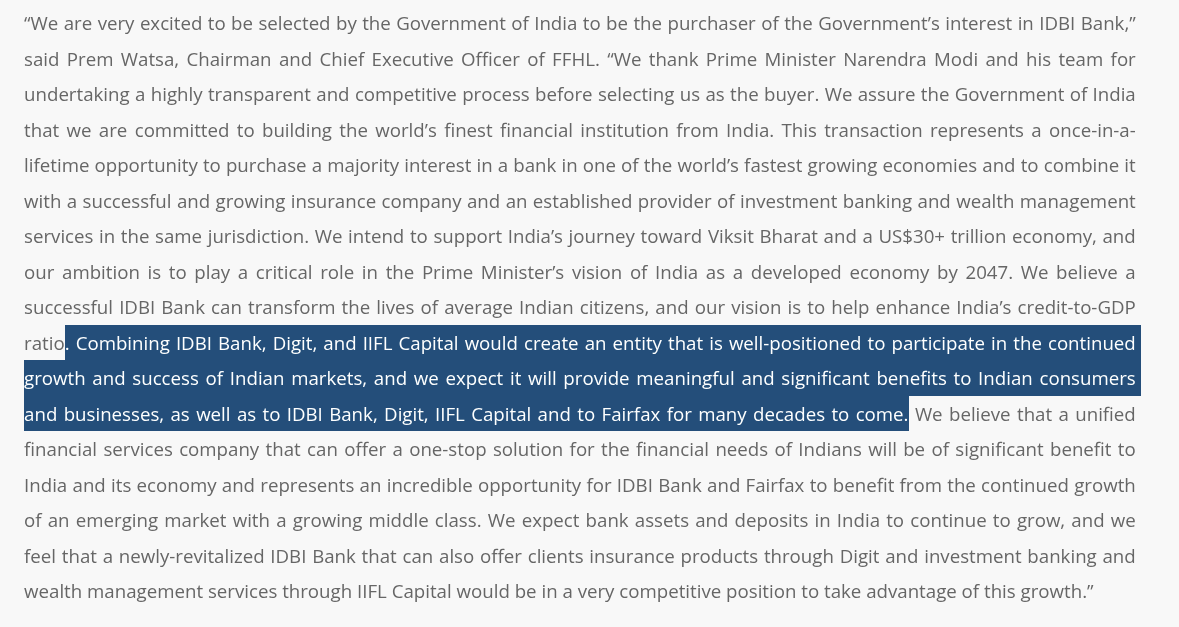
That combination, however, is a separate proposal needing its own approvals from RBI, SEBI and IRDAI. The bank purchase can go ahead without it.
Own 61%, vote 26%
This is where Indian bank regulation starts to bite.
Foreigners can own up to 74% of a private Indian bank. Because of that 2019 reclassification, IDBI counts as private, so the 74% cap applies rather than the 20% limit for public sector banks.
But the Banking Regulation Act caps any single shareholder’s voting rights at 26%, no matter how much it owns. So Fairfax gets to run the bank, but it can’t outvote everyone else. It must also lock in its stake for five years, then gradually dilute to 26% over 15 years.
Then there’s the two-banks problem. RBI doesn’t let one promoter hold large stakes in two banks, and Fairfax already owns about 40% of CSB Bank. Fairfax has offered RBI a two-year glidepath to fix this, with merging CSB into IDBI the likeliest route.
Don’t expect RBI to go easy here. Uday Kotak took the regulator to the Bombay High Court in 2018 over how fast he had to dilute his stake. He withdrew the case in 2020 after agreeing to cut his holding to 26%.
And crucially, none of this is settled yet. So far, RBI has only run its initial “fit and proper” check, and the Home Ministry has done its security clearance. That was just enough for Fairfax to be allowed to bid.
Before a single share changes hands, Fairfax must present its credentials to RBI and submit a roadmap showing how it will meet every one of these conditions: the lock-in, the dilution schedule, and the CSB fix. Minority shareholders also get their turn. Buying 60.72% triggers a SEBI open offer for another 26%, at no less than ₹81 a share.
Price, people and precedent
Fairfax is paying about 10% less than IDBI’s closing price on October 14, and the stock fell as much as 7% the next day. Depending on which book value you use, the deal values IDBI at roughly 1-1.5 times book. That puts it between state banks like PNB, which trades below book value, and private banks like ICICI, which commands about 2.5x. Whether that’s fair, the market will decide. The government’s defence is simply that ₹81 sits comfortably above its own ₹75.99 benchmark.
Critics aren’t convinced. Politicians called it a “Season End Sale”. Bank unions called for black-badge protests on October 16. Many IDBI employees joined expecting a quasi-government career, and their union has sought a parliamentary review. Officials insist employees “need not worry”. For now, Fairfax plans to keep CEO Rakesh Sharma and make N.S. Kannan chairman, subject to RBI’s approval.
Is this India’s first bank privatisation? In substance, yes. Earlier foreign takeovers, like DBS absorbing Lakshmi Vilas Bank or Fairfax’s own CSB deal, involved banks that were already private. Technically, IDBI is private too, but only on paper. It has been owned and run by the state for six decades, so it isn’t really an apples-to-apples comparison.
As for LIC, some calculations show a 7.44% annualised return on its 2019 investment. That’s less than the Nifty delivered over the same period. Then again, LIC’s money was never really about returns. It kept a bank from going under.
Many ifs, but a first
Binding agreements, RBI’s final sign-off, competition clearance, and a fix for CSB all still stand between Fairfax and IDBI. The government hopes to close by March 2027. Any of these could slip. But after a decade of trying, India has finally found someone willing to buy one of its banks.
- This edition of the newsletter was written by Manie & Kashish.
Tidbits
1. India to roll out dedicated data centre policy amid power-use concerns
India is preparing a dedicated policy for data centres as the sector’s growing electricity and water demand raises concerns over resource use and consumer power costs. The government has not yet detailed the policy’s scope or timeline.
Source: The Economic Times
2. Reliance enters ready-to-drink dairy market with ₹20 flavoured milk
Reliance Consumer Products has launched its ready-to-drink dairy brand, Joyland, starting with flavoured milk priced at ₹20 in Tamil Nadu. The rollout places Reliance in direct competition with established mass-market dairy and FMCG brands including Amul, Mother Dairy, ITC, and Cavin’s.
Source: The Economic Times
3. Centre asks states to waive stamp duty on national highway projects
The Ministry of Road Transport and Highways has requested state governments to waive stamp duties on national highway projects. The central ministry argues that varying state levies create compliance burdens, contractual ambiguity, and potential project delays.
Source: The Economic Times
4. Investors question whether China is masking US bond holdings through overseas custodians
Canada’s reported holdings of US Treasuries and federally backed mortgage securities have climbed to nearly $600 billion, prompting speculation that some of the increase may reflect Chinese assets held through Canadian custodians. Analysts say the theory could help explain why China’s official US bond holdings have fallen sharply, though there is no direct evidence linking the Canadian buildup to Beijing.
Source: Bloomberg
5. India targets meeting 90% of domestic urea demand by 2030
India aims to expand domestic urea production capacity to 43.7 million tonnes by 2030 by adding 13.7 million tonnes of new annual capacity. The expansion is projected to cover roughly 90% of the country’s estimated 48.6 million tonnes of domestic demand, significantly reducing import reliance.
Source: Livemint
Want more tidbits? Catch up on last week’s recap!

Beyond Today’s Brief
There’s always more happening at Markets by Zerodha.
The Chatter: What strategic insights are management teams at HCLTech, RBL Bank, and Zetwerk sharing? How is HCLTech offsetting AI contract deflation with advanced AI offerings, while RBL Bank deploys massive FCNR liquidity and Zetwerk prepares its ₹5,012 crore IPO?
Points & Figures: What brings Indians to court? From 6.5 lakh cheque-bounce cases in Delhi to motor vehicle accidents, excise enforcement, and conjugal rights, what does district court data reveal about the everyday legal disputes clogging India’s judicial backlog?
Aftermarket Report: How did Nifty pull back near 22,600 as a 2% overnight surge in crude oil prices weighed on market sentiment? And what do 13 straight sessions of foreign institutional selling, a sharp drop in the Put-Call Ratio to 0.91, and FMCG outperforming as the top-gaining sector signal for the broader market?
Join us on WhatsApp, where we share interesting soundbites from concalls, articles, and everything else we come across throughout the day. You’ll also get notified the moment a new video or article drops so that you can read or watch it right away.
Thank you for reading. Do share this with your friends and make them as smart as you are 😉
Thank you very much Daily Brief Team for providing this wonderful breakdown/description of the lifetime and excellent work by Woodford and Hall. 👍 Not surprised in the least as you folks would not have missed writing about it anyways 🙂