

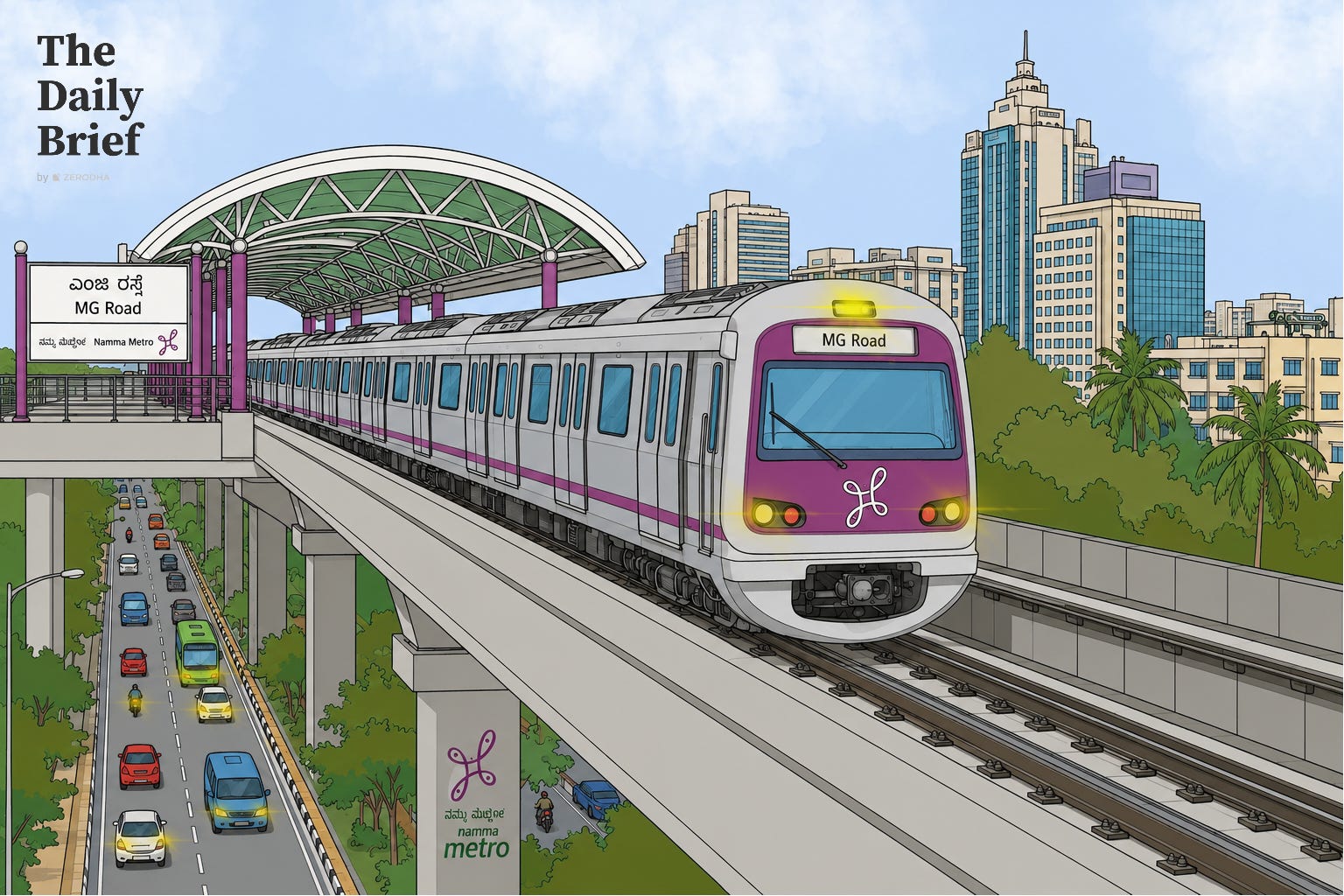
Our goal with The Daily Brief is to simplify the biggest stories in the Indian markets and help you understand what they mean. We won’t just tell you what happened; we’ll tell you why and how too. We do this show in both formats: video and audio. This piece curates the stories that we talk about.
You can listen to the podcast on Spotify, Apple Podcasts, or wherever you get your podcasts and watch the videos on YouTube. You can also watch The Daily Brief in Hindi.
We are hosting a Varsity Live ‘Ask Me Anything’ session with Nithin and Karthik, where you can ask us anything about Zerodha’s journey, trading, investor education, or where the Indian capital markets are headed.
Date: Friday, 14th August 2026 | Time: 6:00 PM – 8:00 PM
In today’s edition of The Daily Brief:
Why Bengaluru’s Metro takes forever?
Why has Phase 2 of Namma Metro dragged on nearly seven years past its 2019 deadline? A CAG audit reveals that awarding contracts before securing land, tree clearances, and utility shifts inflated land costs from ₹1,826 crore to ₹7,455 crore while costing BMRCL ₹3,464 crore in lost fare revenue. Furthermore, projected property development revenue failed to materialise because 55 hectares of assumed land were never actually acquired.
Can “Reconductoring” solve India’s grid problem?
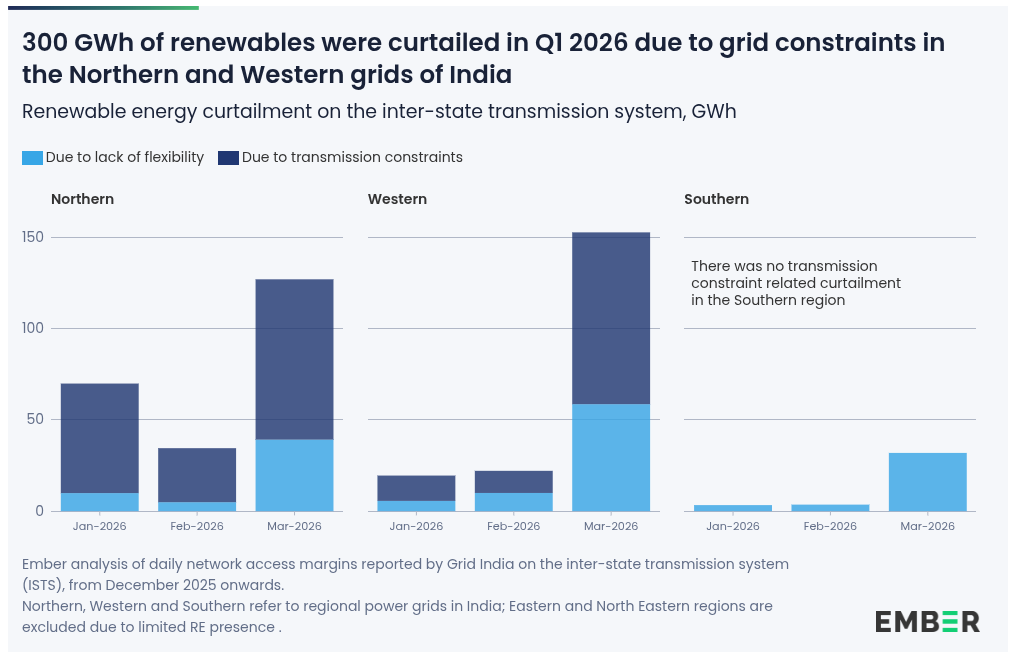
Can "reconductoring"—swapping traditional wires for carbon-fibre HTLS conductors—relieve India's power bottlenecks? Upgrading existing corridors can double capacity in 1.5 to 3 years without new land, directly tackling constraints that caused 300 GWh of renewable energy curtailment in Q1 2026. However, adoption is slowed by regulatory tariffs that offer a 15.5% return on equity for building new lines rather than optimising existing ones.
Just a quick heads-up before we dive in. The Milky Mist IPO is open now. We first covered them back in July 2025 when they filed their DRHP, and you can read our full story on Milky Mist here.
Why Bengaluru’s Metro takes forever?
Bengaluru’s Metro has been built in phases. Phase 1 is fully operational, while much of Phase 2 is also running, with a few stretches still under construction. Phase 3, meanwhile, has been approved but construction is yet to begin.
And this story comes at a time when, this weekend, on August 15, a section of Phase 2’s Pink Line is expected to open.
One of the unfinished parts of Phase 2 was connecting Gottigere in the south with Nagawara in the north. Its project report was submitted in 2011. But tree clearances were sought only in 2017, utility-shifting payments came in 2018, and underground tenders were called in 2019.
And amid all these delays, one problem was remarkably basic: Bangalore Metro Rail Corporation Limited (BMRCL) did not have the land ready for the tunnel-boring machine because the required clearances had not come through.
That meant the contractor could not build the tunnel the way it had originally planned. BMRCL had to change the tunnelling sequence and create temporary shafts and piling works to keep construction moving. Those changes cost money. The contractor was eventually paid an additional ₹33.56 crore for the delays and extra work.
And this was happening on a project that was already running far behind schedule. Phase 2 was originally supposed to be completed by December 2019. Nearly seven years later, parts of it are still under construction.
This is just one corridor on one line. But a 185-page CAG performance audit released earlier this year, covering Phases 1 and 2 of the Bengaluru Metro, finds the same pattern across the project. Phase 1 was completed about five years late; its cost moved from the approved ₹8,158 crore to ₹14,133 crore.
The interesting question isn’t why unexpected things went wrong underground. It is why so many expected things — land, trees, utilities, drawings — were still unresolved when construction began.
What does it take to be ready for a metro construction?
There are different things hiding inside the phrase “the Metro is late.”
Some delays are simply hard to avoid. BMRCL says tunnelling through hard rock cost Phase 1 about 30 months. A tunnel-boring machine broke down, adding another seven months. Courts intervened too. You can plan carefully and still run into problems like these.
But the CAG audit points to a different kind of delay. One that starts before the contractor even gets to work.
Think about what needs to be ready before you start building a Metro. You need the land. You need the final drawings. You need water pipes, sewage lines and other utilities moved out of the way. And you need the necessary clearances. Ideally, all of these things come together before the contractor arrives with people and machines.
That didn’t always happen in Bengaluru. The audit repeatedly found that contracts were tendered and awarded while some of these basic pieces were still unresolved.
This wasn’t entirely accidental. BMRCL told the auditor that it allows land acquisition and construction to happen in parallel. And you can see why. Waiting to acquire every last piece of land before tendering the project could itself cost years, while land prices keep rising.
So instead, BMRCL starts construction and tries to get everything else ready alongside it. That’s a gamble. It works if the land, drawings and clearances arrive before the contractor needs them. In Bengaluru, they often didn’t.
The problems started even before BMRCL acquired the land. The project reports said how much land would be needed along different stretches of the route, but did not identify the actual plots or who owned them. For Phase 2, there were no fixed timelines for doing that homework either — identifying owners, preparing land plans and getting approvals — even though the Government of India had specifically said land acquisition should not delay the project.
And once construction started, these problems began crashing into each other. You couldn’t shift a water line if the land wasn’t available. You couldn’t remove a tree if the clearance hadn’t arrived. And engineers sometimes couldn’t finish the drawings because the alignment and site itself were still being worked out.
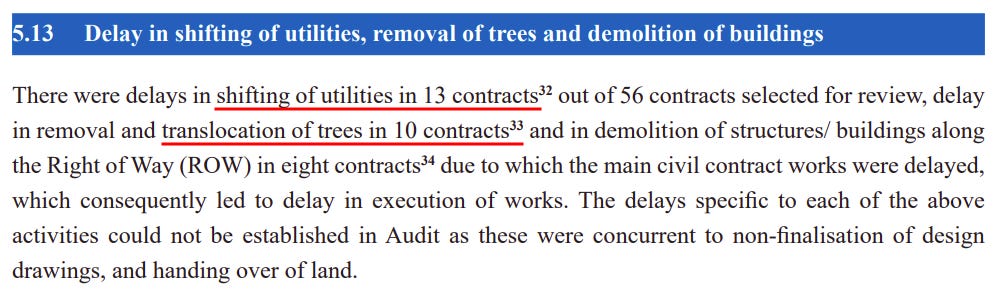
So there wasn’t one neat reason for the delays. In the contracts the CAG sampled, utility shifting held up 13 projects and tree removal delayed ten. But you can’t simply say land caused X months of delay and utilities another Y. These problems were happening at the same time and feeding into each other.
The contractor might have been ready to build, but the place where it was supposed to be built often wasn’t.
What delay does once it starts?
Delay doesn’t merely postpone an opening date. It actively makes the project more expensive through several channels at once.
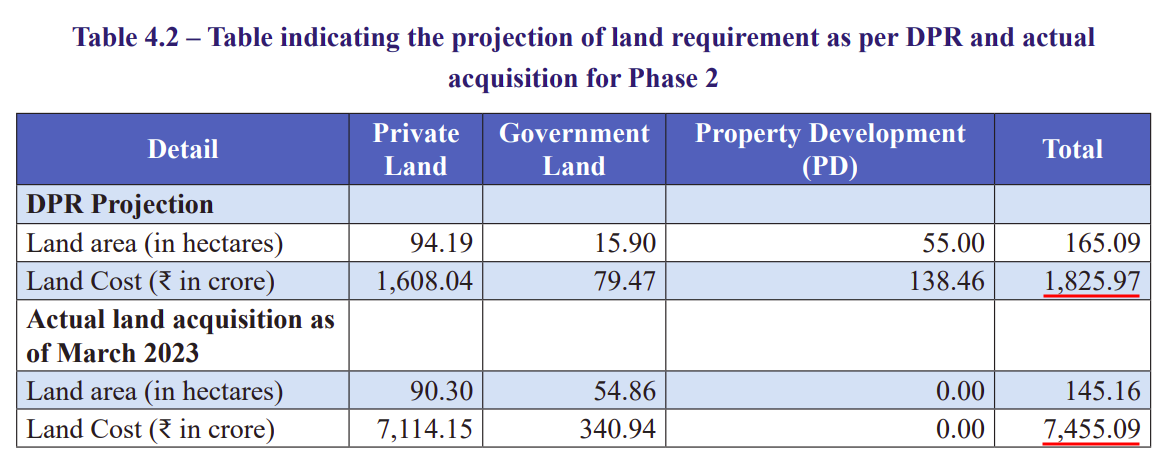
The simplest illustration is Phase 2 land. The report projected a cost of ₹1,826 crore. The Karnataka government’s update raised it to ₹2,003 crore. A revised approval in 2017 took it to ₹6,293 crore. By March 2023, the actual figure was ₹7,455 crore.
Some of this was simply the cost of waiting. Land prices in Bengaluru kept rising, and Karnataka periodically revised its official benchmark values for property. So the longer BMRCL took to acquire land, the more expensive that same land could become.
Then the rules changed too. Bengaluru’s revised master plan — essentially the city’s official map for what different areas can be used for — classified land along the Metro corridors as commercial. Commercial land is valued more highly, so compensation went up.
And a new land-acquisition law made compensation more generous. It required a 100% solatium — an additional payment made to a landowner because the government is compulsorily acquiring their property. Under the earlier rules, that was 30%.
BMRCL did not cause all of those changes. But every extra year left the project exposed to more of them. And sometimes, delay created more delay. When designs changed or a station needed more space, BMRCL had to acquire additional land, which meant starting parts of the acquisition process all over again.
Waiting also came with a direct bill. If an acquisition stretched beyond 270 days, BMRCL had to pay an additional 12% annual compensation to landowners. The CAG estimates that alone cost roughly ₹187 crore.
Once a project is badly late, the priority can slowly shift from doing things the ideal way to simply keeping construction moving. BMRCL paid about ₹144 crore in special advances to contractors who were struggling financially. It also dropped planned property development at three stations to save time, without working out how much future revenue it was giving up.
The broader problem is that delays force these kinds of trade-offs. You spend more money to keep contractors around. You drop parts of the original plan to finish faster. And decisions that would normally deserve more time and scrutiny start being made under pressure.
By then, delay is no longer just one problem with the project. It is shaping how the rest of the project gets built.
The same pattern, after the trains start running
Opening the line did not end the coordination problem. It just changed what needed coordinating. Before opening, BMRCL needed land, utilities and clearances. After opening, it needed buses to bring people to stations, safe ways to reach them and easy connections between different modes of transport.
None of this was an afterthought. The original report recognised these connections as essential, government approvals required them, and BMRCL even set up a committee for the job in 2006. Yet its agreement with Bengaluru Metropolitan Transport Corporation (BMTC) for feeder buses came only in May 2020. That’s nine years after Metro operations began. Common Metro-bus ticketing was agreed only in April 2024. As of May 2025, 40 stations still lacked four-wheeler parking.
And this matters for how many people actually use the Metro. Through March 2023, Phase 1’s highest daily ridership was about 5.89 lakh, 28% below its original projection. But the network was still fragmented then. Once more lines connected, ridership jumped: single-day ridership crossed 11 lakh after the Purple Line was fully connected in late 2023 and the Yellow Line opened in August 2025.
The financial impact of these delays was much larger. Between 2016-17 and 2022-23, BMRCL earned about ~₹1,750 crore from fares, against a projected ~₹8,700 crore.
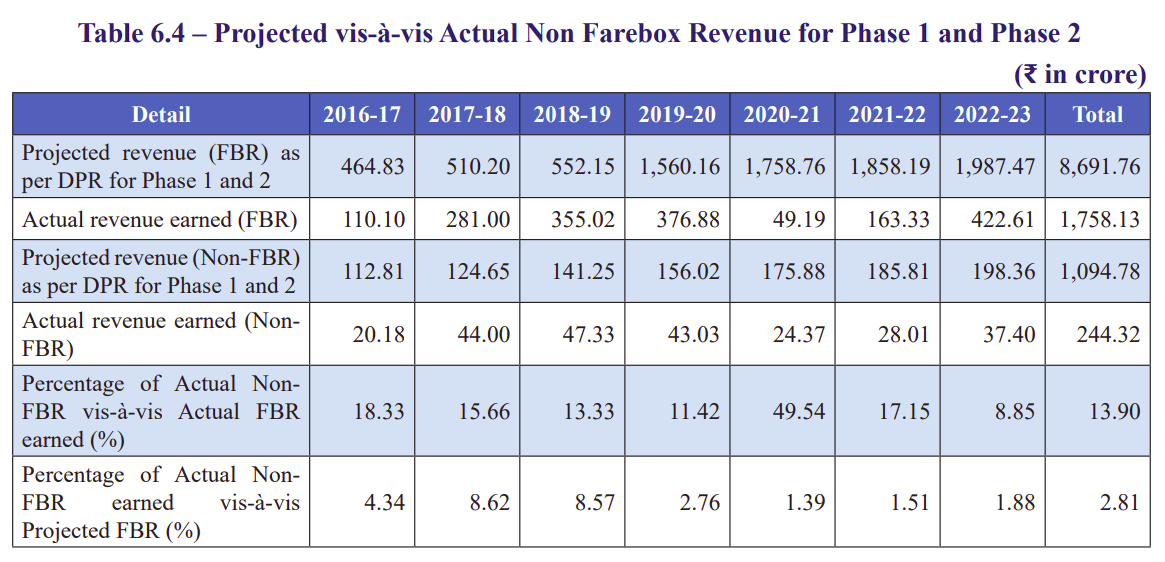
But that doesn’t mean Bengaluru simply had far fewer Metro riders than expected. A big chunk of that projected revenue was supposed to come from Phase 2 lines that hadn’t opened yet. The CAG estimates that ₹3,464 crore of expected fare revenue couldn’t materialise because sections meant to be completed by December 2019 were still unfinished. Covid hurt revenues too.
In other words, construction delays didn’t just increase the cost of building the Metro. They also delayed the revenue the new lines were supposed to earn.
There was another expensive decision on the other side. Despite ridership running below projections, BMRCL converted all Phase 1 trains from three cars to six. The CAG says this was done without analysing how crowded individual sections actually were, leading to ₹1,440 crore of avoidable capital spending and another ₹28 crore in unnecessary operating and maintenance costs.
BMRCL was also counting on another big source of money: property development. Phase 2’s projections assumed ₹21,282 crore of property income between 2016-17 and 2041-42. In fact, without this income, the financial projections for Phase 2 didn’t work.
But there was a fairly basic problem. The project report assumed BMRCL would develop an additional 55 hectares of land without identifying exactly where that land would come from. So BMRCL never acquired it. By March 2023, nearly a decade after Phase 2 was approved, there were still no concrete steps to do so.
The revenue existed in the financial projections. The land needed to earn it didn’t.
The institutional gap
The bigger problem is that the Metro was often planned in isolation. The projections assumed land would arrive, utilities would move, other transport would connect and construction would broadly follow schedule. There wasn’t much room for what happened when they didn’t.
Once delays began, those assumptions unravelled together. Costs rose, revenues got pushed out and plans had to be changed along the way.
So the huge divergence between what the Metro was projected to cost and earn, and what actually happened, is really just a symptom. The deeper problem was planning a project this interconnected as though everything around it would simply fall into place.

India’s power grid sees a high-wire balancing act
Two days ago, a headline caught our eye: “POWERGRID approves ₹857 crore transmission line reconductoring project.”

Basically, for two 400 kV lines in Tamil Nadu, the Power Grid Corporation of India (PGCIL) has approved a project to swap the old wires for newer, more powerful wires. This does not involve the installation of new towers. It’s just new wires on already-existing ones.
While we don’t normally come across the word “reconductoring” in the news, we assumed this was business as usual. After all, how hard could it be?

But when we dug into it, we realized two things. One, the science and execution of reconductoring is pretty complex, and worth outlining. But secondly, that isn’t the biggest hindrance on why it’s surprisingly a very recent phenomenon not just in India, but elsewhere in the world.
Understanding India’s grid has long been a fascination for the Markets team. It’s well-known that the biggest bottleneck for India’s renewables ambitions today is transmission rather than generation. It’s why reconductoring captured our fascination.
Hot and cold
Reconductoring sounds simple enough, but the science and logic behind it is anything but.
See, the standard conductor strung across India’s high-voltage towers is called ACSR, meaning Aluminium-Conductor-Steel-Reinforced. Here, aluminium wires are wrapped concentrically around a steel core. The aluminium does the electrical work because it conducts electricity at an economically-viable scale better than most other materials. The steel core helps hold the wire up, keeping it taut across spans that can stretch hundreds of metres between towers.
Now, when a current passes through a wire, some of it naturally goes to waste as heat. That’s normal. But heat, in turn, expands aluminium quickly. That lengthens the wire, and a longer wire between two fixed towers means only one thing: it sags. If the wire droops too close to the ground or to nearby trees, it can cause short-circuits, or worse yet, spark wildfires. In India, sagging power lines have caused fires on farms and electrocutions of animals in forests.
Steel, to its credit, doesn’t expand as much under heat. That’s partly why it functions as the core, providing support against sagging. But steel also has lower electrical conductivity than aluminium, which means some current leaks through the core and gets wasted as heat anyway.
The traditional ACSR design has another limitation: its aluminium wires are round. When you pack circular wires concentrically around a core, you inevitably get tiny air gaps between them. Air doesn’t conduct electricity. Those gaps are dead space that could have been carrying current.
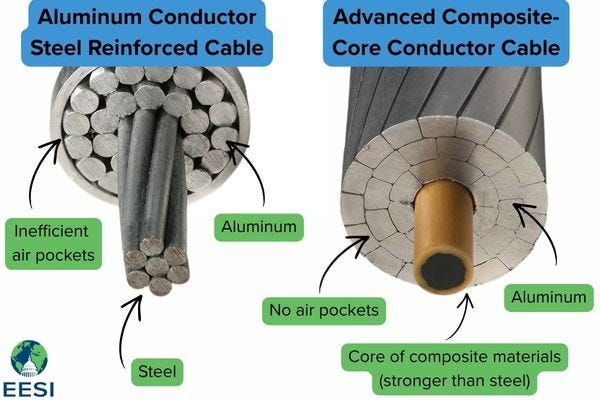
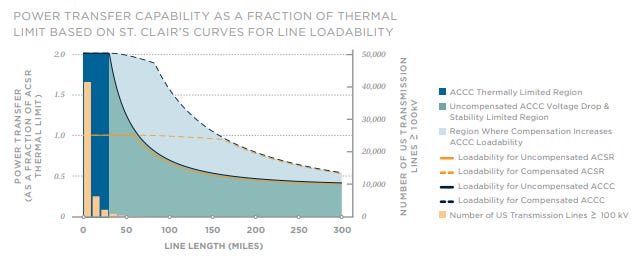
To prevent dangerous levels of sag, utilities often cap how much current can flow through the wire. A line that could, theoretically, carry far more power is deliberately throttled to stay within safe thermal limits. Across India’s all-encompassing grid, a meaningful chunk of capacity is simply left on the table.
No sag, no lag
This is where High-Temperature Low-Sag (HTLS) conductors enter the picture. They handle much higher temperatures without the sag problem that cripples traditional lines.
The accompanying changes to the wire structure are also significant.
First, the steel core is replaced with a carbon fibre composite. Carbon fibre is both lighter and stronger than steel (with roughly twice the tensile strength). Crucially, it barely expands when it heats up. Where a steel-cored wire might sag dangerously at 100°C, a carbon-fibre-cored wire stays remarkably stable even at 200°C.
Secondly, the round aluminium wires are replaced with trapezoidal ones. This change in shape eliminates each air gap that previously existed between any two round wires, while also fitting more conductive aluminium into the same cross-section. More aluminium means better conductivity of electricity.
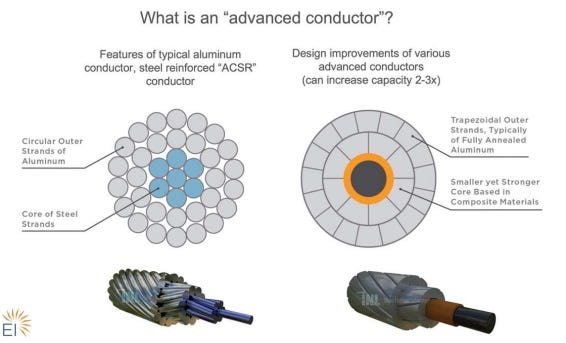
So, not only does this upgrade solve the sag issue, it is also fundamentally a better wire. An HTLS conductor can carry roughly twice the current of an ACSR conductor of the same diameter. This is extra capacity that you can gain without building new towers, which, in turn, need land and environmental clearances.
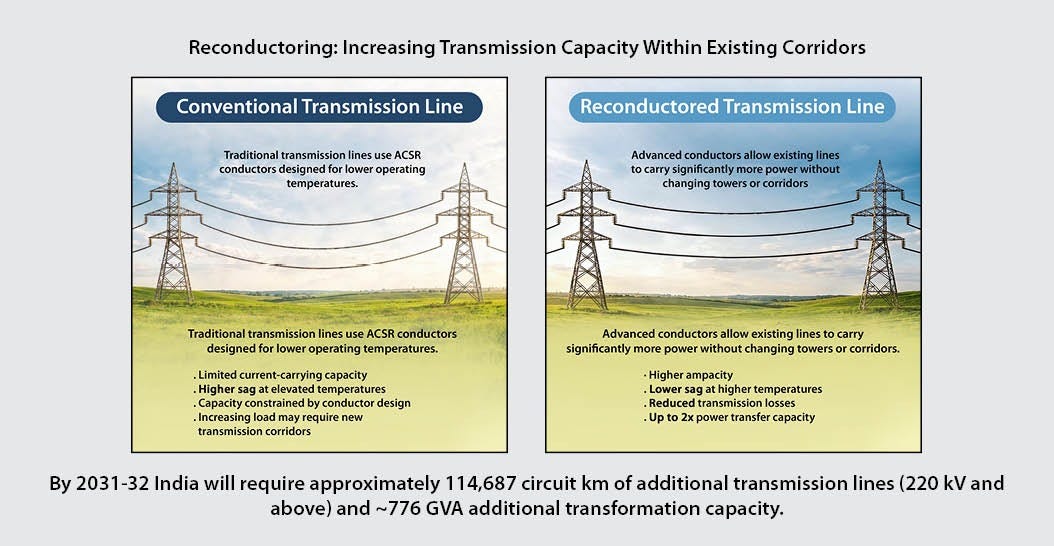
And this is reconductoring’s biggest selling point. It is the quickest fix available to relieve the grid of its stresses.
Building a new transmission line in India can take five to fifteen years once you factor in planning, land acquisition, environmental approvals, and litigation. But reconductoring can be done in 1.5-3 years.
Fear factor
However, while far quicker relatively, reconductoring isn’t particularly easy in absolute terms.
Before a single wire is touched, engineers run detailed system modelling to ensure the upgraded line won’t destabilise the broader grid. After all, a transmission network is hardly just the wires. If you suddenly double the capacity of one corridor, the substations at each end, the circuit breakers, the protection relays, and the transformers all need to handle the increased power flow.
The existing towers need structural checks, too. Carbon fibre-cored wires are lighter than steel-cored ones, which helps, but the forces during installation and high-wind conditions still need to be within tolerance.
But, as with everything else, the actual field execution is the hardest. In fact, it is, quite literally, a high-wire balancing act.
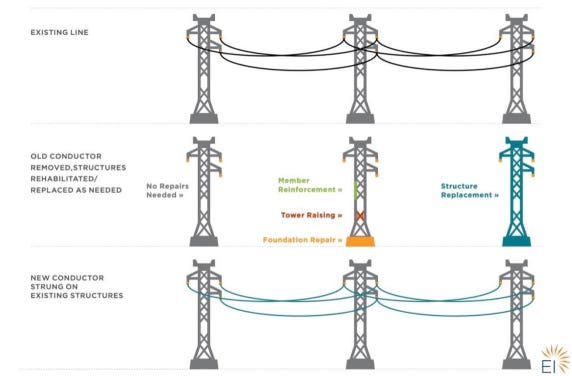
Ideally, you’d de-energise the line, pull the old wire off, string the new one on, and re-energise. But the lines most urgently in need of reconductoring are usually the ones that are most heavily loaded, carrying power from renewable-rich regions to demand centres. Those are precisely the ones you can’t easily take offline. Shutting one down means diverting its load to parallel lines, and if those parallel lines are already running near capacity, the diversion itself risks an overload.
In congested corridors where cutting power is economically unviable (like an industrial corridor where many factories run 24x7), utilities turn to live-line reconductoring, where a crew replaces the wires while the line is still energised. In fact, this is exactly the problem Sterlite Power once faced while trying to upgrade a line that went to Bengaluru’s Electronic City, where, of course, hundreds of IT firms operate. It was unviable to shut power to them for a whole day.
To insulate themselves from shocks, Sterlite’s crews used insulated “hot sticks“, which are long fiberglass rods. In extreme cases, linemen work directly on fully charged wires using the “barehand method“, where they are brought to the same electrical potential as the line itself. One could use robotic arms or aerial platforms to do this, but those are difficult to place in an incredibly congested area. It is dangerous, highly specialised work. Not every crew is certified to do it.
It also goes without saying that the longer the wire, the more time and money spent on a reconductoring project.
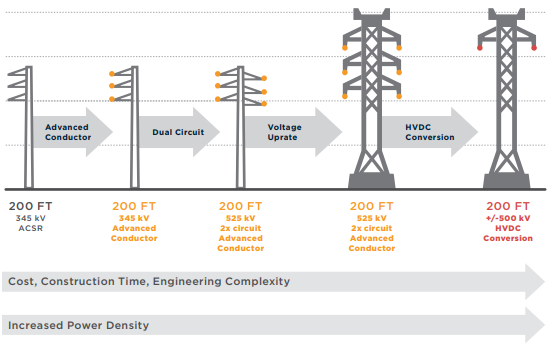
Carrots and sticks
Execution of a reconductoring project is indeed tough, but not impossible. Which is why it begs the question: why haven’t we undertaken more of this simple fix yet?
Part of the reason is because the technology is genuinely new. Carbon fibre composite cores for transmission conductors have only been commercially available recently. The first large-scale deployments happened in the United States and Europe, and India’s experience has been building gradually.
But the second reason, that has long plagued India’s grid, is far more impactful — that our transmission regulation has always incentivised building new infrastructure, not optimising what already exists.
See, the Indian government sets electricity tariffs in a way that state-owned utilities recover all costs, plus earn a fixed 15.5% rate of return on their assets. So, the more capex utilities incur, the larger the equity base, and therefore, the larger the profits. They will always be incentivized to build new lines without corresponding motivation to improve upon what already exists.
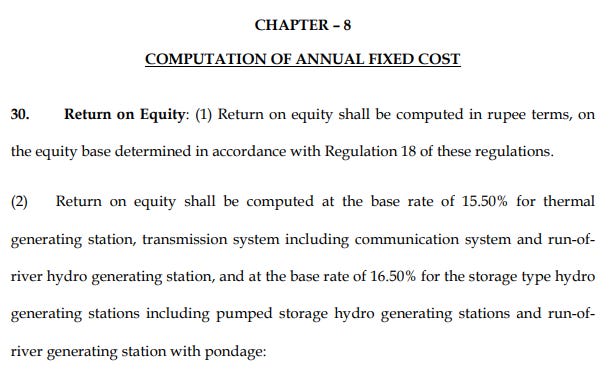
This may have made sense for a country starting to build a national grid, since then, the priority would have been rapid capacity addition. That mission succeeded spectacularly for India: PGCIL today operates over 186,000 circuit-kilometres of transmission lines across 291 substations.
But a comprehensive CAG audit covering 2012–2017 revealed how this mindset had spilled over into an uncontrollable excess. It found that PGCIL had consistently ignored recommendations from multiple technical committees to reconductor critical congested lines. The utility didn’t even have a mechanism to track how heavily its existing assets were being used. About 60% of surveyed transmission assets were utilised at less than 40% of their capacity.
In fact, this issue of prices being biased towards capex is also common to the US and European countries. Cost-plus pricing in itself is not a problem — many countries follow it. But their workaround for this is pricing based on a balance of total expenditures that’s not weighted too heavily on capex.
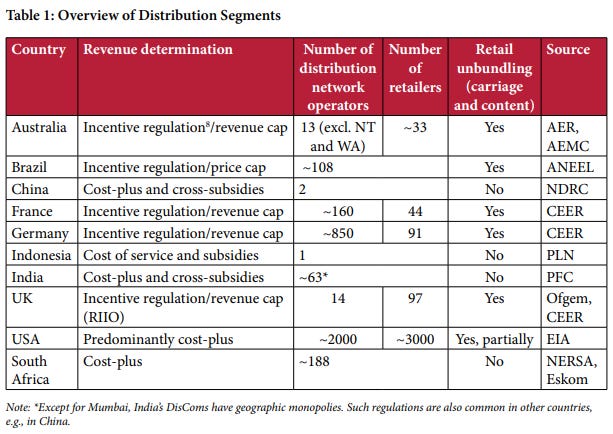
What has also helped is the introduction of competition in certain segments of power pricing. But, as we shall see now, reconductoring in India runs into a battle there as well.
New person, same old mistakes?
That being said, India has been cognizant of the need for reconductoring. That’s why, in June 2023, the Central Electricity Authority (CEA) released a draft discussion paper formally proposing a national reconductoring programme for inter-state transmission lines.
The paper laid out the technical case and the operational considerations. But where it ran into the problem one that we just discussed: how should you price reconductoring projects?
The CEA’s position was straightforward. A reconductoring project was a technical upgrade. As per Indian law, technical upgrades are exempt from the competitive bidding requirement that, today, normally applies to new grid projects. Therefore, reconductoring should be carried out by the existing line owner (typically PGCIL) under the same regulated tariff mechanism (RTM) route.
The CEA’s paper also highlighted what they believed was some real-world evidence of why competitive bidding and reconductoring don’t mix well.
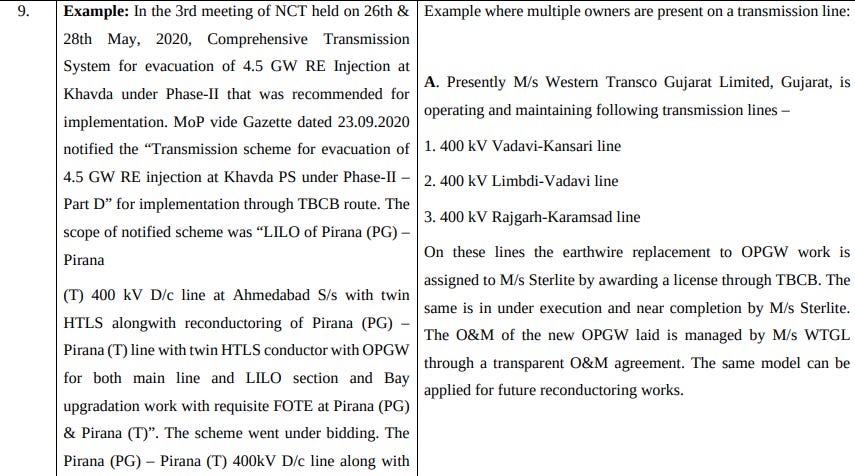
In 2020, the Ministry of Power put a reconductoring scheme on a line in Pirana, Gujarat, up for competitive bidding. This was needed to evacuate 4.5 GW of renewable energy from the Khavda solar park. The existing line owner, Torrent Power Grid, objected. If a different company won the bid, Torrent would own the towers while the new entrant owned the wires, creating an operational nightmare of split accountability.
This project hit a deadlock. Eventually, the government pulled it from the competitive pipeline and allocated it directly to Torrent under RTM.
However, industry associations see it differently, for the reasons we described above.
The Association of Power Producers (APP) argued that India’s existing transmission network was largely built under RTM, where PGCIL got monopolistic power to execute projects. Allowing the same utility to now take on big reconductoring projects without competition, they said, would lack transparency and directly pass inflated costs onto electricity consumers.
The APP also pushed back on the dual-ownership problem, pointing to existing cases where joint ownership was already working. On Western Transco Gujarat Limited’s lines, for instance, a maintenance project (which wasn’t reconductoring) had been awarded to Sterlite Power via competitive bidding, and the two entities worked under a transparent contract without issue. The APP argued that any operational ambiguity could be resolved through better contract drafting, not by avoiding competition altogether.
Conclusion
The debate remains unresolved officially, but India’s reconductoring pipeline, while growing, remains biased towards RTM pricing. The stakes of getting this regulatory framework right only get higher, especially in a country where we were forced to curtail 300 GWh of clean energy in Q1 2026 alone due to transmission constraints.
The choice in the pricing model is one that has plagued India’s power sector for quite a while, and reconductoring is only one aspect of the debate. But reconductoring is also unique because it’s a quick fix for our grid like no other. What remains to be seen is whether we can sort out the right incentive structure to enable it at scale.
Tidbits:
1. Govt Collects approx₹45,300 Crore From Disinvestment
The government surpassed its revised target by raising approx ₹45,300 crore from public sector disinvestment and asset monetisation in FY26. For the current fiscal year (FY27), it has already realized over ₹59,000 crore against an ₹80,000 crore goal.
Source: Business Standard
2. MMDR Bill to Improve Mine Economics and Cut Risks
The proposed MMDR Amendment Bill is expected to significantly reduce legacy mineral levy risks for mining companies like NMDC. The regulatory changes aim to improve overall mine economics and encourage further investments in the sector.
Source: Business Standard
3. Manappuram Finance Transitions to Professional Leadership
Following a strategic investment by Bain Capital, gold loan company Manappuram Finance is ending its family-run era by appointing a professional CEO. Founder VP Nandakumar will transition to the role of Non-Executive Chairman.
Source: The Economic Times
4. PNB to Launch Wealth Management Product by December
Punjab National Bank plans to roll out a dedicated wealth management product by the end of this year to diversify its revenue streams. The strategic move is aimed at significantly boosting the public sector lender’s non-interest income.
Source: The Hindu BusinessLine
5. New FEMA Rules Impact Foreign Investments in AIFs
Upcoming changes to the Foreign Exchange Management Act (FEMA) are creating regulatory uncertainty for Alternative Investment Funds (AIFs) and their foreign backers. The new rules could tighten compliance and alter how overseas capital is deployed in Indian funds.
Source: The Economic Times
6. India Targets 10-Fold Jump in Clean Fuel Output
India aims to increase its domestic production of clean fuels tenfold over the next five to ten years to heavily curb its reliance on energy imports. The massive scale-up is part of the nation’s broader strategy to enhance energy security and accelerate its green transition.
Source: The Economic Times
- This edition of the newsletter was written by Pranav & Manie.
Beyond Today’s Brief
The Chatter: How is Bosch expanding margins while balancing combustion tech with EV joint ventures? What is driving Amara Raja’s ₹1,700 crore push into new energy? And can Zydus, Manappuram, and EPACK Durable sustain growth through market outperformance and product diversification?
Listen to Turbulence: If you’re interested in global geoeconomics, disruption, and the forces reshaping the world economy, check out Turbulence — a podcast series from Takshashila, in collaboration with Zerodha, featuring conversations with some fantastic guests.
Available on Spotify, YouTube, and Apple Podcasts
Watch Tharun on YouTube: If you’re interested in what’s actually happening with AI and how you can use it to make better money decisions, check out Tharun’s new YouTube channel.
Join us on WhatsApp, where we share interesting soundbites from concalls, articles, and everything else we come across throughout the day. You’ll also get notified the moment a new video or article drops so that you can read or watch it right away.
Thank you for reading. Do share this with your friends and make them as smart as you are 😉
Very interesting article on “Reconductoring”. Enjoyed reading it. 👍
Goddamm, ill open this article when ever I see a delayed metro project 😂🤣