

Hi folks, welcome to another episode of Who Said What? I’m your host, Krishna. For those of you who are new here, let me quickly set the context for what this show is about.
The idea is that we will pick the most interesting and juiciest comments from business leaders, fund managers, and the like, and contextualize things around them. Now, some of these names might not be familiar, but trust me, they’re influential people, and what they say matters a lot because of their experience and background.
So I’ll make sure to bring a mix—some names you’ll know, some you’ll discover—and hopefully, it’ll give you a wide and useful perspective.
For all the sources mentioned in this video, don’t forget to check out our newsletter; the link is in the description.
With that out of the way, let me get started.
Will India get a self-driving car?
A bunch of things happened at the AI Impact Summit last week—the memes, the drama, and the billion-dollar commitments. But one comment from Sundar Pichai stuck with me. Here’s what he said:
“Taking my parents for a fully autonomous car ride in San Francisco. Seeing a Waymo ride through my 83-year-old dad’s eyes, I saw the progress in a whole new light. Of course, he said he’d be more impressed if it worked on India’s busy roads. Still working on that one day.”
It was said lightly, but this comment is actually very interesting…at least to me.
When most people hear “self-driving car,” they picture a car that can drive itself anywhere—any road, any city, any country. That version of the technology doesn’t exist yet. What actually exists today is considerably more specific. A self-driving car can only operate in cities where it has been extensively prepared in advance. Before one of these cars ever carries a passenger somewhere new, teams spend months mapping that city in exhaustive detail—every lane, every traffic light, every road marking. The car uses this map constantly while driving, comparing what its cameras and sensors see in real time against what it already knows should be there. If you take it somewhere that hasn’t been set up this way, it cannot operate.
The pursuit of this goes back about 20 years. In 2004, a US defense agency called DARPA offered a million-dollar prize to any team that could build a vehicle to complete a 142-mile course through a desert with no human driver. In that challenge, every vehicle had failed; the best one made it 7.32 miles.
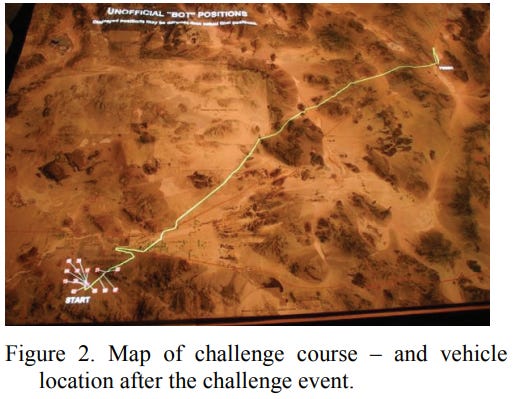
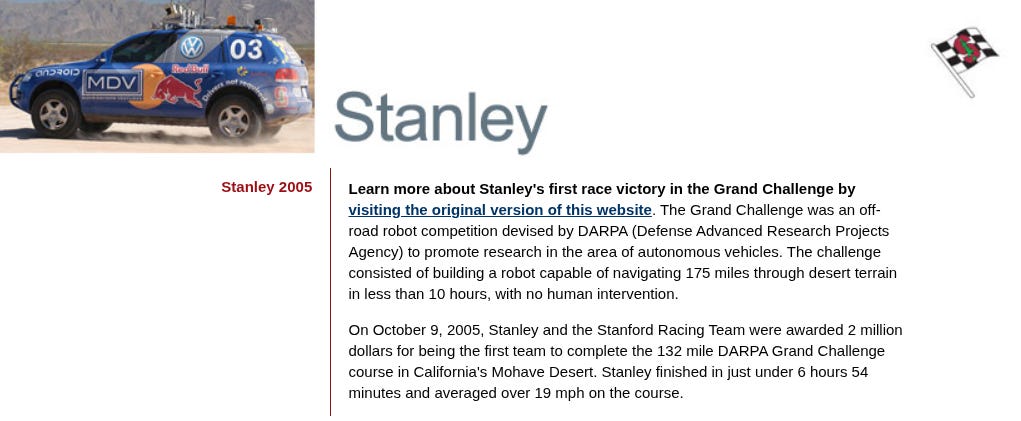
DARPA ran it again in 2005, and this time, a Stanford team’s car called Stanley completed the course.
By 2007, they raised the difficulty, asking vehicles to navigate a simulated city with traffic laws, intersections, and other moving cars. Six teams finished. Google recruited the engineers who did well and launched its self-driving car project in 2009. That project became Waymo, which spun out as a separate company in 2016 and is today the most advanced commercial robotaxi operation in the world.
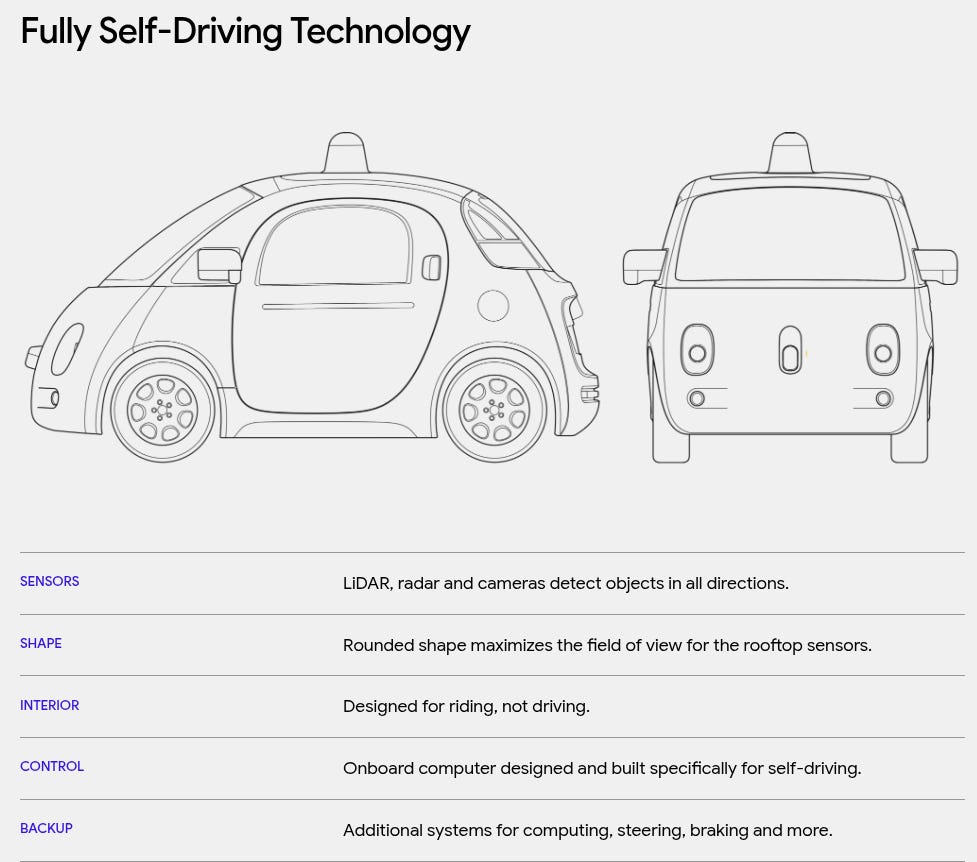
Waymo currently runs 2,500 cars across six American cities — San Francisco, Phoenix, Los Angeles, Austin, Atlanta, and Miami — completing around 450,000 rides per week. In 2025 alone, it did 15 million rides, three times its volume from the year before, and it just raised $16 billion in a new funding round. By the end of 2026, it plans to expand to 20 more cities, including London and Tokyo, its first markets outside America.
Tesla is also running a robotaxi pilot in Austin, but its cars still have human supervisors inside — it isn’t driverless in the same sense. China is the other major story, with Baidu’s Apollo Go operating across 22 cities and a company called Pony.ai claiming fully driverless commercial service across four of China’s largest cities simultaneously. The technology is real, it is scaling, and the money flowing into it is serious.
The difficult part of this story is that the gap between “working in specific cities” and “working everywhere” turns out to be enormous.
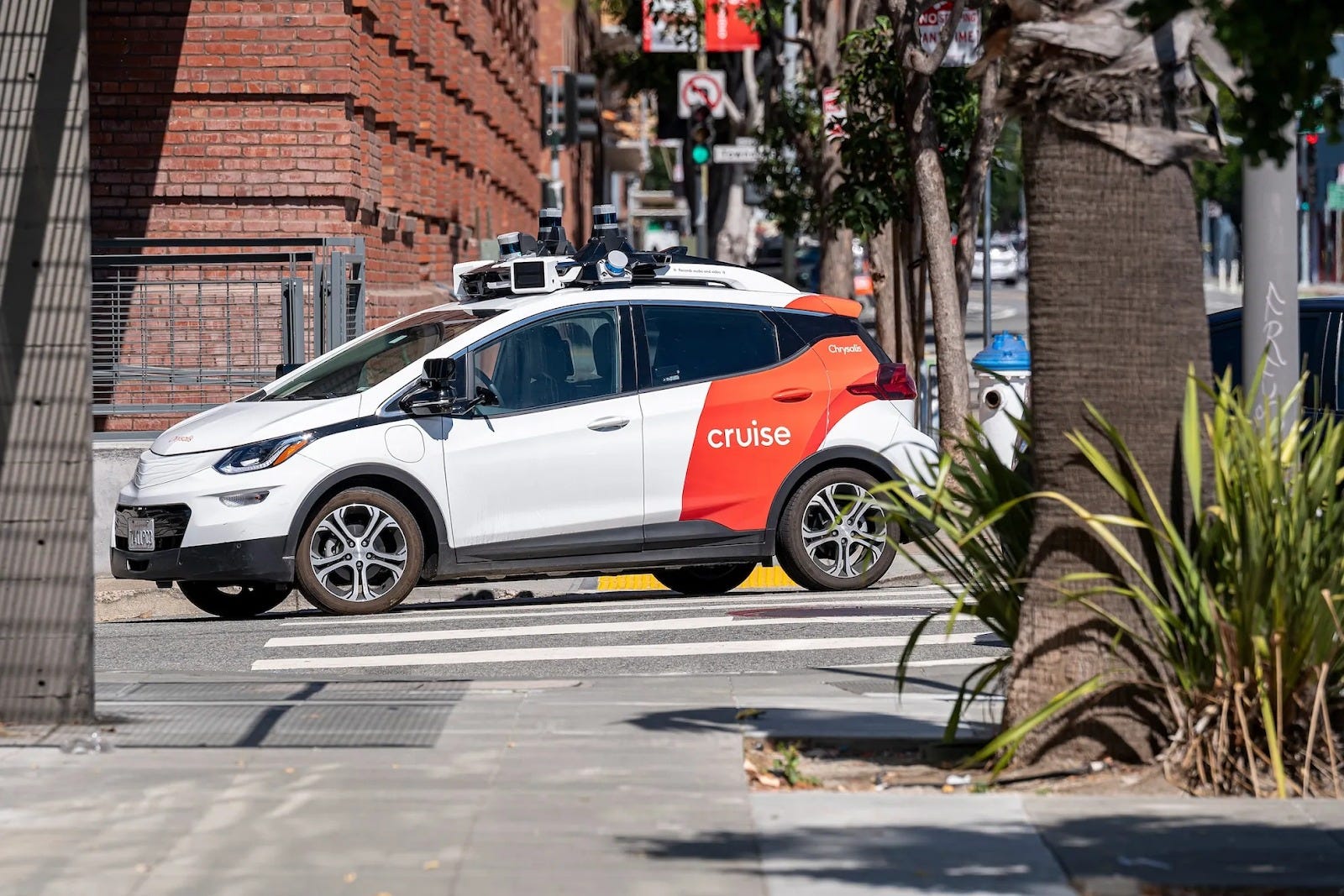
In 2023, a company called General Motors’s robo taxi division, Cruise, had a serious incident where one of its cars struck a pedestrian who had already been hit by another vehicle and then dragged her. California’s regulators suspended Cruise’s permits almost immediately, and within a year, GM had shut the entire operation down, writing off billions.
Beyond safety, there is also a straightforward political problem. For example, New York State recently dropped a plan to legalize robotaxis, not because anyone demonstrated the technology couldn’t handle New York roads, but because taxi unions and transit workers opposed it strongly enough that the government walked away before it was even tested.
Which is what makes Sundar Pichai’s comment so pointed. The autonomous vehicles operating today were built on certain assumptions about what roads look like—lane markings exist, traffic lights are in predictable positions, and vehicles generally stay in their lanes. The system handles deviations from this as exceptions, unusual events it has been trained to deal with occasionally.
Indian roads don’t work this way. Lanes are frequently nonexistent or treated as suggestions. Cars, two-wheelers, auto-rickshaws, pedestrians, and animals all share the same space without any fixed hierarchy between them. Vehicles make U-turns from the middle of traffic. And yet it all functions, because Indian drivers are doing something that cameras and sensors trained on American roads cannot yet do — they are constantly reading the intentions of everyone around them through eye contact, the direction of a front wheel, the pattern of a honk, tiny physical signals that form an informal shared language of the road. This is not a problem that better maps or more sensors can straightforwardly solve. It requires rethinking, at a fairly deep level, how the system models and interprets the world.
There’s another thing: India’s transport minister, Nitin Gadkari, has said clearly and repeatedly that he will not allow driverless cars in India because they would displace between 7 and 8 million driversThe technology arriving in India isn’t just an engineering problem — it is an economic and political one, and no improvement in software addresses that.
And that’s just the surface of it.
The story around self-driving cars goes much deeper—the economics of running a robotaxi fleet, the technical battle between companies like Waymo and Tesla over how these systems should actually be built, and the question of whether any of this ever becomes a real business. I haven’t even gotten into most of that because, well, that’s the nature of this show. But if we find the right trigger, I’ll do a deeper dive on this in The Daily Brief at some point. For now, that’s a wrap on this one.
See you in the next episode.
That’s it for this edition. Thank you for reading. Do let us know your feedback in the comments.
Very good insight. Building a car is one thing.. every city, town etc. is a separate project..
Well if humans can get trained, LLM can too 😊