


Our goal with The Daily Brief is to simplify the biggest stories in the Indian markets and help you understand what they mean. We won’t just tell you what happened, we’ll tell you why and how too. We do this show in both formats: video and audio. This piece curates the stories that we talk about.
You can listen to the podcast on Spotify, Apple Podcasts, or wherever you get your podcasts and watch the videos on YouTube. You can also watch The Daily Brief in Hindi.
In today’s edition of The Daily Brief:
The Smoking Paradox
Who lends to the Indian government?
The Smoking Paradox
For decades, we’ve known that tobacco is the country’s biggest preventable health risk, driving everything from oral cancer to heart disease. It kills about 13.5 lakh Indians every year.
For some time, the standard narrative was cautiously optimistic: surveys like the Global Adult Tobacco Survey (GATS) and the National Family Health Survey (NFHS-5) showed tobacco use declining. Among men, prevalence dropped from about 43% to 29% between 2015-16 and 2019-21. Progress, it seemed, was being made.
Then came the Household Consumption Expenditure Survey (HCES) 2023-24 — the government’s massive exercise in tracking what Indian households actually spend money on — and the picture it painted was radically different. A working paper by the Economic Advisory Council to the Prime Minister (EAC-PM) used this data to argue that tobacco isn’t declining at all. If anything, the opposite is true.
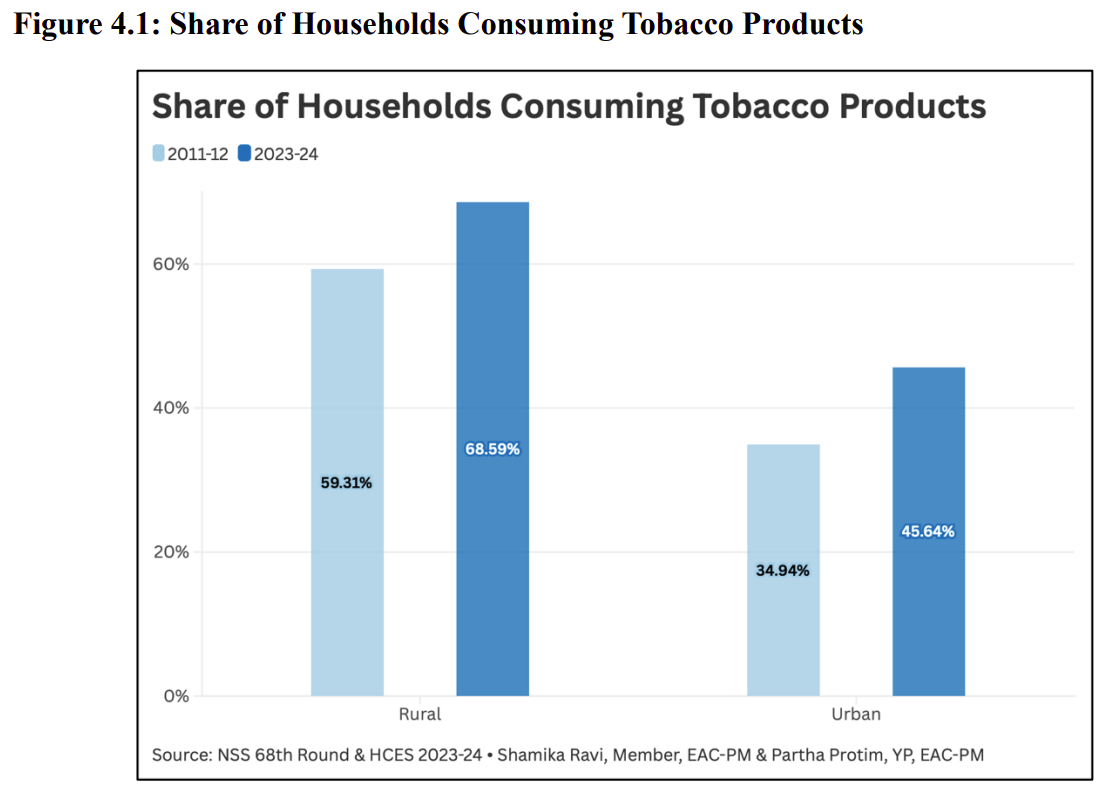
Adjusted for inflation, per capita spending on tobacco surged 58% in rural India and 77% in urban India over the last twelve years. The number of tobacco-consuming households in rural areas rose 33% to over 13 crore. In cities, the growth was even sharper — a 59% jump.
So which is it? Is India winning the tobacco fight, or losing it?
Are we finally counting properly?
Let’s start by attempting to square the contradiction of health surveys showing decline and expenditure data showing a surge. But before asking which dataset is “right,” it’s worth noting that they aren’t measuring the same thing.
GATS and NFHS ask individuals whether they use tobacco, which is a self-reported habit question. HCES asks whether a household spent money on tobacco products in the last seven days — a purchase question. Those generate different numbers for different reasons. A person may deny tobacco use in a health survey out of stigma, while the household ledger still shows the spending. So the “contradiction” is partly real and partly an artefact of two surveys tracking different objects.
That said, even within the HCES framework, there’s a comparability problem. The 2011-12 survey was a single-visit affair. One surveyor ran through a long questionnaire covering everything from food to fuel to clothing. By the time you got to the “pan, tobacco, and intoxicants” section — usually near the end — respondent fatigue had set in. Tobacco is what researchers call a “shame item“. It gets under-reported especially when you’re rushing through a survey.
The HCES 2023-24 fixed this in two ways. First, each household was visited three times in a quarter, with the questionnaire split into four modules. Tobacco wasn’t buried at the end of a marathon session anymore. Second, surveyors switched from paper forms to tablets with real-time validation checks, and the item basket was expanded from 347 to 405 products to capture the full range of smokeless tobacco now on the market.
What this implies is that much of the “surge” may not be new consumption at all. India may have mistaken a fall in self-reported individual use for a broader retreat of tobacco from economic life — when, in fact, tobacco’s footprint in household budgets was deeper than health surveys ever captured.
But even the most generous reading of this change in survey design doesn’t explain away the entire increase. And for that, we’ll need to look at the product data.
The gutkha explosion
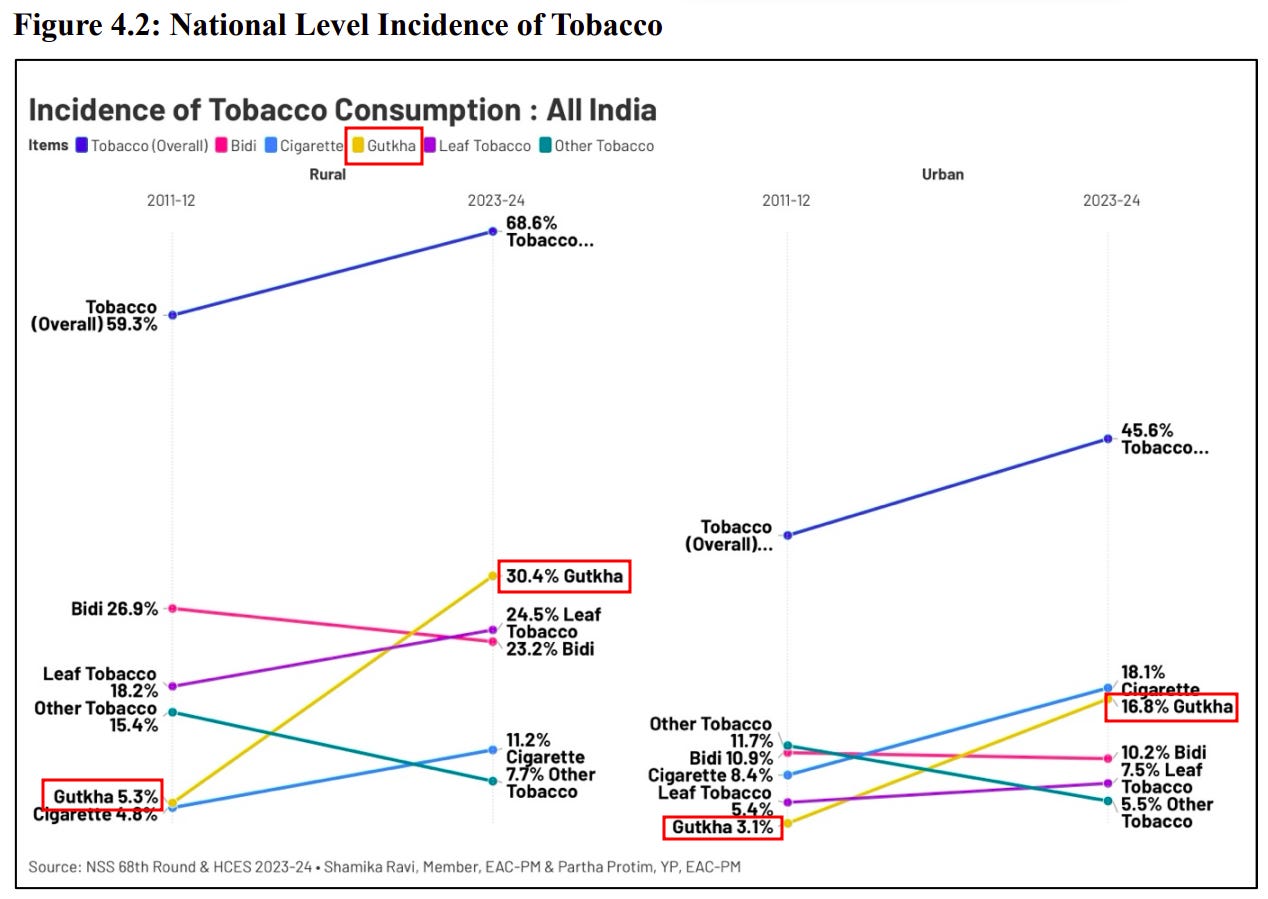
If there’s one number that captures the absurdity of India’s tobacco regulation, it’s that gutkha saw a six-fold increase in rural household consumption over the last twelve years. And this happened despite the fact that gutkha has been officially banned in most states since 2012
The share of rural households consuming it went from 5.3% to over 30%. In rural Madhya Pradesh, for instance, it’s now consumed by 62% of households. In Uttar Pradesh, every second rural household reports buying it. Gutkha today is the single largest tobacco product by value in rural India, making up 41% of total tobacco expenditure.
How does a banned product even achieve that kind of growth? Well, it doesn’t help that the failure lies in the actual enforcement. And the loophole behind it is something even the most creative of storywriters would struggle to come up with.
See, the 2012 ban prohibited the sale of “pre-mixed tobacco and pan masala.” Manufacturers responded by splitting the product into two separate pouches — one containing pan masala, the other containing plain tobacco — and selling them as a bundle. The consumer mixes them at the point of use, effectively recreating gutkha.
The Supreme Court flagged this twin-sachet workaround as early as 2016, directing all states to crack down on it. The Health Ministry’s own petition to the court acknowledged that companies were “selling gutka in twin packs to be mixed as one.” And yet, a decade later, the practice continues openly.

If you thought the problem ended here, the tax system actually worsened the blindspot further. Excise duty on tobacco products is partly calculated as a percentage of the declared Retail Sale Price (RSP) — the MRP printed on the packet. But the small pan masala and chewing tobacco pouches, which are the legal ingredients of the twin-sachet workaround, were historically exempt from even declaring an RSP if they were under 10 grams. No declared price means no basis for calculating tax. Manufacturers could produce millions of ₹5 sachets without the taxman having a reliable way to assess what was owed.
However, while gutkha has risen, the traditional hand-rolled, dirt-cheap bidi is stagnating. Its share among rural households dropped from 27% to 23%. But cigarettes are rising, that too particularly in urban India, where household incidence more than doubled to 18%. Among the wealthiest 20% of households, cigarettes are now the dominant tobacco product. As Indians move up the income ladder, they don’t quit tobacco — but ditch commoditized products for more premium ones.

Trade-offs, moral hazards, and what the numbers don’t capture
The socioeconomic gradient is steep. Over 70% of rural households in the bottom 40% of the consumption distribution are regular tobacco users; in states like UP, MP, and Bihar, that figure crosses 85%.
But beyond mere prevalence, the paper provocatively argues that tobacco spending sidelines more important needs.
In rural India, households in the bottom 40% allocate about 4% of their monthly budget to paan, tobacco, and intoxicants. In contrast, they spend only 2.5% on education. The paper projects that if a smoker located in India’s poorer income distribution redirected what they spend on tobacco toward food, they could add over 500 calories to the daily diet of one or two children. As per the WHO, ~15 million Indians are estimated to live below the poverty line solely because of tobacco-related healthcare expenses.
However, these numbers require closer examination beyond face value. The paper doesn’t capture the context behind these numbers — particularly, why the spend has increased.
For an informal labourer or migrant worker, who may want a release after a grueling day of physical work, a ₹5 sachet of gutkha is the easiest option. But more importantly, it’s also a hunger suppressant — a cheap way to get through a long shift when the labourer can barely afford all three meals of a day.
This is why, even if one raises the prices of tobacco, or even make cautionary tobacco ads, people won’t easily stop buying — especially as it gets more addictive. And it may not be accurate to scenario-model such “what-if” projections of redirecting tobacco spend elsewhere without the full picture.
Now, since 2015, government health expenditure as a share of total health spending has risen from 29% to 48%. Out-of-pocket costs have fallen from 63% to 39%. Ayushman Bharat now covers over 12 crore families, predominantly from the bottom 40% — the same demographic with the highest tobacco prevalence.
Quite controversially, the EAC-PM paper argues this creates a “moral hazard“: when the state absorbs the cost of treating chronic diseases, the personal financial risk against risky behaviour of consuming tobacco weakens. In simpler words, if people don’t face the financial consequences of tobacco consumption (such as increased medical expenses), they have no reason to stop. It cites evidence from NFHS-5 data showing that women with health insurance had tobacco prevalence 2.04 percentage points higher than those without.
This deserves scrutiny. Correlation isn’t causation: people who are already sick are more likely to be enrolled in insurance. Moreover, the idea that a rural labourer consciously uses more gutkha because she knows the government will pay for her future cancer treatment is a behavioural leap without direct evidence. The moral hazard framing may work as a fiscal observation on state finances, but not as an explanation for why people consume tobacco.
The 2026 tax overhaul
India’s fiscal relationship with tobacco has always been lopsided. The economic burden of tobacco use is estimated at ₹1.8 lac core annually — about 1% of GDP. For every ₹100 the government collects in tobacco excise, society bears ₹816 in costs.
The 2025/2026 reforms attempt to close this gap. The Central Excise (Amendment) Bill introduced sweeping duty hikes: chewing tobacco went from 25% to 100%, and the per-stick duty on long cigarettes was raised to ₹11,000 per thousand sticks.

For gutkha specifically, the government went after the legal components rather than the banned end-product. Since gutkha is technically illegal but its ingredients are not, the new “capacity-based taxation” targets the manufacturers of these components. They must now register all packing machinery, with penalties for mis-declaring capacity. This targets the informal, cash-heavy gutkha trade that was previously impossible to tax accurately. The reform also closes the small-pouch blind spot flagged earlier: effective February 2026, all pouches — regardless of size — must display a retail sale price, officially bringing the ₹5 sachet economy into the tax net.
The latest GST changes also rewire political motivations to enforce these taxes. The old GST Compensation Cess on tobacco went entirely to the centre. The new regime replaces it with Central Excise Duty, which falls into the “divisible pool,” meaning 41% of the revenue now flows to state governments. On paper, this aligns state incentives with enforcement. But in practice, it risks creating a new dependency: states that benefit from tobacco tax revenue may have less appetite to crack down on the very consumption that generates taxable revenue.
The bidi, though, remains untouched. Bidis represent roughly twice the consumption volume of cigarettes, are more harmful, and are consumed overwhelmingly by the poorest Indians. Yet they sit at a lower 18% GST rate while cigarettes bear the full weight of sin taxation.
Partly, that may be because the bidi industry employs many poor Indians with no recourse to better jobs. Around 4.5 crore people depend on the tobacco industry for their livelihoods, and nearly 50 lakh of them are registered bidi rollers, predominantly poor women with few other skills. The government has managed to shift just 1.12 lakh acres of farmland away from tobacco cultivation so far, a rounding error against the scale of dependence.
Where this leaves us
Whether the HCES data reflects a genuine surge or a long-overdue statistical correction, the picture it reveals is the same: tobacco is deeply embedded in the consumption patterns of India’s poorest households, and it’s being sold through regulatory failures that make a mockery of existing bans.
The latest tax overhaul might be necessary. But taxation alone won’t work when cessation services reach barely 6-12% of those who try to quit, when a banned product is freely available in twin-sachet form at every roadside shop, and when gutkha functions as a meal replacement for millions of hungry workers.
Perhaps, the more important question is whether India, a developing country where hundreds of millions continue to struggle to meet basic needs, can build a welfare state that covers the health costs of addiction, while also failing to address the poverty that drives it.
Who lends to the Indian government?
Government debt is always scary to think about. The sums involved are many orders of magnitude higher than anything you’ve imagined. It’s hard to imagine how one could ever repay that much money. Meanwhile, the consequences of a default are devastating. We’ve all seen images of chaos coming out of Sri Lanka and Pakistan, and it’s not a pretty sight. Nobody wants to see that in India.

Here are some scary statistics: between 2000 and 2021, the Indian government increased its outstanding debt through securities from ₹4.5 lakh crore to ₹115 lakh crore — a twenty-five-fold increase. According to this year’s budget estimates, the central government’s debt alone shall rise to nearly ₹200 lakh crore by the end of this month. And next year, the government will borrow a record ₹17 lakh crore more.

With this dramatic increase in our debt, you would imagine that borrowers would be terrified; that they would ask for more interest, and seek their money back sooner. Yet, in the 20 years since 2000, the interest on our new borrowings roughly halved, from nearly 12% to under 6%. Meanwhile, the average maturity of that debt got longer, with the share of our bonds maturing in ten years or more rising from 25% to over 40%.
That is, we have more debt, but for cheaper and longer. What’s happening? Are we really a hundred times as trustworthy as we were twenty five years ago?
Maybe we are. Maybe not. But there’s nuance to it. A paper by researchers at the XKDR Forum and IIT Roorkee offers an answer, though it isn’t a flattering one. Its authors argue that our success doesn’t come from market trust — it comes from a system where most lenders don’t really have a choice. In fact, they write that just 5% of the Indian government’s borrowings come from genuinely voluntary sources. The remaining 95% comes from India’s financial institutions, all of whom are steered into buying government bonds.
Here’s what that means, and why it matters.
How do governments borrow?
When a government runs a deficit, someone needs to buy its bonds. There are, broadly, four ways to find that someone.
One, the central bank can just create money and buy the bonds itself. This is cheap in the short run. It’s also disastrous in the long run — it causes inflation, currency weakness, and kills the government’s incentive to reform. India used to do this a lot, but closed the channel after a 1994 agreement between the finance ministry and the RBI.
Two, you can tell the country’s financial institutions buy the bonds, essentially claiming the country’s savings for the government. Regulators, for instance, can write rules requiring banks, insurers, or pension funds to invest some of their assets in government securities. In advanced economies, these requirements tend to be modest — less than a tenth of a financial firm’s balance sheet. If they’re much higher, economists call it “financial repression”: a system where savers have no choice but to support the government’s spending, whether or not that’s the best use of that money.
Three, you can borrow from investors who genuinely want to lend to the government — like mutual funds, foreign investors, private firms, and the like. This, to the paper, is the healthiest option, because it’s voluntary. These investors only lend because they trust the government, and think the yield offered is fair. This creates a genuine market with genuine prices.
Four, you can borrow abroad, in foreign currency. This has advantages: foreign lenders can come in when domestic ones face some sort of economic pressure. But this also creates a mismatch. When things go wrong, the currency weakens, and that debt load balloons. You can only avoid this trap if those lenders are willing to lend in your currency.
Who should you go to? Well, there are three things to think about:
First, your borrowings shouldn’t secretly tax one group of savers. If institutions are forced to buy government bonds, the cost is borne by users of those institutions. If banks have to lend to the government at cheap rates, for instance, bank depositors earn less. This becomes a hidden tax on the formal financial system. While this helps the government, it pulls on the rest of the economy.
Second, ideally, you ought to create a bond market, because markets naturally punish reckless behaviour. Consider this: in September 2022, the brief Liz Truss government in the UK announced a mini-budget, which would widen its expected deficit from 3.8% to 5.3% of GDP. Within days, the interest on ten-year bonds jumped by an entire percentage point. The prime minister resigned within weeks. This discipline can be painful to a government, but it also forces it to avoid bad mistakes.

Third, the government should have the room to borrow a lot during a genuine crisis — like a pandemic or a war. It’s only when you already have the trust of a large base of lenders that you can ask for more when the moment calls for it.
Who does India go to?
The paper only looks at data until 2021. At that point, banks held 36% of all government securities. Insurance companies held 27%. Provident and pension funds held another 10%. The RBI held 11%. Together, these four groups lent about eight-and-a-half rupees for every ten that the government borrowed.
This picture changed slightly over the ten years the paper studies. At one point, banks lent more than half of all the government’s debt. Then, their share began to decline, as India eased the rules that governed bank investments. The “statutory liquidity ratio” — the amount that banks must park in government bonds or other such “safe” investments — fell from 33% in 1988 to 18%. But that lost share didn’t go to the market. Instead, insurance and retirement savings funds were asked to pick up the slack — with their share rising from a quarter to nearly 40%.
Meanwhile, voluntary lenders — the ones that purchased debt without any nudge from the government — accounted for just 5%. In more advanced economies, that rate is closer to 30%.

When they were writing the paper, foreign institutions held just 1.3% of our government’s debt. This made us an outlier among emerging markets, along with China. That picture has changed a little since. India was inducted into major global bond indices for emerging market debt. Any investor that tracked these indices began programmatically lending to the Indian government. With that, foreign entities own around 5% of the government bond market. But this remains a small fraction of the whole.
Why Indian financial institutions love government debt
So why do our financial institutions lend so heavily to the government?
The answer, in part, is that they must.
We’ve already talked about how the RBI mandates that banks put their money in safe securities: government debt, cash, or gold. In that short list, government debt usually gives them the highest yield, which is why that’s where much of their money goes.
These mandates have been eased over the years. This is usually cited as evidence that the financial system has been gradually freed from government capture. That’s partly true; India’s banking regulations have liberalised over this period. But the picture is complicated.

While those bank-specific requirements fell, Indians were rapidly learning to allocate their savings to other pools: like pension funds, or insurance. These had their own mandated allocations. The EPFO, for instance, has to invest 45% of its incremental assets in government bonds — a number that has inched up over this period. Life insurance companies have to put half their funds there. And so on. These ratios, the paper notes, are high by international standards. And unlike the requirements on the banking system, these didn’t come down.
Do note, however, that late last year, the government lowered these requirements for insurance companies as well.
In other words, while the government almost halved the share of funds it demanded from banks, it got access to new, expanding pools of funds from elsewhere — and these too, were mandated by law to buy its debt. To be clear, the paper doesn’t say that the government engineered this outcome: simply that the effect of our financial sector regulations was to create a wide base of captive lending.
That said, there’s something very interesting that the paper notes, but doesn’t explain. These institutions actually held much more government debt than they were required to — and that gap is, in fact, growing!
Banks, for instance, regularly hold far more government bonds than they’re required to, especially after 2017. This excess, by 2021, had grown to 6% of their deposit base, up from nearly zero in 2014. Similarly, 58% of the EPFO’s assets were in government bonds, well above the 45% they were required to. In total, these institutions hold ₹30 lakh crores more than they have to.
The paper calls this “voluntary captive lending”: where regulated institutions choose to go further than the rules demand.
Why is this the case? The paper is candid about not having an answer.
It has some hypotheses. For instance, employees at financial firms might be afraid of the scrutiny that comes with private loans going bad. Perhaps there simply isn’t demand for private debt, because of the muted levels of private investment we’ve seen since 2011. Perhaps there’s some sort of informal pressure.
But these are just hypotheses, not concrete answers.
Why can we borrow more, for cheaper and longer?
A lot of writing on India’s public debt — from us included — blandly talks about how much debt there is. As this paper argues, however, that’s the wrong question. Not all debt behaves the same way; the lender matters as much as the number of rupees we borrow.
On the face of it, India enjoys rather benevolent lenders. It has been able to increase its borrowing manifold over the years, without being penalised by increasing rates or shorter maturities. That is the outcome of who the government borrows from. India’s financial institutions have shouldered most of its debt burden over the years. That is partly because they had to. And partly because they lent much more than they had to, for reasons that aren’t entirely clear.
It’s worth noting, however, that there are costs to this dynamic.
For one, this places an invisible tax on India’s savers. If you have parked your money in bank deposits, or are an EPF subscriber, or a life insurance policyholder, a large portion of those savings are channelled into government bonds. The open market for those bonds is tiny, so it isn’t entirely clear if those savings are getting a fair yield. And if they aren’t, the rate passed down to you might not be fair either.
According to the paper, these low yields may well be why Indians channel their savings into gold or real estate.
Getting out of this loop could be a long, dreary process. But from the new insurance amendments, to India’s inclusion in global bond indices, there are some signals it’s already underway.
Tidbits
Iran conflict hits India’s gems and jewellery trade: Flight cancellations and airspace closures across the Middle East have brought India’s jewellery exports and rough diamond imports to a near-standstill. The region accounts for nearly a quarter of India’s $30 billion in annual gems and jewellery exports, while the UAE alone supplies over two-thirds of India’s rough diamond imports.
Source: ReutersRising petcoke prices are squeezing cement margins: Petcoke — which makes up over half the fuel mix for Indian cement makers — rose $13 per tonne month-on-month in February, and analysts expect the hit to show up in Q1FY27 margins. Companies like Shree Cement and JK Cement, which source 70-95% of their energy from petcoke, are the most exposed.
Source: The Hindu BusinessLineBank of Baroda raises ₹10,000 crore via green infrastructure bonds: BoB became the first Indian bank to issue green infrastructure bonds domestically, pricing a seven-year bond at 7.10% and drawing bids of ₹16,415 crore — over three times the base issue size. Proceeds will go toward renewable energy and other sustainable infrastructure projects.
Source: PSUWatch
- This edition of the newsletter was written by Kashish and Pranav.
What we’re reading
Our team at Markets is always reading, often much more than what might be considered healthy. So, we thought it would be nice to have an outlet to put out what we’re reading that isn’t part of our normal cycle of content.
So we’re kickstarting “What We’re Reading”, where every weekend, our team outlines the interesting things we’ve read in the past week. This will include articles and even books that really gave us food for thought.

We’re now on WhatsApp!
We’ve started a WhatsApp channel for The Daily Brief where we’ll share interesting soundbites from concalls, articles, and everything else we come across throughout the day. You’ll also get notified the moment a new video or article drops, so you can read or watch it right away. Here’s the link.
See you there!
Thank you for reading. Do share this with your friends and make them as smart as you are 😉