

Hi folks, welcome to another episode of Who Said What? I’m your host, Krishna.
For those of you who are new here, let me quickly set the context for what this show is about. The idea is that we will pick the most interesting and juiciest comments from business leaders, fund managers, and the like, and contextualize things around them. Now, some of these names might not be familiar, but trust me, they’re influential people, and what they say matters a lot because of their experience and background.
So I’ll make sure to bring a mix—some names you’ll know, some you’ll discover—and hopefully, it’ll give you a wide and useful perspective.
For all the sources mentioned in this video, don’t forget to check out our newsletter; the link is in the description.
With that out of the way, let me get started.
India's largest IT firm deals with ghosts old and new
With every new development in AI, the pressure on traditional Indian IT services seems to be clamping down.
In an interview with the Financial Times, K Krithivasan, the CEO of TCS, said the following:
“There will always be some segment within some small pockets within the company who will not fit in the scheme of things. AI is not going to create lay-offs by itself.”
In the context of AI itself, this statement is bold about the future. But we’re more interested in how this statement fits in the story that TCS is trying to write for itself.
See, over the past year, TCS has fired about 3% of its workforce. But none of its other peers — not Infosys, Tech Mahindra, or HCLTech — has undertaken any firing of such scale. All of them have already hinted at AI potentially changing not just their own workflows, but also how they charge clients. But any firing that has taken place so far has not been attributed to AI. In fact, a few months ago, Krithivasan explicitly said so:
“No, this is not because of AI giving some 20 percent productivity gains. We are not doing that. This is driven by where there is a skill mismatch, or, where we think that we have not been able to deploy someone.”
In other words, why TCS fired so many people is because they couldn’t deploy a lot of their existing employee base on the right projects.
What does this mean? Let’s start with who got fired. Many of the people who seem to have been fired are project managers, who generally have 10-20 years of experience. Basically, they handle client escalations, assign tickets to developers and testers, manage the bench rotation, and coordinate many different parts of a single large-scale project. This is generally not perceived to be a very technical role where domain specialization is necessary to have.
The idea that AI did not have a huge role to play in these layoffs then makes sense, too. Ideally, entry-level employees would likely have been the first to be asked to leave. Instead, those who were let go are far more senior.
In the pandemic, where large-cap IT stocks like TCS had enjoyed outperformance, over-hiring was pretty common. However, most of the hires were more experienced people from other firms, and not freshers. Rediff spoke to Kamal Karanth, a founder of a specialist staffing company called Xpheno, who said:
“The big-fat middle layer is a net outcome of the hyper-hiring phase, combined with three cycles of low to no fresher intakes. A large chunk of lateral hiring made during the demand surge now sits in the 5 to 13 year experience range -- the very layers seeing restructuring now. Ironically, these were also the layers with the highest churn during the hiring boom.”
In fact, as per Xpheno’s data, the middle layer bloat is quite real. The top 7 Indian IT firms host nearly 4.9 lakh employees who had 9-17 years’ of experience. Many of them — though not all — are the project managers we mentioned above. In comparison, there were 4.6 lakh employees with less than 5 years of experience. This less-experienced group also got paid much less.
When you think about it, what it would imply is that the number of freshers was not that far off from the number of more experienced people. That’s a very lopsided ratio, primarily a consequence of that over-hiring. This inefficiency did not necessarily need AI to be exposed, although AI has now made that clearer than ever
In fact, there were some signs that TCS had recognized this lopsidedness quite early on. In April 2024, more than a year before the mass layoffs, TCS reported a decline in its full-year employee count. This was the first time their headcount declined in nearly 2 decades. In simple terms, they had basically stopped hiring.
Moreover, TCS didn’t seem to be able to utilize its employees well enough. At various points of time, TCS would have a bench of employees who wouldn’t be staffed anywhere. This benching makes up nearly 10% of TCS’ payroll costs. This is why, at the same time as the layoff announcement last year, TCS made its bench policy more restrictive — no employee could be on bench for more than 35 days a year.
It didn’t help that, at the same time, the geography that mostly demanded TCS’ services was going through a rough economic patch. The US was suffering from weak consumer demand, and fears of a recession were high. Now, a recession was eventually avoided, but a slowdown still exists. In fact, right now, besides AI-related capex, the US doesn’t have any strong source of economic growth.
Interestingly, while TCS was lagging, mid-cap IT firms were having some of the best time in their entire history. They had increasingly begun competing for the same deals as TCS and its peers. And more importantly, by virtue of how they specialize in domains, midcap IT firms never really suffered from a bloat of project managers who didn’t have enough technical depth.
So, there is plenty of reason to believe that TCS’ layoffs weren’t due to AI as we know it today. For a long time, this layoff didn’t take place because, after all, TCS is one of the largest providers of stable jobs in India. Any layoff decision would be incredibly political and damaging not just to TCS, but to the Tata brand as a whole.
All of this was way before AI got good at writing code. And now, it can.
TCS wants to be the world’s largest AI-enabled services company. They’re undertaking an organization-wide training exercise on all things AI. They’re also going through a huge restructuring to prepare for the AI age.
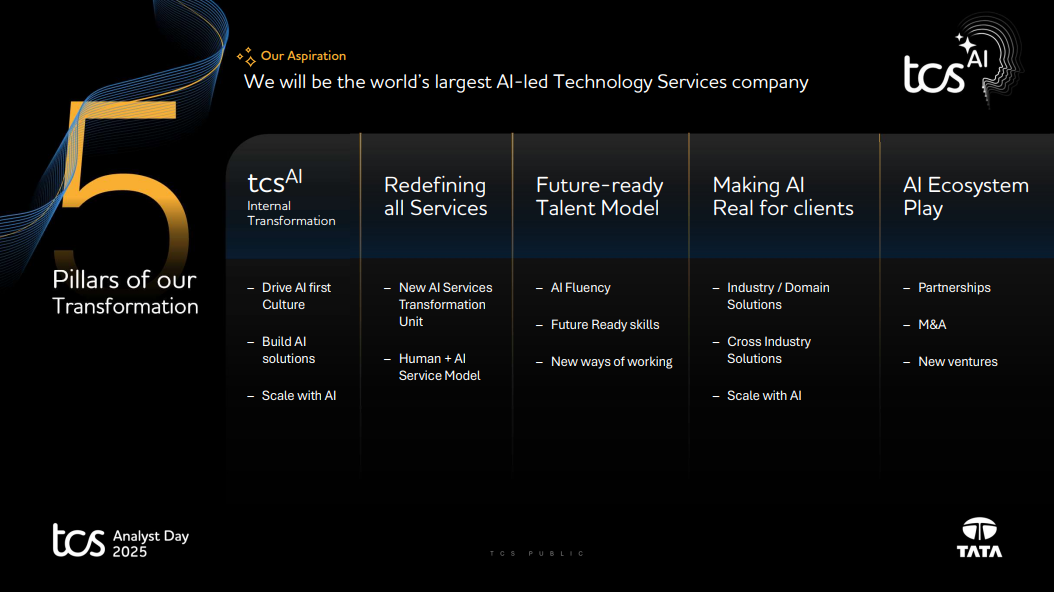
What does this restructuring mean? For one, it would mean smaller teams that would further make pure project managers redundant. Instead, domain specialists would play a much bigger role. And, of course, as we covered in The Daily Brief recently, AI is already changing how Indian IT bills its clients.
So, to a very large degree, why the CEO of TCS said that AI won’t cause layoffs at scale by itself is because, so far, TCS has not made a decision to layoff people because of technological advancements. But TCS has often been late to technological advancements that aren’t AI-related. If anything, TCS bet heavily on scaling its existing model, and couldn’t course-correct quickly unlike its peers.
Now that AI is here, and the problems that TCS was plagued with 2-3 years ago still exist, how does TCS figure out how to change? That is, quite literally, a billion-dollar question for the company that kick-started India’s IT journey.
We’ve spent a lot of time at The Daily Brief writing about the less-visible parts of electronics—semiconductors, PCBs, and everything around them.
We recently released a podcast with someone who’s spent years actually making PCBs, talking through how they work, why they matter, and where India still struggles. If you’re curious, you can listen to the conversation here on YouTube.
If you prefer to listen to the audio, you can check it out on Spotify and Apple Podcasts. Now, back to The Daily Brief.
Hard wakeup call for all Indian SBCs. All these years, India used to leverage its cheap labour as a moat, but not anymore. Al is a quick and easy replacement for most of the use cases.
It's high time we switch to bringing real, meaningful innovation, focus on R&D, and build truly indigenous products & services for the world to use. Heck, just look at China. It's hilarious to see some of these Indian CEOs advocating for inhumane working hours (indirect slavery), and equating that to higher productivity.
A strong mindset change is needed from the top down. Being the IT sweat shop of the world is not glamorous in any way.