


Our goal with The Daily Brief is to simplify the biggest stories in the Indian markets and help you understand what they mean. We won’t just tell you what happened; we’ll tell you why and how too. We do this show in both formats: video and audio. This piece curates the stories that we talk about.
You can listen to the podcast on Spotify, Apple Podcasts, or wherever you get your podcasts and watch the videos on YouTube. You can also watch The Daily Brief in Hindi.
In today’s edition of The Daily Brief:
1. Indian homebuyers get a much-needed painkiller
Why did the Supreme Court intervene in Noida's stalled real estate market? Local authorities tried to force homebuyer groups, who were self-funding stalled construction, to pay hundreds of crores in bankrupt developers' delay penalties. The court struck down these demands, ruling that public bodies cannot penalise victims to recover lost revenue.
2. Is India withdrawing its EV subsidies too soon?
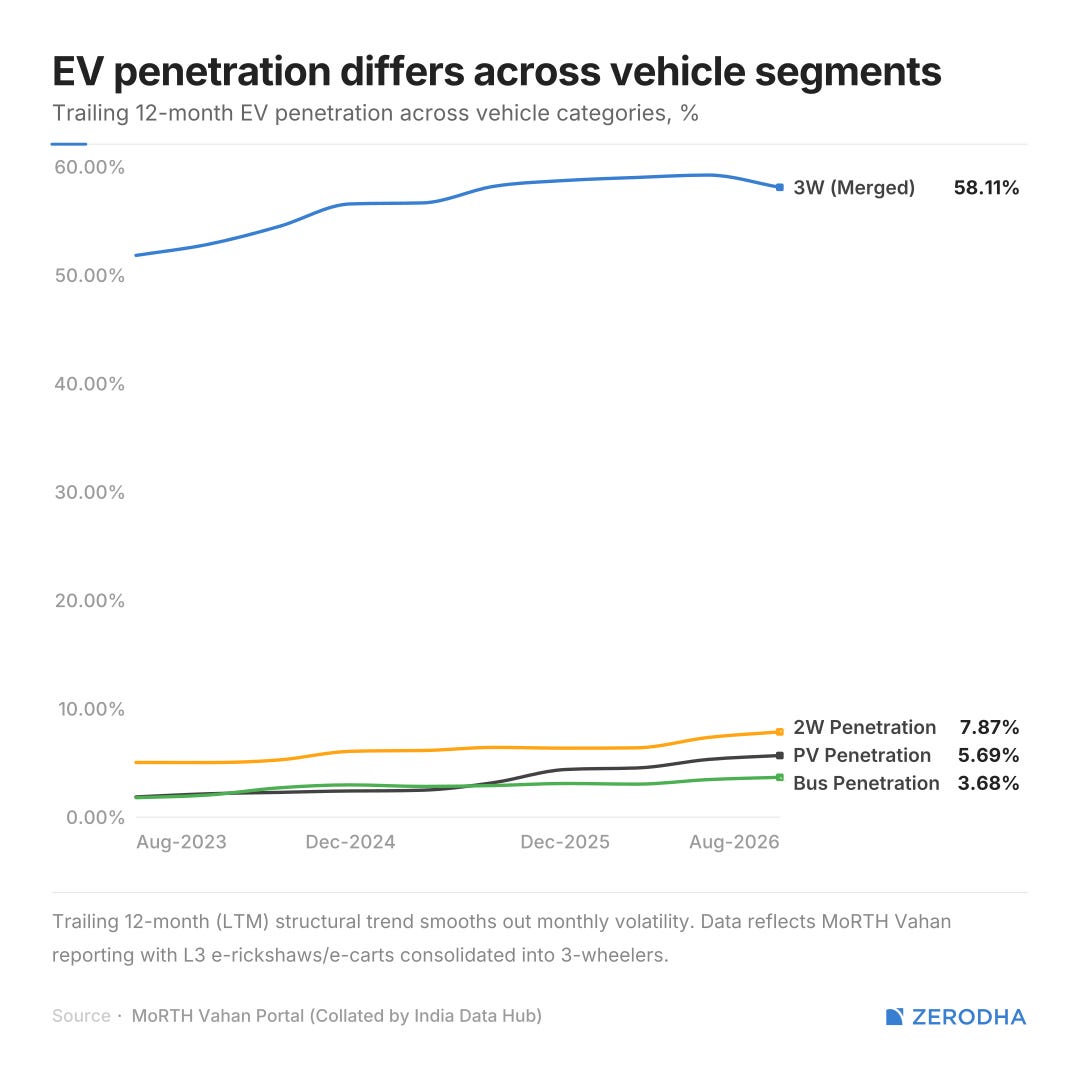
Is India's EV market ready to survive without direct buyer subsidies? While three-wheelers are self-sustaining at 58% penetration, two-wheelers, cars, and trucks still rely heavily on upfront discounts and charging networks. Phasing out subsidies too fast risks stalling consumer adoption before the broader market matures.
Subtext by Zerodha
We sat down with Mudit, co-founder of Voltseal, to talk about the duck curve, the many problems batteries can solve, and what happens when the grid finally gets intelligent. With over two decades in the industry, he helped us connect what we had learned through research with how the power system actually works.
Watch the full episode on YouTube.
Indian homebuyers get a much needed painkiller
Real estate is quite the ground for movie scripts.
One such famous Indian movie is Khosla Ka Ghosla. For those unaware, it’s about a middle-class family in West Delhi which has invested its money in a piece of land, but finds themselves scammed out of the land by a builder. The 2006 movie is beloved for being funny, but its relatability may have gotten only more intense over time.
Just last week, the Supreme Court passed a crucial decision related to a real estate bankruptcy in the city of the New Okhla Industrial Development Authority — or more famously, Noida — which is just a metro ride away from West Delhi. It told the city authority that it cannot charge homebuyers for penalties racked up by a bankrupted developer called Granite Gate.
The decision may sound like it should be obvious to anyone. Why should homebuyers be charged for something they didn’t do? If anything, they’re the victims here.
But this decision doesn’t sit in isolation. It involves one of India’s most notorious urban real estate bubbles, with many high-profile developers going bust left and right, and some being outright fraudulent.
Most importantly, the fallout of this bubble has left many families in India frustrated and confused for years. It gave them no clarity on whether their houses, which they might have invested their life savings in, will ever be completed.
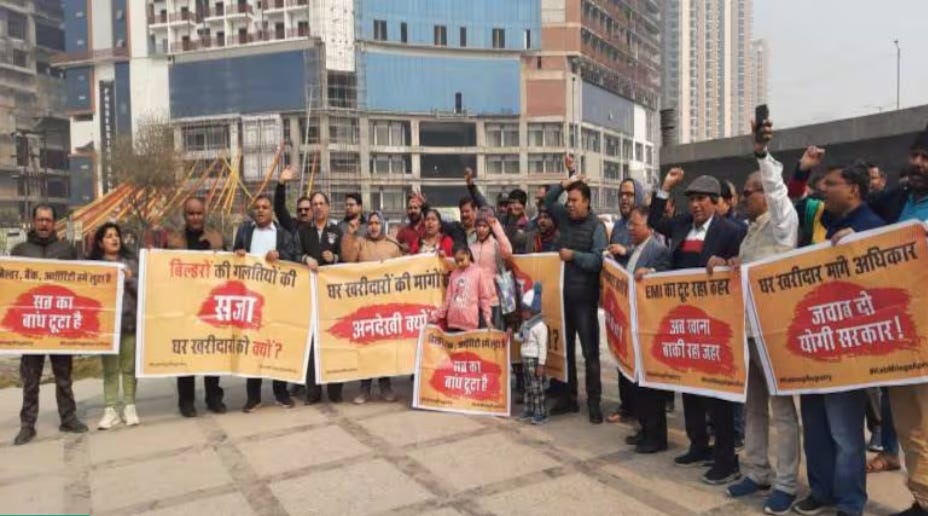
This has important ramifications for homebuyers anywhere in India. That’s the story we’ll be telling you today.
The Noida bubble
To understand why cases like Granite Gate keep reaching the Supreme Court, you need to understand the fragile foundations on which Noida and Greater Noida’s real estate market was built.
Unlike most Indian cities where developers often buy land outright, the Noida model runs on leases. Noida and GNIDA (Greater Noida Industrial Development Authority) are public bodies that acquire land, build trunk infrastructure, and then lease plots to developers on long-term agreements. The developer builds, and the homebuyer eventually gets a sub-lease for their flat.
During the boom years of 2008-2012, Noida and GNIDA went on a questionable spree of allotting land to anyone and everyone.
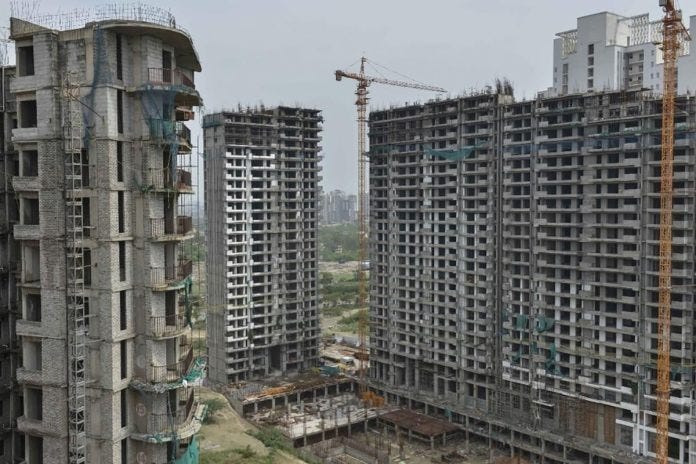
A 2021 CAG report found that 82% of housing schemes launched between 2005 and 2018 were secretly passed by Noida’s Group Housing wing without ever being submitted to the board for approval. Nearly half of all plot allotments happened in just two years.
The bidding process was hardly competitive, either. In 42 out of 49 group housing allotments during 2008–2011, only two bids were received for each allotment. In 15 of those allotments, the bidders were from the same group. In fact, developers often created shell companies that would bid against themselves, just to give a false impression of transparency. The authority also permitted builders with insufficient capital to acquire multiple plots of land.
Simultaneously, GNIDA converted thousands of acres of agricultural land acquired for industrial purposes into residential use, creating a flood of cheap housing schemes that people rushed into.
The developers, meanwhile, were doing what developers in a bubble do: taking on more projects than they could finance. They diverted homebuyer advances to acquire new land or retire old loans, instead of building the towers people had paid for.
So when the market turned in 2015, the whole thing came crashing down.
As of 2024, Greater Noida had nearly 75,000 stalled residential units — the highest of any Tier-1 city in India. Noida and Greater Noida are known for multiple ghost societies where entire high-rises have no occupants.
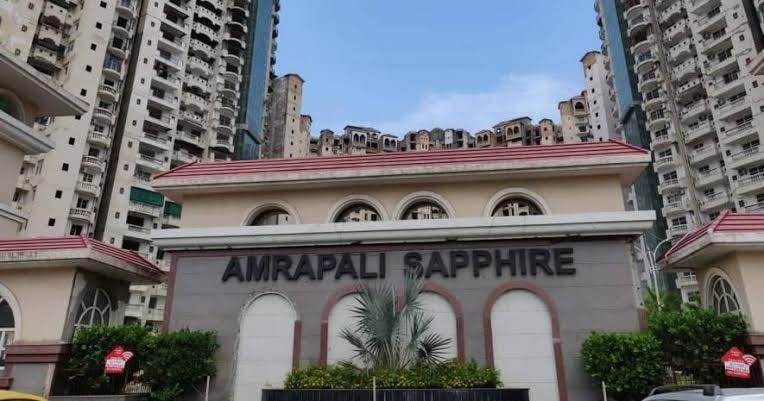
One of the most famous collapses was of the developer Amrapali. It owed ₹5,500 crore to the city authorities, and also siphoned ₹837 crore of homebuyer money using dummy companies and fake bills. It used diverted funds to buy personal assets and fund family weddings. The Supreme Court also found that the local authorities had colluded with the group in allowing this.
Then, in June this year, the directors of Earth Infrastructures (EIL) were arrested by the ED for laundering ~₹2,000 crore collected from over 19,000 homebuyers.
Fraud or not, it was clear that many developers had bitten off way more than they could chew. Hence, what followed was a flood of bankruptcy proceedings in court.
And that’s where the trouble truly began.
A clash of incentives
You see, India’s Insolvency and Bankruptcy Code (IBC) was designed for a specific kind of problem: a company can’t pay its creditors, so a structured process decides whether to revive the company or liquidate its assets and distribute whatever’s left. The creditors just want their money back, plain and simple.
But real estate wasn’t wholly suited for this model.
Why? Well, in real estate, there’s a new, large class of creditors who may not want money. They want a house to live in. And that causes a clash of incentives of homebuyers with other creditors.
See, when a developer declares insolvency, the homebuyers who’ve paid advances are grouped into a Committee of Creditors (CoC), which includes everyone else who is owed money: banks, financial institutions, and suppliers. The CoC now has to make a tough choice: do we go for liquidation, or do we find a new developer to finish these houses?
It is this choice that creates factions within this committee.
On one side are the homebuyers. They’ve already paid huge advances to the developers, and continue to pay EMIs to the bank, all in anticipation of a home they still need. For them, liquidation would be a nightmare. They’d get pennies on the rupee and no home.
The better option is to find a way to finish construction. But that means keeping the insolvency process going, negotiating with potential new developers, and hoping someone bids on the stranded assets. That could take years.
What’s more, the home-owning members of the CoC itself might not agree. Think about it: these are all families with different risk appetites, different life ambitions, and different kinds of people to look after. So even if a majority (whose decision is legally binding) goes one way, the minority may choose to file separate complaints in court, which only further lengthens the battle.
On the other side are banks and other financial creditors. They want cash fast. They can wait for a new bidder to come in, or they can push toward liquidation to recover whatever they can. Either way, they get some money, but they don’t particularly care whether the project gets built. In fact, they are most likely to lean towards liquidation. Their incentives don’t align with homebuyers.
Before 2018, this mismatch was even worse. Homebuyers had no formal standing in insolvency proceedings at all. Banks called all the shots and got first right over the developer’s assets, while homebuyers were left to fend for the leftovers.
As we covered last year, that changed in 2018 when the IBC was amended to treat homebuyers like any other financial creditor. Now, in principle, they had as much of a claim as banks did.
But giving homebuyers more power didn’t solve everything. What about the authority that allotted the land?
NOIDA or GNIDA lease land to developers under long-term agreements which have certain penalty clauses in the case of delays. The original developer was supposed to pay lease premiums and complete construction on time. But now this developer is gone, while lots of dues remain unpaid.
In that case, who pays the authority?
The developer is bankrupt. The banks are looking to recover, not to invest. The only party with any skin in the game left is the CoC, which is often composed primarily of homebuyers. This CoC may choose to continue construction, that too only because it is the only option they have to protect their investment. But does that decision now make them liable to the authority for the developer’s past defaults?
That question is at the heart of the Granite Gate case.
The Granite Gate case
Granite Gate had taken two plots on long-term lease from NOIDA to build and deliver two high-rise projects by 2016. But it overshot the timeline and eventually went bankrupt. By the time insolvency proceedings began, homebuyers had been waiting years. But they knew those proceedings could go for even longer.
Which is why, in an extraordinary move, without waiting, they took matters into their own hands. Since the CoC formed in this case was dominated by homebuyers, they decided to pool their own money and continue construction themselves.
So now, beyond the home loan EMIs, they’re paying for something that ideally, a developer should have handled. Plus, they were actively managing its progress despite not being real estate professionals. But they were just people who acted on what they saw was the best way out, and were willing to bear twice the stress of buying a house. Eventually, though, a resolution plan was approved with a new developer to finish the rest.
But NOIDA had its own claims.
The land lease deeds had a clause for charges in the case of a time extension. Each year had a charge attached. NOIDA argued these charges should be classified as the administrative expenses of the insolvency process, which, as per the IBC, must be paid out before anyone else gets a rupee. Since the homebuyers had taken on funding the construction, this penalty bill would have landed squarely on them.
What’s more, NOIDA had sealed three towers of one of the properties for ~₹700 crore in unpaid dues, shutting down any ongoing construction work. The NCLAT sided with NOIDA and ordered the homebuyers to pay up.
However, the Supreme Court dismantled NOIDA’s arguments.
It reasoned that the time extension charge was meant to deter a developer from dragging its feet. But it was never meant to penalize the homebuyer, who was already a victim. Attempting to enforce a delay penalty against them, or against a new builder trying to rescue the project, served no contractual or even rational purpose.

Moreover, the Court reminded NOIDA that as a public body, its mandate was not limited to squeezing revenue from leased land. It was supposed to promote development and provide housing, which is a fundamental right as per India’s Constitution.
All charges were dismissed, much to the relief of homebuyers.
Home alone
Granite Gate is only the latest in a string of recent legal interventions that form a pattern.
In May 2026, the courts delivered an equally aggressive order in the EIL case. For the stalled projects of EIL, a resolution plan with a new developer was made. But GNIDA blocked it, arguing that the leasehold land technically belonged to the developer’s subsidiaries, not the developer itself.
The Supreme Court ignored this distinction, waived off the charges, and approved the resolution plan. Moreover, it criticised GNIDA itself for “persistent inaction and ineptitude“ in managing the land allotments. The court noted that the developer hadn’t been paying dues since 2013, but GNIDA sat idle throughout and did nothing to beat them into shape.
Before that, the law bypassed normal insolvency procedures entirely to hand 16 unfinished projects of the developer Supertech to a state-run firm.
In each case, the message is the same: public development authorities cannot treat insolvency proceedings as a revenue recovery mechanism, and the costs of developer failure cannot cascade down to homebuyers.
But the courts are doing work that legislation and regulation should have done. The underlying system remains broken. Homebuyers continue to pay upfront for something that takes years to deliver with limited protection if the developer fails.
This isn’t just a Noida problem, either. It was extreme because the allotment machinery amplified every fault line. But wherever pre-sales funding, weak escrow enforcement, and undercapitalised developers exist, a similar dynamic might play out. As residential construction keeps expanding into tier-2 and tier-3 cities, the risk extends well beyond Delhi-NCR.
Even the solutions the court has suggested aren’t fully working. For instance, in the Supertech case, homebuyers have raised concerns that developer delays have been replaced by bureaucratic ones, which are common to state-run firms.
The court has been building the cure. But not much has changed to prevent a future wave of stranded homebuyers.

Is India withdrawing its EV subsidies too soon?
Heavy Industries Secretary Kamran Rizvi recently suggested that EV subsidies cannot last forever. Over the next four to five years, he expects the industry to gradually move away from government support and learn to compete on its own.
That is a reasonable goal. No industry can, or should, depend on subsidies forever. But it also raises a more difficult question: is India withdrawing support too early?
India’s EV market has grown rapidly. According to the Ministry of Heavy Industries, EVs accounted for 0.71% of new vehicle registrations in FY20. The ministry’s more recent data puts it at 8.2% in FY26.
That is a significant increase, but the headline number hides important differences. India does not have one EV market. Electric three-wheelers, two-wheelers, passenger vehicles, buses and trucks are all at different stages of adoption, and face different economic and practical constraints.
To judge whether that shift is premature, we first need to understand what the government has been supporting.
How India built its EV market
The easiest way to understand India’s EV policy is to look at the problems the government was trying to solve.
The first was the price. Batteries made electric vehicles more expensive than comparable petrol and diesel vehicles, so the Centre introduced a series of purchase-incentive schemes to narrow that gap. The Centre used FAME-I and II, followed by EMPS and PM E-DRIVE.
The model was straightforward. Buyers received an upfront discount, and the government reimbursed the manufacturer.
The support varied across vehicle categories. FAME-II covered electric two-wheelers, commercial three-wheelers, commercial cars and buses. Private electric cars, for the most part, did not receive a direct central purchase subsidy.
The Centre also cut GST on EVs from 12% to 5%, and GST on chargers from 18% to 5%. States added their own incentives, including purchase subsidies, scrappage and interest benefits, and exemptions from road and lifetime tax. These could sit on top of the central support. A buyer might receive a central subsidy, pay lower GST and also get a state-level road-tax waiver.
But making an EV affordable was only the first step. The government also had to make it practical to own one.
Lower running costs are a major advantage of EVs, but that advantage matters little if charging is unavailable, expensive or unreliable. The Centre declared EV charging a de-licensed activity, issued rules around tariffs and connections, and supported charging stations under FAME-II. PM E-DRIVE has allocated ₹2,000 crore for charging infrastructure.
This is where the chicken-and-egg problem comes in. Chargers may not be commercially viable until there are enough EVs. But buyers may not purchase EVs until they know that reliable charging is available. Government support is meant to break that loop.
The government was also trying to build the industry behind the vehicles. It wanted the batteries, components and EVs themselves to be made in India.
The automobile and auto-component production-linked incentive scheme has an outlay of ~₹26,000 crore, while the advanced-chemistry-cell battery PLI scheme has an outlay of ₹18,100 crore.
This is why we need to be precise when we say the government is “stepping back”. India may reduce what it pays on each electric scooter while continuing to support factories, batteries and supply chains.
The policy stack is now changing
Purchase subsidies are clearly shrinking. Under the most generous version of FAME-II, electric two-wheelers received up to ₹15,000 per kWh, capped at 40% of the vehicle’s cost.
In June 2023, that cap was cut to 15% of the ex-factory price. Under PM E-DRIVE, the maximum incentive fell to ₹10,000 per electric two-wheeler in FY25 and then to ₹5,000. The scheme’s two-wheeler component ended on 31 July 2026.
The L5 electric three-wheeler subsidy also ended in December 2025 after reaching its target. Other three-wheelers continue to receive limited support.
State-level tax support is changing too. Karnataka had exempted EVs from lifetime road tax. In 2026, it introduced a lifetime road tax of 5–10%, depending on the vehicle’s price rates. Electric two-wheelers remain exempt. Karnataka alone does not mean every state is retreating. Policies remain uneven: some states are continuing or redesigning incentives, while others are letting them expire.
But the broader direction is clear. Support for buyers is shrinking, while support for manufacturing, shared infrastructure and harder-to-electrify segments remains.
One EV market, four different realities
That shift will affect each part of the EV market differently.
Electric three-wheelers may be closest to standing on their own. They are used intensively, so the fuel savings add up quickly and the commercial economics increasingly make sense. Research by IEEFA also suggests that adoption was increasingly driven by operating economics, rather than subsidies alone.
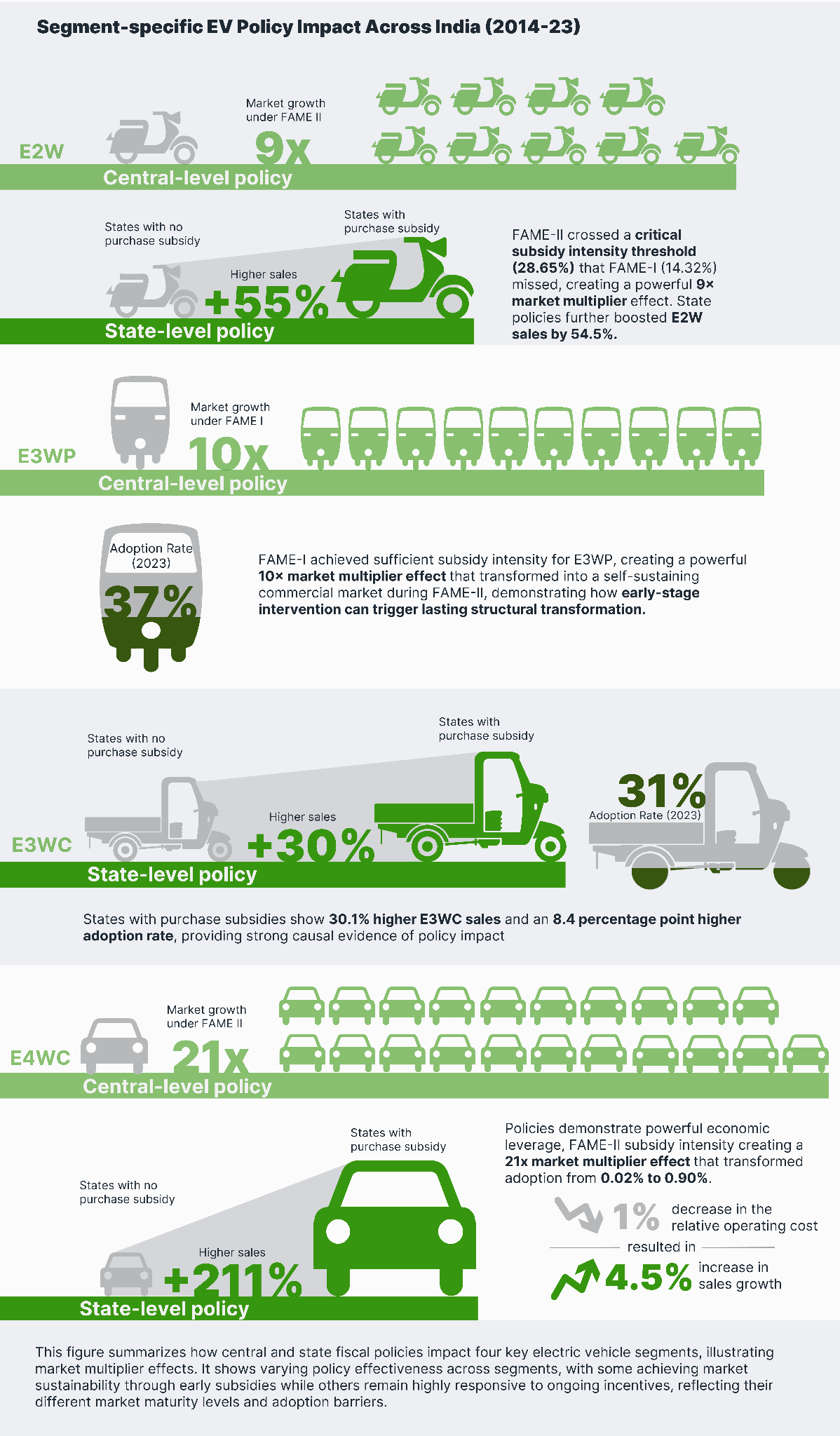
Electric two-wheelers are more sensitive. Scooters have become more competitive, but buyers still respond strongly to upfront prices. When FAME support was reduced in June 2023, many buyers brought forward their purchases, and sales weakened after the deadline. This makes two-wheelers the immediate test of the secretary’s confidence.
Passenger vehicles look more market-led. They have generally not received direct central purchase subsidies, but registrations have grown as more models have arrived, range has improved, battery prices have fallen and manufacturers have competed more aggressively.
Even here, however, “market-led” does not mean “policy-free”. Electric cars continue to benefit from 5% GST, registration-fee concessions, state tax exemptions in some places, charging support and manufacturing incentives.
Buses and trucks are further behind. Electric buses still depend heavily on government orders, payment guarantees and depot infrastructure. Electric trucks face high upfront prices, financing challenges, charging constraints and uncertain resale values.
The timing matters
The question is not whether subsidies should end. It is whether they are being withdrawn at the right time.
A market is ready to stand on its own when sales continue growing after subsidies fall, the upfront price gap narrows, financing and resale improve, and charging becomes viable without constant government support. India has not yet formally separated policy-driven adoption from market-driven growth, so we cannot know how much demand would survive if the entire policy stack disappeared.
China offers one example of a successful transition. It reduced purchase subsidies after building manufacturing scale, battery capacity, charging networks and consumer demand. By 2024, around two-thirds of electric cars sold in China were cheaper than comparable conventional cars even before incentives. But China continued supporting the industry through tax concessions, trade-in schemes and industrial policy.
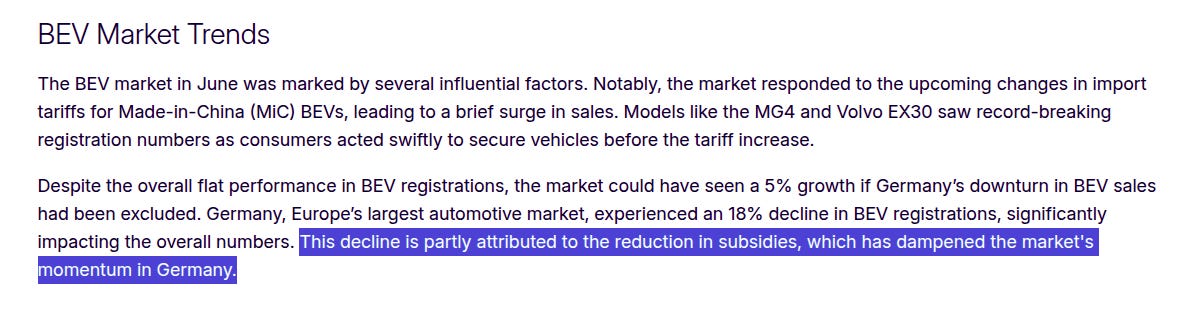
Europe offers the opposite warning. EV sales stagnated in 2024 as subsidies weakened, partly because electric vehicles still carried substantial price premiums.
Withdraw support too early, and the market may stall. Wait too long, and companies may never learn to compete without it.
India’s three-wheelers may be ready to move on. Its scooters, cars, buses and trucks are at different stages. The timing, therefore, cannot be the same for all of them.
- This edition of the newsletter was written by Manie & Kashish.
Tidbits
1. Godrej Consumer Products outlines ₹150 crore R&D investment and higher operating costs
Godrej Consumer Products plans to invest approximately ₹150 crore to establish a new research and development centre. The company expects the facility, along with increased international go-to-market and digital-marketing initiatives, to add around ₹200 crore to its annual operating costs once fully implemented.
Source: The Economic Times
2. Data centre boom projected to add just 0.13% to India’s GDP by 2030
Moody’s Ratings expects India’s expanding data-centre sector to contribute only about 0.13% of GDP by 2030 despite heavy investment. High dependence on imported equipment and the sector’s capital-intensive operations limit domestic value addition and long-term job creation.
Source: Financial Express
3. Afcom signs letter of intent to acquire four Boeing 777-8F freighters
Cargo airline Afcom has signed a letter of intent with Boeing to acquire up to four 777-8F freighter aircraft to support its logistics network. The proposed deal would expand Afcom into wide-body freighter operations and strengthen its long-haul cargo capacity, subject to a final purchase agreement.
Source: Financial Express
4. Swiggy’s Crew expands into dedicated travel concierge service
Swiggy’s premium concierge platform CREW has launched a 24/7 personal travel service covering planning, bookings, and on-trip support. The move follows a year of running CREW as a broader personal concierge, with travel emerging as its strongest-use category.
Source: The Economic Times
5. Shipping groups welcome proposal to add Indian recycling yards to EU list
Major international shipping associations, including BIMCO and the International Chamber of Shipping, have backed a European Commission proposal to include two Indian ship-recycling facilities on its approved European list. If finalised, the inclusion of the Alang-based yards would signal that upgraded non-OECD facilities can meet the bloc’s stringent environmental and safety standards.
Source: Marine Insight
Beyond Today’s Brief
There’s always more happening at Markets by Zerodha.
The Chatter: How is SEBI targeting network-level market risks, and why is Maruti Suzuki betting on biogas alongside EVs? Plus, key updates from United Breweries, Indian Bank, Zen Technologies, and Lumino.
Aftermarket Report: Why did Nifty give up its intraday recovery to close near 23,900 despite global market strength? What does UltraTech’s entry into wires and cables mean for Polycab and KEI? Plus, key updates on SEBI’s derivative pricing, global oil spikes, and Volkswagen layoffs.
Points & Figures: How did India's mutual fund industry surge to ₹74 lakh crore as SIPs became a monthly habit for millions? What is driving the rise of passive investing, and how far has the boom spread beyond top cities?
Join us on WhatsApp, where we share interesting soundbites from concalls, articles, and everything else we come across throughout the day. You’ll also get notified the moment a new video or article drops so that you can read or watch it right away.
Thank you for reading. Do share this with your friends and make them as smart as you are 😉
The real estate element of the newsletter is too good! Enjoyed the story a lot
Decision in true spirit.