

Our goal with The Daily Brief is to simplify the biggest stories in the Indian markets and help you understand what they mean. We won’t just tell you what happened; we’ll tell you why and how too. We do this show in both formats: video and audio. This piece curates the stories that we talk about.
You can listen to the podcast on Spotify, Apple Podcasts, or wherever you get your podcasts and watch the videos on YouTube. You can also watch The Daily Brief in Hindi.
In today’s edition of The Daily Brief:
1. What is eating into Indian QSR’s lunch?
An ICRA study shows that while Indian quick-service restaurant (QSR) operators expanded revenues by adding new stores, sales at existing stores remained sluggish, dragging operating margins down to ~15.9% in H1 FY26. Though Q1 FY27 brought a modest recovery, individual strategies differ sharply: Domino’s is leveraging delivery dominance while upgrading 400 dine-in stores; Devyani and Sapphire rely on KFC’s steady growth while restructuring Pizza Hut; and Westlife (McDonald’s) is managing supply chain disruptions like fryer shortages to protect footfalls through value meals.
2. How are banks lending against cheese as collateral?
In Northern Italy, regional bank Credito Emiliano accepts wheels of Parmigiano Reggiano as loan collateral. Because authentic Parmesan must age for 12 to 36 months before sale, producers face significant working capital lockups. The bank holds young wheels in climate-controlled vaults—now storing over 500,000 wheels worth €300+ million—providing producers 60–80% of estimated value upfront. However, climate change-induced heatwaves and droughts are driving up operational costs by reducing milk yields, inflating local fodder prices, and increasing vault cooling expenses.
What is eating into Indian QSR’s lunch?
India’s listed restaurant chains usually had a fairly simple way to keep growing: open more stores.
An ICRA study of five large quick-service restaurant operators found that industry revenue grew 10% in FY25 and 11% in the first half of FY26, largely because the companies kept adding outlets. But sales at existing stores remained weak, while operating margins fell from around 20% in FY23 to 15.9% in the first half of FY26.
Q1 FY27 suggests that demand is beginning to improve. Domino’s, KFC and McDonald’s all reported positive growth at existing stores. But the recovery looks very different inside each company.
Domino’s is getting much of its momentum from delivery and is now trying to repair dine-in. The two large KFC and Pizza Hut operators are moving towards a merger while taking opposite decisions on weak Pizza Hut stores. McDonald’s is seeing customers return, but inflation has wiped out much of the benefit.
The interesting QSR story is now less about who opens the most outlets. It is about what each company is doing with the stores, kitchens, delivery networks and brands it already has.
Winner winner, pizza dinner?
Let’s start with Jubilant, the largest (and by many metrics, the most successful) QSR operator in India. While Popeyes may be Jubilant FoodWorks’ fastest-growing brand, Domino’s remains the centre of the business.
Jubilant’s standalone revenue rose 9.2% year-on-year (y-o-y) to ₹1,849 crore in Q1 FY27. Domino’s India alone generated ~95% of that revenue. It ended the quarter with 2,513 stores after adding 58 outlets across 19 new cities.
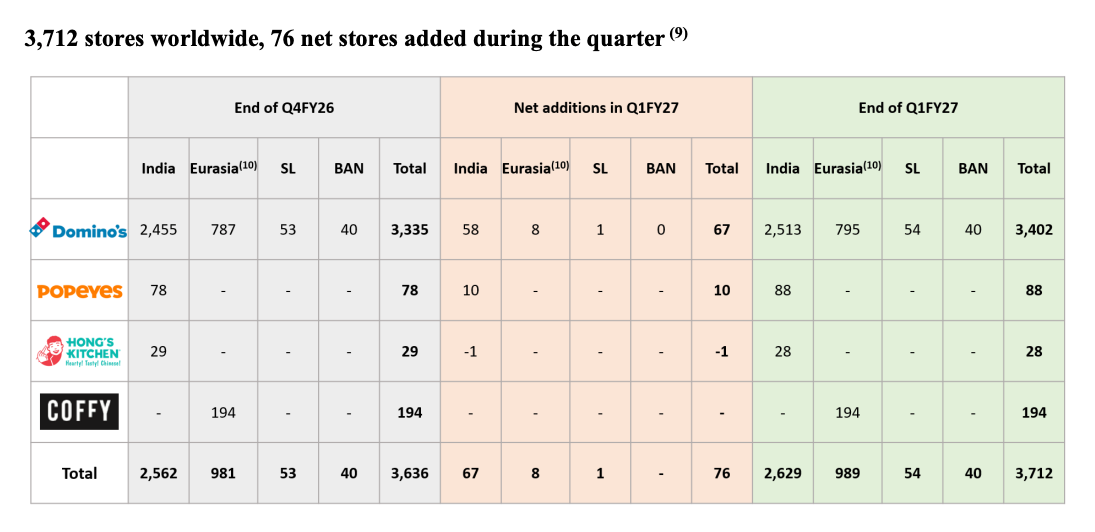
The core business is growing, although not at the pace last year’s number may make you expect. Domino’s like-for-like sales grew 2.5%, compared with 0.2% in the previous quarter. Like-for-like sales tells us whether older restaurants are actually selling more, not merely whether the company has grown by opening new ones. In contrast, in Q1 FY26, like-for-like growth stood at 11.6%. Order volumes rose 6.5% year-on-year, which tells us that more orders were being placed even though growth in sales per existing store was slower.
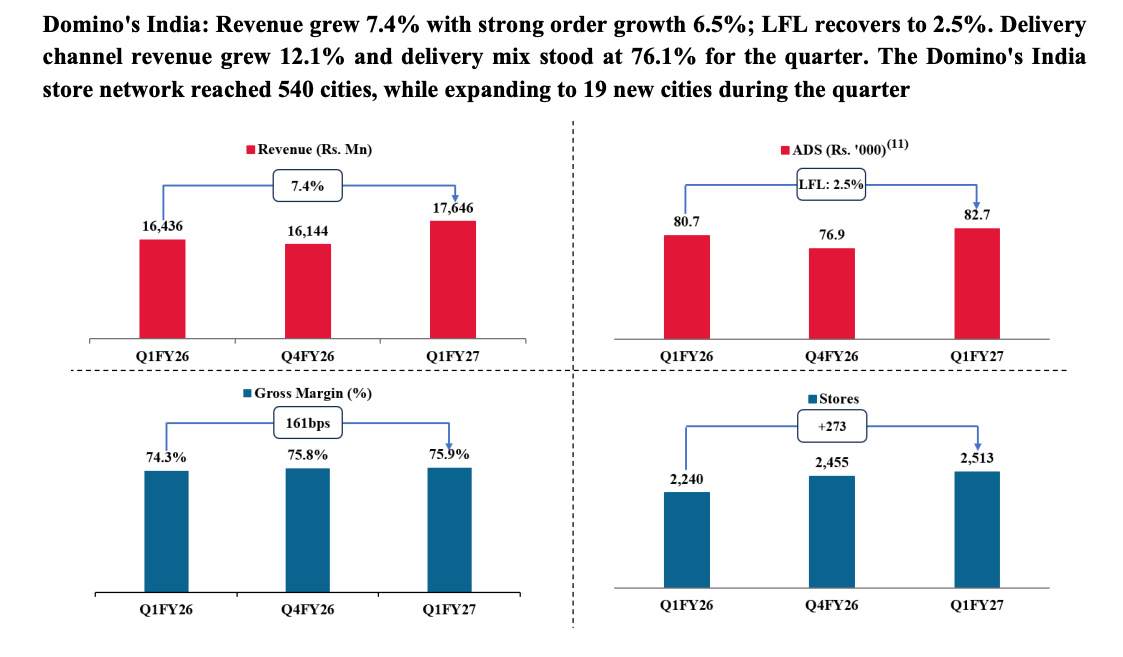
Management still wants Domino’s to produce 5–7% like-for-like growth over the medium term and expects Q2 to be better than Q1. The favourable base will eventually disappear, and Domino’s will have to show that order growth can translate into stronger sales at each store.
For now, delivery is doing most of the work. Domino’s delivery revenue grew 12.1% during the quarter, faster than the brand’s overall revenue, and delivery accounted for roughly three-fourths of sales. This is a strength built over years: Domino’s has its own app, delivery staff, kitchen network and customer data instead of depending entirely on Swiggy and Zomato.

But delivery is not the most profitable channel. Jubilant reduced the minimum order value on its app to stay competitive and encourage repeat orders.
This is also why Jubilant has not abandoned the restaurant. It is upgrading about 400 Domino’s stores to improve service, throughput and the customer experience. Value offers, such as the ₹119 My Meal and Best Deal Wednesdays, are meant to bring people in without relying only on blanket discounts.
The two channels therefore solve different problems. Delivery gives Domino’s frequency and reach, while Dine-in gives it a chance to sell drinks and sides without bearing the full cost of the last mile. A dense physical network still matters even in a delivery-led business because a kitchen closer to the customer can improve speed and reduce the distance of each order.
Pricing is the difficult balance underneath all of this. During the slowdown, Domino’s tried to keep ordering affordable through entry-level pizzas, bundled lunch meals and low delivery charges. This helped protect order volumes, but left the company with less room to pass rising costs on to customers. Additionally, in Q1, Jubilant took a net price increase of about 1.4% to absorb part of the rise in LPG and employee costs.
That being said, Jubilant hopes that Popeyes’ becomes its new driver of growth.
Revenue almost doubled, like-for-like growth stayed above 40% for a third straight quarter, and average daily sales crossed roughly ₹95,000. Jubilant ended the quarter with 88 Popeyes stores and wants to add 35–40 a year, with an ambition to build a ₹1,000 crore brand over the next few years.
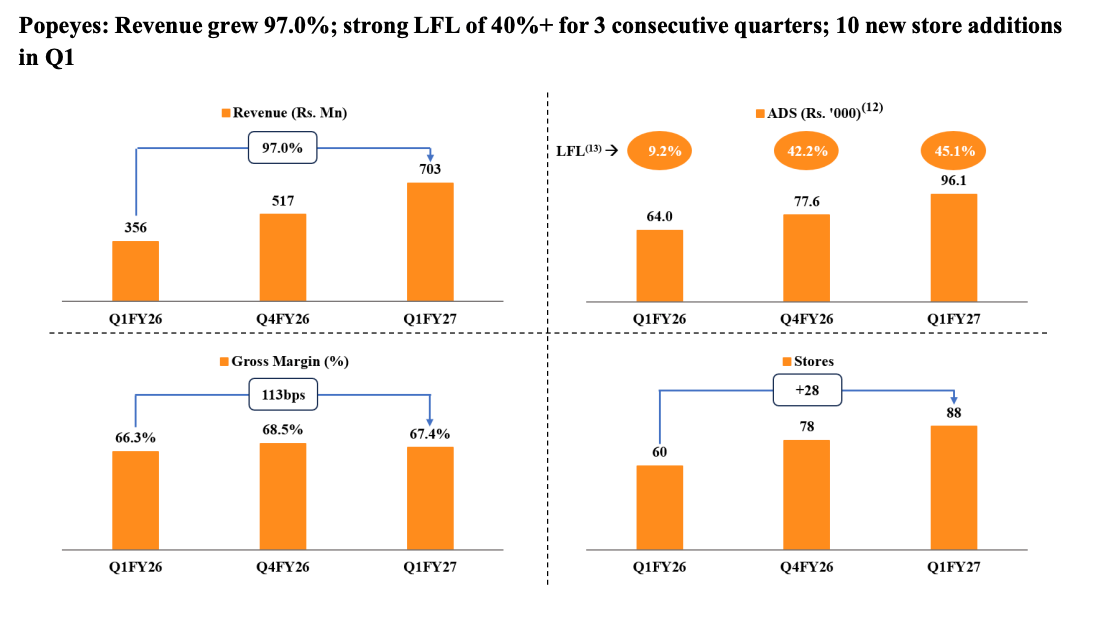
Those numbers are promising, especially because like-for-like sales are improving alongside expansion. Jubilant can also reuse parts of the supply chain, property capability and digital system it built for Domino’s. But Popeyes is still very far from being a strong second engine for Jubilant.
At the same time, Jubilant is cutting fat elsewhere. It will not renew the Dunkin’ franchise agreement after December 2026; the brand contributed only about 0.6% of revenue and was loss-making in FY25.
One merger, several problems
Now, we move on to Devyani and Sapphire.
If you’d remember, it wasn’t long ago that both brands announced a blockbuster merger, the largest in Indian QSR. The merger is still underway: Devyani International and Sapphire Foods still report separately. But it makes more sense to read them together. They’re very similar businesses, quite literally. After all, both operate KFC and Pizza Hut in different territories.
Devyani’s consolidated revenue grew 16.5% to ₹1,581 crore, while PAT rose from ₹2.4 crore in Q1 FY26 to ₹17.1 crore in Q1 FY27. The nearly sevenfold jump looks dramatic because last year’s profit base was unusually small compared to previous years. It was still a genuine operating recovery, but this was more of a return to normal than expansion of new business.
Sapphire’s PAT stood at about ₹14 crore, compared with a loss in the same quarter last year, while restaurant sales grew 15% to ₹888 crore. In both businesses, KFC did most of the heavy lifting.
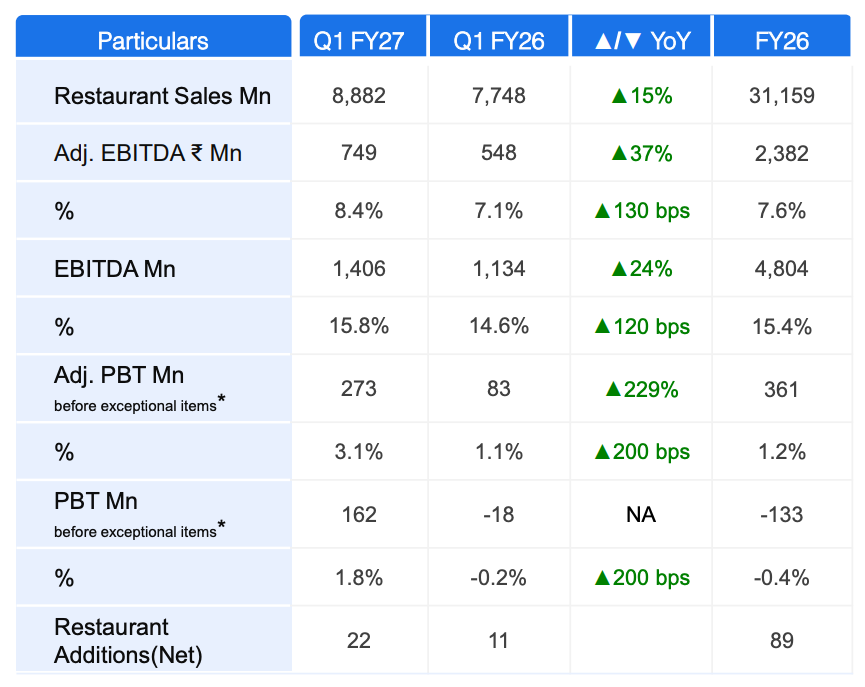
At Devyani, KFC same-store sales grew 3.3% and average daily sales reached around ₹98,000. Management believes brand-contribution margins can cross 20% once average daily sales reach roughly ₹1.05–1.10 lakh. That leaves a gap of ₹7,000-₹12,000 per restaurant per day. Devyani is trying to close that gap with three global KFC initiatives: Kwench beverages, customised sauces and a larger boneless-chicken portfolio.
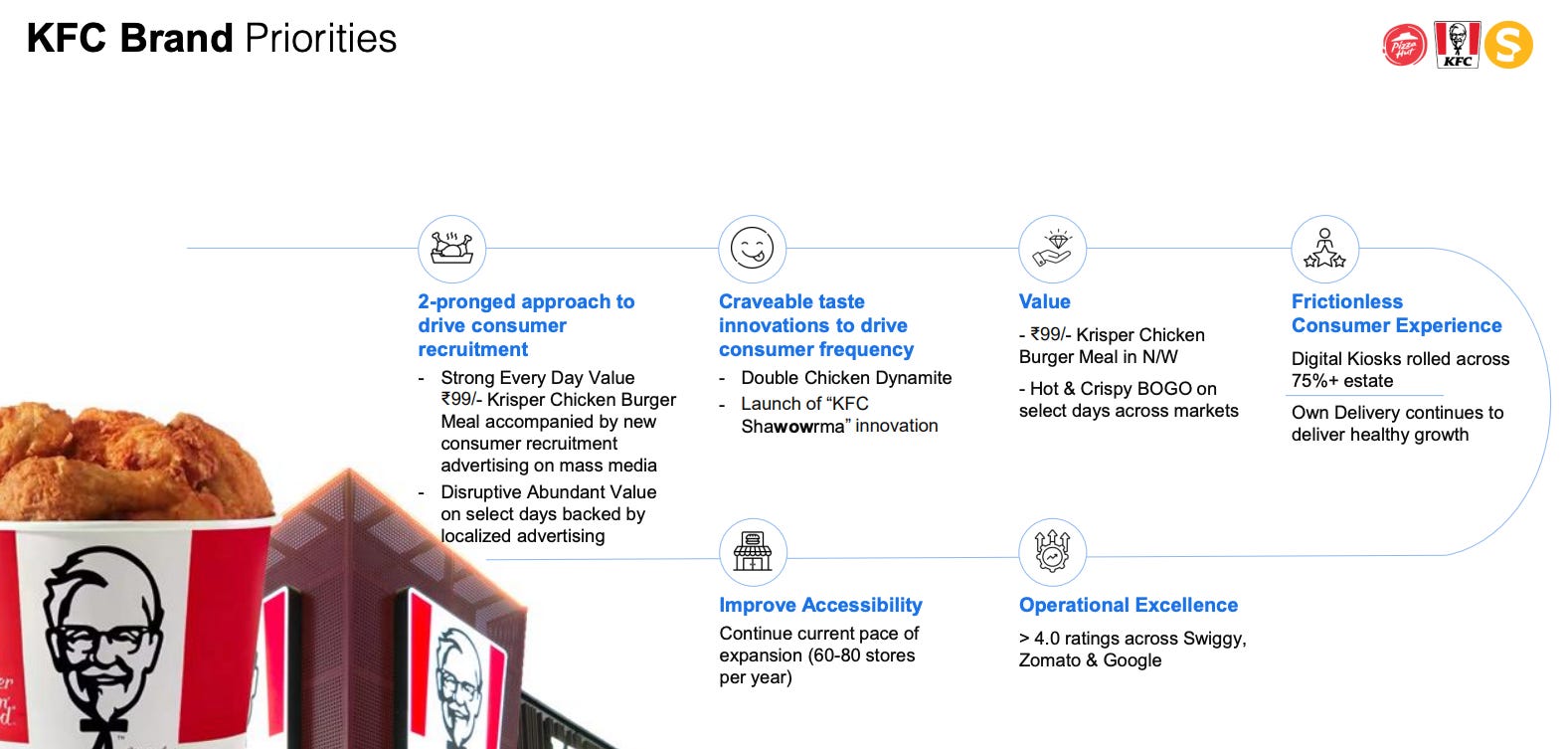
The more revealing change is where Devyani wants those sales to happen. Management has shifted marketing away from deep online discounting and towards dine-in offers. KFC’s dine-in and takeaway share has risen to around 57%. Delivery may add reach, but as Jubilant is finding out, aggregator commissions, discounts and delivery costs make margins less attractive. A customer eating inside the restaurant is also more likely to add a drink or side, which are the exact categories KFC is expanding.
Sapphire is seeing something similar. Its KFC India sales grew 17%, same-store sales rose 5%, and restaurant EBITDA margin improved to 16.9%. It linked the improvement partly to a higher dine-in and takeaway mix, helped by a ₹99 burger meal and occasional buy-one-get-one bucket offers.
Pizza Hut remains the harder problem. Devyani’s Pizza Hut same-store sales fell 2.2%, average daily sales were only around ₹32,000, and the brand made a ₹3.6 crore contribution loss. Devyani closed 13 net Pizza Hut stores in the quarter, reducing its network to 626, and is undertaking a back-to-basics reset around ingredients, menu clarity and better pricing.
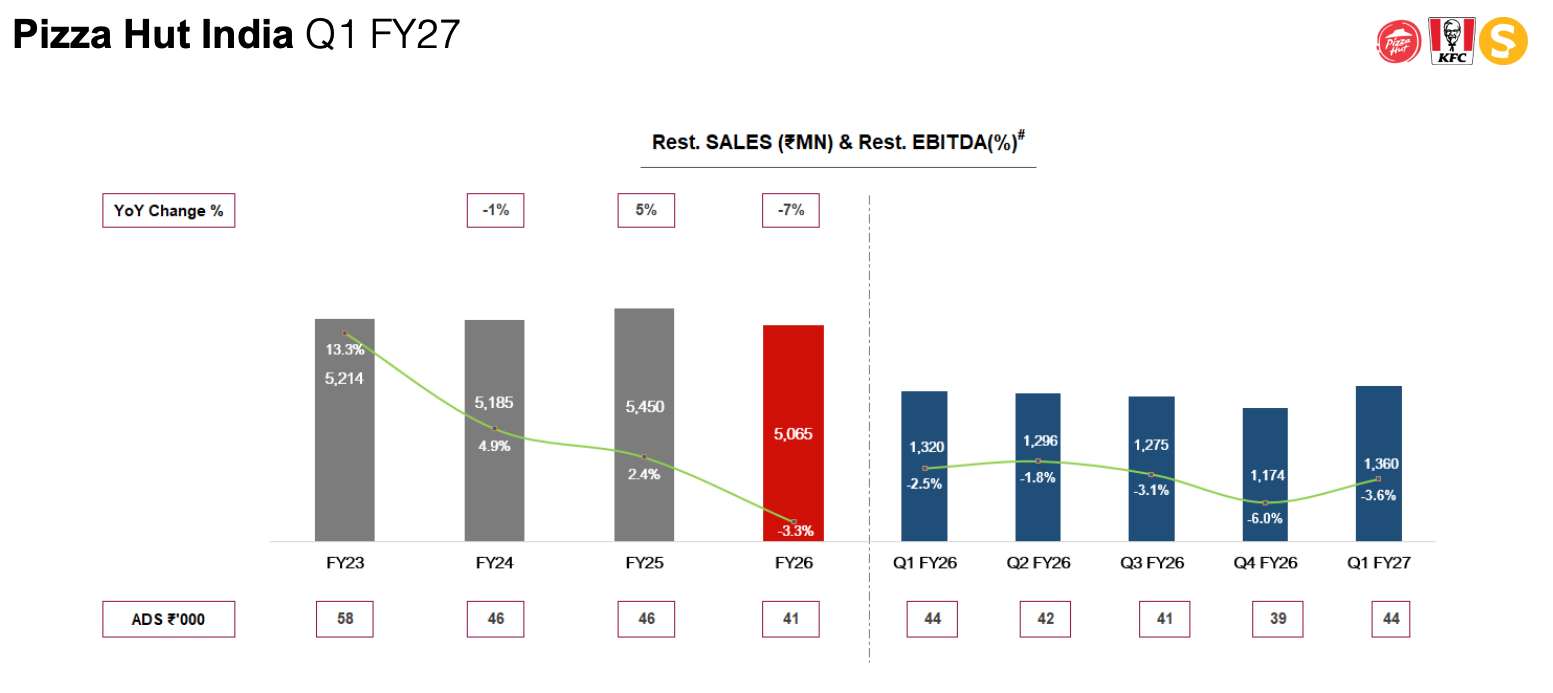
Sapphire’s Pizza Hut business offered a small sign of recovery: same-store sales grew 1% after five negative quarters. But the brand’s EBITDA margin was still in the negative. If the expectation from the merger is to reduce operational inefficiencies and bring back EBITDA in the green, it will be far easier said than executed.
Besides Pizza Hut and KFC, Devyani has also been making other side bets. One such major bet is Biryani By Kilo (BBK).
BBK was built largely as a delivery-led brand, and biryani consistently ranks as the top-most ordered item on Zomato and Swiggy. But Devyani is now testing food-court, airport and dine-in formats with BBK, having rolled out lower-capex BBK Express outlets and experimenting with vegetarian menus after turning the brand positive at the contribution level.
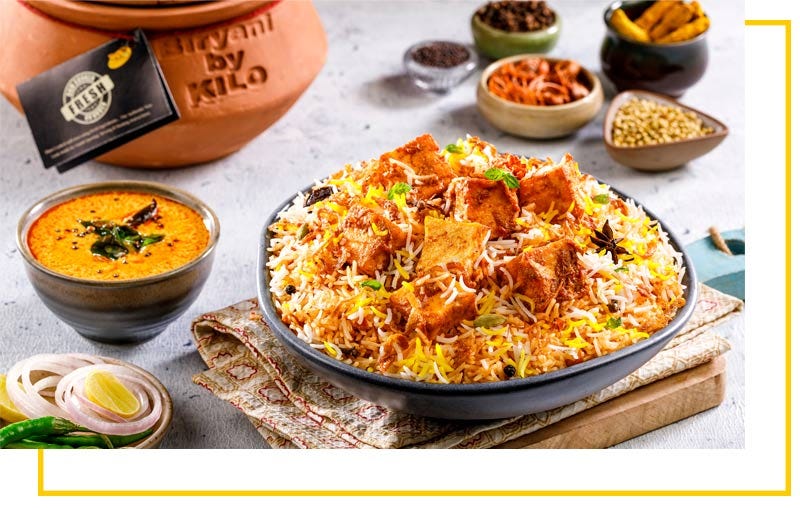
Smaller express outlets let BBK enter a catchment without paying for a large restaurant. Dine-in creates visibility and occasions beyond a delivery search. Vegetarian food can soften the sharp drop a meat-heavy brand may face during religious periods. But a broader menu also adds ingredients and kitchen complexity.
The joker card
Westlife Foodworld, which runs McDonald’s in western and southern India, had the clearest gap between sales growth and profit.
Revenue rose 11.9% to ₹736 crore and same-store sales grew 4.3%, supported by double-digit growth in guest counts.
Gross margin dropped by about four percentage points from last year to 67.6%. However, as per management, commodity inflation was not wholly responsible for this — in fact, they were able to absorb a large chunk of it with cost optimization. It was because, since Q3 FY26, they moved certain supply chain and processing charges to the “cost of goods sold”, automatically reducing gross margins. Otherwise, this metric remained somewhat stable.

Yet, net profit fell by more than half to a measly ₹0.6 crore. This was due to depreciation and finance costs, which increased by more than ₹8 crore from last year.
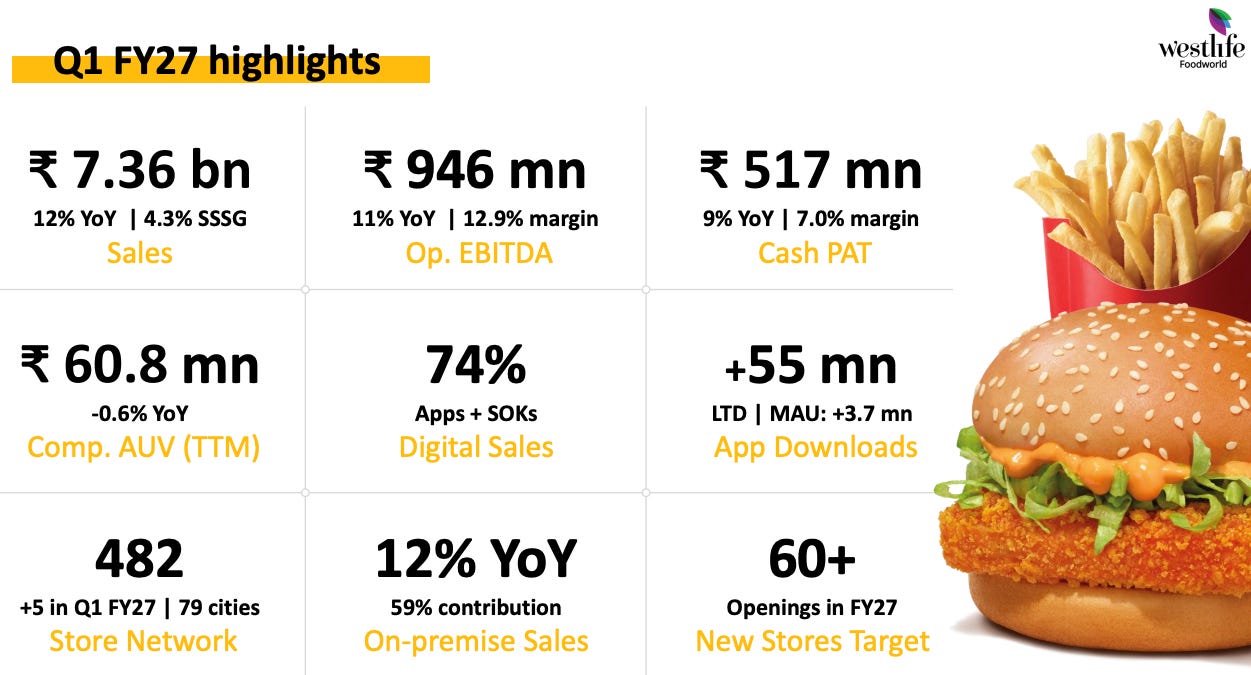
Management has so far avoided a broad price increase, preferring to protect traffic through its Everyday Value platform. That helped dine-in footfalls, while on-premise sales, which include dine-in and takeaway, grew 12% and remained 59% of revenue. Off-premise sales, which include delivery and drive-through, grew at a similar pace, with McDelivery continuing to outperform.
Meanwhile, digital sales formed 74% of revenue. But digital is not a separate channel: it simply means the order was placed through an app or self-ordering kiosk. A digital order can therefore be ordered at an on-premise kiosk, or off-premise, such as a McDelivery order.
The operational response is becoming more local. Westlife is dividing its management structure from three regions into five so that decisions sit closer to restaurants. The South returned to positive same-store growth during the quarter after a weaker period. The new structure should make it easier to adapt promotions and store operations across very different markets. It will only be useful if the extra divisions produce faster decisions rather than extra layers.
Then there is the fryer problem.
Westlife opened five restaurants and closed one in Q1, taking its total to 482. This was not because it had suddenly lost its appetite for expansion. A commercial LPG disruption forced the company to convert equipment in existing restaurants, so electric fryers meant for new stores were diverted to keep old ones running. A temporary global fryer shortage then delayed replacements.
A fryer shortage hasn’t dissuaded the company from planning to open more than 60 restaurants in FY27. That will, however, depend on kitchen equipment, fuel supply and execution as much as it depends on demand.
Conclusion
None of these companies has stopped expanding. Jubilant is still adding Domino’s stores and building Popeyes. Devyani expects KFC and its newer brands to lead additions. Sapphire continues to open KFC outlets while being cautious on Pizza Hut. Westlife is holding on to its annual McDonald’s target despite the slow first quarter.
What has changed is the assumption behind expansion. A new store can add revenue, but it can also add rent, staff, delivery distance and another kitchen that needs enough daily sales to become useful. When growth at older stores is weak, opening more outlets can make the company bigger without making it much healthier.
Jubilant has to make Domino’s delivery growth profitable while giving customers a reason to sit inside 400 upgraded stores. Devyani and Sapphire have to combine two large systems, improve KFC’s store productivity and decide how much of Pizza Hut should survive the reset. Westlife has to convert returning footfall into profit while reorganising its regions and catching up on openings.

The bank where cheese is collateral
In northern Italy, a wheel of cheese can help you get a bank loan.
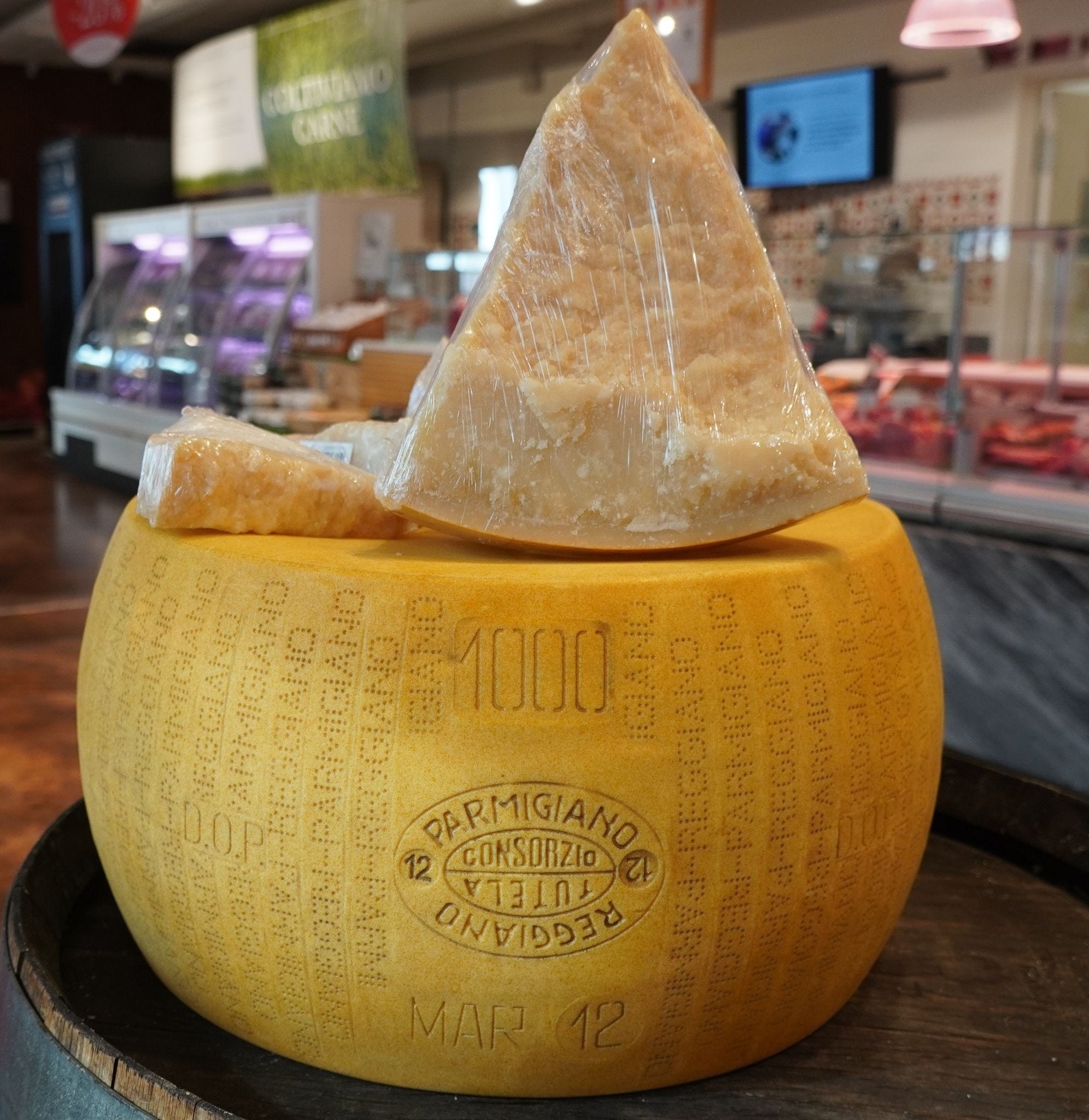
This is not an average supermarket cheese, obviously, but an enormous wheel of authentic Parmigiano Reggiano or commonly known as Parmesan. Producers can pledge these wheels to a bank, receive a loan against them and reclaim the cheese when the money is repaid. If they default, the bank can eventually sell it.
This arrangement might look strange, but there is a very sensible financial reason behind it.
Parmeshan cannot be sold as soon as it is made. The cheese must mature for at least 12 months, and many wheels are aged for 24 or 36 months. During this time, producers have already paid for the milk, labour, salt, electricity and everything else that goes into making it.
Their money is tied up in cheese sitting inside a warehouse. That is working capital: money locked into the business until the product can be sold. But producers still need cash to make the next batch. That is where Credito Emiliano comes in.
The regional Italian bank has accepted young Parmesan wheels as collateral since 1953. In other words, producers can pledge the cheese while it is still maturing, rather than waiting until it is ready to sell. Credem’s subsidiary stores and matures the wheels in specialised warehouses until they are reclaimed or sold to recover the loan.
These two warehouses now contain more than 500,000 wheels worth over €300 million. Producers can receive roughly 60–80% of a wheel’s estimated value upfront. In lending parlance, this is the loan-to-value ratio. The money helps producers fund their working capital while the cheese ages and they continue making more.
The system also works because Parmesan is not ordinary inventory. It can become more valuable as it ages. But first, it must earn the name.
Why is this cheese so precious?
“Parmesan” is used loosely around the world for hard, grated cheese. Parmigiano Reggiano is different. It is legally protected and can only be made in Parma, Reggio Emilia, Modena and specified parts of Bologna and Mantua.
The rules governing it are strict. The milk must come from farms within this region, and at least 75% of the cows’ forage must also be produced there. Silage, a type of fodder fermented to make it last longer, is prohibited. This leaves farmers with less flexibility when heat and drought reduce local grass and hay production.
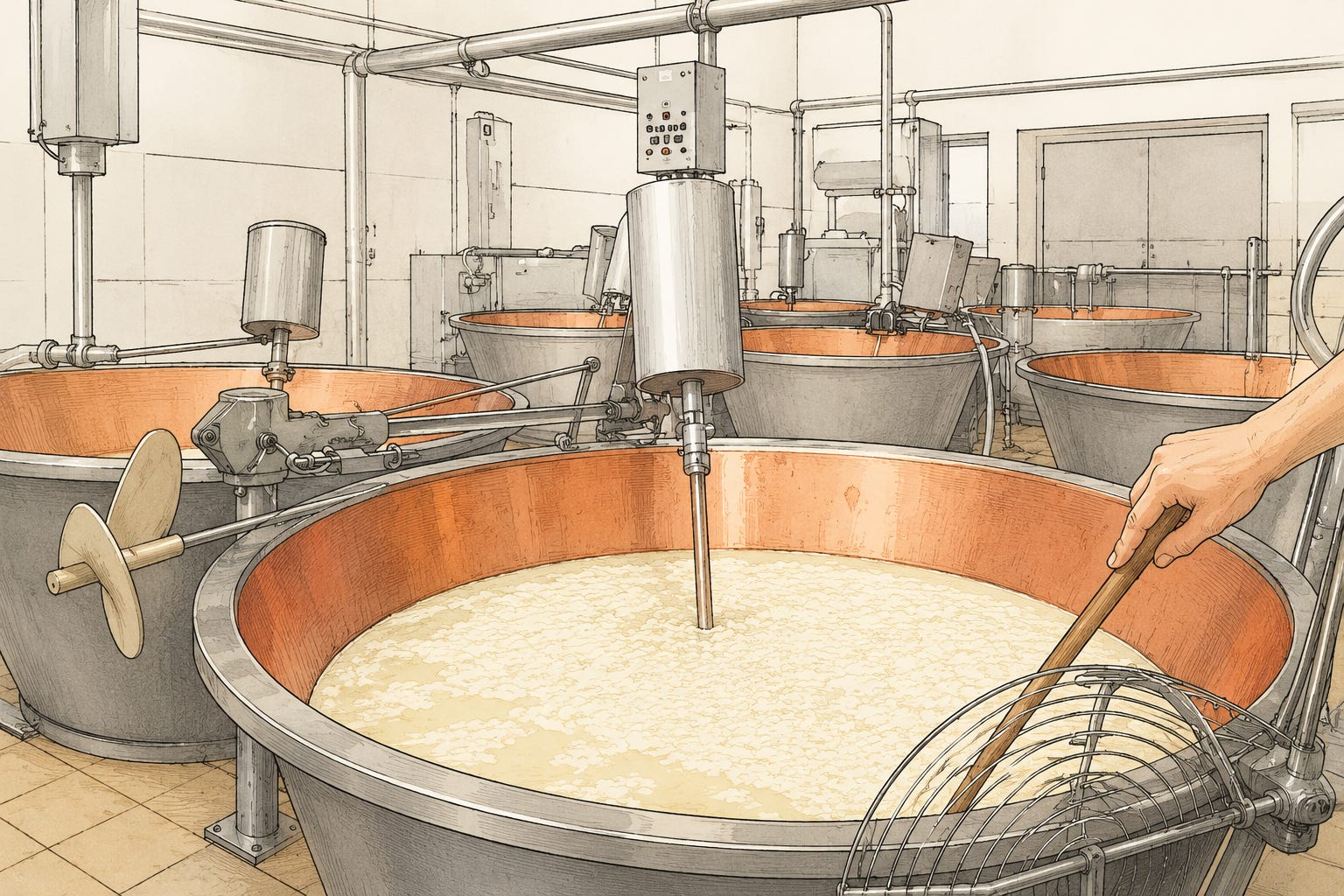
The cheese itself contains only raw cow’s milk, salt and calf rennet. No additives or preservatives are used. It takes roughly 550 litres of milk to make one wheel weighing about 40 kilograms.
The milk is curdled, cooked and shaped into wheels, which are then placed in brine. Each wheel receives the familiar “Parmigiano Reggiano” markings and a unique traceability code linking it to the dairy and production date.
After sitting in the brine, the wheel begins ageing.
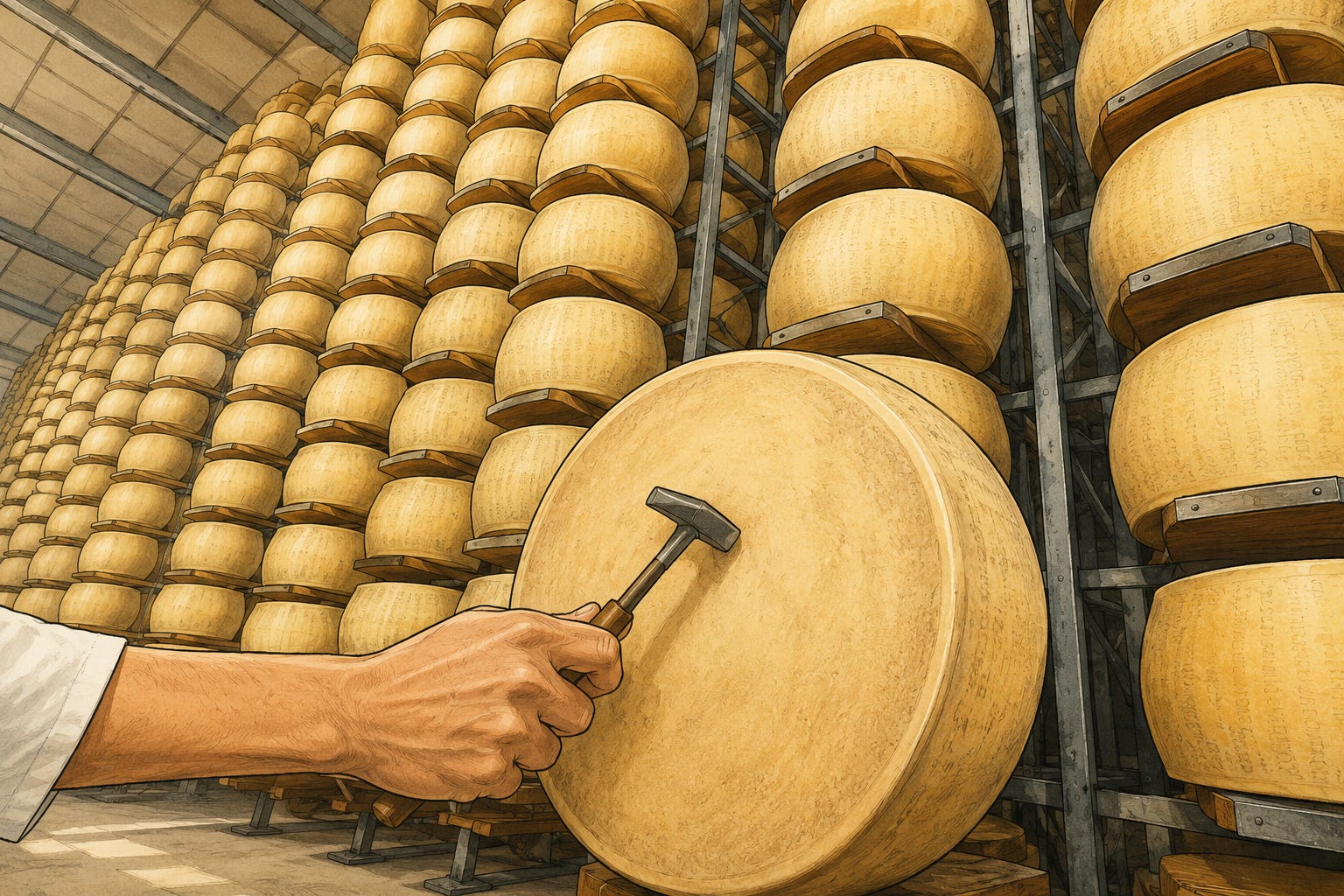
Once a wheel reaches 12 months, experts from the Parmigiano Reggiano Consortium inspect it by tapping the rind with a small hammer. The sound helps them detect cracks, air pockets and other defects. Wheels that pass receive the official fire-branded mark. Those that do not lose the right to be sold as Parmigiano Reggiano.
This is why the cheese is not risk-free collateral. A wheel can develop defects while it ages, reducing its value. Market prices can also change before it is ready to be sold.
Credem can lend against the wheels because it knows how to manage these risks. Its warehouses maintain controlled temperature and humidity, while trained workers inspect, clean and turn the cheese as it matures.
By keeping the wheels under its supervision, the bank can continuously monitor their condition and value. If a producer defaults, it can sell the cheese once it has matured.
It is an unusually neat arrangement. Ageing turns milk into a more valuable product, while the loan turns part of that future value into money the producer can use today.
But climate change is making both processes more expensive.
When the cows feel the heat
During recent heatwaves, temperatures in the Parmigiano Reggiano-producing region have risen above 40°C.
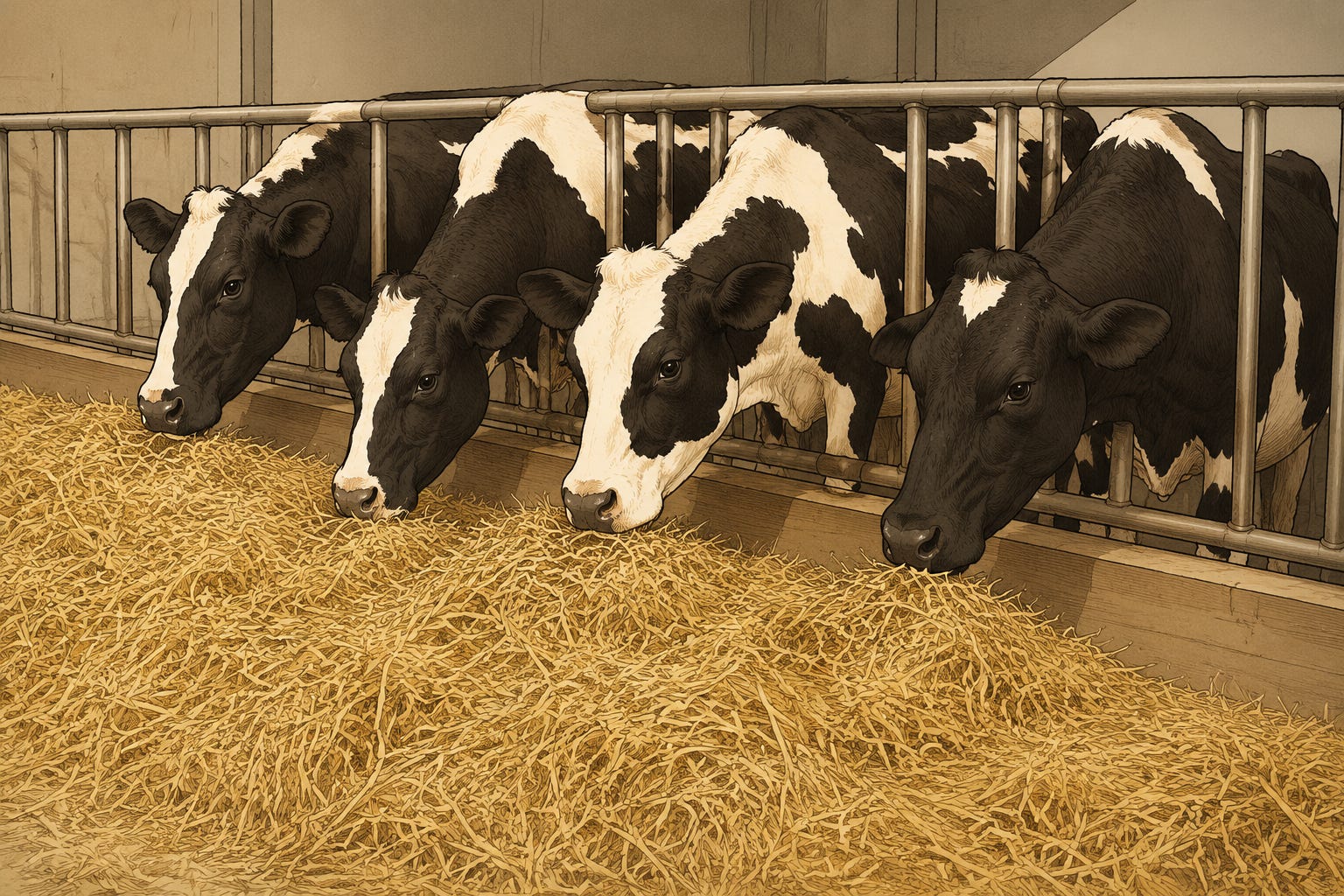
Climate change is putting pressure on the cheese industry at three different points: on the farm, in the search for fodder and inside the warehouses where the cheese matures.
1. The cows produce less milk
Extreme heat makes cows eat less and use more energy to cool themselves. This affects both the quantity and quality of their milk. During severe heat, milk output can fall by as much as 10%.
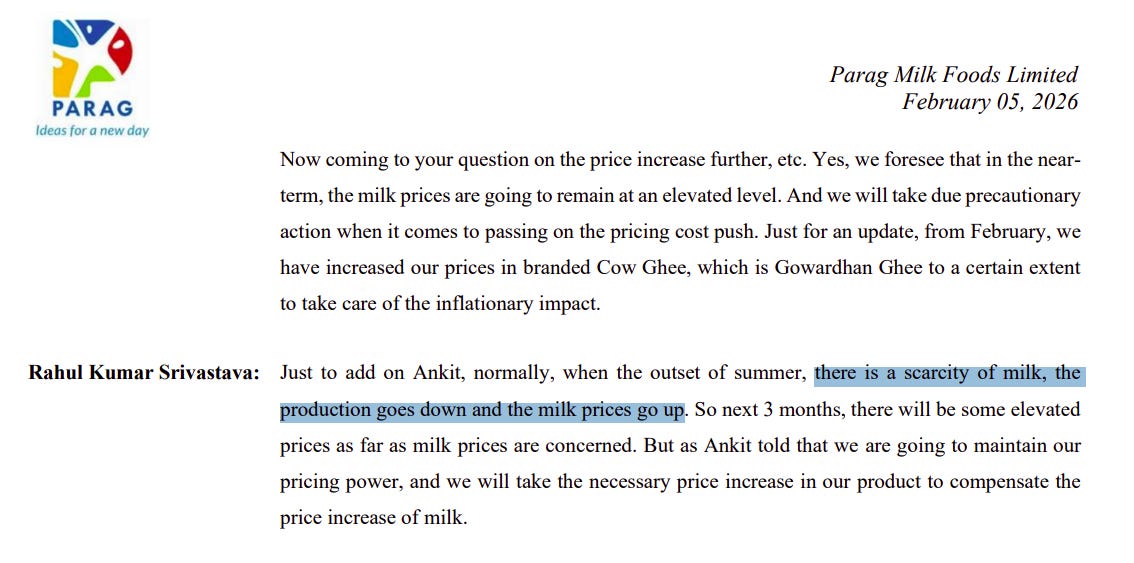
This is not unique to Italy. Indian dairy companies face similar seasonal pressure. In a February 2026 earnings call, Parag Milk said summer typically brings milk scarcity, lower production and higher milk prices.
Farmers are trying to protect their animals by keeping barns open and installing industrial fans and water-misting systems. But this equipment is expensive to buy and operate. Reuters reported that it is increasing farms’ energy costs and, in turn, the cost of producing the cheese.
2. Fodder becomes harder to find
Drought creates another problem. If hot, dry weather reduces grass and hay production within the protected region, farmers cannot replace the entire shortage with cheaper forage from elsewhere. At least 75% of the cows’ forage must come from within the designated area.
That makes locally compliant fodder scarcer and more expensive, leaving farmers with fewer options when local supplies are hit.
3. The cheese costs more to store
Parmigiano Reggiano wheels can spend one to three years maturing. Throughout that period, they must be kept at controlled temperatures and humidity levels so they do not spoil or lose value.
At the peak of this year’s heat, daily electricity consumption at cheese vaults increased by around 30%. The warehouse operator has responded by upgrading refrigeration, improving insulation and expanding renewable-energy generation. But these measures also raise the cost of maintaining the cheese — and therefore the collateral backing the loans.
This does not mean there is an immediate “Parmesan crisis”. The warehouses continue to operate normally, the cheese is aging under optimal conditions and the Parmigiano Reggiano Consortium says production is not currently at risk.
But the financial pressure is real. Italy produced more than 4.19 million Parmigiano Reggiano wheels in 2025, generating consumer turnover of approximately €3.96 billion. More than half of total sales came from exports.
Parmigiano Reggiano is valuable because it can be produced only in a specific region, using locally sourced milk and a centuries-old production system. But that also means producers cannot simply move somewhere cooler as the region gets hotter.
The cheese may become more valuable with age. Climate change is making the wait more expensive.
- This edition of the newsletter was written by Kulsum.
Tidbits
1. India’s services exports rise 13.4% to $38.25 billion in July
India’s services exports rose 13.4% year-on-year to $38.25 billion in July, while imports increased 19.1% to $20.61 billion. The country still recorded a services trade surplus of about $17.65 billion during the month.
Source: The Economic Times
2. Government notifies ₹1.28 lakh crore Semicon 2.0 scheme for domestic chip ecosystem
The Indian government has introduced the Semicon 2.0 policy, allocating approximately ₹1.28 lakh crore to broaden support for the domestic semiconductor industry. The revised incentive framework moves beyond fabrication facilities to cover raw materials, chip design, manufacturing equipment, assembly, testing, and R&D support.
Source: The Economic Times
3. ITC Infotech to acquire 22.1% Happiest Minds stake ahead of merger
ITC Infotech will acquire a 22.1% promoter stake in Happiest Minds for about ₹1,330 crore, with the two companies also proposing a merger subject to regulatory and shareholder approvals. The combined IT services company is targeting $1 billion in annual revenue by FY28.
Source: The Hindu BusinessLine
4. GRT Jewellers to acquire 74.12% stake in Tribhovandas Bhimji Zaveri
Chennai-based GRT Jewellers has entered into an agreement to acquire a 74.12% stake in heritage jewelry retailer Tribhovandas Bhimji Zaveri. The acquisition represents a major consolidation in India’s organized jewelry retail sector, allowing GRT to rapidly expand its geographic presence into western and northern markets.
Source: Livemint
5. Maruti Suzuki outlines ₹77,500 crore capital expenditure plan through FY31
Maruti Suzuki plans to invest ₹77,500 crore over the next five years as it prepares for its next phase of expansion. The spending will support higher production capacity, new vehicle models and research and development.
Source: The Hindu BusinessLine
Beyond Today’s Brief
There’s always more happening at Markets by Zerodha.
The Chatter: What connects Indian Railways’ expansion to our power grid? How is TCS using its Porsche partnership to reshape European mobility? Plus, updates from Hexaware, Max Life, Tempsens, and Gokaldas Exports.
Aftermarket Report: How did a late closing-auction session save the day for bulls as Nifty held near 24,050? What pushed crude oil up toward $88 as U.S.-Iran tensions flared? And why did Japan's 10-year bond yield hit 3% for the first time since 1996?
Points & Figures: How did India’s microfinance sector recover after writing off 17% of its loan book? This edition looks at tighter regulation, falling delinquencies, and a two-speed recovery, with large NBFC-MFIs taking 98% of fresh borrowings.
What we’re reading: How did ITC move from cigarettes to biscuits, and how can rogue AI be held accountable? This week’s list covers ITC, Anthropic’s AI findings, rogue AI regulation, SEBI regulators, “thick” art, and our offline reading club.
Join us on WhatsApp, where we share interesting soundbites from concalls, articles, and everything else we come across throughout the day. You’ll also get notified the moment a new video or article drops so that you can read or watch it right away.
Thank you for reading. Do share this with your friends and make them as smart as you are 😉
2nd article was bit confusing. It would have been better if you could have given some one sentence or one word explanation to technical terms or new words. Thanks 👍
Fascinating to read about cheese as collateral. Please do keep publishing about lesser known economic stories around the world!!
Curious whether Italy was impacted by Middle Eastern war which impacted cattle fodder price like India or it was only because of extreme summers..