

Our goal with The Daily Brief is to simplify the biggest stories in the Indian markets and help you understand what they mean. We won’t just tell you what happened; we’ll tell you why and how too. We do this show in both formats: video and audio. This piece curates the stories that we talk about.
You can listen to the podcast on Spotify, Apple Podcasts, or wherever you get your podcasts and watch the videos on YouTube. You can also watch The Daily Brief in Hindi.
In today’s edition of The Daily Brief:
Who gets the spare lane on India’s power grid
A dispute between Jindal Stainless and Haryana highlights the growing tension between industrial consumers seeking open access to renewable power and discoms trying to preserve grid capacity and protect their electricity business.India’s refrigerant industry runs into a hot issue
India’s refrigerant makers are racing to expand capacity before production caps take effect in 2028, setting up a difficult transition as environmental regulations reshape the future of the air conditioning industry.
Who gets the spare lane on India’s power grid
On 7 January 2025, Jindal Stainless wrote a letter to Haryana’s state transmission utility.
The company runs a stainless steel plant in Hisar. Through a partnership, it had developed wind and solar projects in Gujarat and Madhya Pradesh, and wanted to wheel 100 MW of that power to Hisar, round the clock, over the interstate transmission grid. To do that, it needed a no-objection certificate (NOC) from the state.
In mid-February, Haryana said no.
To understand the refusal, you need to know how a state gets access to the national grid in the first place. Interstate transmission access is allocated through what the regulations call General Network Access, or GNA — a standing entitlement to draw a fixed number of megawatts from the national grid, from anywhere on it. Haryana’s GNA entitlement is 6,913 MW. The physical lines running into the state can carry roughly 10,000 MW. That gap between the entitlement and the wire is the interesting part, because Haryana leans on it every summer, when state demand climbs towards 16,500 MW and the state buys short-term power on the exchanges to cover the peak. Those purchases move over the same spare capacity Jindal was asking for.
Haryana’s power procurement arm framed the problem as a question of who has first claim on that headroom. If Jindal took 100 MW of it on a long-term basis, that was 100 MW the state could no longer reach for in June.
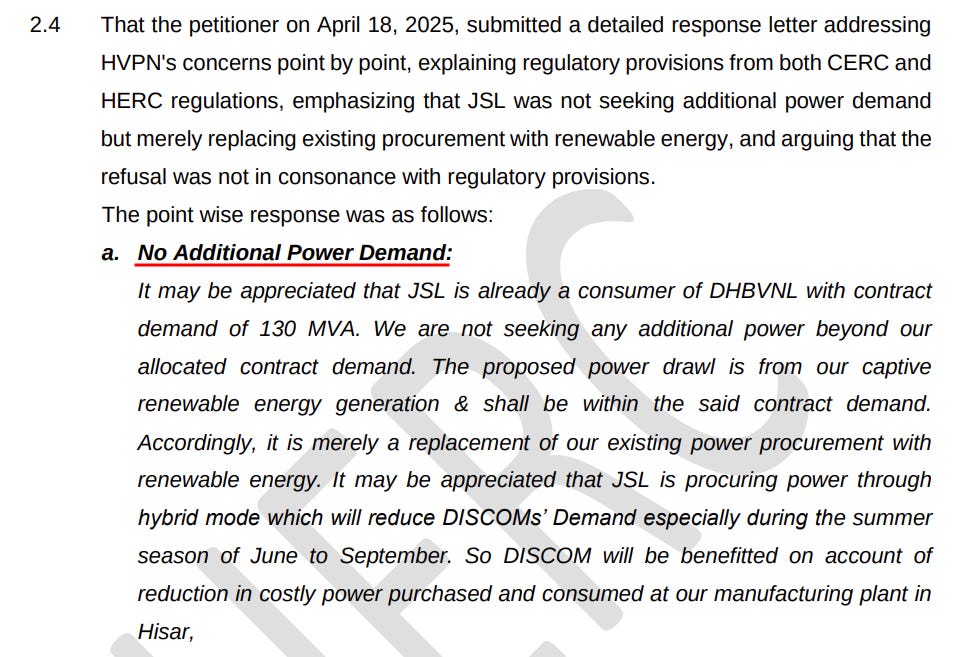
Jindal wrote back in April, saying it wasn’t asking for any additional power. It was already buying about 104 MW from the local discom. Every unit it sourced from Gujarat would simply replace a unit it would have otherwise bought from Haryana’s discoms.
In May, the company went a step further. It said that if the grid came under stress, the Haryana electricity department could disconnect its open-access supply, and Jindal would also bear any imbalance charges.
The state still refused.
By September, the matter had reached Haryana’s Grid Co-ordination Committee, which proposed a split. The certificate could be issued for nine months of the year, but not for June, July and August. Jindal could import its own power for three-quarters of the calendar and buy from the discom for the rest.
Jindal took the matter to the regulator instead. On 23 June 2026, the Haryana Electricity Regulatory Commission ruled in the company’s favour. It held that Haryana could not deny long-term open access just to preserve corridor capacity for temporary users. Keeping spare capacity for short-term summer purchases may make operational sense, but it is not a lawful reason to deny a Jindal access to the same transmission corridor.
Even then, the victory came with conditions. The commission gave the transmission utility two weeks to put in place the procedures and undertakings needed to operationalise Jindal’s curtailment proposal, and only then issue the certificate. Eighteen months after the first letter, a company that had already invested hundreds of crores in generation capacity finally had a way to move its electricity.
Before 2003, your electricity had exactly one seller
Thirty years ago, if you ran a plant in Haryana, you bought electricity from the Haryana State Electricity Board. There was no second option, at any price, for any quantity.
The Electricity Act, 2003 broke that monopoly with a deceptively simple rule. If a transmission or distribution network has spare capacity on it, the owner must make that spare capacity available to others who want to buy and sell electricity across it. Wires became shared infrastructure rather than the private property of whoever sold the power flowing through them. This is open access.
It was never designed for households. The threshold was set at loads of 1 MW and above, which in practice meant steel plants, cement kilns, textile mills and auto factories. The Green Energy Open Access Rules, 2022 pulled it down to 100 kilowatts for renewable power. And for captive consumers — companies that own a stake in a power plant and consume its output themselves — there is no minimum at all.
Now the part that trips up almost every conversation about this.
When Jindal’s factory in Hisar draws power from a wind farm in Gujarat, no electricity physically travels from that wind farm to the factory. There is no dedicated wire connecting the two. India’s grid is one synchronised system. What actually happens is that the generator injects an agreed quantum into the grid at one end, the consumer withdraws an agreed quantum somewhere else, the system operator keeps the whole thing balanced in between, and the two are matched afterwards on a spreadsheet.
Think of it like a bank transfer. If someone deposits ₹500 into your account from another city, you don’t receive the same note they handed over. You simply receive an equivalent value from a system that’s kept in balance.
That’s why open access is better understood as an accounting method than a delivery method.
A discom is two businesses, and only one of them loses
Haryana’s utilities maintained throughout the proceedings that their objection was purely about transmission. Protecting revenue, they repeatedly told the commission, had nothing to do with it. That deserves to be taken at face value because the operational concern is real. A state that cannot import power on a June evening has a genuine problem.
But money hangs over every open access dispute in India. It’s worth understanding why, because the answer explains not just this case, but the pattern behind many others.
Start with what an open access consumer actually pays. It pays the generator and then pays for every wire in between — interstate transmission charges, state transmission charges, wheeling charges for the local distribution network, along with scheduling, load despatch and deviation charges, and the cost of electricity lost as heat along the way. Power Grid gets paid. Haryana’s transmission utility gets paid. Even the discom gets paid for the use of its poles and wires.
What the discom loses is the margin on the electricity sale. The confusion comes from thinking of a discom as a single business when it’s really two businesses. It’s a wires business that rents out infrastructure, and a retail business that sells electricity. Open access lets a customer keep using the wires while not buying electricity from them.
The problem is that the retail business depends on exactly the customers most likely to leave. Industrial and commercial users are deliberately charged more than it costs to serve them, and that surplus subsidises farmers and households, who pay less than cost. In Maharashtra, commercial consumers paid roughly 50–70% above the average cost of supply in FY24, while agricultural consumers paid about 43% below it. So when a discom loses an industrial customer, it doesn’t just lose revenue in proportion to that customer’s consumption. It loses the surplus that was helping pay for everyone else.
The law tries to compensate for this through two charges. The first is the cross-subsidy surcharge, which is effectively an exit fee for taking a profitable retail customer out of the pool. The second is the additional surcharge, which addresses a subtler problem. Discoms sign power purchase agreements that run for 20 to 25 years, and those obligations don’t disappear when a customer leaves. If demand falls, the discom still has to pay generators for electricity it no longer needs.
Haryana’s own numbers show how quickly this problem has grown. The state’s two discoms told the commission that between April and September 2024, 8.6 crore units of contracted power went unused because consumers had shifted to open access. Just six months later, for October 2024 to March 2025, that number had risen to 14.5 crore units — nearly 70% higher. The additional surcharge rose alongside it, from ₹1.15 to ₹1.21 per unit, and then to ₹1.37 from 30 April 2026.
Which brings us back to Hisar, and to the twist in this case. Captive consumers are exempt from both the cross-subsidy surcharge and the additional surcharge. Jindal had applied as a captive consumer. So whatever Haryana’s discoms were losing as industrial consumers shifted to open access, they had no legal claim on Jindal for any of it, and no forum in which to argue otherwise. The only objection available in this case was a technical one about transmission corridor capacity. That was also the only objection Haryana made.
Jindal, meanwhile, argued that it was already paying for the privilege of staying connected. It paid fixed charges of ₹290 per kVA every month on its entire sanctioned load — kVA being the amount of capacity the discom keeps reserved for you — whether it bought a single unit of electricity from the discom or not.
The queue is about to get much longer
Everything above concerns one factory, one transmission corridor and 100 MW. But policy is moving towards a system where aggregators bundle rooftop solar, home batteries and electric vehicles into virtual power plants that can bid into electricity markets just like any other generator. At the same time, instruments like virtual power purchase agreements separate the financial contract from the physical flow of electricity altogether.
None of that resolves the tension at the heart of the Jindal case. It simply multiplies the number of parties competing for the same wires. Discoms will still have twenty-year power purchase agreements to honour, cross-subsidies to fund, and a statutory duty to supply the customers nobody else wants.
The commission has now made one thing clear: when a permanent right and a temporary one compete for the same corridor, the permanent right prevails. The harder question is what happens when there are ten thousand permanent rights waiting in the same queue.

India’s refrigerant industry runs into a hot issue
Imagine you have an AC that needs fixing. It blows normal air instead of cold air, even though the settings look right.
You call the technician, and he says the refrigerant needs to be refilled. However, the refrigerant inside an air conditioner, a fridge, a car AC, or a cold-storage truck isn’t meant to run out. In a sealed, leak-free machine, it can circulate for years without a single refill. A top-up usually means something more has gone wrong.
Without a leak, the demand for refrigerants would stay fairly steady and would be enough for new machines and odd repairs, nothing more.
But instead, right now, India’s biggest chemical companies are racing to build as much refrigerant-making capacity as they possibly can.
This has nothing to do with how many ACs India needs this summer. It’s because of a state-mandated deadline, after which no new capacity can be built. Starting in January 2028, a new cap on the total amount of refrigerant India can produce kicks in.
What exactly is being restricted
To understand what’s being restricted, let’s first get into what an AC does.
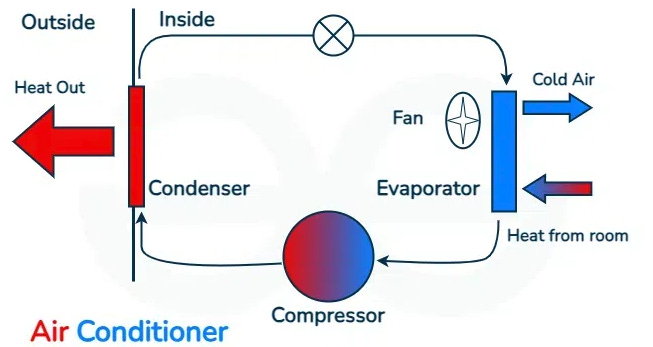
An AC doesn’t make cold air, but moves heat from inside a room to outside it. The refrigerant absorbs heat from indoor air, then goes into a compressor where its temperature is raised further, and releases that heat outdoors through the condenser. Lastly, it cools down and flows back inside to repeat the cycle. The refrigerant itself isn’t consumed in this process; it’s a fluid that circulates in a closed loop.
One of the most common types of refrigerant is the hydrofluorocarbon, or HFC. You may also be familiar with chlorofluorocarbons (CFCs), which were also a refrigerant used in ACs.
In this story, two HFCs matter most: R32, which is now standard in newer room ACs, and R134a, which is mostly used in vehicle ACs. There are other older ones, like R410A and R22, but we’ll not focus on those for now. The policy restriction is around these refrigerants.
Why so? Well, it’s primarily because HFCs and CFCs are powerful greenhouse gases that contribute to global warming. In 2013, India followed a similar policy to phase down hydro-chlorofluorocarbons (HCFCs), like HCFC-22.
Here’s how the restriction comes into effect. Between 2024-2026, whatever HFC is produced in India will be averaged out and then topped up with 65% of the corresponding HCFC production baseline, which was calculated using 2009-10 data. This year, companies are not restricted on how much HFC they can manufacture. But every tonne produced this year will contribute to the 2024-26 average.
Then, from January 1, 2028, the average gets frozen. India can’t produce or consume more HFC than that number going forward. By then, any new refrigerant factory has to be fully built and running. The only exception to this rule is factories that only make raw material used to manufacture other chemicals.
That frozen ceiling doesn’t stay flat forever either. It shrinks in stages after that. It falls 10% by 2032, 20% by 2037, 30% by 2042, and 85% by 2047.
For clarity, the HFC production doesn’t stop in 2028. Existing factories keep running. HFC-based ACs aren’t banned, and nobody with an old air conditioner needs to worry about it becoming illegal to use.
But a major unresolved concern is who gets to keep producing how much. The government hasn’t yet said how the national quota will be divided among individual companies. That means having a plant that’s up and running by the deadline is not the same as having a guaranteed right to keep producing after it.
Race against time
That being said, companies are rushing to install capacity as soon as possible. Even while considering that the quota may not be evenly distributed, it’s their best bet to try and expand the ceiling.
A plant commissioned late in 2026 only contributes a few months of output to a three-year average. Most of its potential contribution is already lost. And crucially, 2027 falls entirely outside that baseline window. So, a plant that starts up in 2026 only gets that partial year spread across three years of averaging, while anything produced in 2027 doesn’t enlarge the ceiling at all.
So companies have three overlapping reasons to produce more now. They want to:
establish a production history before the ceiling window shuts,
become an operating producer before the quota rules are written,
build enough capacity to use whatever entitlement eventually shows up.
The same rush creates three risks. Companies could overbuild relative to what they ultimately keep producing, prices could swing as pre-deadline capacity floods a market that hasn’t yet caught up, and some plants could simply receive much less quota than their owners expected.
Take, for instance, SRF, one of India’s leading makers of chemicals (including refrigerants). In Q1 FY27, SRF’s gross operating revenue came in at ₹5,033 crore, and PAT grew 76% to ₹759 crore. Its chemicals business grew by 26% to ₹2,315 crore, driven by strong refrigerant sales and improved realisations despite costlier raw materials.
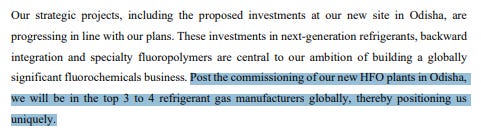
SRF is running two tracks at once. It’s debottlenecking its conventional HFC lines to exceed 65,000 tonnes a year, while separately investing about ₹2,300 crore in Odisha to build 20,000 tonnes of next-generation HFO (Hydrofluoroolefin) refrigerants. After this project, SRF expects to rank among the world’s top four refrigerant-gas manufacturers. It is expanding its conventional HFC business while simultaneously investing in the next generation of refrigerants expected to gain importance later.
The only alternative
At the centre of this investment cycle is the R32 HFC. It has a lower global warming impact than R410A and carries more heat per kilogram, so an AC built for R32 can move the same amount of heat using less refrigerant than one built for R410A. That’s partly why it is increasingly replacing R410A in new room ACs.
But, at the end of the day, R32 is still an HFC, so it will be subject to India’s quota.
This sets up a two-stage transition. Over the decade, R32 will continue to gain share from R410A, R22, and other older gases. After that, as India’s frozen quota starts shrinking over the 2030s and 2040s, parts of the market will need to move away from HFCs altogether toward lower-impact alternatives such as propane, CO₂, or ammonia.
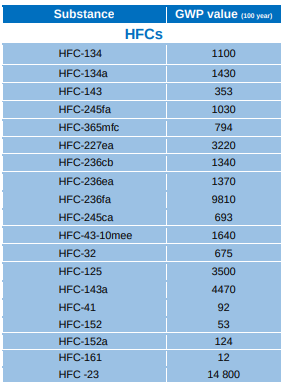
What’s also worth noting is that India’s quota isn’t measured in physical tonnes, but in carbon dioxide equivalent terms, meaning each gas is weighted by its global warming potential relative to CO₂. R32 is much lower than R134a and the R410A.
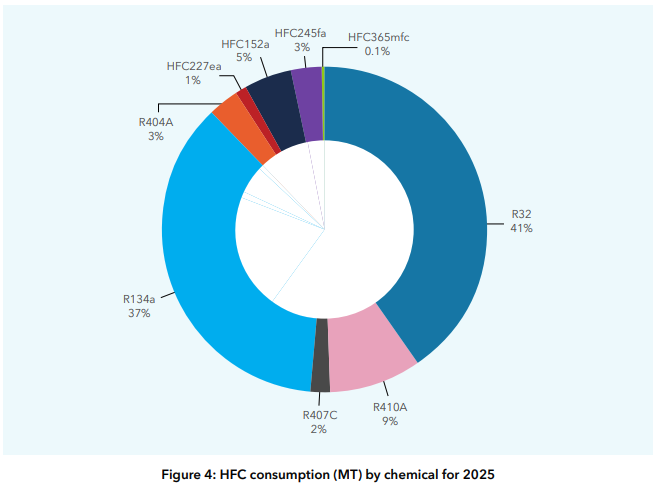
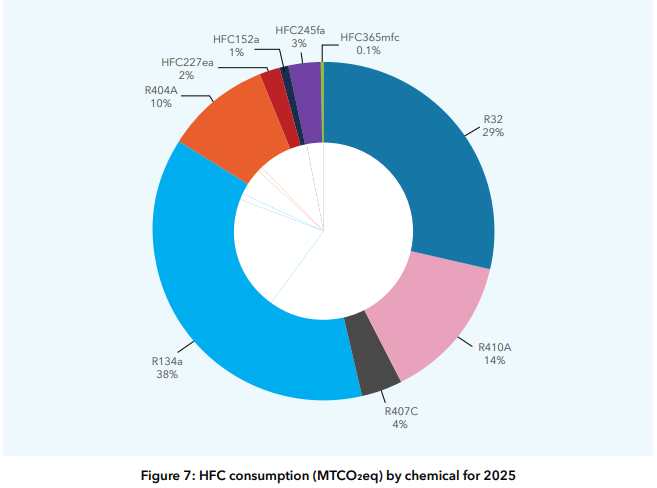
A 2025 report by think-tank NRDC puts R32 at 41% of India’s HFC consumption by physical weight, but only about 29% in terms of warming impact. R134a, by contrast, was 37% by real weight but 38% by warming-adjusted weight.
But these numbers come from outside researchers, not from the government. India’s official baseline will be built from real production and consumption data reported to the Ozone Cell by companies.
Still, the direction is clear. A company that shifts its production mix toward R32 can sell more physical tonnes off the same quota than a company sticking with R134a. So there’s a real incentive to prefer R32, not just an environmental one.
None of this means manufacturers can simply swap one gas for another easily, though. Each refrigerant operates at different pressures and temperatures, so switching usually requires redesigning core components of the system, such as the compressor and the safety systems around it. It also means retraining every technician who services it.
What that also means is if a company wanted to shift to gases outside the quota, that would be incredibly hard to do.
Propane, for instance, is highly flammable, so it requires extra safety design measures and limits on how much can be used in a single system. It works better in small appliances than in large systems.
Meanwhile, HFOs are more environmentally friendly than HFCs, but are costlier to produce and adopt. Ammonia and CO₂ sit in a different category altogether. Both already work well in specific industrial and commercial cooling setups, but neither was ever going to work as a drop-in replacement across the whole market. The easier, significantly cheaper move for now is toward R32.
Unplanned obsolescence
Now, roughly 40% of India’s current HFC consumption goes into servicing and refilling machines that are already running, while the rest 60% goes into new equipment.
That servicing share is complicated transitions between refrigerants. Even after every new AC leaving a factory uses a different gas, the millions of older units already installed keep needing whatever refrigerant they were originally built for.
Routine gas top-ups should not be necessary in a properly sealed system. But servicing demand cannot disappear entirely because machines leak, components fail, and refrigerant may have to be removed during major repairs. A technician who tops up the gas without first finding and repairing a leak skips the essential part of the job. It’s faster and cheaper upfront, but it leaves the underlying leak in place, which means the customer pays again next season.
Even when a technician does it properly, pumping out that remaining gas before repair is only half the job. What happens to that extracted gas afterward is its own problem. Reusing it requires machines, separate cylinders and access to a recycling or reclamation facility. And even when it’s properly collected, that gas might be contaminated.
India has tried to build this kind of infrastructure before. The government set up 18 mini-reclamation centres across the country and provided technicians with subsidised recovery machines to recycle older gases. But running these centres cost money, and there wasn’t enough coming back in, whether from selling the reclaimed gas or from fees, to cover that cost. So technicians had no financial incentive to use them rather than just topping up and moving on.
Without a functioning recovery and reclamation system, all of this adds up to a problem. On one hand, India’s quota caps how much brand-new refrigerant gets made. On the other, reused refrigerant isn’t picking up the slack. Without recyclable older gases, otherwise repairable machines might be forced to retire early, especially if the correct refrigerant becomes difficult to obtain.
Conclusion
India’s refrigerant transition isn’t really about swapping one gas for another. Producers are racing to lock in production history before a government deadline. Manufacturers are leaning on R32 as a bridge while hedging toward what replaces it. And technicians are still keeping decades-old machines running on gases they were built for.
It is a classic case of trade-offs. There is an undeniable need for India to focus on environmental objectives, and phasing out HFC and CFCs is a part of it. But the transition is hardly guaranteed to be clean for all parties involved, especially as state-directed environmental mandates come into direct conflict with economic ones.
Tidbits:
[1] L&T Semiconductor Shifts Chip Backend Operations to India
L&T Semiconductor Technologies is relocating its outsourced semiconductor assembly and test (OSAT) operations from overseas to India, partnering with domestic players like Tata Electronics. The company says Indian OSAT facilities have become globally cost-competitive, a strategic shift that aims to strengthen the local chip manufacturing ecosystem while helping the firm break even within two years.
Source: Business Standard
[2] Adani Proposes ₹1 Trillion AI Data Centre in Odisha
The Adani Group has proposed a massive ₹1 trillion standalone investment to build a large-scale, AI-ready data centre in Odisha, seeking 250 acres of land from the state government. If approved, the Cuttack-based facility could emerge as one of India’s largest artificial intelligence infrastructure hubs.
Source: Business Standard
[3] Govt to Offload 6.5% Stake in LIC to Raise ₹31,000 Crore
The Indian government is launching a two-day Offer for Sale (OFS) to divest up to a 6.5% stake in the Life Insurance Corporation of India (LIC) at a floor price of ₹382 per share. If fully subscribed, the stake sale will raise roughly ₹31,000 crore for the government while helping LIC meet market regulator SEBI’s minimum public shareholding rules ahead of schedule.
Source: Mint
[4] Airtel Projects $3-4 Billion Annual Capex Amid 5G Push
Bharti Airtel’s Chairman Sunil Bharti Mittal announced that the telecom giant will continue to spend $3–4 billion annually on network upgrades, even though the bulk of its 5G rollout is complete. To successfully monetize these massive investments, Airtel is heavily betting on upgrading users to premium post-paid plans and expanding its home broadband business.
Source: Livemint
[5] Indian Agricultural Industry Seeks Legal Backing for Gene Editing in Seed Bill
The Indian agricultural industry is urging the government to officially recognize and provide legal backing for gene-editing technologies within the proposed Seed Bill. By integrating gene-edited crops directly into the main bill or its rules, the move aims to modernize India’s seed regulatory framework and boost domestic crop innovation.
Source: The Hindu BusinessLine
- This edition of the newsletter was written by Kashish & Vignesh.
Beyond Today’s Brief
There’s always more happening at Markets by Zerodha.
Aftermarket Report: How did a late Closing Auction Session (CAS) boost help Nifty defend key support levels despite a weak session? And what snapped the market's multi-day winning streak?
What We’re Reading: Everything from why book clubs often reward identity more than curiosity to the economics of the AI bubble to the hidden history of the Swiss watch industry.
Subtext: In the debut of Cash & Copium, Abid Hassan and Bhuvan Singh break down why the rupee is sliding faster than a weak US dollar, the structural math behind currency depreciation, and how Indians can actually hedge against rupee risk.
Join us on WhatsApp, where we share interesting soundbites from concalls, articles, and everything else we come across throughout the day. You’ll also get notified the moment a new video or article drops so that you can read or watch it right away.
Thank you for reading. Do share this with your friends and make them as smart as you are 😉