

Our goal with The Daily Brief is to simplify the biggest stories in the Indian markets and help you understand what they mean. We won’t just tell you what happened; we’ll tell you why and how too. We do this show in both formats: video and audio. This piece curates the stories that we talk about.
You can listen to the podcast on Spotify, Apple Podcasts, or wherever you get your podcasts and watch the videos on YouTube. You can also watch The Daily Brief in Hindi.
In today’s edition of The Daily Brief:
How is natural gas traded in India?
Despite extensive gas infrastructure, only a tiny fraction of India’s natural gas is traded. The story explores how government allocations, long-term contracts, and policy bottlenecks have prevented a competitive gas market from emerging.The sparks and stops of the wires & cables industry
India’s wires and cables makers delivered another strong quarter, but falling metal prices, rising data centre demand, and export uncertainty are creating very different growth strategies for the industry’s leading players.
We have a new Subtext episode out!
Why are so many of India’s recent large manufacturing investments (like Foxconn) located in Tamil Nadu? How do the Centre and states work to make industrial policy happen?
We spoke with Mausam Kumar, an industrial policy researcher based out of Princeton to unpack everything entailing India’s manufacturing push: from how state policy complements central policy, bidding wars between states like Tamil Nadu and Karnataka, development finance, how India should handle Chinese FDI, and lessons from economic success stories like Japan.
Watch the full podcast episode below, where Mausam breaks down how India’s industrial policy really works. You can also listen to the full conversation on Spotify and Apple Podcasts, or read the transcript.
How is natural gas traded in India?
In June 2020, India saw physical natural gas trading for the first time through the Indian Gas Exchange (IGX), the country’s only gas exchange. To be fair, it hasn’t grown substantially. Last year, IGX handled just 1,924 trades, or about five a day.
That’s the entire organised trading layer for a country that consumed roughly 69 billion cubic metres of natural gas in FY26, importing half of it, and has spent a decade calling gas the bridge from coal to solar. India is one of the world’s largest LNG importers. It aims to raise natural gas’s share in its energy mix from about ~6% today to 15% by 2030. It has eight LNG import terminals with more capacity than it uses, nearly 26,000 kilometres of transmission pipelines, and city gas networks that reach 99% of the population. But only about 3% of the country’s gas is actually traded.
This got us scratching our heads when we were reading IGX’s DRHP. India has the gas infrastructure. Every physical piece is in place. Why don’t we trade?
The answer begins with something unusual: not all gas in India is legally free to be sold.
Gas, in India’s context
Let’s set the foundation by first understanding where India’s gas comes from and where it goes.
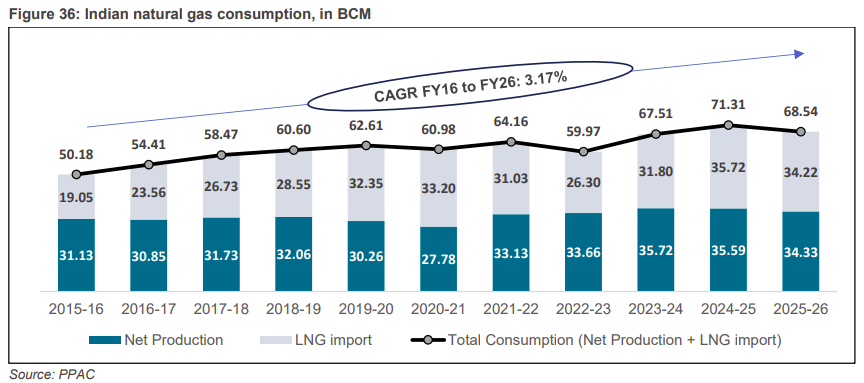
India’s appetite for gas has grown steadily, over the last many years. Yet, our ability to produce it has been flat. Resultantly, imports which accounted for 33% of India’s gas consumption in FY16, have now ballooned to 50% in FY26.
And where does all this gas go? The largest consumer, by a wide margin, is the fertiliser sector, with roughly a 30% share. Here, gas isn’t a fuel but the feedstock used to make ammonia, which is then turned into urea. City gas distribution, which supplies CNG and piped cooking gas to homes, accounts for another 20% and is the fastest-growing segment. Refineries and the power sector make up much of the rest, but their share has been declining. In fact, India’s power sector has burned less natural gas every year for the past five years.
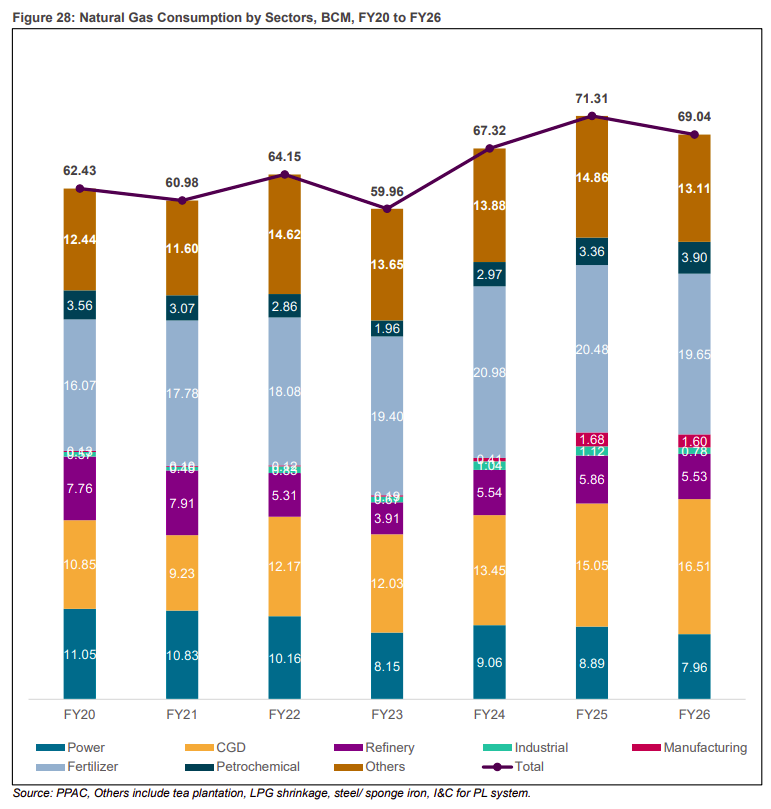
That’s a little counterintuitive. Gas was supposed to be the transition fuel. Because gas-fired plants can ramp generation up or down within minutes, they’re an ideal partner for solar and wind, whose output changes with the weather. They can quickly fill the gaps when renewable generation falls.
But in India, gas has been losing ground anyway. That’s not because the country is shutting down gas plants. It’s because we’re generating far more electricity from increasingly cheap solar and wind, while imported LNG has remained too expensive to compete with coal whenever additional generation is needed. As a result, gas plants are simply being used less often. Today, gas generates only about 5% of India’s electricity. Partly because of this, India’s gas consumption has grown at just 3.17% a year over the past decade, while meeting the government’s 15% target would require growth closer to 11.7% annually.
Closing that gap somewhat depends on gas becoming cheap enough that industries actually want to use it. Which raises an awkward question. How does an Indian buyer even know what gas should cost?
For most of the gas in this country, nobody ever finds out. The price is either set by a government formula or negotiated privately between two large companies, and never published. That’s where gas trading and pricing come in.
Not all gas is actually for sale
For gas to be traded, and eventually priced by the market, you first need someone who is free to sell it. As we saw earlier, about half of India’s gas supply comes from domestic production. India’s gas is produced by domestic firms like ONGC and Oil India. But if ONGC extracts a million units of gas tomorrow, can it simply sell that gas to whoever it wants? Not quite.
In fact, how a unit of gas is priced depends entirely on which field the gas came from.
There have been three different regimes, across Indian history, under which gas fields have been handed out. Every field in India was awarded on the terms of whichever policy regime happened to be in force at the time, and those terms decide what a producer may do with the gas.
Bucket one is the gas the government hands out.
India’s oldest gas fields weren’t auctioned. From the 1940s to the 1990s, the government simply nominated them to state-owned companies, mainly ONGC and Oil India.
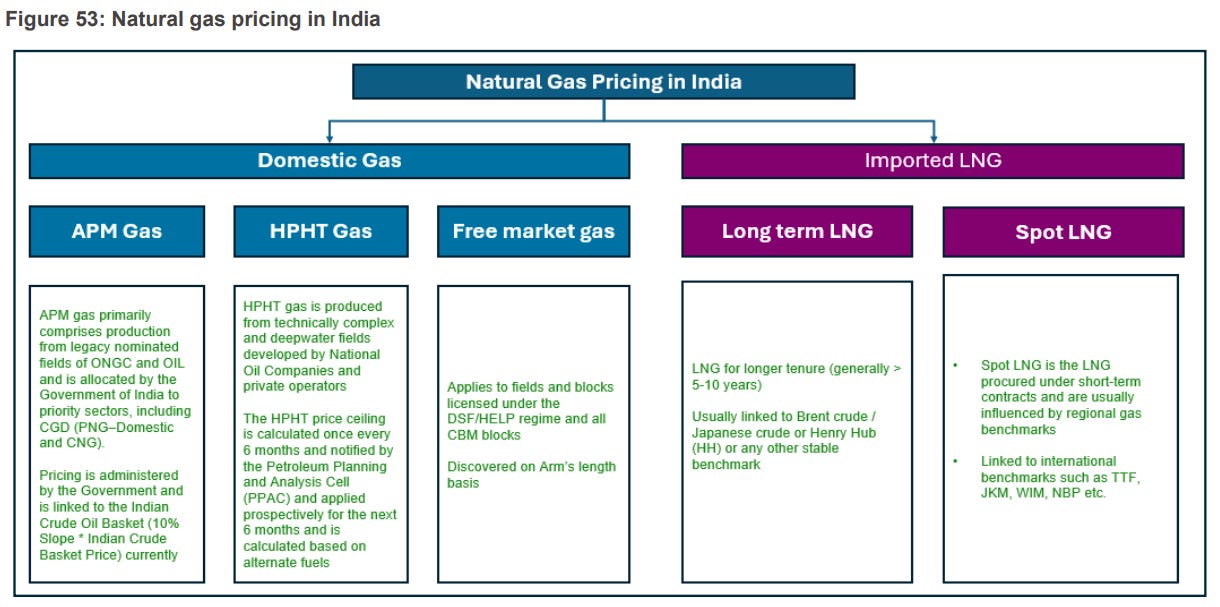
Gas from these legacy fields is called APM gas, short for Administered Pricing Mechanism. The government decides its price using a formula. It also decides who gets it, typically priority sectors such as city gas distributors supplying piped cooking gas and CNG, along with fertiliser plants.
This price is fixed well below market rates.That insulation is worth a great deal when global prices spike. It’s a large part of why city gas distributors and fertiliser companies didn’t have to pass on the full force of soaring LNG prices to their customers during the Hormuz crisis, whether to households using piped cooking gas, CNG vehicle owners, or farmers buying fertilisers.
This is the biggest bucket, accounting for more than half of India’s domestic gas production. And almost none of it can be traded, because there is no commercial decision left for the market to make.
Some Indian gas is difficult to produce. It lies deep offshore under high pressure and high temperature, ‘HPHT’ in industry shorthand. That’s the second bucket. Nobody would develop these fields if they were paid an administered price.
So, in 2016, the government offered a bargain. Develop these difficult fields, and you can market the gas yourself to whoever you choose. This is called marketing freedom, and it’s what makes a market possible in the first place.
But the freedom came with two leashes.
The first was a price ceiling. Producers couldn’t charge more than the cost of the imported fuel their customers would otherwise have bought, whether imported LNG or oil.
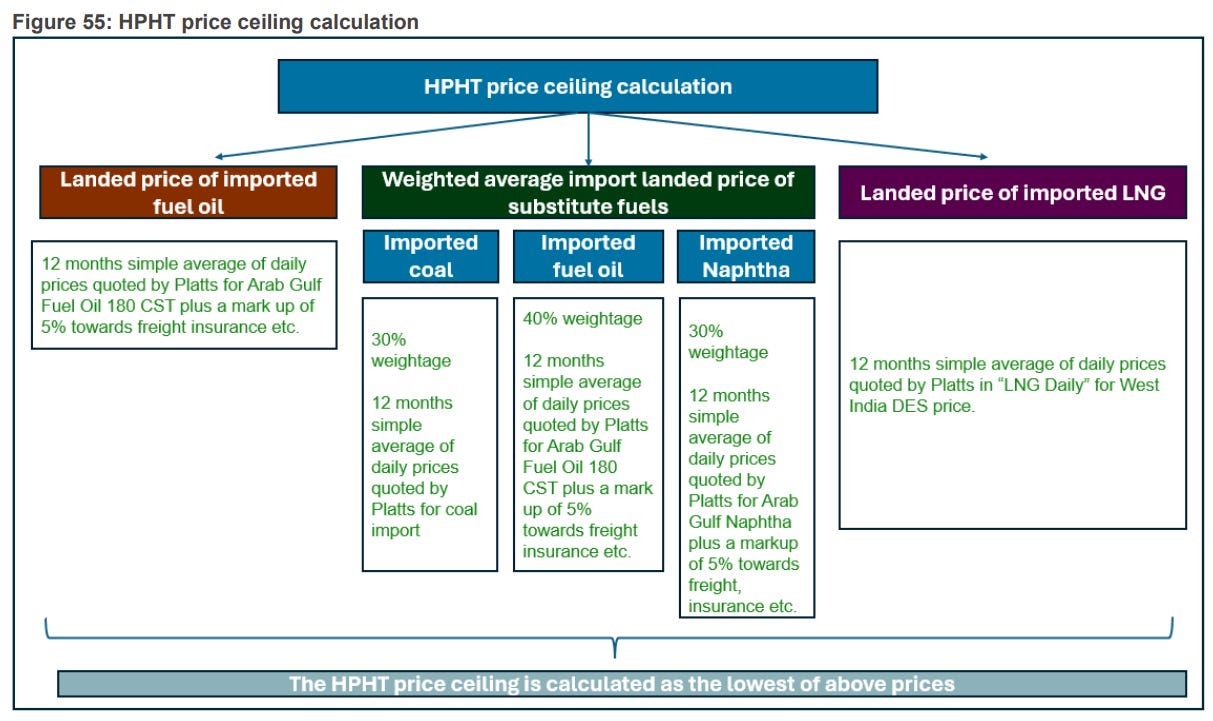
The second limited trading itself. Producers could sell only 10% of annual production from a contract area through a gas exchange, or 500 million standard cubic metres, whichever was higher. The rest had to move through bilateral contracts. HPHT fields produced about 10.6 BCM of gas last year, which means only a little over 1 BCM was legally eligible for exchange trading.
Bucket three is the closest thing to a free market.
It includes fields licensed under India’s newer exploration regime, introduced after 2016. It also includes the Discovered Small Field policy, under which previously overlooked fields were auctioned to private companies. Then there are coal bed methane blocks, where gas is extracted from coal seams rather than conventional gas reservoirs. Across all of these, the principle is the same. Producers choose their customers, negotiate their own prices, and sell however they like.
It’s also the smallest pool, because these fields are relatively young and India hasn’t discovered large reserves under these liberalised regimes yet.
So more than half of India’s domestic gas is already allocated before it even leaves the ground. What about the imported half? Can that be sold freely?
Imported gas arrives in India as LNG — natural gas cooled to around -162°C so that its volume shrinks by almost 600 times — making it economical to ship. Once it reaches India, it’s regasified and enters the pipeline network, making it indistinguishable from domestic gas. Commercially, though, it’s a completely different animal. The importer owns it outright and is free to sell it to anyone.
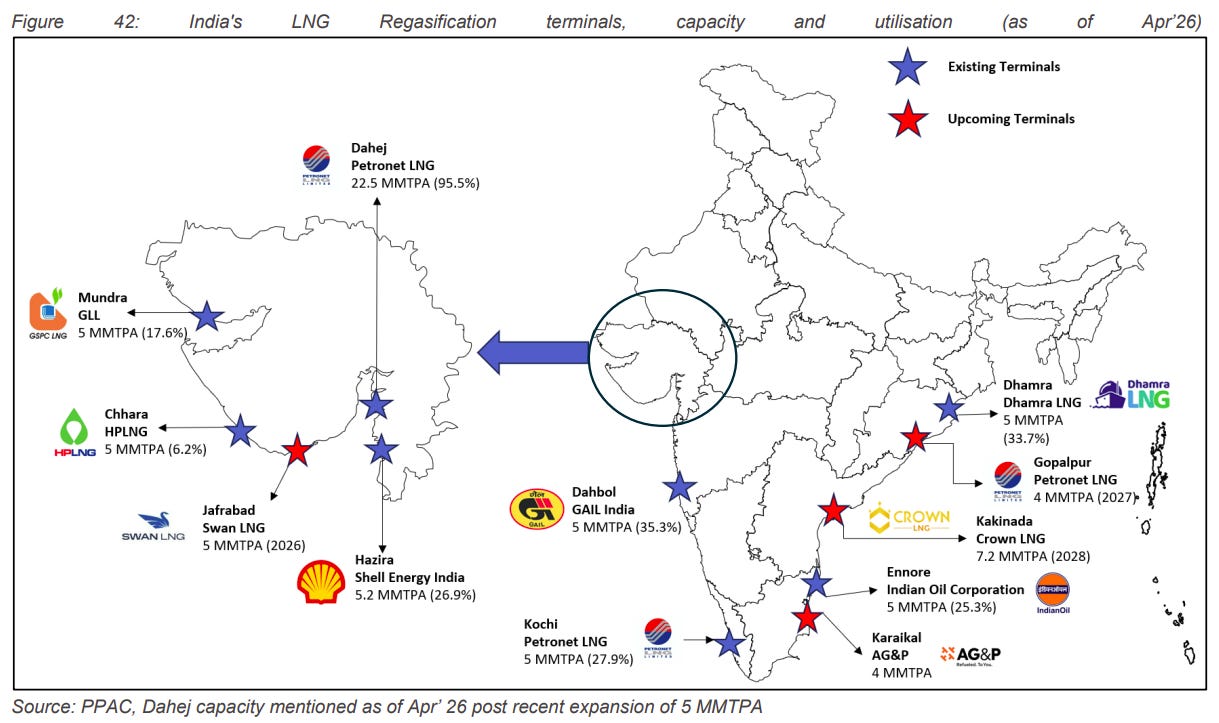
Which produces a counterintuitive result: a molecule from Qatar is more likely to be traded on an Indian exchange than a molecule from an old ONGC field in Gujarat.
And yet most imported gas doesn’t trade either.
Roughly three-quarters of India’s LNG imports arrive under long-term contracts which are bilaterally negotiated, with the rest bought on the global spot market. LNG export projects cost billions of dollars to build, so buyers and sellers typically sign 15-20 year long contracts for visibility.
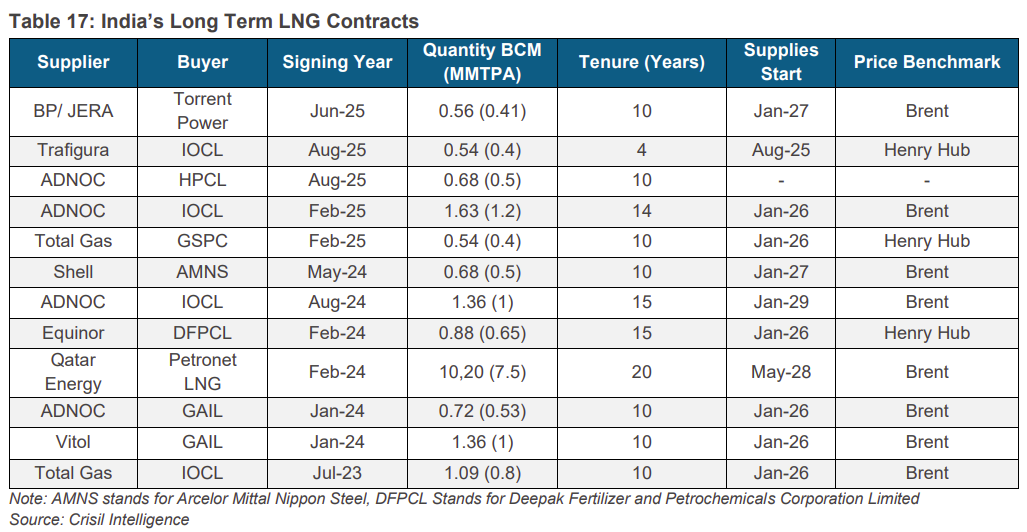
This means long-term LNG stays off the exchange not because of regulation or a lack of commercial freedom. Quite the opposite. By the time the LNG ship reaches India, the gas has already been sold to a specific customer under a contract signed years earlier.
Put those two pieces together and India’s tiny gas exchange suddenly makes sense. More than half the country’s gas isn’t free to sell because the government allocates it. Most of the rest was sold years ago under long-term contracts. By the time gas enters an Indian pipeline, very little of it is actually looking for a buyer.
But strangely, the exchange has been finding new customers anyway.
The APM pool is shrinking by design. Those legacy fields are in natural decline, and what’s left is being rationed. In October 2024, GAIL, the nodal agency for gas allocation, reduced APM supplies to the CNG segment by 20% of requirement. In April 2025, it cut another 20%. In roughly a year, the supply of cheap administered gas to city gas distributors had almost halved.
But those distributors still have vehicles to fuel and kitchens to supply. They’ve had to replace the lost volume by buying at market prices instead. This has made them the largest buyer group on the exchange, both by participant count and by traded volume.
India needs a price of its own
Henry Hub, the American gas benchmark, physically settles only a small share of the gas Americans actually burn. But, the contracts across the country are priced in it. Because prices are discovered here, a producer a thousand miles away can price gas without negotiating from scratch. Since futures settle against it, a utility can lock in next winter’s fuel cost and borrow against it.
IGX already publishes GIXI, the Gas Index of India, a volume-weighted average of gas actually traded and delivered on the platform. It rests on thin volumes today. But if bilateral contracts start reading “GIXI plus a premium,” the exchange becomes India’s reference price without ever handling most of the molecules. A ceramics cluster in Morbi and a fertiliser plant in Uttar Pradesh would look at the same number and know whether they’re being overcharged.
A price is how an economy decides where a scarce thing should go. India currently makes that decision by allocation. Our government departments make such decisions by fiat: for instance, that fertilisers get cheap gas before power producers do. A discovered price does the same job more organically, by revealing who actually values the molecule most, while telling producers if there’s enough demand to make the next well worth drilling.
But, two things have to change first before any of this happens.
The bigger one is tax. Natural gas still sits outside GST, taxed under state VAT instead. VAT offers no input credit. Every time the same gas changes hands, tax is charged again on the full value. Sell it twice and you pay VAT twice. That makes re-trading uneconomic, and re-trading is precisely how every mature gas exchange builds volume, because the same molecule gets bought and sold several times before anyone burns it. Bring gas under GST, where that tax becomes a credit, and people shall be more willing to trade.
The other is transport. India still charges for moving gas by how far it travels. So the same gas bought on the exchange lands cheap in Gujarat and expensive in Tamil Nadu. Which means a buyer can only realistically deal with a seller nearby, and what looks like one national market is really a few small regional ones sitting next to each other. An entry-exit system would charge a flat fee to put gas into the grid and a flat fee to take it out, whatever the distance in between, so Gujarat and Tamil Nadu end up paying roughly the same. Then it stops mattering where the seller sits, and every buyer can bid for every molecule.
The sparks and stops of the wires & cables industry
It’s likely that if you ask an electrician or hardware dealer when to buy copper wire, they may say that you shouldn’t buy on the very first day prices fall. Wait a week, and the same coil costs even less. Across India this June, that habit turned into something close to a stampede, as dealers everywhere delayed their orders and waited for cheaper cable.
That alone would make for a mildly interesting quarter. What makes Q1 FY27 stranger is that now, India’s wires and cables industry has three different stories to tell about its own future: one built on data centres, one on defending market share, and one on simply outgrowing everyone else.
We read the earnings calls of Polycab, KEI Industries and RR Kabel, the three big listed wire and cable makers, to look into how these stories are shaping up.
The numbers
On paper, all three companies had a strong quarter.
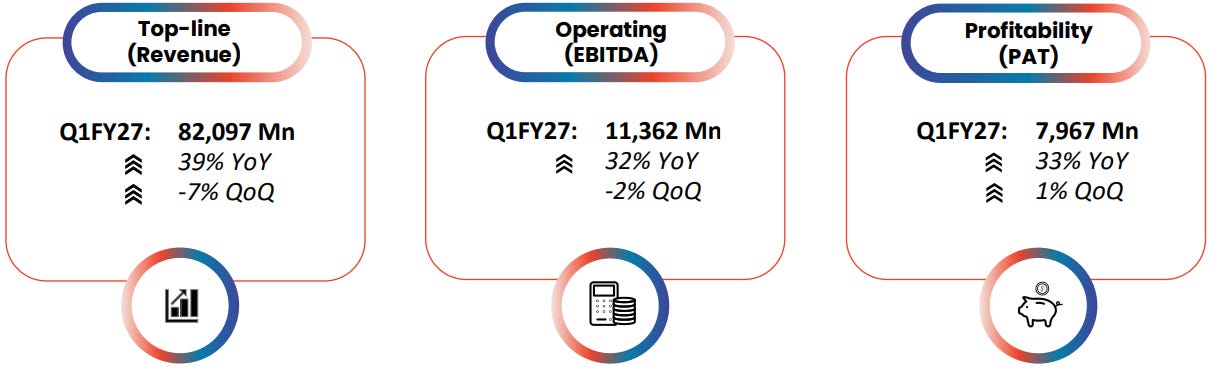
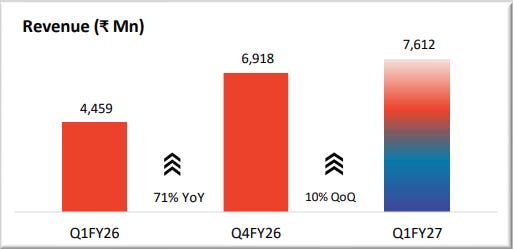
Well in continuation of a long trend, Polycab, the largest player, is still one of the fastest-growing players too. It posted a revenue of ₹8,200 crore, up 39% year-on-year. Its profit-after-tax (PAT) rose 33% y-o-y to ₹797 crore. Little of that came from selling higher volumes, which grew only in the low- to mid-single digits on a high base. Most of it owed to higher prices instead.
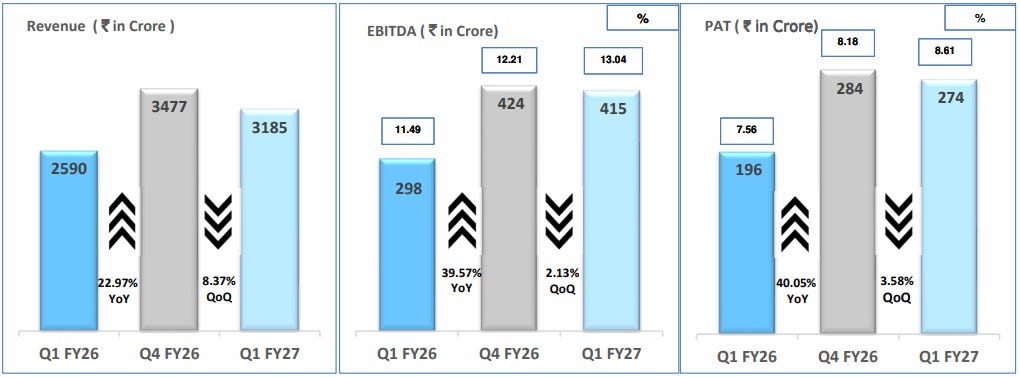
KEI posted a revenue of ₹3,185 crore, up 23% y-o-y and PAT rose 40% y-o-y to ₹274 crore. Unlike the last few quarters, this time, KEI didn’t disclose product-level volume and instead provided value guidance. They also gave a very specific reason for why they did so: they were afraid their competition could use that data against them. That makes it difficult to know how much of that growth was driven by more volume versus price inflation.
RR Kabel posted a revenue of ₹3,168 crore, up 54% y-o-y, while the PAT more than doubled annually to ₹205 crore. The PAT includes a one-time ₹14 crore benefit from the reversal of an old labour-law provision, but excluding that takes nothing away from their impressive performance. What’s more, unlike its peers, RR Kabel’s growth was indeed driven substantially by volumes, as it disclosed double-digit volume growth of 17% — with cables up more than 25% and wires up about 12%.
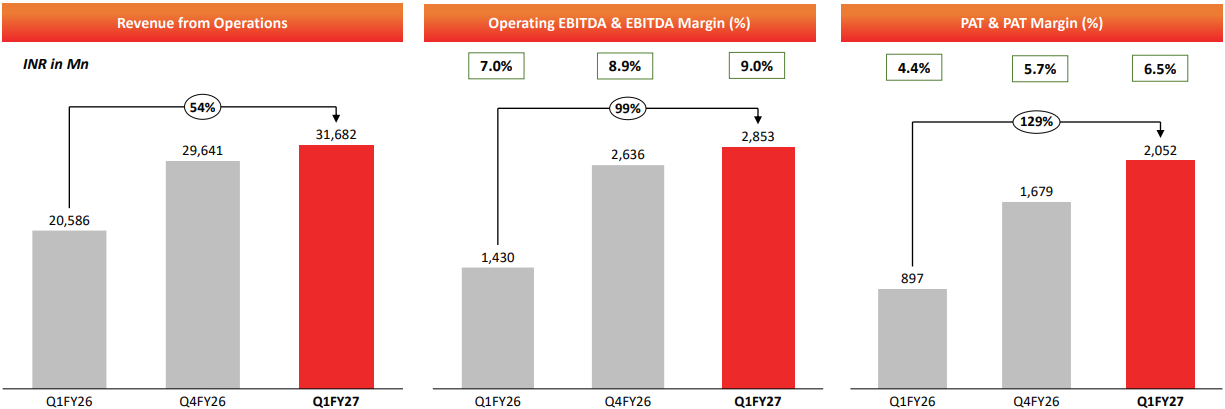
Its own management estimated the whole industry grew only 10 to 12% in the quarter, well short of RR Kabel’s own 17%. That gap suggests RR Kabel grew by taking business away from smaller, unbranded manufacturers, not simply by riding a market that expanded just as fast. The formalization of the industry has been a long, ongoing shift.

Metal prices reverse
For much of last year, the story was one of raw material price inflation. The world’s shortage of copper and aluminium directly impacted all three companies, which followed different strategies of price absorption.
This quarter, though, that story has flipped. The price of copper and aluminium, which make up most of the cable’s cost, fell in June. As per Polycab, aluminium dropped 18–20%, while copper fell from about ₹14,000 a tonne to ₹13,100–13,200. Prices had remained steady or risen during most of April and May, so the decline in June was sudden and largely confined to the end of the quarter.

Cable prices in India follow a cost-plus model, meaning companies revise prices when metal costs change significantly. When metal prices rise, dealers buy more, anticipating the next price hike. When prices fall, they do the complete inverse. They don’t buy immediately and wait for lower prices. This is exactly what happened: Polycab said the dealer’s stock was below its normal expectations and corrected its price by 3–4% in the first half of July.
This distortion explains much of the gap in Polycab’s numbers. When dealers delay orders for a few weeks, it does not necessarily mean construction or retail demand has weakened. They may simply be waiting for lower prices. What remains to be seen is whether these delayed orders return in Q2 as dealers restock, or get postponed further as dealers anticipate further drops.
Naturally, these large movements in raw material prices affect cashflow significantly.
Polycab, for instance, relies on letters of credit to procure copper and aluminium. Here, the bank pays suppliers upfront, and the company settles the amount later. Ideally, they sell their product, often on credit, and use the cash generated from there to pay off the bank on time. The faster they convert their credit sales to cash, the better.
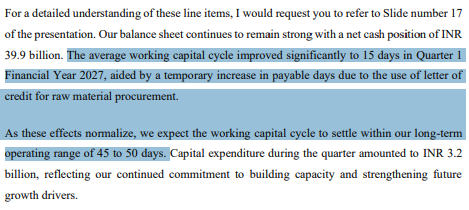
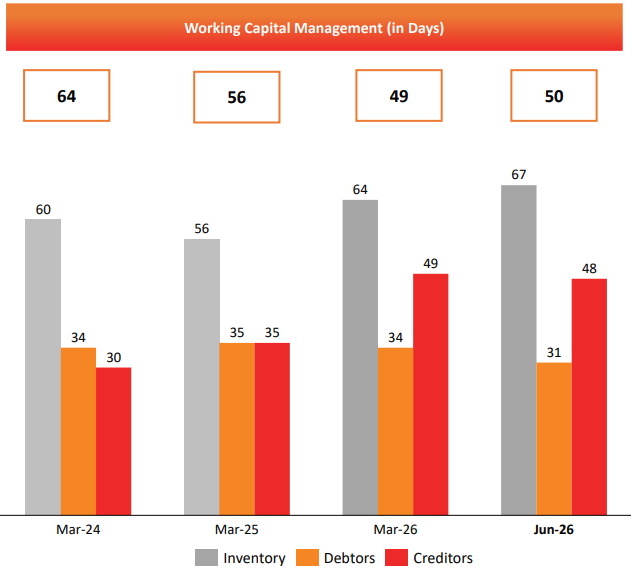
Now that raw material prices dropped and selling prices didn’t, all else remaining the same, Polycab’s cash position would improve significantly. And it did, as its working capital days reduced to 15 days, compared with its usual 45–50 days. Management expects the cycle to rise back to normal once this timing benefit fades.
KEI, however, takes a different approach. It pays for most of its raw materials in cash rather than using supplier credit. That being said, it did not disclose its cash cycle in days. RR Kabel shared fewer details about its procurement process, but its cash cycle remained broadly stable at around 50 days.
The data centre boom
In the previous quarter, we flagged that data centres had emerged as a demand driver. At the time, none of the three companies earned meaningful revenue from this segment, and all saw it as a multi-year opportunity. This quarter offers the first real signs of revenue, but the bet is paying off very differently for each of the three.
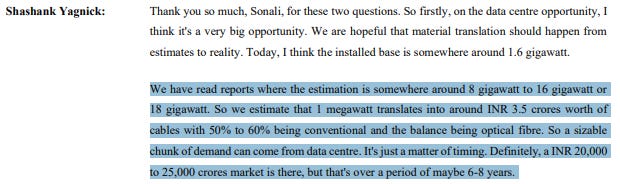
Polycab has now put a number on the data-centre opportunity. It estimates that every megawatt of capacity built in India requires about ₹3.5 crore worth of cables. Around 50–60% of this is conventional power cable, with the rest carried by optical fibre, which transmits data using light signals.
India currently has about 1.6 gigawatts of installed data-centre capacity. Industry estimates suggest this could rise to 8–18 gigawatts over the next 5-8 years, implying a cable market of roughly ₹20,000–25,000 crore.
Polycab has also named a customer for the first time, supplying cable to Vodafone-Idea’s data centres in Mohali, Pune and southern India.

RR Kabel, meanwhile, has made much more limited progress. Last quarter, it identified data centres as a medium-term opportunity but had no orders from the segment. It has now started receiving a few orders for standard power cables, but orders still remain largely in the announcement stage, with actual execution yet to pick up.

KEI has said that the company is already working with data centre projects in the US alongside oil and gas. However, the company has not provided any numbers to show the scale of this business. It didn’t disclose any customers, orders, or revenue specifically linked to data centres, either in India or the US.

At least, from these disclosures, the gap between the three companies looks wider. Polycab has a named customer and a clear estimate of cable demand per megawatt and detailed forecasts to support its case. RR Kabel has gained an early foothold, while KEI has provided little update on a plan it once described in detail.
Other sources of demand
Data centres may receive more attention, but the power grid remains the larger and more established driver of demand, especially as we continue to scale up solar.
India added roughly 14,000–15,000 circuit kilometres of transmission and distribution lines each year over the past five years. Polycab expects this to rise to 20,000–21,000 kilometres annually through FY30, with about 2,000 kilometres already added in April and May.
Polycab estimates that for every ₹100 spent on transmission and distribution, around ₹15 flows into cable demand. KEI is already benefiting from this trend. Revenue from its extra-high-voltage cables, which are used to transmit power over long distances, rose 48% year on year to ₹186 crore. The segment also earns an operating margin of about 15%, compared with 10.5% for KEI’s regular institutional cable business.
The boom is visible beyond cables too. Polycab’s consumer electricals business, FMEG, grew 71% year-on-year to a record quarterly high. Solar inverters more than doubled, driven by the PM Surya Ghar Yojana rooftop solar scheme and related state incentives.
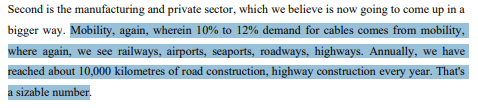
Besides the grid, railways and other transport infrastructure together account for an estimated 10–12% of total cable demand. This includes projects such as 800 new Vande Bharat trains planned by 2030, as well as airports, seaports and the roughly 10,000 kilometres of highways India builds each year.
The export game
Last quarter, we tracked how the Strait of Hormuz shipping blockade hit exports in March. Not only did that compress volumes to a degree, but it also forced companies back toward the very market they had been avoiding due to tariffs — the US.
This quarter is a mixed follow-up. The Strait of Hormuz blockade hasn’t been fully resolved, and a separate US dispute has joined it.
Polycab’s international revenue fell 13% from a year earlier, while exports declined to 3.3% of total revenue from 5.2%, despite the renewed focus on the US market. As per management, a healthy order book across the US, Europe and Latin America should support a recovery in the coming quarters.
KEI couldn’t escape the wrath of declining exports, either, recording 7.3% less exports compared to last year. And their reversion back to the US is hardly helping: KEI’s American shipments ran into a fresh customs duty dispute. Management expects exports to recover to 17–18% of total revenue this year, but this quarter, they were squeezed from either end.
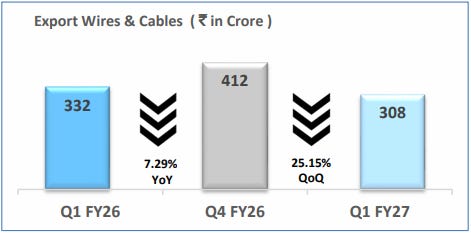
RR Kabel, which has relied far more on exports than its peers, also offers the clearest sign that export conditions may be improving. Last quarter, disruptions in the Middle East, which accounts for nearly 40% of its exports, left the company with inventory it could not ship. This quarter, shipments to the region returned to normal, while stronger demand from markets such as Europe supported growth. As a result, exports grew at roughly the same pace as the domestic business.
Despite the uncertainty of tariffs, RR Kabel’s COO, Rajesh Jain also described the US as a major opportunity. The region makes 8-10% of the company’s export revenues.
Conclusion
Three things will show whether this quarter marked a real turnaround or was only a temporary bounce.
First, dealers will need to start restocking. But the problem of expecting lower prices in the future has still not gone away.
Moreover, Polycab and KEI may need to deliver genuine volume growth in Q2. Over the last two quarters, growth was primarily driven by price rather than volume. If that doesn’t happen, and the restocking shows longer signs of not continuing, that may indicate a real weakness in demand.
Then, what happens to exports? All companies are optimistic about exports recovering, but that is highly contingent on the state of the world going back to normal. The industry can’t afford to be squeezed from the Middle East and the US simultaneously.
Lastly, where does new growth come from? RR Kabel beat the industry average, although that’s partly a function of its size. Polycab, however, is a complete outlier, being not just the largest but also one of the fastest-moving. It has announced a real data centre customer in Vodafone Idea. KEI, meanwhile, has remained far more mum on real numbers, but that’s partly because they want to protect information from their competition.
Tidbits:
[1] MoD to Fully Reimburse 18% GST on Defence Startup R&D Grants
The Ministry of Defence will now fully refund the 18% GST charged on research and development grants given to defence startups. This ensures startups get to keep their full funding to focus on building new technology.
Source: The Hindu BusinessLine
[2] Tata Sons Retains NBFC-Upper Layer Status Under New RBI Framework
The Reserve Bank of India confirmed that Tata Sons will keep its “NBFC-Upper Layer” status under the new rules. This means the main holding company of the Tata Group must continue to follow strict financial regulations and face close monitoring by the central bank.
Source: ET BFSI
[3] India’s Services Sector Growth Hits 4.5-Year Low in July
India’s services sector expansion slowed to a four-and-a-half-year low in July as demand softened and new business growth cooled according to PMI data. While the industry is technically still growing, businesses are feeling the pinch from rising operational costs.
Source: The Hindu
[4] Government Penalises 9 Digital Platforms for Misleading Consumers
The central government has penalised nine high-profile digital platforms including Zepto, IndiGo, SpiceJet, and PhysicsWallah for employing dark patterns and deceptive trade practices that mislead consumers. The regulatory action is part of a wider push to crack down on unfair digital commerce and hidden fees.
Source: Hindustan Times
[5] RBI to Harmonise Lending Rate Rules Across Financial Entities
The Reserve Bank of India is proposing new rules to standardise how all financial institutions calculate interest rates on loans. This change aims to make loan pricing clearer and better protect borrowers from confusing or unfair charges.
Source: ET BFSI
- This edition of the newsletter was written by Kashish & Vignesh.
Beyond Today’s Brief
There’s always more happening at Markets by Zerodha.
The Chatter: How is Marico navigating demand trends across urban and rural markets? What is driving DLF’s momentum in luxury housing pre-sales? How are rising trading volumes fueling BSE’s top line, and what does Nykaa’s latest performance signal for beauty and personal care growth?
Aftermarket Report: How did Nifty remain locked in a narrow range between 24,605 and 24,675 to end flat at 24,636? And how are markets reacting to strong earnings from Trent and LIC alongside record July vehicle retail sales?
What We’re Reading: Everything from why book clubs often reward identity more than curiosity to the economics of the AI bubble to the hidden history of the Swiss watch industry.
Join us on WhatsApp, where we share interesting soundbites from concalls, articles, and everything else we come across throughout the day. You’ll also get notified the moment a new video or article drops so that you can read or watch it right away.
Thank you for reading. Do share this with your friends and make them as smart as you are 😉