

Our goal with The Daily Brief is to simplify the biggest stories in the Indian markets and help you understand what they mean. We won’t just tell you what happened, we’ll tell you why and how too. We do this show in both formats: video and audio. This piece curates the stories that we talk about.
You can listen to the podcast on Spotify, Apple Podcasts, or wherever you get your podcasts and watch the videos on YouTube. You can also watch The Daily Brief in Hindi.
In today’s edition of The Daily Brief:
India’s Railway blues turn color
How drones are changing the economics of modern warfare
India’s Railway blues turn color
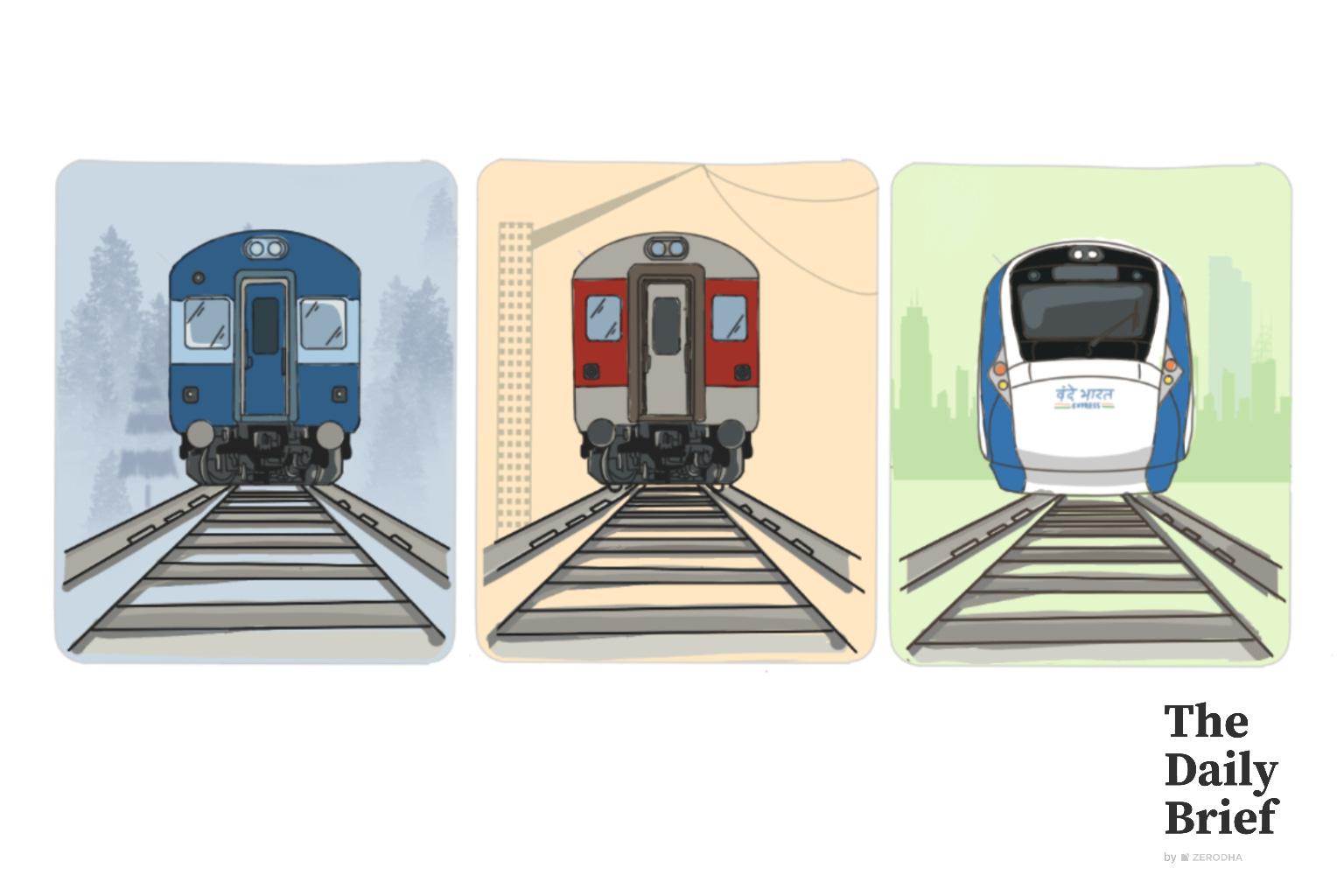
At Markets, we’ve been looking at the many moving parts behind India’s rail infrastructure, from electrification to Kavach. Today, we’re looking at the most visible part of a train that a passenger can see, feel and board: the iconic blue-bodied, mild-steel coach.
For over six decades, India’s passenger trains ran on the same basic idea: a powerful locomotive up front, pulling a long string of passive coaches behind it. As of March 2018, 49,033 conventional coaches were still in service. Since 1955, the Integral Coach Factory (ICF) in Chennai and its sister factories have built over 75,000 coaches of all types. For most of that history, the dominant design was the conventional ICF coach.
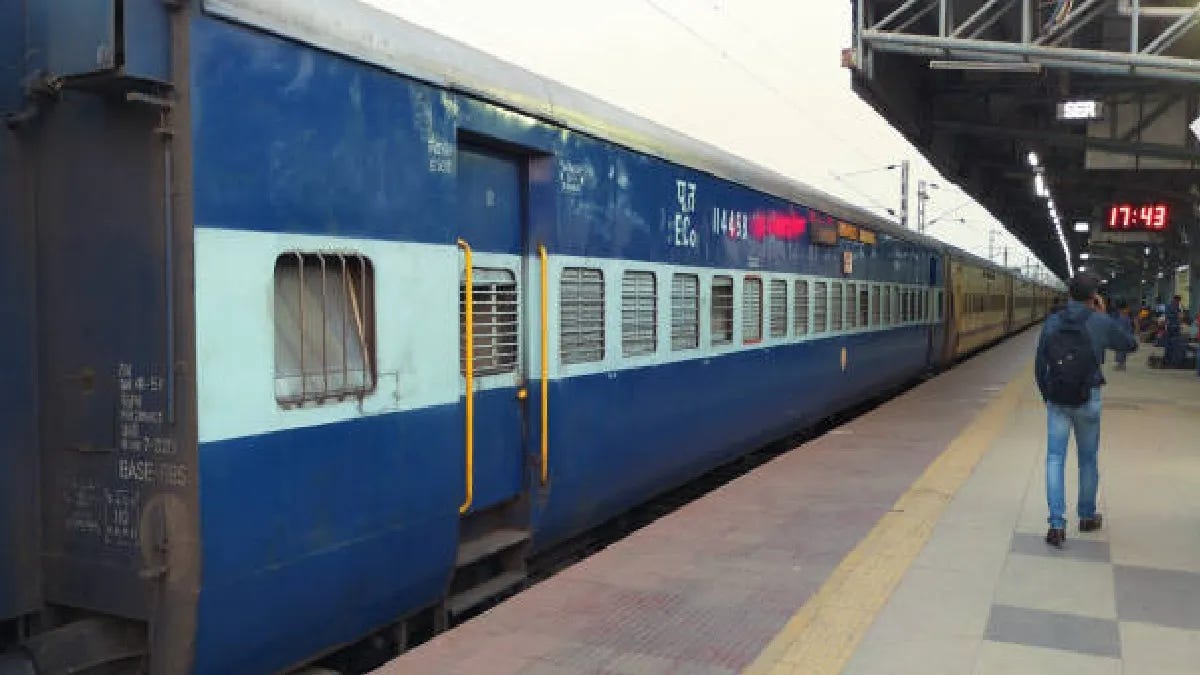
In January 2018, though, the ICF flagged off its last one. What replaced them, and why, is a story that goes beyond a simple paint upgrade.
Let’s dive in.
Like a rolling stock
The original ICF coach was designed in the 1950s with technology from a Swiss company. It was made of mild steel, which made it heavy and prone to rusting quicker. These coaches had a maximum permissible speed of 110 kmph. And like all conventional trains, they were locomotive-hauled: one engine at the front did all the pulling.
Beyond speed, though, coaches also have to primarily account for safety.
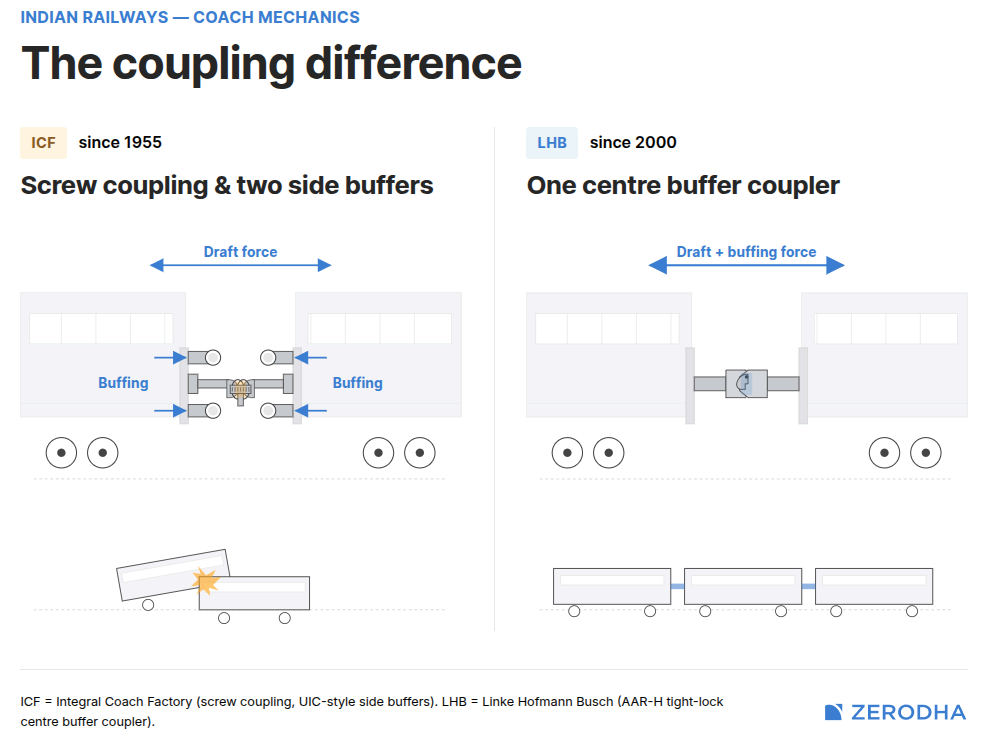
See, in the old ICF coaches, the connection between any two coaches had two separate parts. The first mechanism (called a screw coupling) held coaches together when the locomotive pulled them forward. The second mechanism, called side buffers, absorbed the shock impact when coaches pushed into each other, like during braking.
However, since these were two separate systems with gaps between them, coaches actually had room to move too loosely against each other. Which also meant that if the train stopped suddenly, say, in a collision, coaches could disconnect, slam into each other, and climb on top of one another. This is what kept happening through a series of bad derailments in 2015-16, and it forced Indian Railways to act.
What German technology changed
Now, in 1998, the Rail Coach Factory in Kapurthala received a technology transfer from a German company called Linke-Hofmann-Busch (LHB). The coaches built using this design are known as LHB coaches. Manufacturing at Kapurthala began in 2001. LHB coaches first appeared on premium services like Rajdhani and Shatabdi, before gradually spreading across the network.
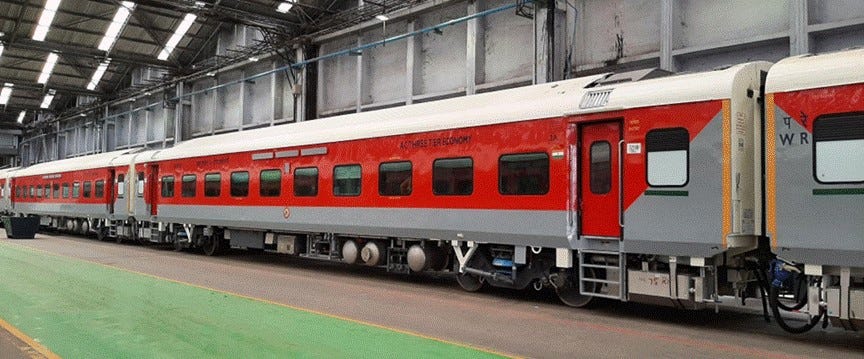
The LHB coaches are made of stainless steel instead of mild steel. They’re lighter, stronger, and don’t rust as easily. They last longer too: an LHB coach is designed to stay in service for 35 years versus 25 for ICF coaches. They use disc brakes instead of the older tread brakes, which means shorter stopping distances. And they also sound quieter.
But the most important change was, of course, in how the coaches are joined together. Instead of the old system where pulling and pushing forces went through different mechanisms with slack in between, LHB coaches use a single, heavy-duty coupler at the centre of each coach that handles both. It locks tight, and it’s designed so that in a crash, the coaches stay in line instead of climbing over each other.
This made a noticeable difference in reality. For instance, in 2014, the Dibrugarh Rajdhani derailed at high speed, but there was no loss of life. A CAG audit of the accident explicitly noted that none of the LHB coaches flipped over and there was no loss of life. After the derailment spree of 2016-17, Indian Railways pushed hard to replace the older coaches with LHB stock.
This upgrade did not come cheap, though. According to parliamentary replies, each LHB coach cost ₹75 lakh-₹1 crore more than the ICF equivalent. But the longer lifespan partially offset that premium. By 2024, the Ministry said about 23,000 conventional coaches had been replaced by LHB since 2015.
LHB solved the crash safety problem and raised the speed ceiling to 160 kmph. But the trains were still being pulled by a single locomotive. The next shift might just change the very idea of how the train moves.
Why Vande Bharat accelerates differently
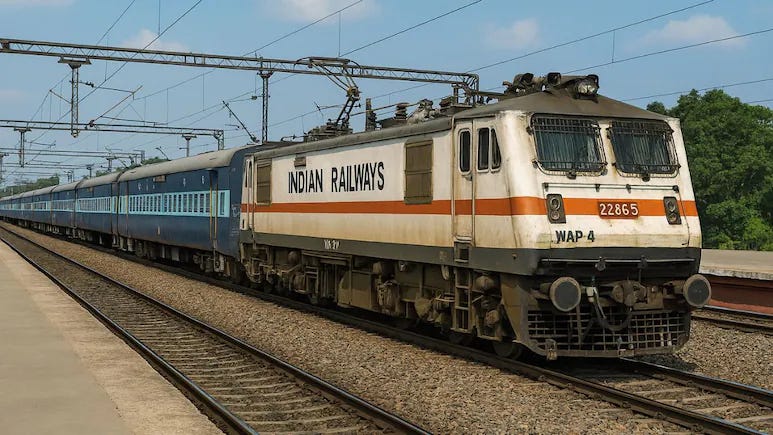
In most conventional trains, one locomotive does all the work. For an intercity service, that’s a single engine pulling 16 to 24 coaches that have no power of their own. All the pulling force has to travel through the entire chain. Getting the train up to speed takes time.
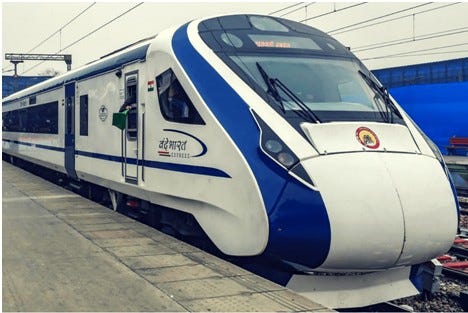
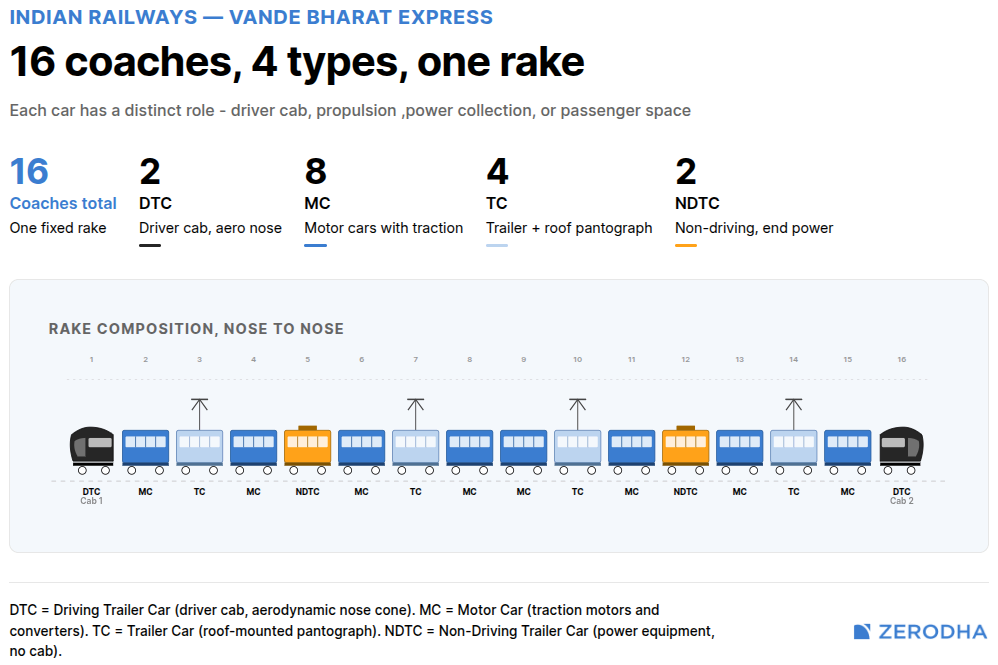
Vande Bharat works differently, though. Half of its coaches have their own motors. A standard 16-coach Vande Bharat has 8 motor coaches, with traction motors tucked under the floor. There is no need for a separate locomotive. Driver cabs sit at both ends, so the train never needs to be turned around at a terminal, either. Since the power is spread across the train instead of sitting in one engine, it accelerates much faster.
The government says Vande Bharat can cut journey times by up to 45% compared to conventional trains. The time savings come mostly from acceleration: a Vande Bharat gets up to cruising speed much faster than a locomotive-hauled train, and brakes more efficiently too. In a 2022 trial, a Vande Bharat went from standstill to 100 kmph in 52 seconds. The braking system also feeds energy back to the grid, saving up to 30% of electrical energy.
Now, Vande Bharat is not a bullet train. The Indian Railways calls it “semi-high-speed.” Its design speed is 180 kmph, with a maximum operating speed of 160 kmph. But even that 160 is rarely achieved. India’s rail tracks were largely built for slower trains. Upgrading them to handle higher speeds requires replacing rails, strengthening the track bed, upgrading signalling, and fixing curves and gradients.
It is a modern trainset designed to deliver meaningful time savings on India’s existing track network. The first prototype, Train 18, was built in under 20 months with about 80% content sourced from Indian supply chains. As of April 2026, 79 Vande Bharat services are operational.
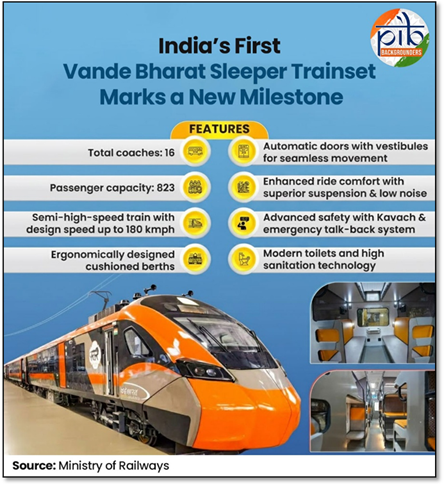
The sleeper variant was launched in January 2026 on the Guwahati-Howrah route, India’s first long-distance Vande Bharat. It carries 823 berths across 16 coaches. A 24-coach version is in design, and 260 sleeper trainsets are planned.
The builders
Who has been building all of these coaches?
For decades, the answer was government entities. ICF Chennai, Rail Coach Factory (RCF) Kapurthala, and Modern Coach Factory (MCF) Rae Bareli were the three pillars. They still are. In the last fiscal year, ICF produced 3,007 coaches, RCF produced a record 2,383, and MCF hit a record 2,025. That’s over 7,000 coaches in a single year. ICF, where the Vande Bharat was born, is among the world’s largest rail coach manufacturers.
But the ecosystem has broadened beyond them. For instance, a consortium consisting of Bharat Heavy Electricals (BHEL) and Titagarh Rail Systems won the contract for 80 Vande Bharat Sleeper trains worth over ₹23,000 crore, with 35 years of maintenance included. Titagarh, once a wagon maker, has built a Vande Bharat production line at Uttarpara in West Bengal. Meanwhile, BHEL, a government-owned capital goods firm, is now making the power electronics that drive these trains.
Then there is Medha Servo Drives, a Hyderabad-based private company that built the propulsion system for the original Vande Bharat prototype. It won a ₹2,211 crore contract from Indian Railways for the electrical systems of 44 Vande Bharat trainsets, with a requirement of at least 75% local content.
The Indian Railways still sets the standards and creates the demand for these items. But the making of trains, and especially the high-value electronics and long-term maintenance, is now spread across government companies, listed firms, and private specialists. The biggest contracts include not just manufacturing, but decades of maintenance afterwards.
The Union Budget’s rolling-stock capital outlay for FY 2026-27 is ₹65,496 crore. That number is a signal to every steelmaker, electronics firm, wheel plant, and brake supplier in the country.
The road ahead
India also exports coaches. The ICF has shipped over 875 coaches to countries including Thailand, Bangladesh, Mozambique, and Sri Lanka. In 2022, officials said India aimed to export Vande Bharat trains to Europe, South America, and East Asia. But as of April 2026, no confirmed overseas sale exists in public record.
The domestic constraint is just as telling. As of 2025, only about 21.8% of India’s tracks (23,010 km) support speeds of 130 kmph and above. Vande Bharat’s maximum operating speed of 160 kmph is achieved on just one 174-km stretch between Tughlakabad and Agra. Most services run at 130 kmph or below. The trains can do more, but the tracks can’t — yet.
The three eras of India’s passenger coaches tell a story that goes beyond trains. The old coach was a passive steel box pulled by a locomotive. The LHB coach was redesigned so that crashes wouldn’t kill. The Vande Bharat is a train that powers itself. Each shift followed the same pattern: bring in the technology, learn to make it, then make it better.
India’s coaches have come a long way from the blue boxes of the 1960s. The manufacturing base is real, the technology is increasingly homegrown, and the private sector is now part of the story. But the tracks that these trains run on still can’t match what the trains themselves can do.
How drones are changing the economics of modern warfare
Iran’s entire defence budget is $10 billion (₹84,000 crore). The United States’ defence budget is $850 billion (₹71 lakh crore).
Yet, in the war currently being fought in the Gulf, Iran has the better economics. A ₹29 lakh drone with a moped engine is draining the world’s most expensive air defence system faster than any factory can replenish it. The side spending more is at least being held to a standstill, if not losing.
Cheap drones have broken the economics of modern warfare. Every dollar spent making them is forcing the other side to spend a hundred shooting them down, and nobody can manufacture the expensive thing fast enough to keep up. This is the central fact of the modern wars being fought today. And it might have something important to say about the ₹2 lakh crore India just approved for defence procurement.
What a ₹29 lakh drone is doing to the world’s most expensive military
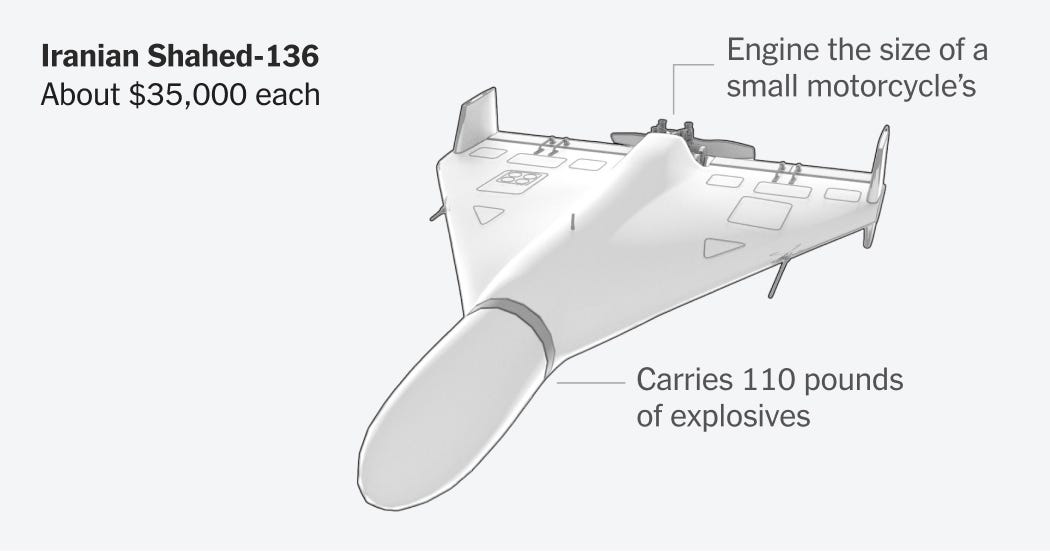
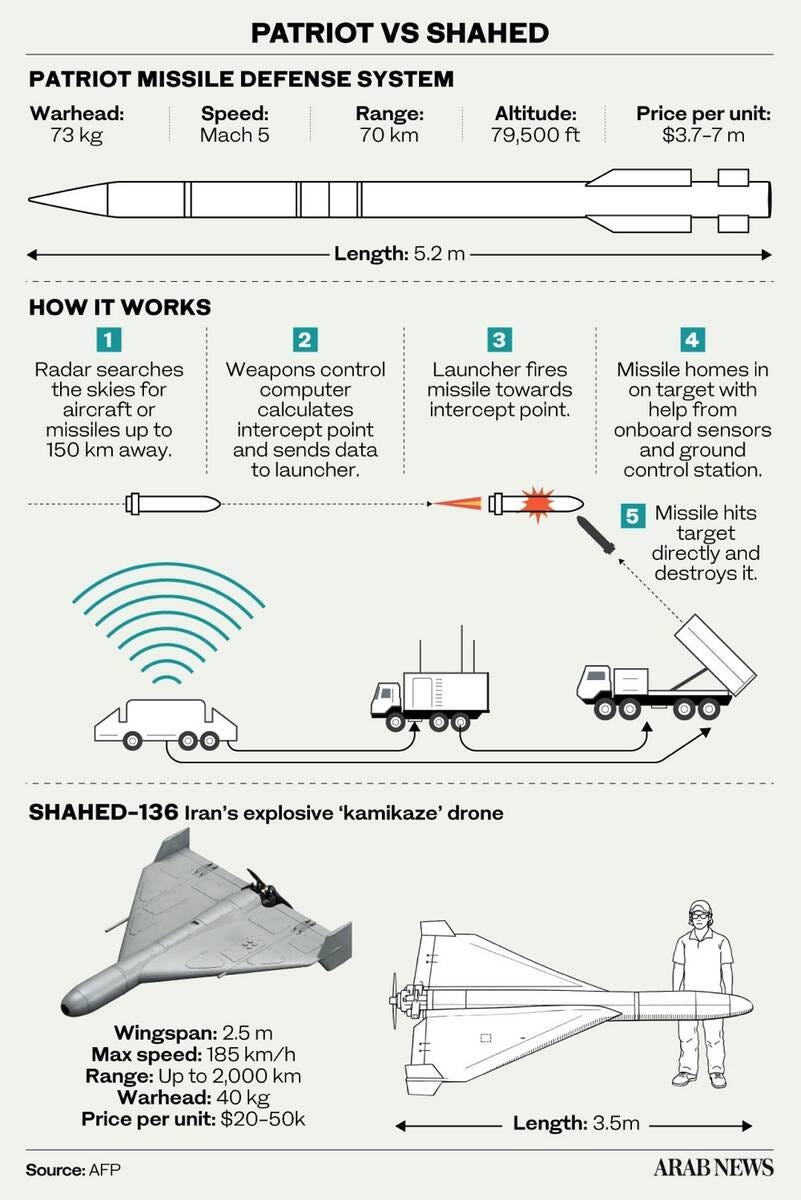
Since late February, Iran has been firing a weapon called the Shahed-136 at US military bases, Saudi oil infrastructure, and Israeli cities. It is not impressive by any conventional measure. It has a small piston engine, the kind you’d find on a moped. Its body is moulded from cheap composite material. It navigates on basic GPS and flies low and slow, at roughly the speed of a car on a highway. Each Shahed costs about $35,000 (₹29 lakh), less than a mid-range SUV.
General Hossein Salami, who commanded the Islamic Revolutionary Guard Corps until Israeli strikes killed him last June, was known for boasting about Iran’s weapons manufacturing capabilities. In one speech, he told his audience that Iran had gotten so good at building weapons that it was now about as complicated as making bicycles. At $35,000 a unit, the Shahed-136 suggests he was not far off.
Now consider what stops it. The Patriot missile system is one of the most sophisticated weapons ever built. A single Patriot battery, the radar, launchers, control systems, costs over $1 billion (₹8,400 crore) to set up. Each interceptor it fires costs $4 million (₹34 crore) — around 114 times that of the Shahed. It costs them that much more to destroy an Iranian missile.
You might think the US is rich enough to absorb that. But here is the thing, Lockheed Martin produced roughly 600 Patriot interceptors in all of 2025. And this was considered a strong production year for them.
But in the first week of the Iran conflict, the UAE alone reported being targeted by over 689 drones. Gulf states burned through months of interceptor stockpiles in days.
Iran’s strategy is now to drain stockpiles that take years to manufacture, faster than they can be replaced.
Ukraine understood this three years ago
What Iran is doing to the Gulf is not new. Ukraine lived through this problem and found an even cheaper solution.
Russia has been firing Shahed-type drones at Ukrainian cities every night for years. Ukraine could not keep shooting them down with million-dollar missiles, that would have bankrupted them.
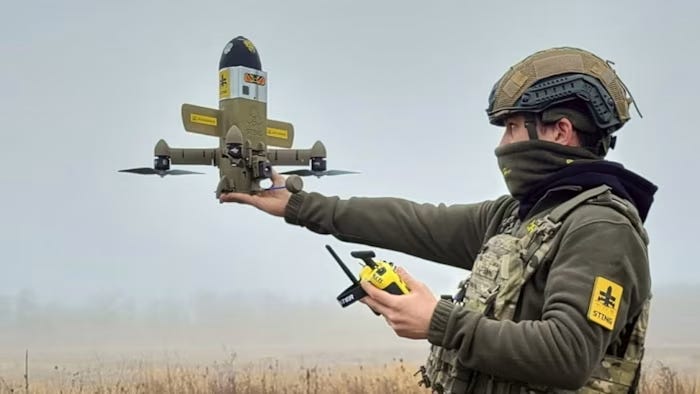
So Ukraine built their own cheap drones. The most common weapon on the Ukrainian front line today is something called a first-person-view (or FPV) drone. It’s a $400 (₹34,000) racing quadcopter strapped with a small explosive, steered by a soldier through video goggles directly into an incoming target. Ukraine produced ~800,000 drones in 2023, two million in 2024, and is targeting five million this year.
Russia, watching this, announced targets of 1,000 Geran-2 attack drones per day in 2026.
Drones have changed modern warfare, soldiers on both sides report never seeing enemy troops on the front line. They only ever encounter drones.
And your drone economics decide how long you can stand in the war.
Why America didn’t see this coming
It is interesting to see how the world’s most powerful military, the USA, is only now catching up to this reality.
You see, after World War-II, the US spent eight decades and trillions of dollars on the idea that if your weapons are sophisticated enough, one of yours beats many of theirs. The F-35 can evade radar, the Patriot can intercept ballistic missiles, and the aircraft carrier can project force anywhere on earth. And for most of the 20th century, this worked.
Through this approach, the US built a massive military-industrial complex, consisting of companies like Lockheed Martin, Raytheon and Northrop Grumman. It was optimised around making extraordinarily sophisticated weapons, slowly and expensively, for a military willing to pay whatever it cost.
What Ukraine and Iran have exposed is a specific weakness in that logic. When your adversary fires ₹29 lakh drones faster than you can produce ₹34 crore interceptors, technological superiority only does so much. Then, production speed becomes the decisive advantage.
And America’s procurement system was built for a different kind of war. The US government’s own auditor, the Government Accountability Office, found in June 2025 that the Pentagon takes an average of 12 years to deliver the first version of a weapon system. The problem ran so deep that Secretary of Defence Pete Hegseth stood at the National War College in November 2025 and declared that, “the defence acquisition system, as you knew it, is dead,” announcing the most sweeping procurement overhaul in decades. A system that takes 12 years to field a weapon was never going to produce 1,000 of anything per day. Production speed, it turned out, was the one advantage money could not simply buy.
In December 2025, the US military deployed a new weapon for the first time in combat. It is called LUCAS, the Low-Cost Uncrewed Combat Attack System, and it was reverse-engineered from Iran’s Shahed-136, sped through the Pentagon’s acquisition process in just 18 months.
The LUCAS programme is the US acknowledging that the current version of modern warfare is won not just on sophistication but also on economics.
But the problem is that building cheap drones at scale requires a manufacturing ecosystem the US does not have. Motors, batteries, sensors, electronic speed controllers, the components inside any cheap drone, come overwhelmingly from Chinese manufacturers. Even the US, with all the money and urgency of a shooting war, is discovering it cannot simply wish this industrial base into existence.
For India, that presents an acute geopolitical problem.
India’s trap
In Operation Sindoor, India used precision Israeli drones to attack Pakistani air defence systems. These drones cost close to $1 million (₹8.4 crore) each.
Pakistan, meanwhile. used Turkish Bayraktars and Chinese CH-4s. These are cheaper, mass-produced, backed by their allies Turkey and China — a significant cost advantage over the drones India acquired. Operation Sindoor may not have lasted for too long for this to matter. But when a war gets stretched over years, the math gets hefty.
India does have a cheap drone — the Nagastra-1 — which costs about $500 (₹42,000). IdeaForge, founded by IIT Bombay engineers, holds ~50% of our domestic UAV market. A ₹10,000 crore drone PLI is also being proposed for the coming budget.
But inside every cheap Indian drone right now is a core dependency. The camera and sensor payload, which allows a drone to see its target, track it, and navigate to hit it, accounts for 60 to 70% of total drone cost. India does not manufacture it at scale, relying primarily on imports from China.
China controls the global drone production ecosystem not through any military strategy but because it spent twenty years building the world’s best commercial drone industry. DJI, which holds 70% of the global commercial drone market and was banned by the US Army in 2017, is just the most visible face of an ecosystem that now underpins every military on earth.
It goes without saying that in a conflict with China (or even Pakistan with Chinese support), India loses a connection to the Chinese component supply chain immediately.
Ukraine, for instance, runs its entire drone industry on Chinese components to this day, three years into the war. The supply has not stopped, but only because China has chosen not to stop it. For India, though, that’s a geopolitical risk we probably can’t afford for long. We will have to build the capability ourselves.
In March, India’s Defense Acquisition Council approved a ₹2 lakh crore ($25 billion) package, our largest defence procurement ever. It’s a broad push to upgrade what modern warfare is validating — more S-400 batteries, sixty new remotely piloted strike aircraft.
But will this package be enough to make us self-sufficient on time? After all, China already has a massive cost advantage through its inescapable supply chain, and that advantage only compounds itself.
Tidbits
Russian oil sales to India expected to stay near record levels at over 2 million barrels per day in April-May following US sanctions waiver renewal, with March imports hitting record 2.25 million bpd (50% of India’s total), Indian refiners paying $7-9 premium to Brent for deliveries.
Source: ReutersTata Elxsi reported Q4 profit of Rs 2.20 billion, up 27.8% year-on-year, ending five-quarter decline streak, driven by transportation segment’s 7% constant currency growth and media unit’s 2.3% rise, with overall revenue at Rs 9.94 billion, declaring Rs 75 dividend per share.
Source: ReutersJPMorgan expects China’s property market turnaround to drive mainland stocks above emerging market peers, citing Hong Kong real estate recovery spillover to tier-one cities, wealth effect from equity rebound, and housing affordability at 2016 levels, with March showing slowest home price decline in a year.
Source: Bloomberg
- This edition of the newsletter was written by Vignesh and Aakanksha.
What we’re reading
Our team at Markets is always reading, often much more than what might be considered healthy. So, we thought it would be nice to have an outlet to put out what we’re reading that isn’t part of our normal cycle of content.
So we’re kickstarting “What We’re Reading”, where every weekend, our team outlines the interesting things we’ve read in the past week. This will include articles and even books that really gave us food for thought.

How can Indian IT flip the AI script ft. Ameya P
The age of AI agents has, so far, been a thorn on Indian IT’s side, at least as far as valuations are concerned. Its business model is getting stale each passing day - that’s understood. There might be a possibility that Indian IT might just adapt to the new paradigm. But what does adaptation for Indian IT look like? What are the forms of inertia they will have to overcome to successfully change themselves? And even if they do adapt, will they be able to defend their new business? To unpack all this, we spoke to Ameya P, a veteran in the global IT industry, and a prolific technology investor well-known for his investing takes on X. It’s an incredibly nuanced conversation from an expert who understands the nitty-gritties of what each AI development brings forth for this industry
Thank you for reading. Do share this with your friends and make them as smart as you are 😉
You guys always do a great job. I loved reading both the pieces today :)
The train is outrunning the track. This is the standard sequencing problem in Indian rail: rolling-stock procurement moves faster than track geometry upgrades, because coaches have a visible price tag and a ribbon to cut. The signalling and grade correction work that would let Vande Bharat actually run at 160 kmph has neither.