

Our goal with The Daily Brief is to simplify the biggest stories in the Indian markets and help you understand what they mean. We won’t just tell you what happened, we’ll tell you why and how too. We do this show in both formats: video and audio. This piece curates the stories that we talk about.
You can listen to the podcast on Spotify, Apple Podcasts, or wherever you get your podcasts and watch the videos on YouTube. You can also watch The Daily Brief in Hindi.
In today’s edition of The Daily Brief:
India dreams of owning the sea
Why is protein powder getting expensive?
India dreams of owning the sea
Picture a container leaving a garment factory in Tiruppur, packed with T-shirts bound for Rotterdam. It moves by road and rail to a port on the western coast, waits its turn, gets lifted onto a ship. From that point on, when it touches the water’s edge, almost everything about the journey belongs to another country.
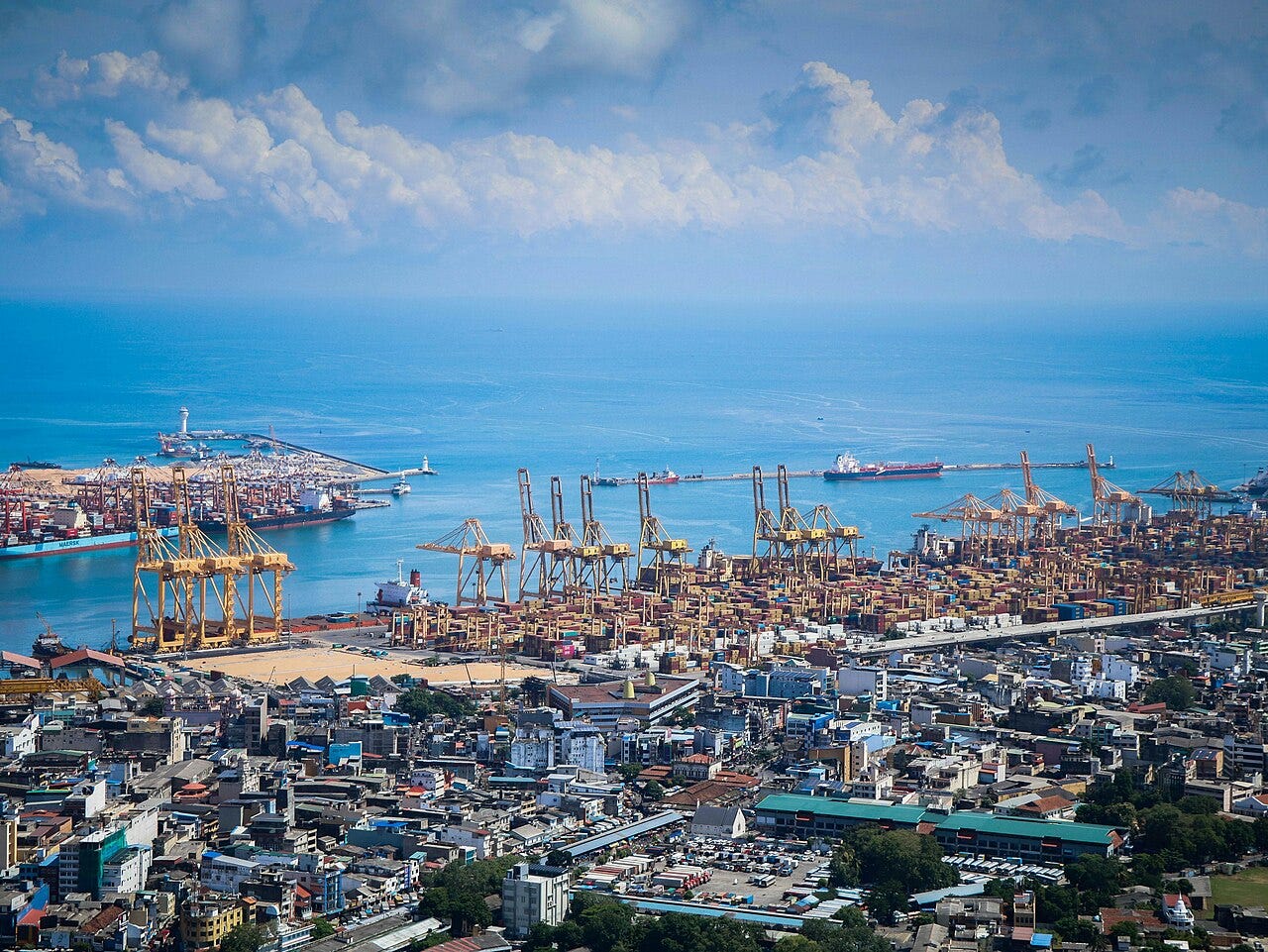
The ship carrying the shipment is almost certainly foreign-flagged. Indian ships carry only about 5% of the country’s export and import cargo. That ship probably doesn’t head for Europe. Instead, the container is likely “trans-shipped” from a nearby port in another country like Sri Lanka or Singapore, as three-quarters of India’s long-distance shipments are. A foreign flagged ship, financed and insured from abroad, then carries it to its destination.
The bulk of India’s trade crosses the sea. But the entire infrastructure carrying it — the ships, the hubs, the insurers — comes from other countries.
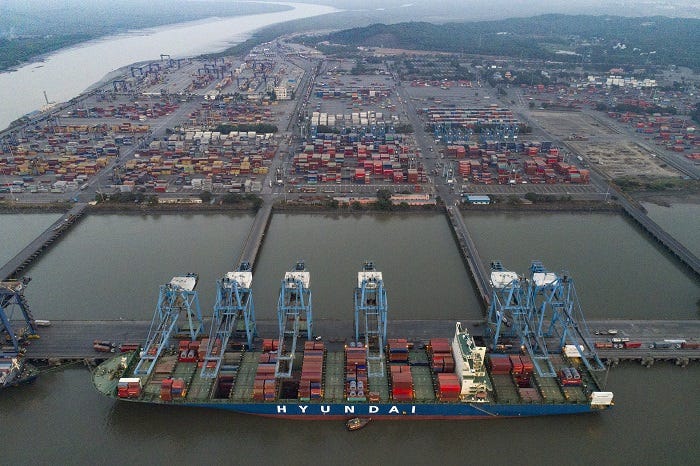
Since the COVID-19 pandemic, we have made a strong push to upgrade our port infrastructure. The Mundra port, the Pipavav port and the Jawaharlal Nehru Port in Navi Mumbai rank among the world’s top thirty most efficient ports. In fact, the Jawaharlal Nehru Port was among the most-improved ports on earth in the last five years. We clearly have the ability to build world-class maritime infrastructure. These improvements have also reduced our logistics costs substantially — from well into the double digits to just about 8% of our GDP, which is in the same ballpark as countries like the United States and Germany.
But Indian shipping suffers from a wider range of legacy problems. These fall into two broad families: one, that we rely too heavily on foreign infrastructure, and two, that range of frictions make India’s experience with shipping uneven.
The last year has seen the Indian government wrestle extensively with these issues. In the space of a single year, it brought in a ₹69,725 crore package, floated three new laws replacing statutes dating as far back as 1908, launched a development fund and an insurance pool that both run into thousands of crores, and inaugurated a new deep-water port.
Taken together, these measures present a serious overhaul of Indian shipping on the horizon.
The many ailments of Indian shipping
Depending on who you are, your logistics costs can vary substantially. To a large company, shipping costs can add up to ~8% of their turnover. Smaller businesses, meanwhile, spend more than twice as much — at roughly 17%. The very exporters least able to carry those costs pay the most.
Some of this is structural. Scale unlocks many efficiencies, and gives you bargaining power that a smaller firm simply doesn’t have. These differences are hard to iron out.
Some frictions, however, are peculiar to India. Indian ports are wrapped in layers of process and procedure, which small businesses struggle to handle. Those struggles create a crop of brokers and intermediaries one must go through to get a shipment through. Each middleman adds to a firm’s costs, making shipping far more expensive than what tariff cards alone imply.
This isn’t uniformly the case. Some Indian ports compare favourably to the world’s best. At the same time, many of India’s most important ports — like those at Visakhapatnam, Cochin or Chennai — don’t even feature among the world’s hundred most efficient ports. The experience of sending a shipment out depends entirely on where you do it.
At any of those ports, you’re probably met by a ship that carries a foreign flag.
After all, it’s incredibly expensive to run an India-domiciled ship. Running an Indian-flagged vessel for a foreign voyage costs about 20% more than running a foreign one. This is almost entirely a matter of policy. Indian ships borrow at higher rates over shorter tenures, pay tax on their crews’ wages, pay import duty on the vessel itself, lose tax credits they cannot recover, and pay GST on domestic legs that a foreign ship sails free of. Moreover, a foreign charterer must pay a withholding tax of around 7.5% on the freight they earn if they’re renting an Indian ship.
This is a business where a few percentage points of cost can make-or-break a contract. A twenty percent gap essentially kills the case for Indian shipping — ensuring that Indian shipping is extremely unattractive to Indian firms, let alone foreign ones.
In fact, even when Indians own and operate ships, they don’t fly them under an Indian flag. It makes better sense to register a ship in Panama or Liberia.
As a result, we pay foreign shipping companies roughly ₹6 lakh crore a year, a figure close to our defence budget. This is a serious loss of foreign exchange. An Indian shipping company would spend some foreign exchange in fuel costs as well, to be fair, but this exaggerates the outflow.
There are some issues we have less control over.
Take trans-shipment. Most long-distance cargo travels on massive ships that can’t dock on regular ports. These ships require deep drafts, and ports with enough terminal and berthing capacity to handle their cargoes. And the more cargo a port moves, the cheaper each becomes. That is, the more traffic a shipping hub sees, the more attractive it becomes.
Until recently, India didn’t have a port that could perform this job. Most Indian cargo would have to go through ports like Colombo and Singapore. The fees was an annual outflow of more than $200 million in foreign exchange.
We’re also dependent on other countries for insurance. Large ships inevitably need insurance. In fact, no port would accept a ship that doesn’t have insurance cover, while no canal would offer them passage. Traditionally, those liabilities would be carried by the International Group of P&I clubs, a set of mostly European insurers.
This system evolved as a question of convenience, but recently, it became a liability. When Western countries placed sanctions on Russian oil, the channel through which they enforced those sanctions was insurance. European insurers were instructed to cut off tankers carrying Russian crude, at least if it was being sold above the G7’s price cap.
Effectively, this made India hostage to the foreign policy of Western countries.
In all, the decades-long neglect of India’s maritime sector had left us riddled with a series of compromises and dependencies. These made our imports expensive, our exports uncompetitive, while a substantial share of the foreign exchange we earned drained away to foreign firms. But worse still, we lost options of how to manage our own affairs.
India’s response
Over the past year, the Indian government has tried to break through each of these dependencies.
The easiest of these issues is routine friction, which lands the hardest on India’s small businesses. The key challenge, here, is excess paperwork — and paperwork can be cut. Last October, the government announced its “One Nation, One Port” effort. This brought down the documents a container needs by roughly a third, from 143 to 96.
It has also tried bringing more transparency and accountability to India’s ports, with indices like the Saagar Aankalan, a benchmarking system that scores ports against one another. This grants more visibility over how India’s ports perform — shining a light on ports that perform poorly.
Then, there are costs.
Previously, we tried cutting the costs of Indian shipping through subsidies. Our shipping firms were unable to win government tenders, let alone commercial contracts. And so, the government set aside ₹1,624 crore to help Indian ships outbid foreign rivals for these tenders. This only addressed the symptoms, however, and did little to fix the 20% structural drag our policies created.
This time around, we’ve dug deeper. The government has reclassified ships as infrastructure, which unlocks cheaper and longer credit for them. It has also introduced tax breaks for ships leased through the GIFT City financial hub. This has been paired with a variety of other sops, aimed at re-flagging 300 foreign ships to India by 2030.
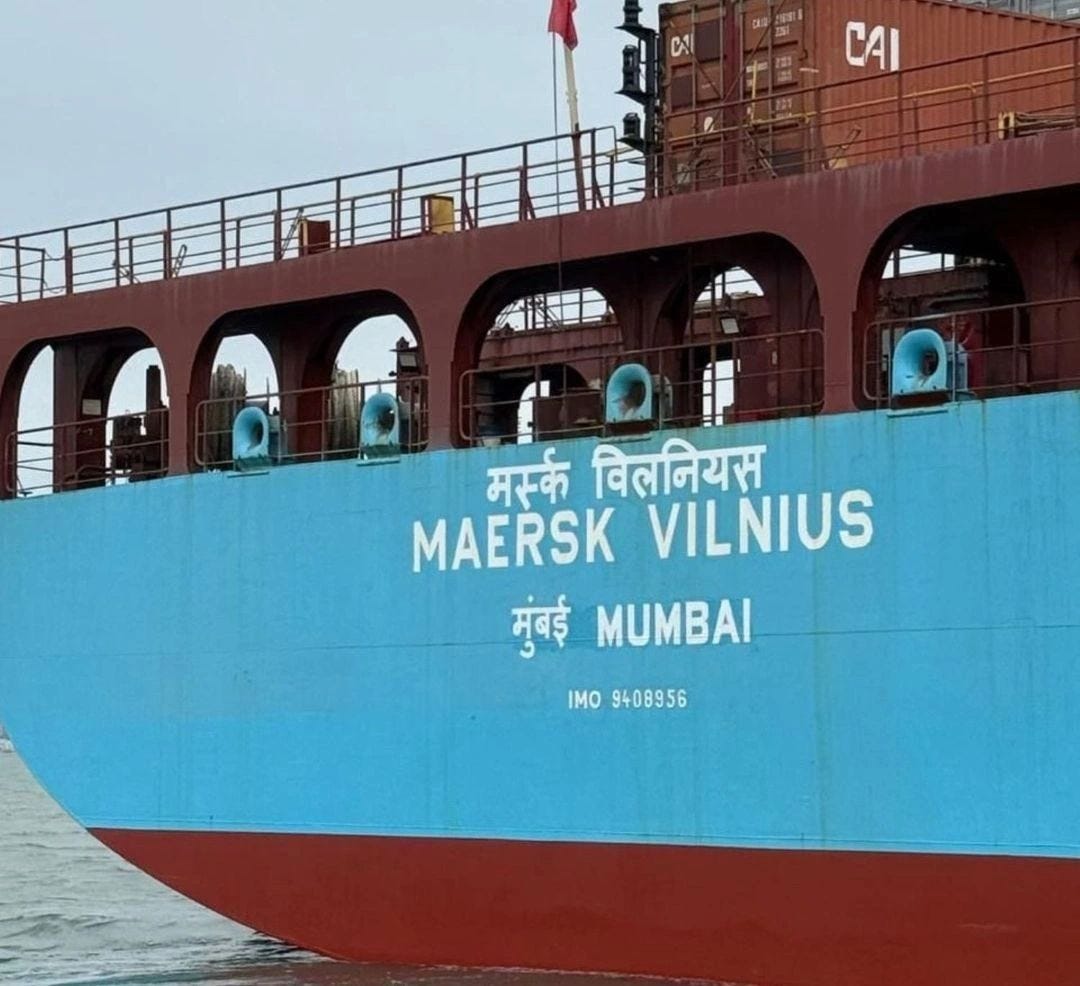
We haven’t eliminated all bottlenecks — there are still serious issues around the tax treatment of Indian ships. But there are signs that the case for an Indian flag is growing stronger. The global shipping giant, Maersk, for instance, recently brought two ships, previously registered in Singapore, under the Indian flag.
The government is also trying to get around this problem through easier finance. Ships are costly, long-lived assets, which need patient capital. Meanwhile, our mortgage rules make it difficult for a lender to repossess a ship cleanly in the case of a default, making banks hesitant to fund them. This is why the government has stepped in with a ₹25,000 crore Maritime Development Fund to fill the gap.
More recently, the government also made a serious push for domestic insurance, to by-pass the policy prescriptions of the West. It just announced the Bharat Maritime Insurance Pool, which comes with a ₹12,980 crore sovereign guarantee. That insurance brings independence. The next time a foreign insurer withdraws cover, an Indian ship can find it at home and keep its business afloat.
It isn’t just funding, though. We’re also creating infrastructure.
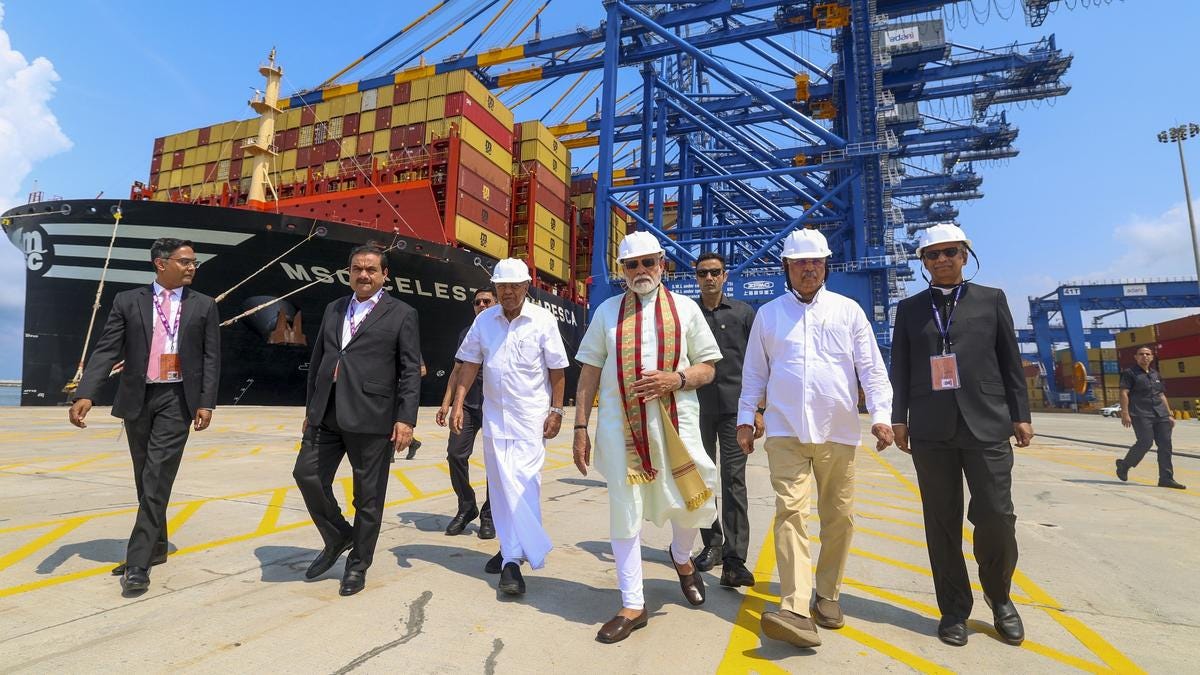
To solve the trans-shipment problem, last May, we opened the Vizhinjam port, India’s first deep-water trans-shipment port. This ₹8,800 crore investment can handle the world’s largest ships, and is aimed at plucking business away from Colombo. That won’t be easy. Colombo has economies of scale that we do not yet enjoy. But the port has already crossed ₹450 crore in revenue, which shows that demand exists.
All of this is backed by a serious legal push.
Last year, the Parliament passed three new shipping laws. These replaced an ancient set of statutes, including the nearly 120-year old Indian Ports Act of 1908. The new laws greatly liberalised how Indian shipping would work. The Merchant Shipping Act, for instance, liberalised who could own an Indian-flagged ship. Where previously, an Indian ship would have to be owned wholly by Indian nationals, the act opened it to NRIs, overseas citizens, foreign lessors leasing to an Indian, and others. Similarly, the new Indian Ports Act modernised how Indian ports are run.
The laws aren’t completely in force. The rules under them are still being drafted. But this is a massive update to India’s maritime sector.
Where this leaves us
To recap, in the space of a little over a year, we have new laws, new ports, new financing vehicles, fewer compliances, better data, and more. Collectively, this amounts to a serious push to make India a maritime powerhouse. These aren’t palliatives that treat the symptoms of a bad problem. They’re a fundamental rethink of how shipping works in the country. They attempt to directly address the root causes of our poor performance.
This isn’t to suggest that the sector will turn around overnight. Shipping is a competitive business, where scale and financial muscle matter for a lot. Ultimately, India will have to win its cargoes one container at a time.
But where that was once impossible, it is now merely difficult. That, alone, may make all the difference.
Why is protein powder getting expensive?
Today we want to try to answer a simple question: why is whey getting so expensive?
Our teammate Kashish Kapoor likes to boil down such questions to a reductionist, but effectively true answer: demand and supply. It feels like a crime to agree with him, but at the end of the day, that’s just it. It is expensive because there’s not enough of it.
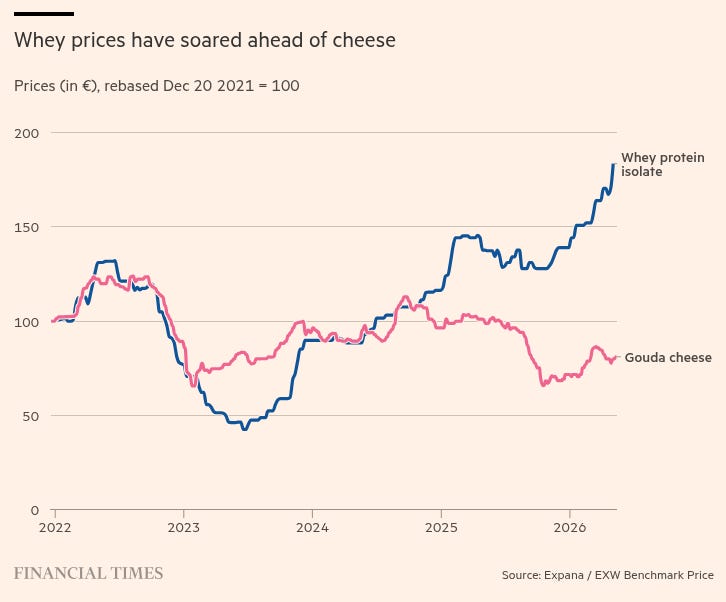
To understand how bad things have become: as per The Guardian, the supplement-grade version of whey protein concentrate has gone from around £4,300 (~₹4.5 lakh at 2023 rates) per tonne in mid-2023 to nearly £24,000 (~₹30 lakh at current rates) per tonne today. The more refined version, whey protein isolate, has risen fivefold to ~€28,000 euros (~₹30 lakh at current rates) per tonne since 2023.
But obviously, we want to go a little deeper into why this is. And that answer starts with understanding how whey is even made.
How do we get whey
Think about how paneer is made at home. You heat milk, add some lemon juice, and the milk splits into solid and liquid. The solid bits clump together and become paneer after you press them. The thin, watery liquid that drains off is whey. Every time someone makes paneer, curd, or chhana in India, they produce whey as a byproduct. Most of it gets thrown away.

In the West, the dominant dairy tradition was never paneer, but aged cheese like cheddar, mozzarella, and gouda. Aged cheese is also made differently — instead of lemon, you add an enzyme called rennet to the milk. Rennet also separates the milk into curds and liquid, but this liquid — called sweet whey — has a different chemistry from the liquid that comes off paneer or curd-making. The proteins in sweet whey are largely intact and undamaged, which means you can process them further.
In the latter half of the 20th century, food scientists figured out what to do with this sweet whey. You filter it through specialised membranes to remove water, fat, and lactose. Then, you dry what remains into a powder. The resulting product contains all nine essential amino acids, absorbs into the body faster than almost any other protein source, and causes far fewer digestive issues than plant proteins.
That is whey protein concentrate (WPC), the powder in every protein tub at every supplement shop. Whey protein isolate (WPI) is a stronger, more protein-heavy version of it. As an analyst told the Financial Times earlier this year:
“It used to be a product with no value. Now cheese could become the byproduct of whey production.”
Now, you’re probably wondering: why can’t India, the world’s largest milk producer, just make this powder itself?
The answer comes down to the fact that India never really developed a cheese-eating culture. Traditional Indian cuisine has no use for aged hard cheese. Our dairy heritage went entirely in the direction of fresh dairy which is consumed quickly: paneer, dahi, chhana, ghee.
Moreover, hard cheese requires weeks or months of aging, which historically wasn’t practical in India’s hot climate and without a cold chain. Many Indian households also traditionally avoided rennet because it comes from a calf’s stomach lining. And until pizza chains and fast food culture arrived in the 2000s, there was simply no consumer demand for it.
Even today, hard cheese is less than 3 percent of India’s milk pool. Without a cheese industry, there is no sweet whey. And without sweet whey, there is no whey protein powder industry.
Why demand has been picking up
The demand for whey protein did not appear suddenly. It built up from several completely independent directions over roughly 15 years, and they all converged at similar times.
The first was a cultural shift. In the 2010s, keto and paleo diets went properly mainstream, spreading from gyms and nutrition circles to social media, where fitness influencers made protein the hero macronutrient and carbohydrates the villain. A generation of consumers started reading nutrition labels and choosing the higher-protein option.
The consumer demand came first, and then, beyond protein supplement makers, the world’s largest food companies followed. According to NielsenIQ, the average American supermarket carries more than 38,000 products with a protein claim on the label today. Protein is in cereals, in chips, and in Starbucks coffee drinks.
For instance, General Mills launched Cheerios Protein, which was on track for $100 million in first-year sales. Then, Coca-Cola is spending $650 million (~₹5,500 crore) building a plant to expand capacity for Fairlife, its high-protein milk brand. When a cereal that sells hundreds of millions of boxes adds whey protein as an ingredient, the demand for whey as a raw material is much larger than what a single supplement brand can create.
The second driver is aging. Adults start losing muscle mass from around the age of 50, at 1-2% per year. This is a condition called sarcopenia, and the clinical recommendation for its treatment is higher protein intake. People born between 1946-1964 (called baby boomers) are now between 60-80 years old. That’s the exact age range where this becomes serious and a doctor’s advice most directly translates into someone buying a protein supplement. The number of people in this cohort is something the market has never absorbed before.
The third and most recent driver is GLP-1 weight-loss drugs, like semaglutide, which we know through brands like Ozempic and Wegovy. These drugs suppress appetite dramatically. But when you eat less and lose weight rapidly, you lose muscle alongside fat. Research from Harvard Medical School found that ~40% of the weight lost on semaglutide is lean mass rather than fat.
So to prevent this, doctors now prescribe high protein intake alongside these drugs. That has created an entirely new category of protein consumers — patients on medical prescription, as opposed to gym-goers. As per JP Morgan, 10 million Americans were on GLP-1 treatment by the end of 2025 — double that of 2023.
Erika Tamayo, the founder of protein brand Hermosa, told The Guardian in June 2026:
“Once GLP-1s started soaring, people realised how important protein is in their diet. Then loads of products in mainstream supermarkets started adding whey protein to everything — popcorn, crisps, even protein doughnuts.”
The collision moment
All three of these demand trends were building through the last few years. But there is a specific reason as to why whey prices hit their peaks only in 2025 and 2026.
In 2022, whey prices were already elevated, and producers across Europe and North America ramped up manufacturing to capture the margins. By 2023, demand softened, and they found themselves with warehouses full of inventory that was rapidly losing value. Their response was to stop building inventory entirely and switch to made-to-order production — you only produce once someone has already paid for it. Producers actively shut down WPC and WPI production runs and stripped all buffer product from the system.
But then, in 2024, a demand surge arrived, but supply chains that were ramped down earlier had little capacity to absorb it. After all, building a new whey processing plant takes a minimum of two years.
Glanbia, the world’s largest WPI producer, announced new capacity in New Mexico in November 2025, but it will not be online until 2027. They expect whey costs to show a double-digit increase in 2026. They also noted that whey protein showed “limited consumer elasticity from 2025 price increases to date“ — meaning they raised prices and people kept buying.
Meanwhile, Arla Foods, one of Europe’s largest dairy cooperatives, reported its ingredients division grew revenue 43% in 2025 from the demand surge, even as it struggled to keep up.
Where India sits
Now, India imports around 85% of our supplement-grade protein powder despite being the world’s largest milk producer. Without a large-scale cheese industry, we generate little sweet whey and have almost no infrastructure to process what little there is.
On top of this, India got caught in a cascade.
See, the US had been one of the largest exporters of supplement-grade whey. But from 2024 onwards, GLP-1 drugs created a new source of domestic demand that helped absorb all its supply. US exports of WPC and WPI to China fell 47% in the first four months of 2026 compared to the year before. So, China moved its purchasing to Europe.
Now India had separately lost US supply in late 2024 due to a veterinary health certificate dispute. We also source nearly 60% of its supplement-grade whey from Europe. So suddenly, we began competing with China for the same European supply. Industry estimates put current WPC prices in India at over ₹2,000-2,300 per kilogram — three times that of the price range of ₹700-800 per kilogram in 2024. Retail prices on protein supplements are up 15-25%.
Then, our own GLP-1 generic boom made it harder for ourselves.
As we’ve covered before, the semaglutide patent expired in India in March 2026. India’s pharma giants didn’t wait to pounce on the impending gold rush, some even launching the day after the patent expired. Dr Reddy’s has publicly said it is building protein supplementation products for GLP-1 patients.
India has 254 million people with a body mass index above 25, and 89 million diabetics. Each new GLP-1 patient adds to the protein demand. We are creating more of this demand at home at the exact moment we are least equipped to supply it domestically.
Conclusion
They say that the solution to high prices is, well, high prices. The economics of building domestic hard cheese and whey processing infrastructure might make far more sense at current import prices. In fact, our recent coverage on the dairy sector’s results showed how Parag Milk Foods is rapidly scaling up its whey production. Quite clearly, there are visible sources of domestic demand that make domestic whey production viable.
But whey plants take time to build. And as with any other industry with long capex cycles, you can never tell how demand and supply will ever meet on time. Within that time, there is a possibility that the market could shift. The growth of sweet whey is fundamentally dependent on India’s cheese market.
Until that happens, India keeps buying protein powder from the other side of the planet while producing more milk than anyone else on earth.
Tidbits:
Meesho’s board approved acquiring 100% of Singapore-incorporated Kirana Club and 0.41% of its Indian subsidiary Retail Pulse Labs for ₹202.08 crore, payable in three tranches.
Source: BSIndustry bodies representing 80% of India’s liquor market accused Telangana of breaching accounting rules by paying new dues while leaving ₹3725 crore in December 2025–April 2026 dues unpaid, risking bad debt.
Source: BSThe Trade Promotion Council of India constituted a Bio-Energy Committee on June 12 to facilitate policy dialogue and investment frameworks, positioning bio-CNG, ethanol blending, and biomass power as strategic pillars of India’s energy transition.
Source: ET
- This edition of the newsletter was written by Pranav and Krishna.
What we’re reading
Our team at Markets is always reading, often much more than what might be considered healthy. So, we thought it would be nice to have an outlet to put out what we’re reading that isn’t part of our normal cycle of content.
So we’re kickstarting “What We’re Reading”, where every weekend, our team outlines the interesting things we’ve read in the past week. This will include articles and even books that really gave us food for thought.

Amit Kumar Gupta on the copper cycle
For months, almost every major story we’ve covered—from the energy transition and the AI data-center boom to EVs and power grids—has had copper quietly sitting at the center of it. To make sense of why this metal keeps showing up everywhere, we sat down with Amit Kumar Gupta, who runs Fintrekk Capital and has over two decades of experience in the markets. Our conversation dives deep into the nuances of the copper cycle, the sheer scale of demand from new technologies, the things most people get wrong about the metal, and what it all means for the global economy. Read the key takeaways on Subtext.
Watch the full podcast episode below, where Amit walks us through the mechanics of the copper cycle and its impact on the future of energy and tech
Thank you for reading. Do share this with your friends and make them as smart as you are 😉