

Our goal with The Daily Brief is to simplify the biggest stories in the Indian markets and help you understand what they mean. We won’t just tell you what happened; we’ll tell you why and how too. We do this show in both formats: video and audio. This piece curates the stories that we talk about.
You can listen to the podcast on Spotify, Apple Podcasts, or wherever you get your podcasts and watch the videos on YouTube. You can also watch The Daily Brief in Hindi.
Rajashree Murukute on the future of India’s municipal bond market
In the latest episode of Subtext, we host Rajashree Murukute (Senior Director, CARE Ratings) to break down how Indian cities are financed and why municipal bonds haven't taken off. We cover how rating a municipal body differs from a corporate entity, why cities struggle with data disclosures, how policy incentives like AMRUT nudge municipalities toward capital markets, and how pooled finance structures can help smaller cities access the bond market.
You can watch or listen to the full episode on YouTube | Spotify | Apple Podcasts
In today’s edition of The Daily Brief:
Story: Indian auto: an export boom, a demand crunch
Why are Indian carmakers seeing a massive surge in EV exports to Europe while simultaneously struggling to meet demand at home? Driven by Maruti’s European export boom, automakers are seizing a huge global opportunity. Yet domestically, supplier fires, severe weather, and spiking raw material costs have created a supply crunch—forcing companies into a high-stakes race to add factory capacity while balancing electric vehicles with thriving CNG lineups.
Chart: Why Big Tech is spending so much on AI
Why are tech giants pouring nearly all their cash flow into artificial intelligence infrastructure? Unlike traditional software, AI requires massive upfront investments in data centers, chips, and power long before generating major revenue. As capex and R&D soar, these companies face a high-stakes gamble on whether future AI returns will justify today's astronomical spending.
If you’re new to investing or have recently opened your account with us, we are hosting a Varsity Live session for you, where we’ll do an interactive walkthrough of all our platforms and show you how to make the most of your Zerodha account.
Date: Saturday, 22nd August | Hindi session: 11:00 AM | English session: 4:30 PM
Indian auto: an export boom, a demand crunch
Last year, India’s electric car exports were so small they didn’t really show up in the trade data. This quarter, India’s total exports came at $369 million (~₹3,500 crore) — in Q1 FY26, the same number was just $22 million.
What’s crazier is that almost all of that jump came from one car which didn’t even exist in the export numbers twelve months ago. We probably just witnessed a massive inflection point for Indian EVs, and things will only grow further from here.
This export boom clashed with everything else happening in Indian autos. Customers wanted more cars than factories could build. Raw material costs were climbing. One supplier caught fire, and a few others were simply short-staffed. And in the middle of all of it, every major carmaker was spending heavily to add capacity they couldn’t fill fast enough.
In short, there was no shortage of action in Q1 FY27. Let’s dive into the nitty-gritties of what the quarterly results have said.
EV exports
India’s electric passenger-car exports went from barely 1,300 units in Q1 FY26 to over 10,800 units in Q1 FY27. Europe alone accounted for most of it, with Spain the single largest buyer at over 4,000 units.
Almost all of this boom traces back to Maruti Suzuki’s eVITARA, which wasn’t even part of India’s car export base a year ago. Commercial shipments to Europe only began in August 2025, with just over 2,900 units. By March 2026, cumulative shipments had crossed 25,000 units. By May, it passed 35,000 to 46 countries.
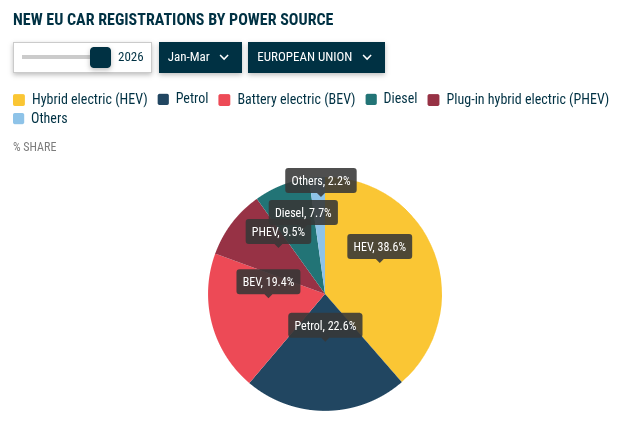
So why Europe? It’s no secret that Europe’s demand for electric cars has been rising fast — battery-electric cars accounted for 19.4% of new EU registrations in the first quarter, up from 15.2% a year earlier.
But more importantly, India has a price advantage up its sleeve.
You see, Europe has long been complaining about an over-flooding of Chinese EVs. That’s why the EU has added an extra tax of up to 35.3% on Chinese-made electric cars since October 2024, on top of the normal 10% import duty. An India-built Suzuki pays only that normal 10%.
None of this makes India an EV-export powerhouse, though. India still barely makes its own EV battery cells. Most of what goes into Indian-made electric cars is imported, unlike China, which builds its own batteries and then exports the finished car.
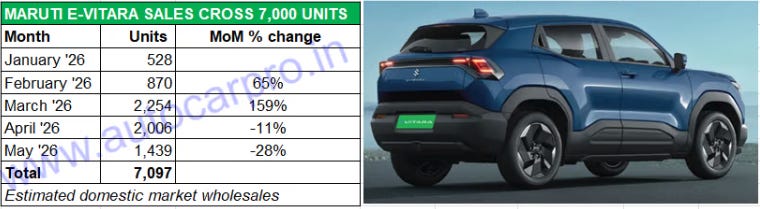
What makes this export boom more interesting is that within India itself, the eVITARA has been quieter. Between January-May 2026, Maruti sold nearly 7,100 units domestically: less than the 10,800-plus exported in a single quarter. Domestic sales peaked in March at 2,254 and eased off since.
But what is this a sign of? Well, it could partly reflect the fact that India’s EV infrastructure is not as developed as Europe more than anything. Plus, Suzuki always planned to send most of the production overseas, since the Gujarat factory serves 46 countries, not just India.
But what about Maruti’s peers? Tata, Mahindra and Hyundai don’t hold a candle to its export numbers, but not because their cars are bad.
Tata sold more than 92,000 EVs in FY26, but its international growth has mostly been a story in one country: South Africa. Mahindra, meanwhile, has strong electric SUVs but nothing at eVITARA’s export scale. Hyundai already makes EVs in other countries, so it doesn’t need India as the source for a European electric car the way Suzuki does.
Exports go well beyond EVs, too. Maruti’s overall exports grew 28.6% even as the rest of India’s passenger-vehicle industry saw exports fall 8.4%, helped by a spread across nearly 120 countries that cushioned the West Asia conflict’s impact on its Middle East shipments.
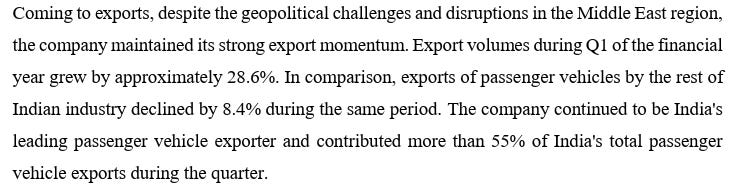
But Hyundai had no such cushion. Its own exports fell nearly 20%, from 48,140 units to 38,708, directly because of the same conflict, and that shortfall is a real part of why its overall numbers came in the way they did this quarter, not just a side detail.
The eVITARA fits the same pattern from a different angle. Producing cars in India for Europe improves factory utilisation and diversifies where demand comes from, which is genuinely useful. But it also creates dependence on shipping routes, destination-market regulation and geopolitical (in)stability that no Indian carmaker controls. The same processes that opened this opportunity for Maruti is what left Hyundai’s Middle East business exposed this quarter.
EVs aren’t the only green option in town
Now, some of these numbers also reveal how each of the four big carmakers is approaching EVs very differently this quarter. As we covered briefly last quarter, their approaches are quite divergent.
Tata, for instance, has been selling electric cars in India longer than anyone else. It sold a record 34,000-plus EVs in Q1 — roughly a fifth of its total sales — and still holds more than 40% of the Indian EV market. Two of its models, the Nexon and the Harrier, also earned ₹313 crore under the government’s PLI scheme, which pays companies a subsidy for manufacturing cars with a high share of locally made parts rather than just putting together imported components.
Mahindra, in contrast, only started selling its electric SUVs about a year ago. In that time, EVs have gone from zero to 12% of what Mahindra sells, against about 9% for the industry, and volumes grew 77% year-on-year. More importantly, management said the EV business already makes money on its own without needing PLI.

Hyundai hasn’t launched its big EV in India yet, but it’s building the car to use as many Indian-made parts as possible from the very first day, including locally made battery packs. So, it qualifies for PLI the moment it goes on sale. And Maruti, as we’ve seen, entered the EV market very late, but jumped into the front with an export story none of the other three have.

But here’s the deal. Not everyone is convinced that EVs are the only, or even the most important way forward towards a greener world.
In fact, while electric cars get most of the attention, what has been eating petrol’s share the most is actually CNG. Maruti sold about 2.2 lakh CNG vehicles in the quarter. This made up around 42% of everything it sold, and it’s targeting sales of 9 lakh CNG cars for the full year. Hyundai’s CNG share also hit a record at 18.2% of its quarterly sales. Between them, along with Tata, CNG cars are selling in far greater numbers than electric cars in India today.

For buyers, the appeal of CNG doesn’t just lie in it being cheaper than petrol, but also that it doesn’t need a home charger or range planning like EVs do. But CNG is also cheaper for companies. Hyundai’s management said on its Q1 call that CNG is the most cost-effective way for it to meet the government’s vehicle pollution limits, and it helps increase volumes at the same time. That’s partly why every one of these companies keeps investing in CNG even as they launch more electric cars.

These divergent approaches show themselves partly through the government’s recent CAFE norms, which aimed to reduce emissions. While CAFE III norms are yet to be finalized, Tata was projected to meet the new norms consistently, while Maruti and Hyundai were expected to struggle, and Mahindra would miss meeting the norms for the first time in 3 years. We covered this a few months ago if you wish to know more about it.
Demand >>> supply
All four companies described strong demand this quarter, but each ran into a different kind of problem on the supply side.
For instance, Maruti’s dealerships had about 13 days’ worth of cars on their lots at the end of June: well below the one month of inventory the company likes to keep. The pending order book was about 1.3 lakh cars, down from 1.9 lakh the previous quarter.
Management didn’t explain exactly where those 60,000 orders went, but said supply is increasing fast and the company doesn’t want to keep customers waiting too long. Growth, they said, remains healthy but still limited by how many cars the plants can turn out. On top of that, the new Brezza, launched in late July, was pulling in about 2,000 bookings a day in its early weeks.

Hyundai’s problem, though, was a specific unfortunate event. A fire at a supplier’s facility in June knocked out production of nearly 14,000 Cretas. But Hyundai’s plants had capacity available, which is also why it had recovered most of the lost output by July.
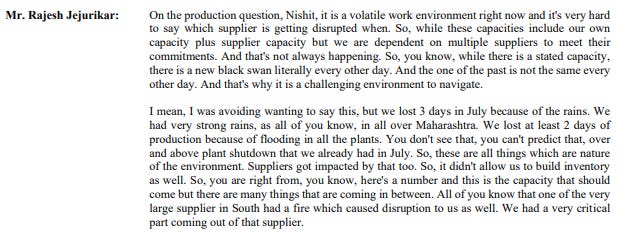
Mahindra got hit from several directions at once. For one, three days of production were lost to Maharashtra’s floods. Then, they lost two more days when the same floods hit auto supplier plants. Lastly, a fire at a large supplier in South India disrupted a critical part. Dealer stock was at 15 days.
The biggest gap between demand and supply lay with Tata.
Shailesh Chandra, the company’s MD and CEO, said bookings had risen to nearly 3.5 times what they were before the West Asia crisis began. But EV production hardly kept pace; it was running at about 9,000 cars a month three or four months ago and had only just crossed 15,000 by June. On top of that, heavy rain at its Sanand plant in Gujarat cost five full days of production in one month. Dealer stock was at 30 days, lower than what Tata wanted heading into the nearing festive season.
The capacity race
In response to this surge of demand, all of them are adding more capacity.
Maruti commissioned a second line at Kharkhoda in Haryana in May and the fourth line at Hansalpur in Gujarat, dedicated to the eVITARA, at the end of July, taking total capacity across both states to about 2.9 million vehicles a year. This should be enough to serve both its domestic order book and its growing export business off the same lines.
Mahindra plans for its total capacity to rise from 64,500 vehicles a month to 82,000 by March 2027, with electric SUV capacity moving from about 8,000 a month to 12,000. Mahindra’s pinch in recent times has been that buyers wanted specific SUVs faster than it could build them, so more capacity here has a clear path to more sales if demand holds.
Hyundai’s new Talegaon plant near Pune, which was bought from General Motors, is running at 1.7 lakh units a year alongside its 8.2 lakh-unit Chennai complex. Talegaon will move to three shifts from October, nearly two years ahead of the original plan, and Chennai itself is expected to expand its capacity usage from 72% in 2026 to over 90% next year.
Tata is lifting monthly EV output from 9,000 to over 15,000 by running both petrol and electric versions of the Nexon and Punch through the same factory lines.
All of this capacity will take some time to come online and produce at full speed, though. In the meantime, though, much of today’s unmet demand will remain where it is.
Making more cars is getting more expensive
But this expansion of supply isn’t as straightforward as building more factories. It’s arriving in the same quarter that raw material costs turned against every one of these companies.
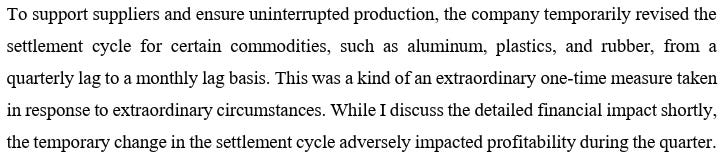
Maruti’s commodity costs alone cut about 3 percentage points off its profit margin, going from 8.8% last quarter to 5.1% now. Roughly a third of that fall came from a one-time decision to pay suppliers with a monthly lag instead of a quarterly one.
As we covered in a past story, the payments that automakers make to their suppliers take 2-3 months. It’s partly why ancillaries often remain severely crunched on working capital. Maruti made this move so that their suppliers wouldn’t run short of cash as aluminium, plastic and rubber prices spiked.
Meanwhile, Mahindra took a hit of about 4.5 percentage points in its margins. This was offset partly by price increases taken in July, and Mahindra is considering further hikes.
Hyundai’s quarter was an amalgamation of many things landing at the same time, including commodity pressure. Total sales fell 1.3% to 178,082 units, and revenue stayed roughly flat at ₹16,335 crore. However, net profit dropped to ₹889 crore from ₹1,369 crore a year earlier, with its EBITDA margin falling to 9.3% from 13.3%.
For Tata, commodity costs wiped 4.5 percentage points in the quarter, with another 3% expected in the next one. They chose to absorb most of the hit.

There’s a lag built into this too. Supplier contracts typically reset with a delay, so a commodity spike in one quarter can keep showing up in profit margins the next. If a manufacturer passes the cost through with a price hike, it protects its margin but risks denting affordability. If it absorbs the cost instead, profit takes the hit. That trade-off, not the individual margin numbers, is the more useful thing to watch into Q2.
What comes next
Q1 showed that demand isn’t the problem anymore. This was a quarter that looked good on the demand side and difficult on almost every other side.
Maruti, Mahindra and Hyundai have all switched on new plants this year, but commissioning a factory and running it at full speed are two different things. The e VITARA and Hyundai’s Venue both had strong opening months, but initial excitement doesn’t always turn into sustained sales.
Commodity costs may have peaked, but supplier contracts reset with a delay, so the pain could linger into Q2 even if prices start falling. And the Middle East, which was a reliable export market for most of these companies until recently, remains uncertain.

Why Big Tech is spending so much on AI
The world’s largest technology companies are reinvesting more of their cash because artificial intelligence requires an enormous amount of physical infrastructure. Training and operating AI models needs specialised processors, servers, data centres, networking equipment, cooling systems and electricity. Goldman Sachs estimates that data-centre electricity demand could grow by 220% between 2023 and 2030.
Unlike traditional software, much of this capacity must be built and paid for before it can generate revenue. Alphabet says most of its capital spending is going towards servers, data centres and networking equipment. Microsoft says its spending is being driven by demand for cloud and AI services, while Meta has linked its higher investment to the data centres and hardware needed for AI.
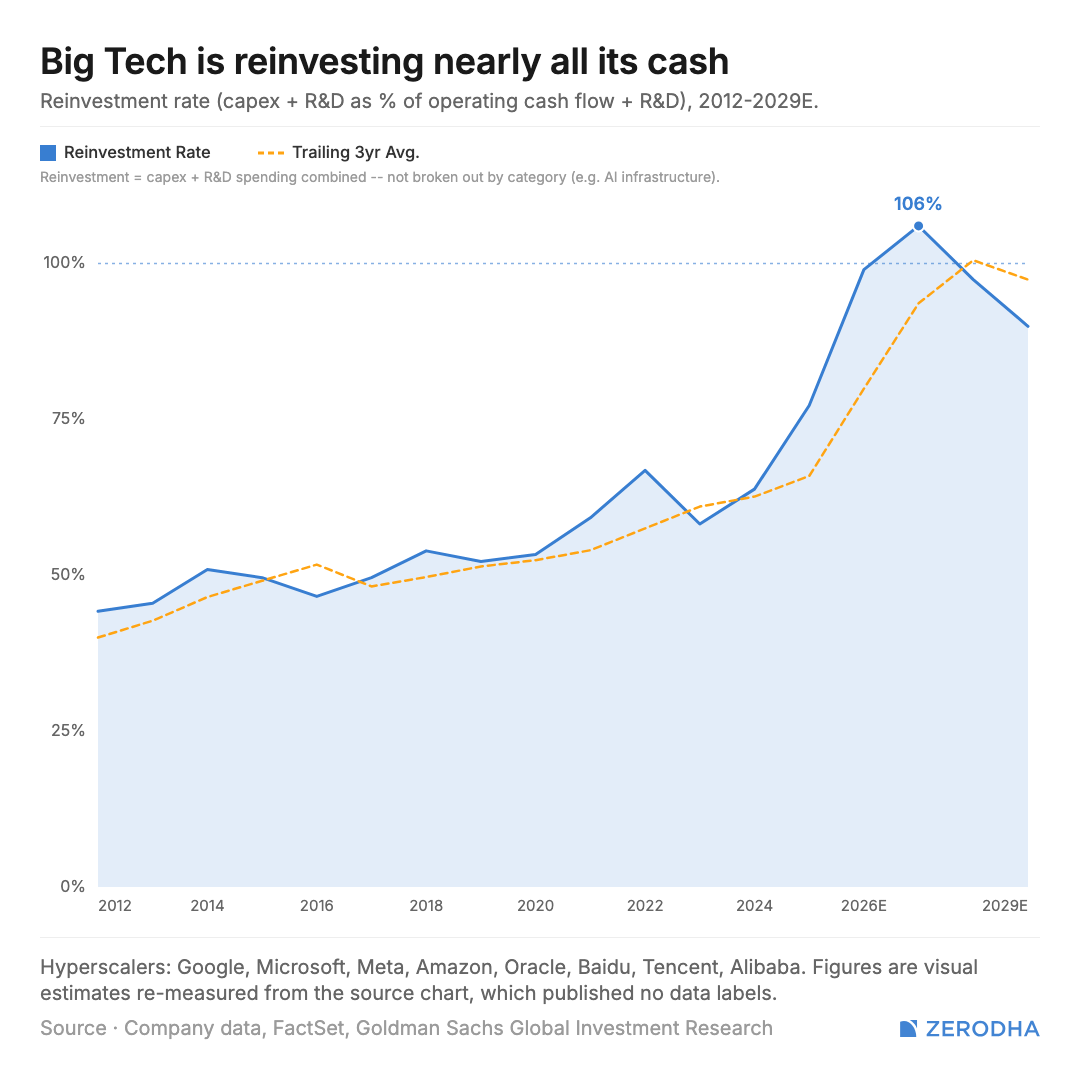
Research spending is rising alongside this physical investment as companies develop models, chips and AI products. Together, capex and R&D are forecast to consume nearly all the cash generated by these businesses—and briefly exceed it in 2027.
That does not mean these companies will necessarily become unprofitable. A rate above 100% means their combined capital expenditure exceeds operating cash flow under this calculation. They may have to use existing cash reserves or outside financing. The real uncertainty is whether future AI revenue will justify the scale and speed of today’s spending.
- This edition of the newsletter was written by Vignesh.
Tidbits
[1] Reliance Industries has proposed investing ₹2.73 lakh crore over 30 years in India’s first integrated underground coal gasification complex in Andhra Pradesh, subject to successful exploration and commercial viability. The project would convert deep, otherwise uneconomic coal reserves into syngas.
Source: The Economic Times
[2] Elon Musk’s Starlink has submitted a fresh application to Indian regulators to launch its satellite network, this time including advanced direct-to-device technology. The move would potentially allow standard smartphones to connect directly to satellites, heating up the race for space-based telecom services in India.
Source: The Economic Times
[3] LIC has received regulatory approval to increase its holding in HDFC Bank to as much as 9.99%. However, the approval timeline should be checked carefully because a similar RBI permission was originally granted in January 2024 with a one-year completion window.
Source: The Hindu BusinessLine
[4] The Union Cabinet has cleared significant infrastructure upgrades, including extensive railway multi-tracking and the expansion of the NH-22 highway. These projects are aimed at decongesting critical freight and passenger routes while boosting regional connectivity and economic growth.
Source: The Indian Express
[5] SEBI has barred Copthall Mauritius Investment and Mansi Share and Stock Broking over alleged manipulation during the market’s Closing Auction Session. The regulator said the trades were designed to influence the Sensex closing level and benefit related derivatives positions.
Source: Reuters
[6] Road Transport Minister Nitin Gadkari has warned consultants and contractors of performance audits, blacklisting and other penalties for defective Detailed Project Reports. He said poor-quality DPRs contribute to economic losses, weak construction outcomes and road-safety failures.
Source: Business Standard
[7] The Maharashtra government has signed multiple Memorandums of Understanding as part of a $300 billion push to expand the state’s digital infrastructure. The Fadnavis administration is targeting a massive 5.7 GW of operational data centre capacity by 2031 to establish the state as a premier global technology hub.
Source: Financial Express
[8] Facing surging domestic prices ahead of the festival season, India may be forced to import sugar for the first time in nearly a decade. The potential market intervention aims to boost local availability, marking a significant supply-chain shift for the world’s largest consumer of the sweetener.
Source: Business Standard
Beyond Today’s Brief
There’s always more happening at Markets by Zerodha.
The Chatter: What does SMBC’s landmark stake acquisition in YES Bank mean for its global corporate banking ambitions? How is Colgate-Palmolive defending margins amidst FMCG demand shifts? And what is driving momentum for electric bus maker Olectra Greentech and logistics giant Allcargo?
Aftermarket Report: How did cooling US bond yields help Nifty snap its 7-day losing streak to close above 24,200? And how are markets reacting to India's July infrastructure output growth alongside L&T's major Dubai airport order win?
Join us on WhatsApp, where we share interesting soundbites from concalls, articles, and everything else we come across throughout the day. You’ll also get notified the moment a new video or article drops so that you can read or watch it right away.
Thank you for reading. Do share this with your friends and make them as smart as you are 😉
Your content is amazing what amazing part is the presentation. The way you simplify the story is amazing. But I request you to continue your old system where you put 2 stories. The current one is also good , but I got the habit of read 2 stories each day.
loving this format. one story, one stat, multiple tidbits