

Our goal with The Daily Brief is to simplify the biggest stories in the Indian markets and help you understand what they mean. We won’t just tell you what happened; we’ll tell you why and how too. We do this show in both formats: video and audio. This piece curates the stories that we talk about.
You can listen to the podcast on Spotify, Apple Podcasts, or wherever you get your podcasts and watch the videos on YouTube. You can also watch The Daily Brief in Hindi.
Rainmatter Originals is our new series profiling entrepreneurs who are taking the long road and doing things differently. We’re kicking things off with the story of Shashi and Akshayakalpa—and the sweat, patience, and organic farming vision behind building a different kind of company.
Watch the full story: The Akshayakalpa Story
In today’s edition of The Daily Brief:
Indian urea makers will make lesser money now
Why did a tiny tweak in government energy rules wipe out a quarter of Indian urea makers' profits? Because fertilizer prices are strictly controlled, legacy manufacturers rely on beating government energy baselines to earn most of their margins. But with the government tightening these benchmarks, plants are left squeezed—forcing them to invest in costly tech upgrades, rely on gas price movements, or wait for policy relief.
Chart: India’s share of the world population may have peaked
Why is India’s share of the global population starting to slip even while its total numbers keep rising? Driven by birth rates that have fallen below replacement level, India's rapid demographic expansion is ending. While "population momentum" will ensure the total population keeps growing through the early 2060s, the UN projects that faster demographic growth in regions like Sub-Saharan Africa means India's ultimate slice of the world population pie has likely already peaked
We’re trying out something new
With each episode, instead of two stories, we’re trying one longer story. Along with that, we will have one chart created by our team, and some extra tidbits. We’d love to hear feedback and suggestions from you on what you feel about this format.
Indian urea makers will make lesser money now
We were reading a CRISIL report last week with a fairly dry headline: tighter energy norms are going to cut the profitability of urea makers by about 25%.
Our first reaction was, well, maybe this is business-as-usual. The government tells factories to burn less fuel. Factories grumble, spend money on new equipment, and margins take a hit for a while. We’ve seen versions of this play out in steel, cement and refining.
But the urea case was a bit peculiar. In short, the government moved one number in a formula from 5.77 to 5.67, and CRISIL reckons that alone will take operating profit for these plants from about ₹1,700 a tonne to about ₹1,250.
So we went digging. And it turns out urea plants don’t make money the way you’d assume. You see, in many industries, an energy norm is one among many standards you have to meet. In urea, the energy norm itself is a very large determinant of profits. That’s the story we’ll be narrating today.
First, the basics
Before we get there: how does a urea plant work?
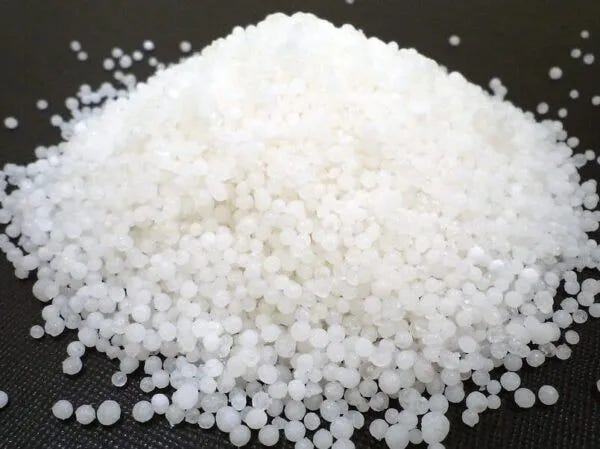
A urea plant is basically a gas plant making fertilizer. You take natural gas, turn it into ammonia, then combine that ammonia with carbon dioxide to make small white prills of urea, which are eventually used by farmers. Gas is both a key raw material to make urea, and also the fuel that runs the whole energy-hungry process.
Naturally, a useful measure of how efficiently a urea plant runs is how much energy it uses to make one tonne of urea. That’s measured in gigacalories per tonne (Gcal/t). On average, Indian urea plants collectively consumed about 5.5 Gcal/t last fiscal.
In a normal business, the less Gcal/t you use, the more profitable you are. But urea is not a normal business.
The person using the product is not really paying its full economic cost. Urea is sold to farmers at a price the government controls at levels that have barely moved for years. That price doesn’t move around with gas costs, plant expenses or global urea prices. The government keeps it low to make fertilizer affordable for farmers, and a sharp increase would have serious consequences for farm economics. They bear the price on behalf of the farmer with a subsidy.
Now, the tempting way to think about this is that the company sells urea, earns revenue, and then gets some subsidy on top from the government.
Well, yes, but for legacy urea plants, the subsidy is the revenue. As per CRISIL, subsidy inflows make up about 80–85% of revenue.
Which raises the obvious question: if the government is paying for most of it, how does it decide what to pay?
The only margin outlet
For legacy plants, the subsidy calculation has two core cost components.
The first is fixed-cost compensation. It is a defined rupees-per-tonne amount meant to cover costs that don’t change much with production, like staff, maintenance, and the general expense of keeping a large industrial plant running.
You’d expect that amount to be revised over time as costs rise, right? Well, the last time the base fixed component was revised was March 2007. There was some additional support in 2020 for certain plants, but it only partly offset the rise in fixed costs. In simpler terms, several urea manufacturers still weren’t recovering enough to cover their fixed costs.
The second is variable-cost compensation, which covers costs that move with production. Energy is a big part of this. And because the fixed-cost side wasn’t recovering enough, plants increasingly depended on what they could make on the variable side for their profitability.
Now, say you’re the government, and you’re paying a plant’s energy bill. You could simply say: send me your gas invoices and I’ll settle them.
But that wouldn’t be a great idea: if a plant gets reimbursed for whatever it burns, it has very little reason to burn less and be more efficient. So instead, the government says: for every tonne of urea you make, I’ll calculate your energy compensation assuming you consumed a specified amount of energy.
That specified amount is the energy norm. Burn more than the norm, and you bear the extra cost. Burn less than it, and you get to keep the savings — and this was what urea plants banked on to survive.
Last fiscal year, the composite norm by the government was set at 5.77 Gcal per tonne, while the actual industry consumption was around 5.50 Gcal. That left a positive gap of 0.27 Gcal per tonne. This is the amount of energy that industry saved, and made surplus money on.
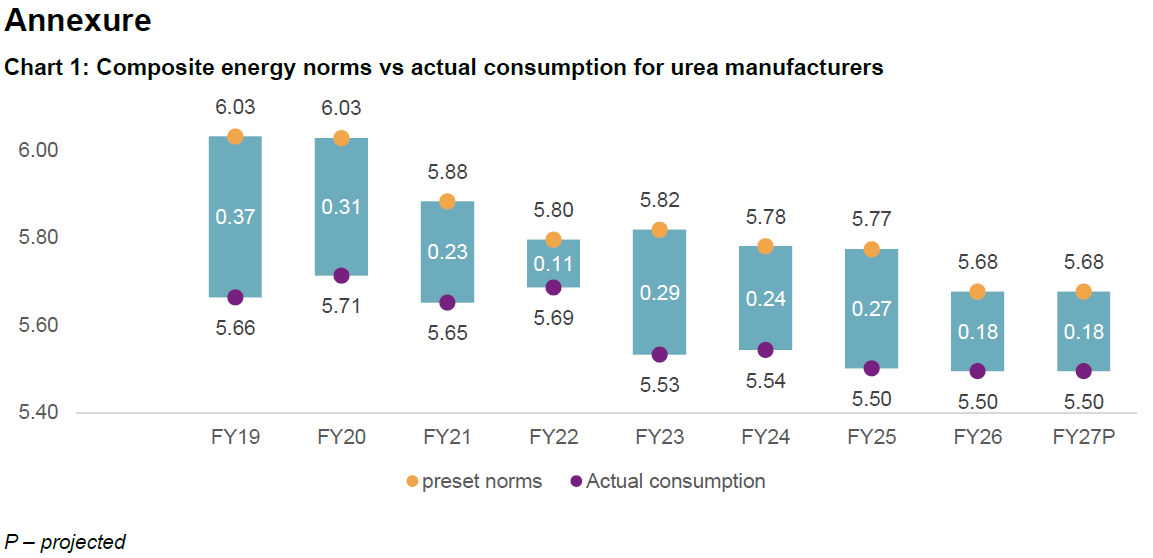
In rupee terms, that translated to ₹1,300 per tonne of profitability for the urea plant. Now compare that with total operating profitability of roughly ₹1,700 per tonne. Nearly 75% of operating profitability from urea for these plants was linked to energy-efficiency gains.
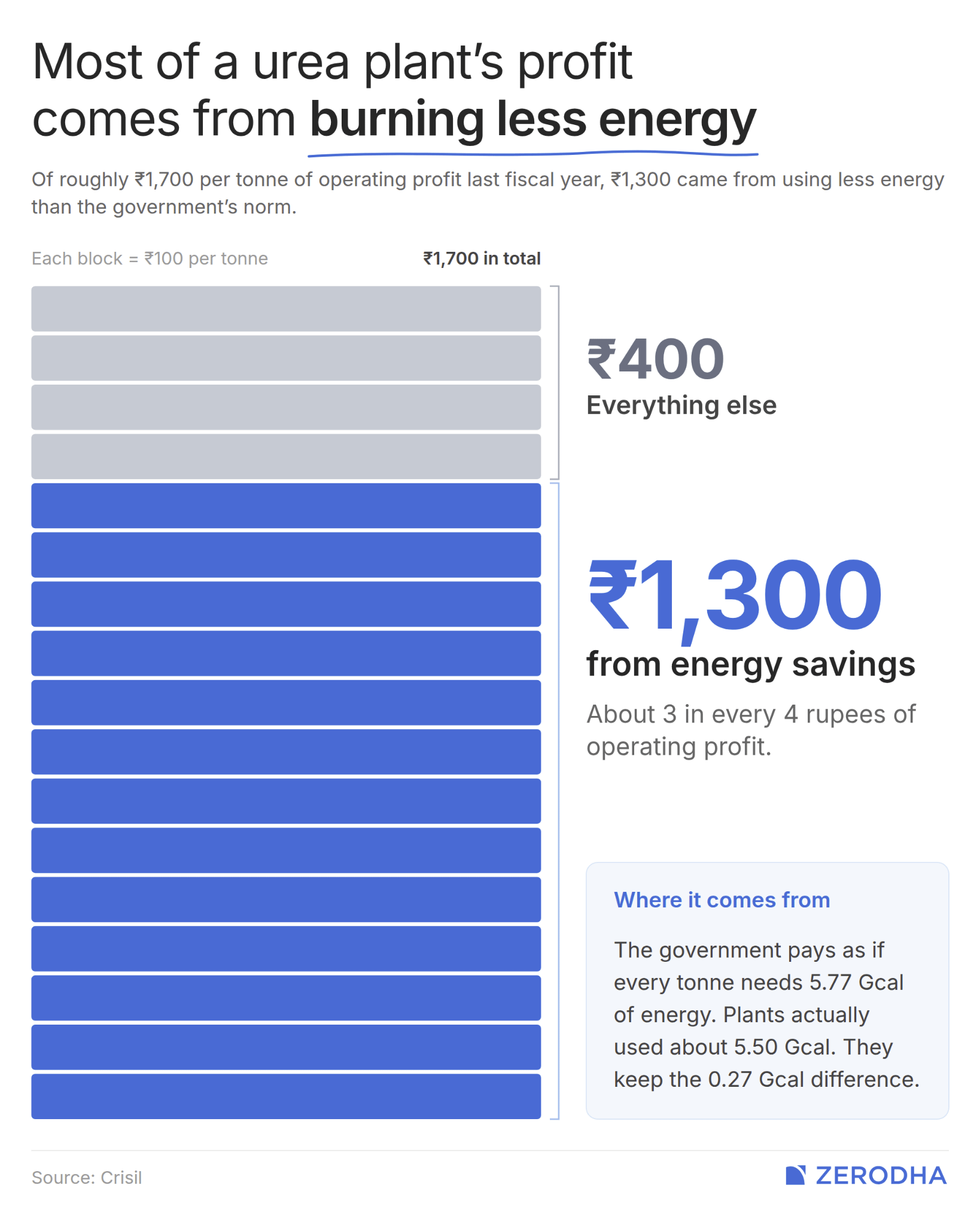
The government announced the new norm on July 30, 2026, but made it applicable retrospectively from April 1, 2025. The new baseline has now been cut to 5.67 Gcal per tonne. With actual consumption still around 5.50, the efficiency gap falls from 0.27 to 0.17 Gcal. With that drop, the estimated profitability could decline from about ₹1,700 to ₹1,250 per tonne.
Who’s on the other side of this?
If plants lose about ₹450 per tonne, where does that money go?
The answer is that the government simply pays less subsidy. Earlier, the formula assumed a plant needed 5.77 Gcal to make a tonne of urea, even if it actually used only 5.50. That gap became an efficiency gain for the manufacturer. Tighten the norm to 5.67, and the government reimburses less.
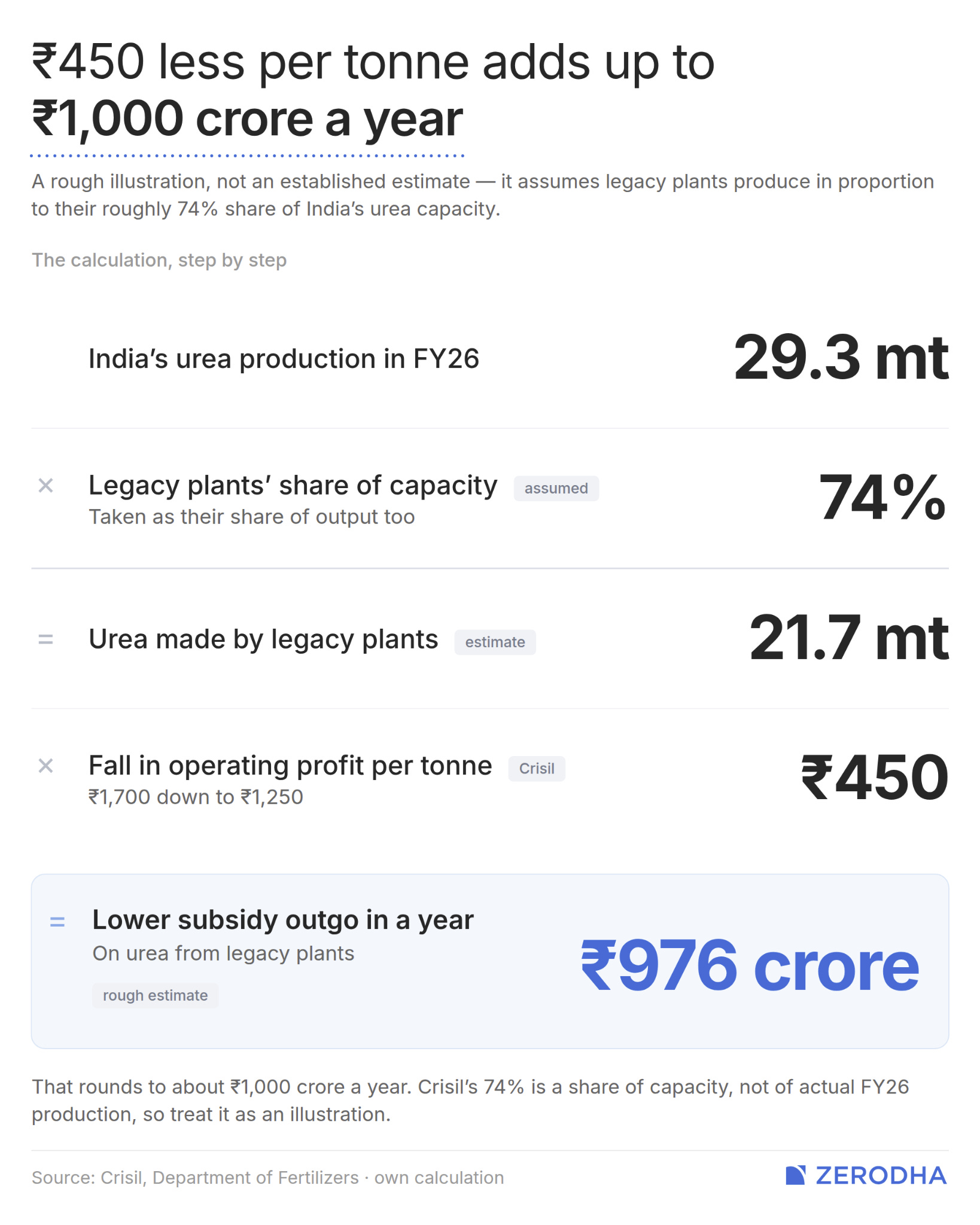
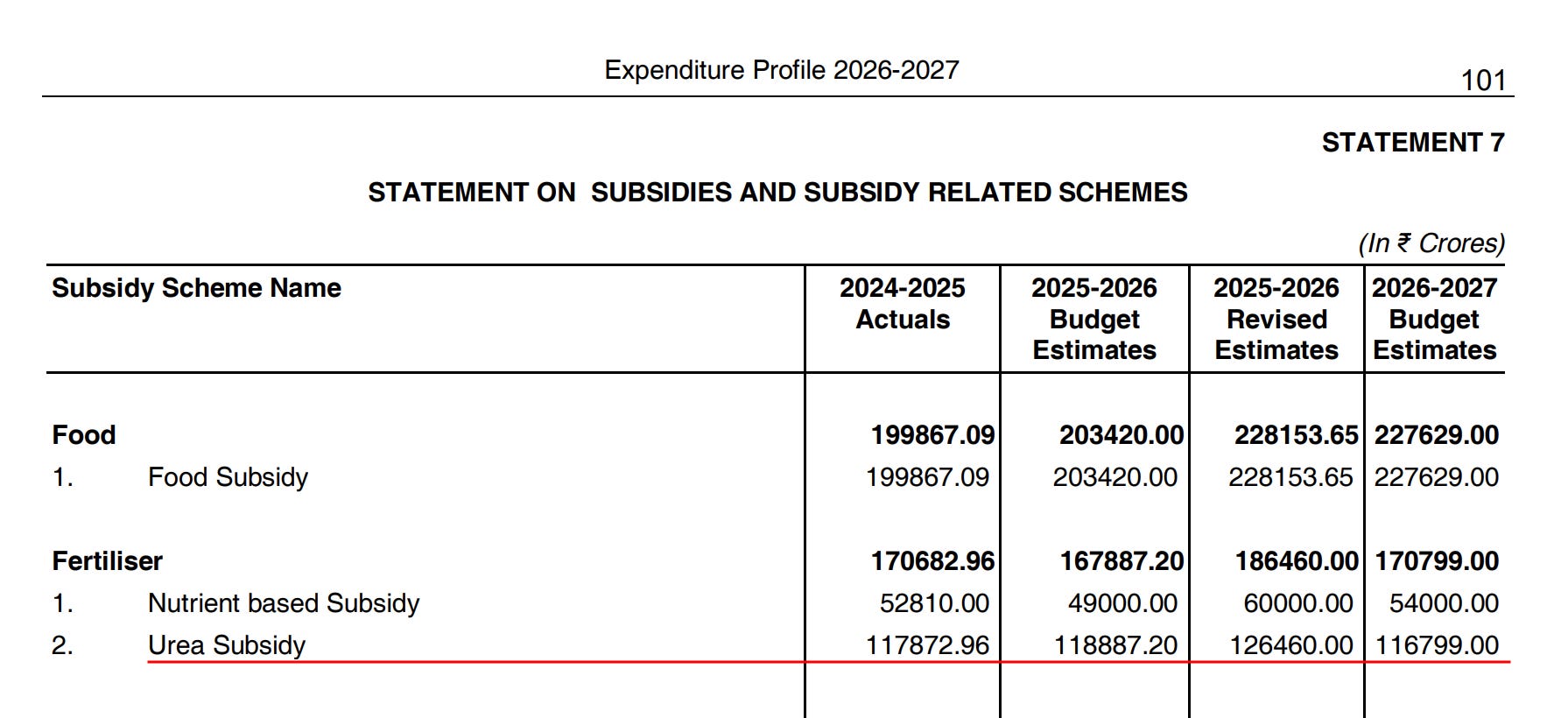
Across legacy urea production, that could add up to roughly ₹1,000 crore a year based on our very rough back-of-the-envelope estimate. We may be wrong on the number itself, but against a urea subsidy bill of more than ₹1 lakh crore, the order of magnitude should provide enough direction. For manufacturers, the exact same adjustment can wipe out roughly a quarter of operating profitability. But for the government, it’s a small 1% saving.
But that is also the point of the norm. The government wants plants to keep becoming more efficient, so it lets them keep the savings when they beat the benchmark. But if the benchmark never moves, those efficiency gains slowly become a permanent surplus, and that could reduce the incentive to become more innovative.
None of the above applies uniformly across all urea plants in India, either.
The plants we’ve been describing so far that will be most affected by reducing subsidies are the legacy fleet. Their economics run on that March 2007-era fixed-cost reimbursement benchmark and the prescribed energy norm. However, they represent three-fourths of India’s urea capacity. Their revenues are primarily made up of the government subsidy.
The other, newer set of plants exists because at some point, we realized that we didn’t have enough domestic urea capacity, and we were importing the shortfall. Building a new ammonia-urea complex costs thousands of crores, and with a selling price that’s essentially controlled by the government, an investor interested in a urea plant will be skeptical of the returns they can earn, especially with the old benchmarks.
That being said, for these new plants, an exception was made so that new investors did not have to live on the old framework. Fresh capacity got its own structure, one built around delivering a return on the capital rather than a reimbursement of costs. CRISIL characterises these newer plants as assured a 12% return on equity for their policy period, and notes they are insulated from this energy-norm change entirely.
Can urea plants win it back?
There are three ways urea plants can claw some of this profitability back.
The first one is what the new norm directly encourages: being more efficient with capex. If a plant can reduce its gas consumption further, it widens the gap against the new norm and earns some of that profit back.
But there is a limit to this. The payoff of this move will depend on the age of the plant and how much scope is left for technological upgrades. Older plants may already have captured the easier efficiency gains, but getting the next bit out won’t just be harder, but also more expensive.
The second option is on the fixed-cost side. The government could increase fixed-cost reimbursement and compensate for some of what plants have lost through tighter energy norms. Given that the base fixed-cost component dates back to 2007, there is certainly room for a rethink. But that’s ultimately the government’s call.
The third option is slightly counterintuitive: higher gas prices.
Expensive gas sounds like terrible news for a business that basically relies on it. But remember how the efficiency gain works. A plant gets to keep the value of the energy it was compensated for but didn’t actually consume. So when gas gets more expensive, every gigacalorie saved becomes more valuable. In fact, CRISIL estimates that higher gas prices, including those caused by the West Asia conflict, could offset around ₹75–100 per tonne of the profitability hit this fiscal.
Conclusion
So this isn’t necessarily the end of the road for margins. Plants can still improve, gas prices can move, and the government might just revisit fixed costs. But the bigger takeaway is that urea profitability sits inside a moving policy formula. Plants are rewarded for becoming more efficient, and once that efficiency becomes normal, the benchmark moves closer.
More than that, when you zoom out for the full-picture view, you will see a government simultaneously juggling four things that don’t naturally cooperate: keeping urea cheap for farmers, keeping domestic plants running (and creating new capacity), reducing dependence on imports, and keeping the subsidy bill from exploding. Every lever it pulls on one of those four objectives tugs at the other three.
This has no impact on new investments, which are insulated from the new norm. The government has a new investment policy for urea (NIPU), which has incentivized India’s fertilizer industry to commit over ₹80,000 crores over the next 6 months. The impetus for this comes from the Strait of Hormuz crisis, which had bottled our urea imports.
But even if it doesn’t hurt new capacity, what signal does the norm give to investors as a whole? We know that the fixed-cost benchmark has remained unchanged for nearly 2 decades, while the energy norm has only tightened. The signal, then, becomes policy evolution: things may look profitable now, but how will the government react 10-15 years later? Will it continue to keep key parameters unchanged while squeezing the one remaining outlet for margins?
There are no easy answers to these questions. For now, the pressure is back on the manufacturers to create another gap.

India’s share of the world population may have peaked
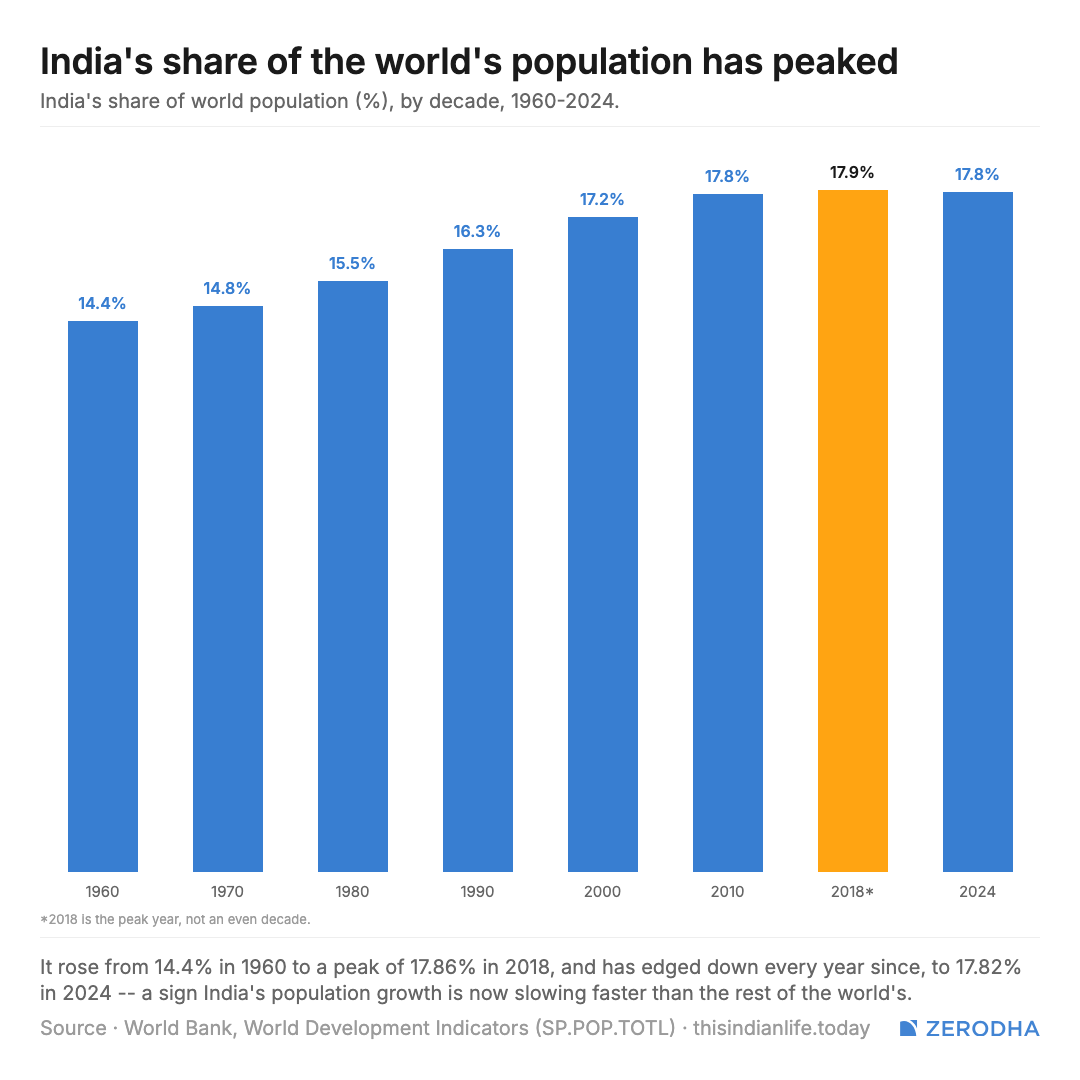
India’s demographic weight did not rise simply because it is a large country. For several decades, its population grew faster than the world average. Improvements in healthcare, sanitation and food security reduced death rates, while birth rates remained high. This gap created a long period of rapid population growth.
That phase is now ending. India’s fertility rate has fallen below the replacement level of roughly 2.1 children per woman. But the population will not immediately decline. India still has a large generation of young people entering childbearing age, so births continue to outnumber deaths. Demographers call this “population momentum”.
There is already a small turning point in the data. India’s share of the global population peaked at about 17.86% in 2018 and slipped to 17.82% in 2024, even as its total population continued to increase. A country’s population can therefore grow while its share of the world declines, if other regions grow faster.
That is likely to become more important in the coming decades. The United Nations expects India’s population to continue increasing through 2054, but much of the world’s future population growth will shift towards Africa. Sub-Saharan Africa’s population is projected to rise 79% to 2.2 billion by 2054. India will remain the world’s demographic heavyweight, but its share of humanity may have already stopped rising.
- This edition of the newsletter was written by Kashish.
Tidbits:
[1] Wipro Consumer Care and Lighting is acquiring a 60% stake in science-focused direct-to-consumer skincare brand Dermatouch at an enterprise value of ₹387.5 crore. The acquisition marks Wipro’s entry into the digital-first brand segment, with the remaining 40% to be acquired over the next three years.
Source: The Economic Times
[2] Telangana and Maharashtra are restructuring their power sectors by separating agricultural consumers and their finances from existing state distribution companies. The move aims to launch dedicated agriculture-only Discoms—a model that Haryana has also proposed—to improve financial tracking and targeted power delivery.
Source: Business Standard
[3] KKR has signed a definitive agreement to acquire a minority stake in BookMyShow, with the investment reported at about $40 million. The funding will support the platform as it expands its live entertainment business across India.
Source: Business Standard
[4] Finnish telecom equipment maker Nokia plans to cut most of its workforce and shutter nearly all its sites in mainland China in stages by the end of 2026. The move reflects a broader strategic realignment to cut global costs, as Nokia’s operations and market share in China have steadily declined in recent years.
Source: ET Telecom
[5] Manipal Health Enterprises is acquiring the business and assets of the 100-bed Kinder Women’s Hospital in Bengaluru’s Whitefield micro-market for a cash consideration of ₹130 crore. The business transfer agreement allows Manipal to further consolidate its presence and clinical capabilities in one of the city’s fastest-growing healthcare hubs.
Source: The Hindu BusinessLine
[6] The Indian government is considering allowing limited, duty-free sugar imports to boost domestic supplies ahead of the upcoming festival season. The market intervention is being weighed as ex-mill sugar prices in key hubs like Maharashtra have surged to record highs.
Source: The Hindu BusinessLine
[7] The National Stock Exchange of India (NSE) is reportedly targeting a valuation of up to $55 billion for its highly anticipated IPO, marketing its shares between ₹2,000 and ₹2,100. The offering, consisting entirely of a 6% stake sale by existing shareholders, is currently expected to launch in the second half of September.
Source: The Hindu BusinessLine
[8] Industry experts are urging the government to strictly enforce its coal-allocation policy to prevent penalizing thermal power plants that properly maintain adequate fuel inventories. Currently, disciplined power generators risk facing indirect penalties as emergency coal supplies are routinely diverted to plants that fail to adhere to prescribed stocking norms.
Source: The Hindu
Beyond Today’s Brief
There’s always more happening at Markets by Zerodha.
The Chatter: What does SMBC’s landmark stake acquisition in YES Bank mean for its global corporate banking ambitions? How is Colgate-Palmolive defending margins amidst FMCG demand shifts? And what is driving momentum for electric bus maker Olectra Greentech and logistics giant Allcargo?
Aftermarket Report: What dragged Nifty below the 24,100 mark as its losing streak extended to 7 consecutive sessions? And how are fresh El Niño concerns, elevated crude oil prices, and rising bond yields weighing on broader sentiment?
Subtext: A deep dive into the Impossible Trinity—why central banks cannot simultaneously maintain independent monetary policy, exchange rate stability, and free capital flows, and how the RBI navigates this classic trilemma.
Join us on WhatsApp, where we share interesting soundbites from concalls, articles, and everything else we come across throughout the day. You’ll also get notified the moment a new video or article drops so that you can read or watch it right away.
Thank you for reading. Do share this with your friends and make them as smart as you are 😉
I’ve been thinking about the change in Daily Brief’s format.
For me, the value of Daily Brief was never the number of stories covered, but the depth and variety of ideas I could learn from.
Adding more and more tidbits may increase the number of updates, but it can also make Daily Brief feel like any other news channel. Most of those headlines are already easy to find elsewhere.
What makes Daily Brief valuable is when it gives us different stories with enough context to understand why something happened and what we can learn from it. Over time, when similar events come again, that knowledge compounds and helps us connect the dots faster.
If resources are limited, I’d honestly prefer one story explained really well rather than one detailed story followed by several small tidbits that don’t add much learning.
For me, the question isn’t “How many stories did I consume today?” but “What did I understand today that will help me understand something better tomorrow?”
That’s where I think Daily Brief can remain different from ordinary news.
guys never ever go back to the old format, THIS IS SUCH A GOATED FORMAT MAN.....ALSO I LOVE TIDITS, KEEP THEM COMMING SIR