

Our goal with The Daily Brief is to simplify the biggest stories in the Indian markets and help you understand what they mean. We won’t just tell you what happened; we’ll tell you why and how too. We do this show in both formats: video and audio. This piece curates the stories that we talk about.
You can listen to the podcast on Spotify, Apple Podcasts, or wherever you get your podcasts and watch the videos on YouTube. You can also watch The Daily Brief in Hindi.
In today’s edition of The Daily Brief:
1. When did social media stop looking innocent?
How did social media evolve from a tool for human connection into an alleged youth mental health crisis? Driven by addictive design choices like infinite scroll, streaks, and personalized feeds, platforms now face a massive global backlash—culminating in Meta's landmark $18 billion settlement to enforce strict daily time limits and restrictions for teenagers.
2. SEBI finds another SME IPO fraud
Why did regulators halt Trafiksol’s wildly popular SME IPO just hours before its stock market debut? Behind a massively oversubscribed issue lay cooked books, circular trades, and a zero-revenue shell vendor set up to receive the bulk of the proceeds. While a last-minute investor complaint saved public funds this time, the scandal highlights severe due-diligence failures among merchant bankers—underscoring why SEBI is aggressively tightening rules across India's booming SME market.
When did social media stop looking innocent?
There is a decent chance you found this story through one of the platforms it is about.
Maybe it appeared on Instagram. Maybe someone sent it to you on X. Maybe YouTube, or another app. And when you finish reading, there will almost certainly be something else waiting for you. That ability to always have the next thing ready is now at the centre of one of the biggest fights over social media.
On August 26, Meta agreed to settle a case brought by US states that accused Facebook and Instagram of using design features that encouraged children and teenagers to keep using the apps compulsively.
The multistate settlement could cost Meta up to $18 billion. Meta did not admit wrongdoing.
The number sounds enormous, but Meta does not have to pay it all at once. The settlement is spread over ten years, and part of the amount is conditional. The settlement also does not prove that Instagram caused America’s youth mental-health problems.
But Meta has agreed to change how its apps work for younger users. That makes this a strange place for social media to have ended up. Twenty years ago, the goal was to get more people onto social media.
Today, governments are asking whether children should be on these platforms at all.
How the feed took over
The early story of social media was almost the opposite of the one we tell today.
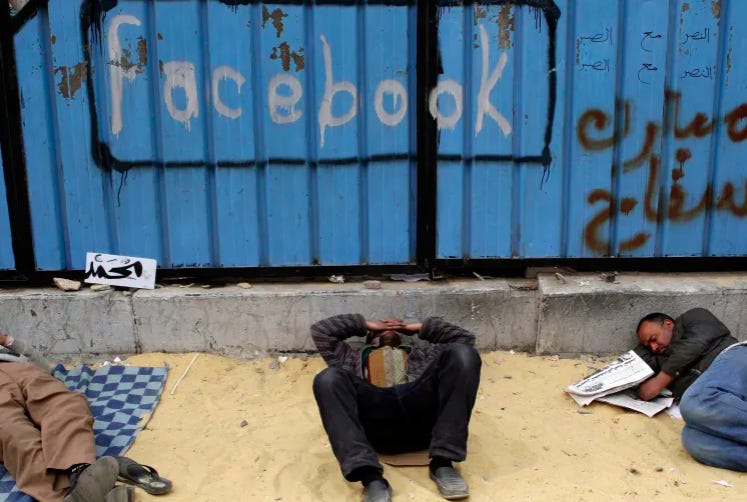
Facebook arrived in 2004 and Twitter in 2006. Their promise was easy to understand: they let ordinary people reach a large audience directly. Before this, newspapers and television channels decided who got heard. Social media lowered that barrier. Anyone could publish, find an audience or organise a group. For a while, that looked enormously empowering.
The Arab Spring became one of the strongest symbols of that optimism. Arab spring began in Tunisia in December 2010, after street vendor Mohamed Bouazizi set himself on fire after repeated harassment by local officials. The protests that followed soon spread across the region. Social media mostly helped information spread faster.
But over time, people started seeing another side of social media.
A Cambridge University researcher named Aleksandr Kogan built a personality quiz app on Facebook. Facebook’s rules at the time allowed the app to collect data from the people who used it. The app could also collect data from millions of their Facebook friends. It was later confirmed that Kogan’s app also collected data this way.
Some of that information later reached Cambridge Analytica. Facebook said Kogan broke its rules when he shared the data with the company. It was the time of US Elections. Cambridge Analytica used that information to build profiles of voters. Political campaigns could then show different messages to different kinds of people based on their profiles, with the intention of influencing their votes.
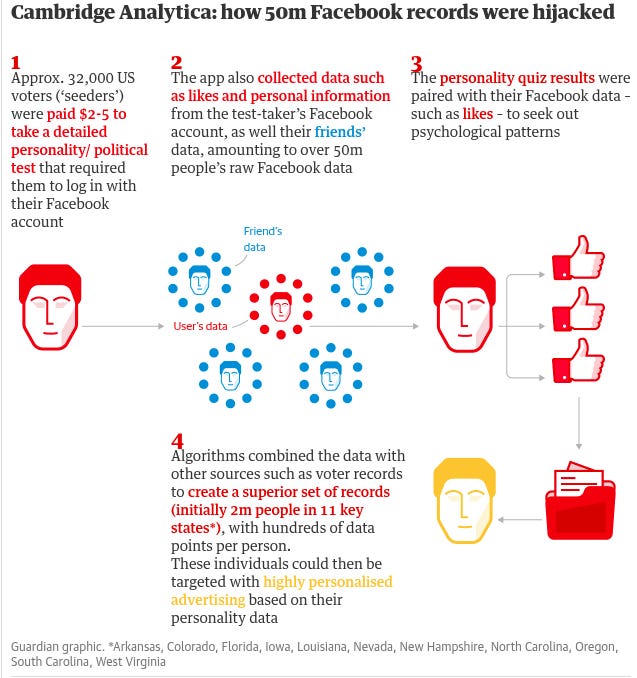
How much this actually influenced the 2016 US election is still debated. But the scandal also turned attention towards Facebook. Its platform had allowed outside developers to collect information about millions of people who had never used those apps themselves.
US regulators eventually went after both sides. The Federal Trade Commission took action against Cambridge Analytica and Kogan. It also brought a separate privacy case against Facebook. Facebook eventually agreed to pay a $5 billion penalty.
This changed how people in general looked at Facebook. It was not simply a place where friends posted things for each other. Facebook also watched how people behaved on the platform. It used those signals to decide what appeared in each person’s feed.
That raised another question. Why did Facebook want to get so good at predicting what people would watch or click next?
Part of the answer was simple. These platforms made money from advertising. So the longer people stayed on these apps, the more opportunities the platforms had to show ads. That made attention valuable.
That does not mean every feature was built to be addictive. But it gave the companies a clear reason to keep people coming back.
Over time, the products got better at removing the little moments when we might otherwise stop.
A newspaper eventually runs out of pages; infinite scroll does not. Finishing a television episode normally forces you to decide whether to watch another; autoplay removes that decision. Close the app and a notification can pull you back. Snapchat’s Streaks give people a reason to come back every day, because missing a day can break the streak they have built.
The concern around social media therefore moved from what people posted and their personal data to how the apps themselves were designed.
That was harder to escape because a few big platforms accounted for much of people’s online attention. Moving from Instagram to TikTok, YouTube or Snapchat often meant entering another app built to keep you engaged.
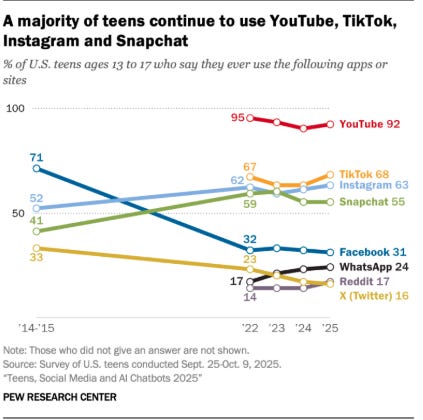
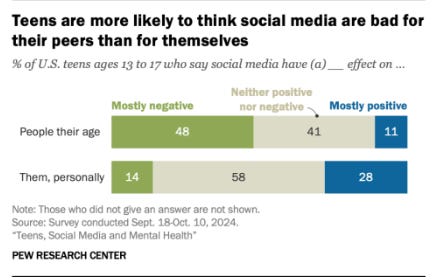
And the concern became sharper when the users were children and teenagers. In a 2025 Pew survey, 48% of American teenagers said social media had a mostly negative effect on people their age, up from 32% in 2022. But only 14% thought it had a mostly negative effect on them personally.
But is social media actually harming children?
That brings us to the harder question: are these fears actually backed by evidence?
The answer is not very clean.
Some stronger studies do find harm. In one large experiment, researchers randomly asked Facebook users to deactivate their accounts for four weeks. Those who did reported a small improvement in their wellbeing.
But other studies find much weaker effects. A 2019 study of more than 350,000 teenagers found only a tiny link between heavier digital use and worse wellbeing. Digital use explained less than 0.4% of the differences in wellbeing they found.
Part of the problem is that screen time tells us very little about what someone actually does online. Take two 15-year-olds who both spend three hours on Instagram. One spends that time chatting with friends and watching cricket. The other spends it doomscrolling through posts and videos.
Their screen time is identical but not their experience.
That is why averages can hide a lot. Social media may barely affect one teenager, help another stay connected and make things much worse for someone who is already vulnerable. This raises another question: where exactly does that harm come from?
Sometimes, it comes from what users post. Someone can upload a cruel comment, a disturbing video or an image that makes another person feel worse about themselves. In Pew’s 2025 survey, teenagers themselves pointed to things like bullying, sleep loss and feeling worse about their own lives as part of their experience online.
But platforms are not just passive pipes. They decide who sees that content, what gets recommended next and when a notification brings you back. The post may come from a user, but the platform shapes the experience around it.
That distinction later became important in court. Platforms had long enjoyed strong legal protection from being held responsible for what their users posted. The harder question was whether that protection also covered the systems they had built around that content.
The research did not offer a simple answer either. It did not show that every extra hour online harms every teenager. But it did suggest that some users, some experiences and some product features can carry much greater risks.
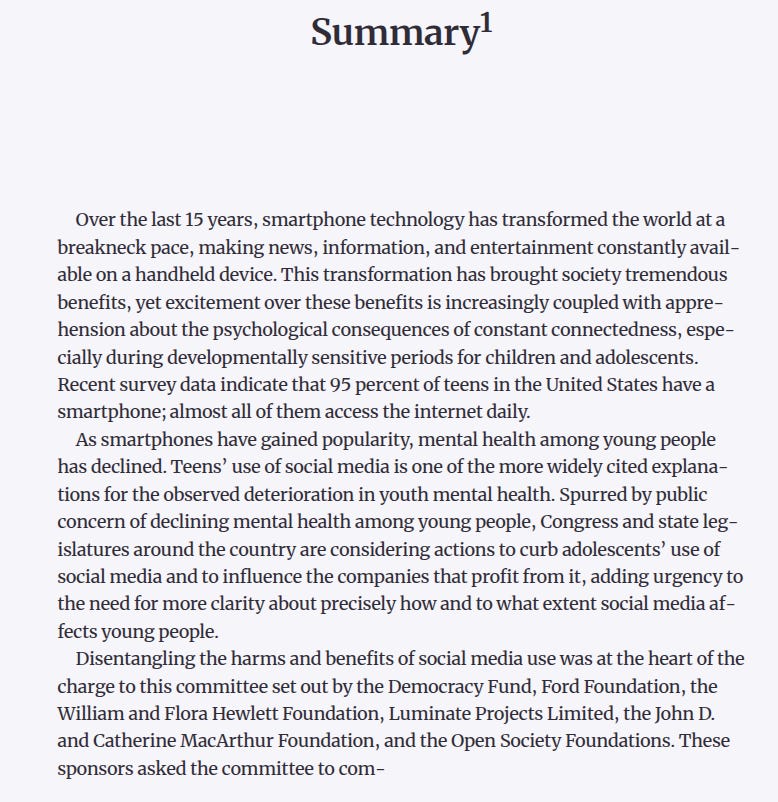
A major review by the US National Academies reached a similar middle ground. It stopped short of blaming social media for population-wide harm. But it still found enough risk to recommend precautions.
Then, in 2021, the debate changed again.
Former Facebook employee Frances Haugen shared internal company documents. Some included Meta’s own research on teenagers and Instagram.
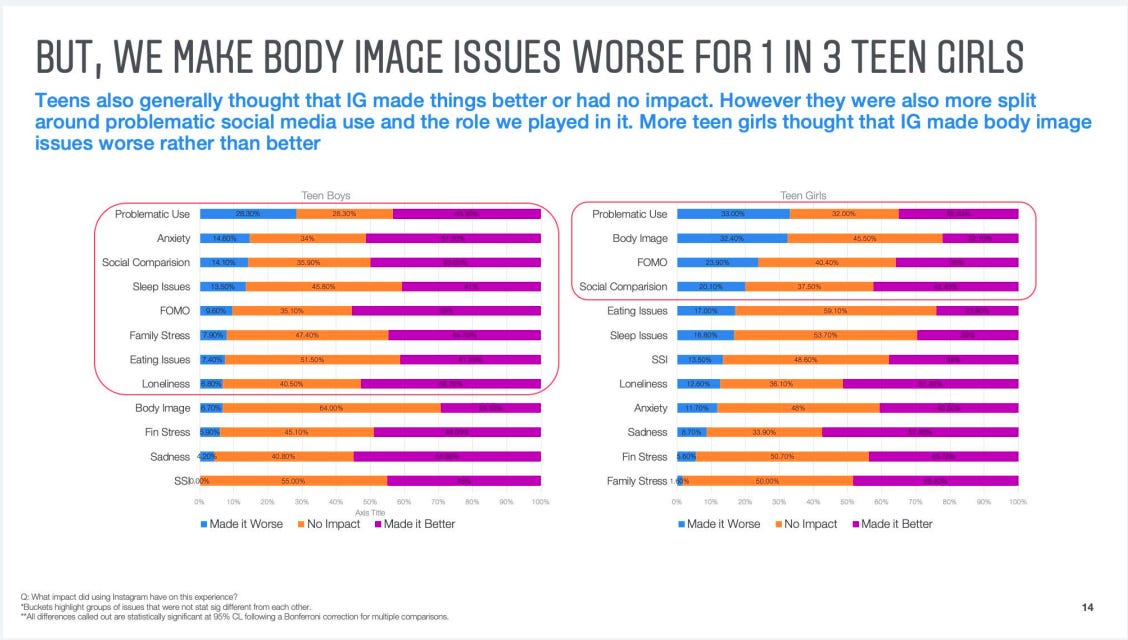
One internal slide said Instagram made body-image problems worse for one in three teenage girls who were already struggling with them. Meta argued that critics were presenting the finding without enough context.
But the documents revealed something different. Meta itself was studying some of the same risks that outside researchers and regulators were worried about. That left governments with an awkward choice. The science still did not offer a simple verdict. But the risks were becoming harder to ignore. Many decided not to wait.
Governments stopped waiting for an answer
Europe moved first on the broader idea that platforms themselves needed to change.
Under the Digital Services Act, large platforms have to assess and reduce risks to children. By 2025, the European Commission was already telling them to cut back on addictive features and improve age checks. Then, in July 2026, it said Instagram and Facebook may have broken the law because features like infinite scroll, autoplay and notifications were designed to keep people on the apps for longer.
That was only a preliminary finding, so Meta had not yet been forced to remove those features. But the Commission could eventually order changes or impose penalties if it concludes that Meta has not done enough to reduce the risk.
Australia went further.

Since December 2025, major platforms such as Facebook, Instagram, TikTok, Snapchat, X and YouTube have had to stop children under 16 from holding accounts. Britain and Indonesia have moved in a similar direction, while Britain has also proposed switching off autoplay and personalised feeds by default for older teenagers.
But age limits create a harder problem: platforms still need to know who is actually underage. A birthday is easy to fake. More reliable checks can involve government IDs, facial scans or outside identity-verification services.
So a rule meant to collect less data about children may first require platforms to collect more sensitive information about them.
India already faces this trade-off. Under the Digital Personal Data Protection Act (DPDP Act), companies generally need a parent’s verified consent before using a child’s personal data. The law also limits tracking and targeted advertising aimed at children.
Now some states want to go further. Karnataka has proposed restricting social-media use for children under 16. That makes the same question much harder for platforms: how do you protect children without collecting even more information just to prove their age?
In the United States, that concern moved into the courts.
Instead of writing new rules for platforms, parents, young users, school districts and state attorneys general went to court. But there was a problem. Platforms had long been protected from many lawsuits over harmful content posted by their users.
That is where Meta’s own internal research became more important. Plaintiffs could point not only to the design of the product, but also to evidence that the company itself had studied some of the risks.
So lawyers changed the argument. Instead of saying, “Instagram showed me harmful content,” they increasingly argued that Instagram’s own design had caused harm.
The lawsuits changed the target
As we have seen, platforms were already protected from the lawsuits over what their users posted. That protection came from Section 230 of the US Communications Decency Act of 1996. So the newer lawsuits focused on features the platforms had built themselves, such as Instagram’s feed, Snapchat’s Streaks and YouTube’s recommendations.
And slowly, arguments began getting further in court.
Earlier this year, a Los Angeles jury sided with a young woman who said Meta and YouTube had contributed to her social-media addiction. She was awarded $6 million in damages, while TikTok and Snap had settled even before the trial. Around the same time, New Mexico won a separate $942 million judgment against Meta and forced Meta to make changes aimed at protecting younger users.
By August, the pressure had moved into another major trial. Attorneys general from California, Colorado, Kentucky and New Jersey began presenting their case against Meta on August 18.
Eight days later, Meta settled the case. The timing does not tell us why Meta settled.
Meta has agreed to change how teenagers use Facebook and Instagram. Users under 18 will face a default two-hour daily limit across the two apps. They will need a parent’s permission to turn that limit off.
Meta will also restrict most use between midnight and 6am It will mute most notifications during school hours. The company will also try harder to identify a teenager who enters an adult birthday. It will remove accounts that it believes belong to children under 13.
An independent auditor will check whether Meta follows these rules. If TikTok and YouTube adopt similar protections, Meta’s limit will fall to one hour per app. The overnight restriction will also expand from 10 p.m. to 7 a.m.
That matters because the settlement itself is tied to what Meta’s rivals do. Meta has split the payment into two parts. It will pay about $12.7 billion to participating states over ten years. The remaining $5.3 billion depends on what TikTok and YouTube do. Meta will pay it only if both platforms adopt similar teen protections and make matching payments.
Meta has an obvious reason to want that.
If Instagram alone becomes less attractive to teenagers, they can simply spend more time on TikTok or YouTube. But if all three platforms face similar rules, the settlement starts to look less like a Meta-only penalty and more like a new industry standard.
That is a much bigger shift than the headline fine.

SEBI finds another SME IPO fraud
Over the past two years, SEBI has been pulling apart India’s SME IPO market, one order at a time.
Just recently, we covered the case of Varanium Cloud, which fabricated revenues and diverted IPO proceeds away from what it said on the prospectus. Last year, SEBI barred Synoptics Technologies for siphoning 54% of its fresh issue proceeds the day before listing, and Varyaa Creations for transferring over 70% of its IPO money to third parties.
In essence, a small company raises money from the public, the money disappears, and SEBI steps in after the fact.
Last week, the regulator published another one. This time it’s Trafiksol ITS Technologies, a company that builds intelligent transportation systems, toll management software, and traffic automation for government projects. It raised ~₹45 crore through an SME IPO on BSE in 2024. The IPO was oversubscribed 345 times, attracting bids worth over ₹10,000 crore. The shares were allotted and the listing was scheduled for the next day.
But right before that day, an investor complaint pointed out that the vendor Trafiksol had chosen for its biggest expenditure item — a ₹17.70 crore software purchase — hadn’t filed financial statements for three years and reported zero revenue.
BSE immediately halted the listing and SEBI froze the proceeds. It began an investigation whose final results have just been published.
An audit at midnight?
The story begins with the vendor.
The software vendor, Oasis Corpcare, had been purchased by one Kishanlal Kumhar for ₹20,000. Kishanlal told SEBI that a middleman named Vijay Oswal had asked him to give Trafiksol a quotation. Oswal prepared the quote himself in return for a commission. Call data records placed Kishanlal, Oswal, and Trafiksol’s managing director Jitendra Das at the same location on September 17 — the exact day BSE halted the listing.
The financial statements Oasis submitted to BSE were signed by a CA one day after the halt. All three years’ audit identification numbers were generated within a five-minute window and emailed to BSE at midnight.
When SEBI called one of Oasis’s directors, he answered the phone and then switched it off. A site visit found the office locked.
The Securities Appellate Tribunal called it a “sham transaction.” Trafiksol’s board had approved procurement from Oasis within two days, ignoring its own policy requiring at least three quotes.
Dressed up financials
SEBI’s latest order digs into Trafiksol’s books for FY24, the year right before the IPO, and finds systematic revenue inflation.
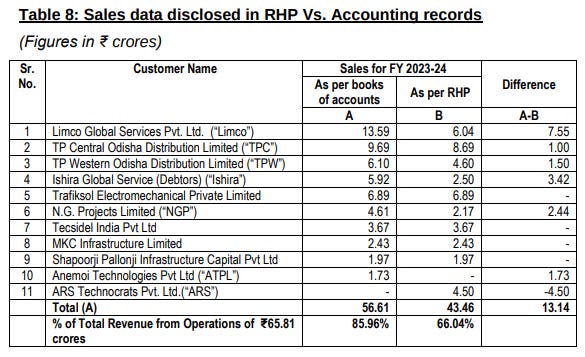
First, on March 31, 2024, Trafiksol booked ₹4.5 crore in “unbilled revenue“ through journal entries against three customers. It claimed this was revenue recognised proportionate to work completed.
But these amounts were never reflected in the company’s GST filings. When SEBI asked for proof of work, like work orders, milestone records, or invoices, they couldn’t produce anything.
In the prospectus, this same unbilled revenue showed up under the name of an entirely different entity called ARS Technocrats, which was listed as a top customer despite having bought nothing from Trafiksol at all.

Trafiksol’s own auditor later qualified the next year’s financials, noting the ₹4.50 crore had been reversed. Jitendra Das’s own statement during the investigation was telling: “This is a book entry passed to inflate the turnover in March 31, 2024.”
Second, Trafiksol had been running circular transactions between two entities, Limco and Ishira. Ishira would sell goods to Trafiksol, and Trafiksol would sell the same goods to Limco at a ~10% markup. Then, the same products would cycle back the other way. One of Trafiksol’s own ledger narrations described it as “third party invoicing from Limco to Ishira.” Receivables from these two entities, totaling over ₹11 crore, remained uncollected more than two years later.
In the prospectus, Trafiksol “netted“ its purchases from these entities against sales, making them look like they accounted for 13% of total sales. The real figure, on a gross basis, was closer to 30%.
As a result, SEBI estimated that at least 20% of Trafiksol’s reported ₹65.81 crore revenue was artificially inflated.
The phone that went off the Sea Link
A couple of other details are worth noting.
On the same day Trafiksol paid ₹50 lakh in merchant banking fees to its lead manager Ekadrisht Capital, it also transferred ₹67 lakh to the personal bank account of the father of Ekadrisht’s director and 99% shareholder. This was supposedly booked as a security deposit for office rent. SEBI didn’t necessarily deem it illegal, but said that it should have been disclosed, since it exceeded the merchant banking fee itself.
When SEBI asked Jitendra Das for data from his mobile phone, he said he’d bought a new phone during the investigation and had discarded the old one off the Bandra-Worli Sea Link after deleting its data. SEBI alleged that this was done to wipe out incriminating evidence. But there was no way to prove what evidence was really on there.
Why this matters beyond Trafiksol
Trafiksol, Das, and his wife and co-promoter Poonam Das have been barred from the market for one year and fined a combined ₹1.05 crore. The merchant banker has filed a settlement application.
The penalties are lighter than the Varanium Cloud order. But that’s because Trafiksol was a real business, plus the worst of the damage was avoided because investors got refunded before the shares ever traded.
But step back, and the pattern across these cases is consistent. Small companies raise money from the public on inflated or fabricated financials. The merchant bankers, who SEBI relies on to catch exactly this, either don’t look hard enough or don’t look at all. In the Synoptics case, the lead manager actually instructed the fund transfer. In Varyaa Creations, the modus operandi was identical. SEBI has now restricted two merchant bankers this year alone, including First Overseas Capital, which was the lead in the Varanium deal.
The regulator has been tightening SME IPO rules since late 2024, including minimum EBITDA thresholds, caps on promoter share sales, higher minimum application sizes, mandatory monitoring of proceeds. Those reforms are sensible. But Trafiksol’s IPO predated most of them, and the complaint that actually stopped the listing came from one individual investor who checked the Ministry of Corporate Affairs.
Until the gatekeepers start doing what they’re paid to do, rules on paper will only go so far.
- This edition of the newsletter was written by Mridula & Manie.
Tidbits:
[1] Japan’s JCRA upgrades India’s sovereign rating to A- from BBB+
The Japan Credit Rating Agency has upgraded India’s sovereign rating to A- from BBB+, marking the country’s first return to the ‘A’ rating category from an international agency in over 35 years. The agency cited India’s solid economic growth, sustained public infrastructure investment, and a healthier banking system driven by structural reforms as key drivers for the revision.
Source: The Economic Times
[2] Canada’s La Caisse acquires 24% stake in Altius Telecom for ₹12,100 crore
Canadian investment group La Caisse has acquired a 24% stake in Altius Telecom Infrastructure Trust for about ₹12,100 crore. Altius owns more than 258,000 telecom towers and sites across India, giving La Caisse major exposure to the country’s expanding 4G and 5G infrastructure market.
Source: The Hindu
[3] Digital Communications Commission to decide satellite spectrum fee and tenure
The Digital Communications Commission is expected to soon consider a proposed satellite-spectrum usage charge of 5% of adjusted gross revenue, along with allocation-tenure rules. The framework will shape how operators including Starlink, Eutelsat OneWeb, and Jio Satellite access spectrum in India.
Source: The Economic Times
[4] Banking system liquidity reaches four-year high of ₹7.7 lakh crore
Indian banking liquidity has surged to a four-year high of ₹7.7 lakh crore, driven primarily by strong inflows of foreign-currency non-resident deposits. The sharp increase in surplus funds is expected to help domestic lenders lower their cost of funds and potentially alleviate recent pressure on net interest margins.
Source: Financial Express
[5] DGGI proposes payment tracking after uncovering ₹70,000 crore in illegal betting transactions
The Directorate General of GST Intelligence has proposed mandatory tracking of websites that redirect users to payment gateways and stronger mapping of linked bank accounts. The recommendation follows a 14-month probe that detected about ₹70,000 crore of transactions in one financial year routed through illegal online betting networks.
Source: The Economic Times
Beyond Today’s Brief
There’s always more happening at Markets by Zerodha.
The Chatter: How is Milky Mist leveraging IoT logistics and reverse freight to cut transport costs by up to 20%? What is driving Bluestone’s confidence in smaller cities as consumers pivot toward 14-carat and lightweight jewellery? How did Leap India’s palletisation model boost a beverage maker’s daily truck throughput by 500%? Plus, updates from Avanti Feeds and Precision Camshafts
Aftermarket Report: How did early optimism over a stronger rupee and record FCNR inflows fail to sustain market sentiment as Nifty closed at its day’s low below 23,900? And which global headwinds continue to pressure domestic equities?
Join us on WhatsApp, where we share interesting soundbites from concalls, articles, and everything else we come across throughout the day. You’ll also get notified the moment a new video or article drops so that you can read or watch it right away.
Thank you for reading. Do share this with your friends and make them as smart as you are 😉