

Our goal with The Daily Brief is to simplify the biggest stories in the Indian markets and help you understand what they mean. We won’t just tell you what happened; we’ll tell you why and how too. We do this show in both formats: video and audio. This piece curates the stories that we talk about.
You can listen to the podcast on Spotify, Apple Podcasts, or wherever you get your podcasts and watch the videos on YouTube. You can also watch The Daily Brief in Hindi.
In today’s edition of The Daily Brief:
Is the moat of the FMCG industry changing?
Driven by Gen Z consumers shifting toward niche, personalized products and quick commerce consolidating distribution power, the traditional FMCG moat of mass-market branding and kirana-store reach is resetting—forcing legacy giants to buy digital-first challenger brands while navigating rising platform fees and lost control over consumer data.A temperature check on India’s trade moves
Facing global trade unpredictability and heavy reliance on Chinese supply chains, India is aggressively pursuing bilateral deals with resource-rich nations like Indonesia, Australia, and Canada to lock in critical minerals for its energy and defense ambitions, though persistent manufacturing gaps threaten to widen trade deficits if domestic product strength fails to keep pace.
The Chatter by Zerodha
Our team at Markets spends a lot of time reading earnings call transcripts and listening to management interviews. Along the way, we come across plenty of interesting insights that are worth sharing.
That’s what The Chatter is for.
It’s a weekly newsletter where we dig through what India’s biggest companies are saying and bring you the most interesting insights into businesses, industries, and the wider economy.

Is the moat of the FMCG industry changing?
Indian FMCG has long been one of the most dependable ways to make money in this country. These companies have compounded through recessions, demonetisation and even a pandemic, while consistently generating cash. The market has rewarded that consistency too, valuing FMCG companies at a premium to most other sectors in our economy.
There could be many reasons for that, but the one that stands out to us is their moat.
A moat is simply a lasting advantage that helps a company stay ahead of rivals and protect its profits. And for decades, some FMCG companies built strong moats around them.
We’re no experts here—just curious observers of businesses. But from everything we’ve read, the FMCG moat has always come down to one thing: winning the consumer. And there were two ways to do that. Reaching their hands, or reaching their minds.
Getting in front of them meant distribution. For years, that mostly meant being present at the neighbourhood kirana store. Getting into their head meant branding: memorable TV ads, catchy jingles and products people instinctively reached for. Everything else was in service of those two goals.
Now a report from HDFC Securities argues that this moat might be resetting. It’s even titled The Great Moat Reset.
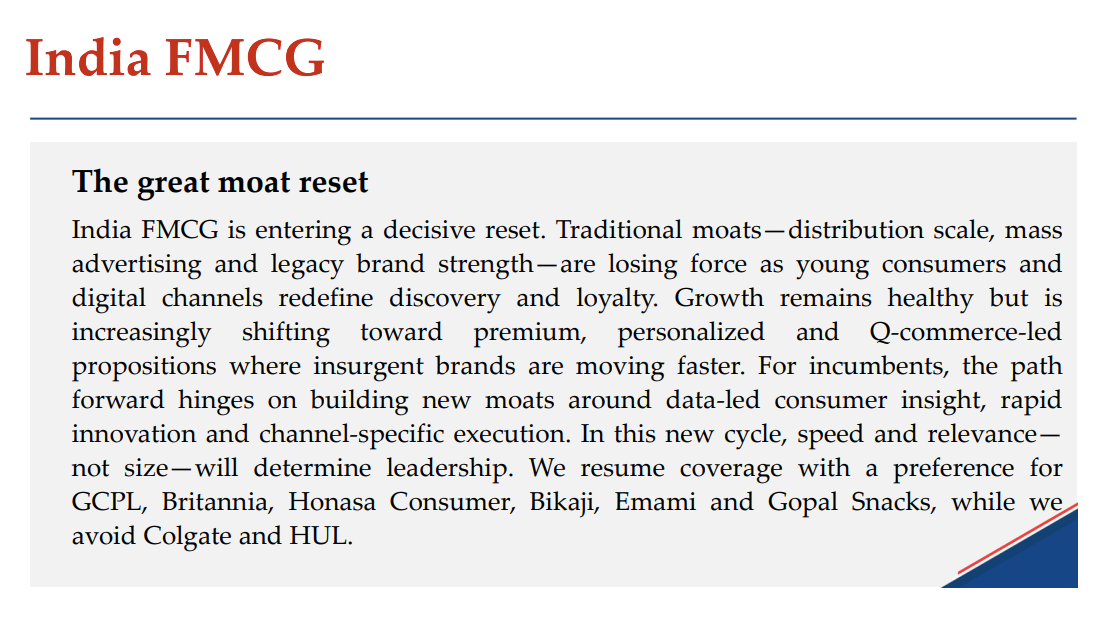
That’s a bold claim. FMCG is one of India’s oldest industries, and industries like this rarely change overnight. But we do think there’s something interesting in the argument. And the easiest way to understand it is to go back to the question that has always – according to us – defined this industry: how do you win the customer?
Think of it all as a mental model, not a prediction.
The customer changed, and so did their preference
Almost every projection about Indian consumption leans on the same demographic trend: millennials and Gen Z are becoming the country’s dominant consumers. More importantly, they’ll make up a much larger share of India’s working population. By the end of the decade, these two generations are expected to account for almost 75% of all consumer spending in India.
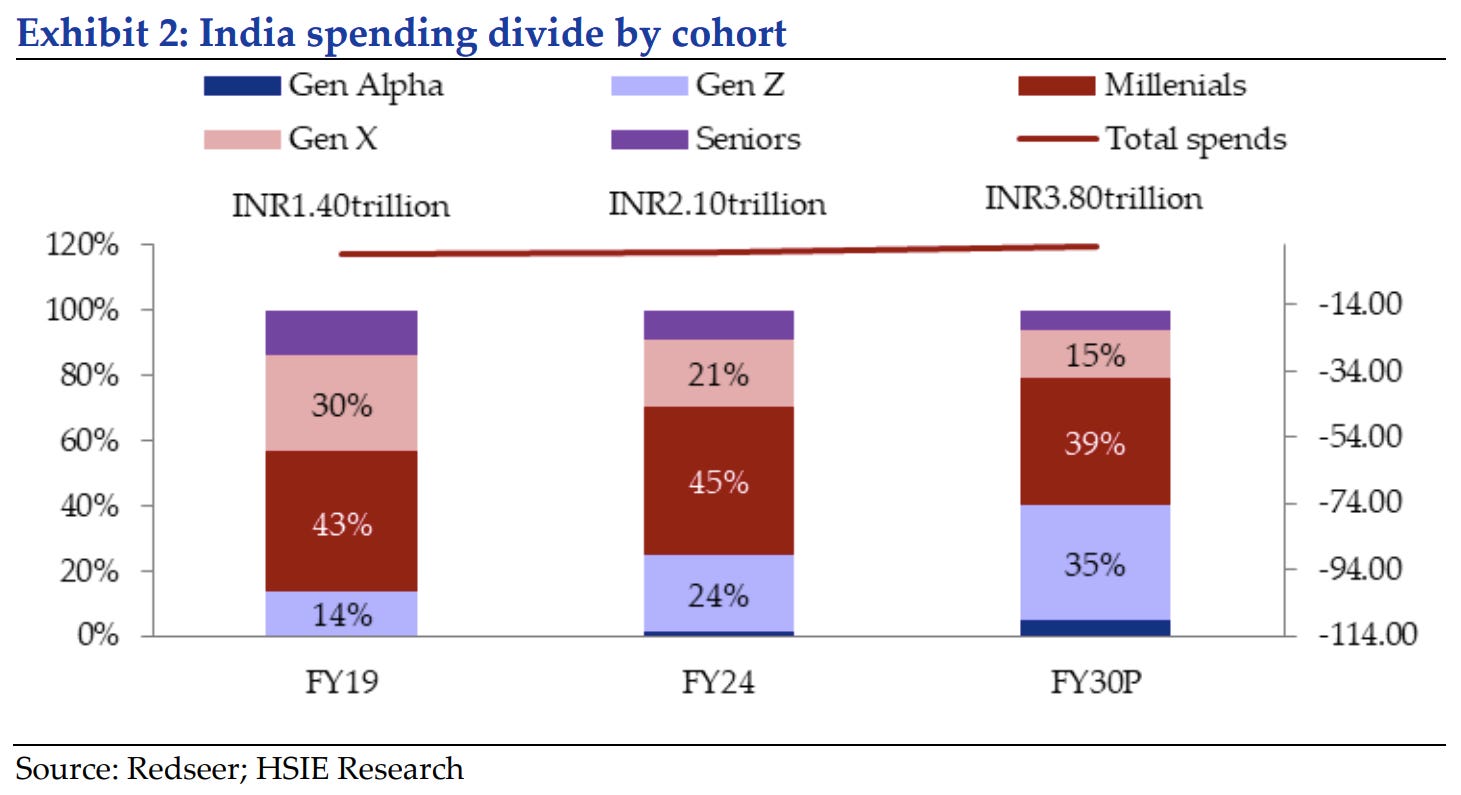
Much of what follows is anecdotal, but this generation behaves differently. They want different products, shop differently, and are influenced by different things. That’s a challenge for legacy FMCG companies that spent decades understanding a very different customer.
It also changes the answer to the question we asked earlier: how do you win the customer?
Part of the answer lies in what you sell. For most of FMCG history, companies built products for an entire category. HUL had Clinic Plus. P&G had Head & Shoulders. These were products designed to serve the broad haircare market, with line extensions like Pantene or TRESemmé filling a few gaps along the way.
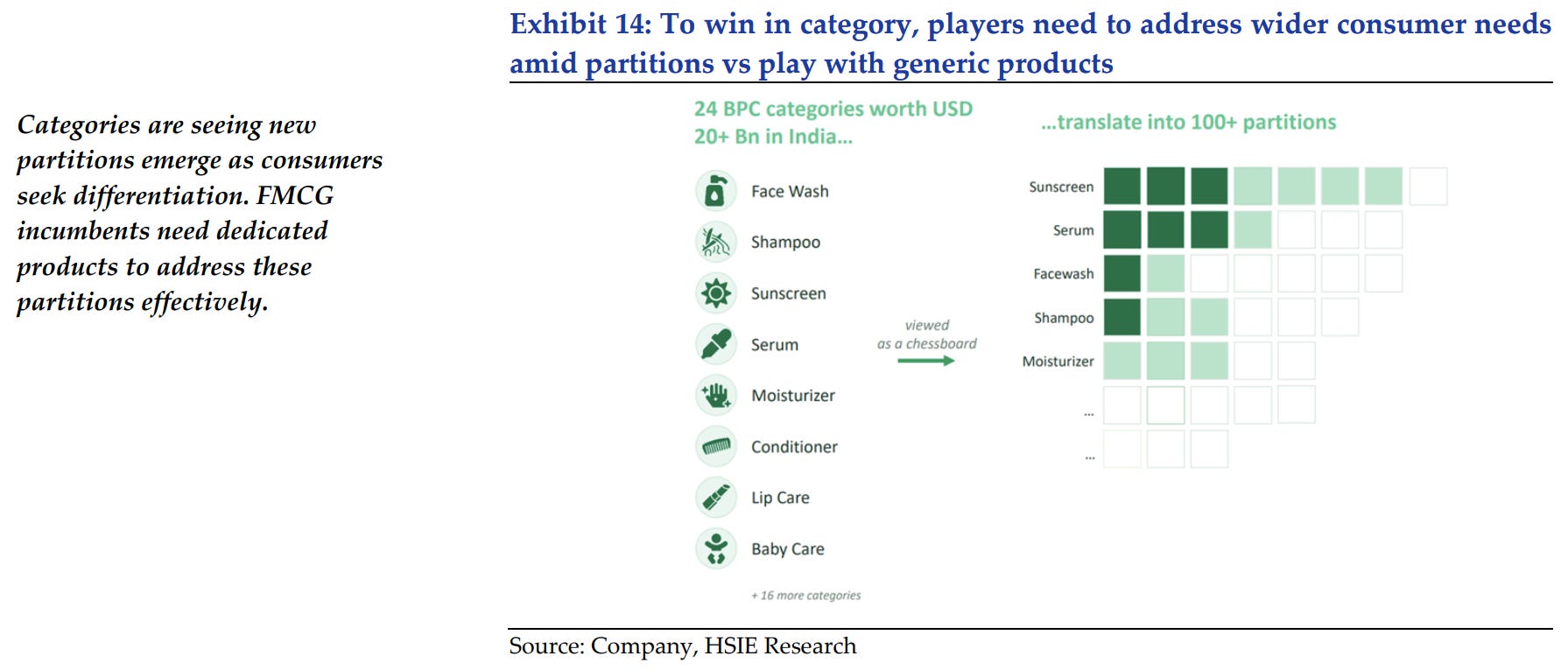
The report argues that this playbook is breaking down. Today’s customer doesn’t want a product made for everyone. They want one made for them.
They don’t just want a shampoo. They want a sulphate-free shampoo for coloured hair. In other words, one large category is splitting into dozens of smaller needs, or what the report calls “partitions”. Instead of one product serving everyone, each need gets its own product.
There’s some evidence this is already happening. Broad, mass-market categories are slowing, while a long tail of focused brands chips away at their market share.
Take Dr. Melaxin, the South Korean skincare label that just launched in India through Reliance’s Tira platform. It isn’t trying to solve “skincare.” Instead, it sells clinically positioned products for specific concerns like pigmentation, texture and firmness.
This is where incumbents are starting to lose ground. Their overall market share may still look intact, but the incremental customer—the young, urban, first-time buyer—is increasingly choosing these focused brands. In other words, a disproportionate share of new industry growth is flowing to challengers, not incumbents.
So how does a hundred-year-old FMCG giant respond? It has two choices. It can build a niche brand from scratch, but that’s slow and often goes against its instinct for scale. Or it can buy one.
If you can’t build it, buy it
The faster route is to buy, and over the last few years the biggest names have gone shopping for exactly the focused, digital-first brands the new customer likes.
HUL acquired Minimalist, a brand built around ingredient-led skincare with products like niacinamide serums and salicylic acid cleansers. This is very different from the mass-market beauty brands like Pond’s or Glow & Lovely it built over decades.
Marico, meanwhile, has spent the last few years acquiring and backing digital-first brands like Beardo, Just Herbs, Plix and Cosmix, each catering to a much narrower consumer need than its traditional portfolio. Most of these started online, spoke a very different language, targeted specific consumer problems, and built loyal communities before they ever reached supermarket shelves.
That’s why buying them often makes more sense than building them. Marico could have launched its own wellness nutrition brand to compete with Cosmix. But a legacy FMCG company would have struggled to create the same credibility, community and identity that Cosmix had already built with its audience.
Of course, buying brands isn’t cheap. And that brings us to the next question: who can actually afford to play this game?
The balance sheet gives the answer. ITC sits on the largest cash pile in the sector. Dabur has the biggest cash reserve relative to its own size. HUL also has a comfortable war chest. At the other end, Godrej Consumer and Gopal Snacks are in net debt. Any meaningful acquisition would likely require them to borrow first.
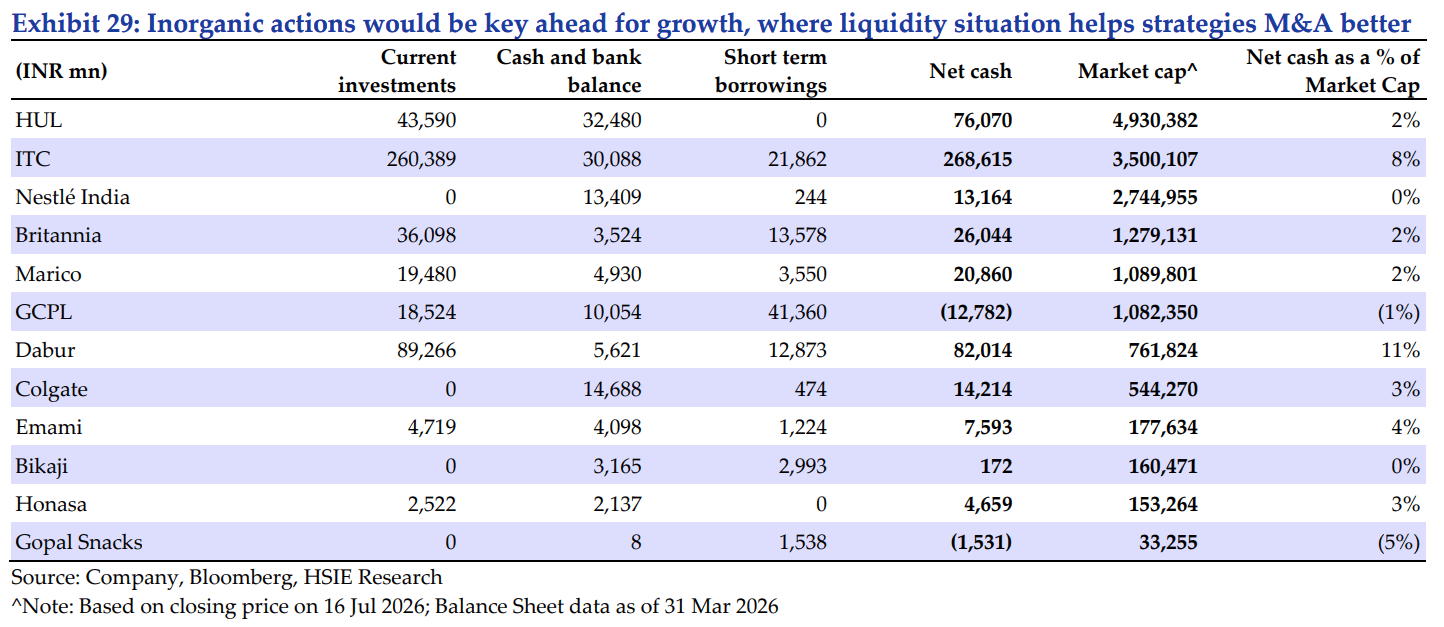
But cash on hand is only half the tell. It shows the ability to spend, but not the intention to.
Britannia has long preferred to hand money back to shareholders through dividends rather than chase acquisitions. On average 80% of their profits have been handed back to shareholders in the past 5 years, which is more than what an average FMCG company has given.
Even Honasa, the Mamaearth parent and the sector’s poster child for new-age growth, declared its maiden dividend this year after a strong run. Dry powder left unused is itself a choice.
We’d add one caveat of our own here: buying growth in FMCG is tricky. The industry’s history is full of expensive deals that looked sensible on paper but aged badly.
HUL’s roughly ₹3,000 crore purchase of Horlicks and Boost is a good example. The deal was meant to give HUL a stronger foothold in health food drinks, but the category itself was already losing momentum. At the same time, products like Horlicks and Boost were facing growing scrutiny over how healthy they really were. HUL eventually had to move away from the old “health food drinks” label and reclassify them as Functional and Nutritional Drinks.
Which shows, the winners here probably won’t be whoever spends the most; they’ll be whoever buys the way Marico has, slowly and cheaply and close to the trend, rather than in one splashy cheque.
The reach that no longer belongs to you
FMCG used to be a world of consolidated brands and fragmented distribution: a few giant labels pushed out through millions of tiny shops.
This arrangement is, arguably, inverting. The brands are fragmenting into a long tail of niche labels and distribution is consolidating into a handful of platforms. And the fastest-consolidating platform of all is quick commerce.
Quick commerce has gone from novelty to the single fastest-growing sales channel in FMCG, and for several large companies it now drives up to 75% of all online sales.
The channel’s economics are alien to everything the industry knew. For example, as per calculations a kirana does ~₹15,000 of revenue a year per square foot; but a dark store does closer to ₹1.23 lakh. A kirana stocks around 600 items; a dark store carries 15,000. In simpler words, quick commerce gives so much more volume at much lesser inconvenience to the brands.
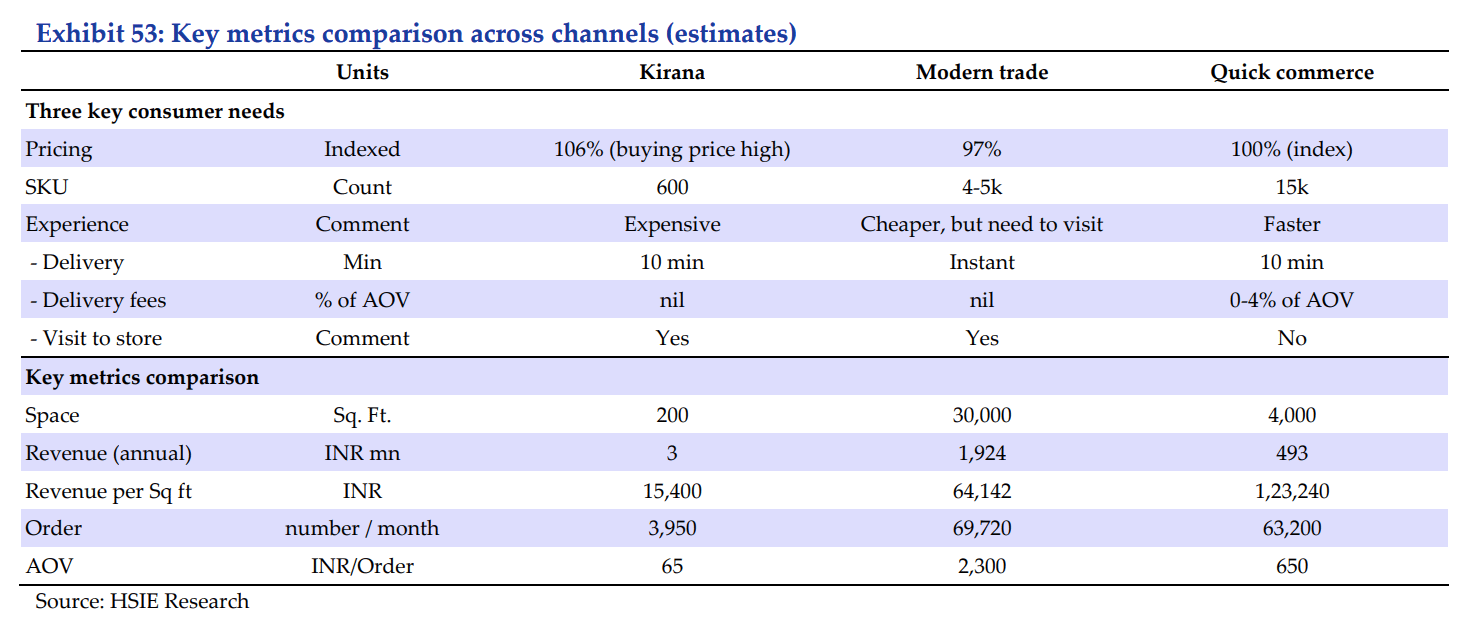
Now, let’s not forget that Kiranas still account for the overwhelming majority of Indian grocery. So, the old moat of kirana’s reach isn’t gone but being poked by this small but fast growing alternative.
What does this mean for brands? As these platforms have scaled, power has started to flow to them. As a kirana shop operator, you are too little to have any negotiating power with the big brands or their distributors. But, that’s not the case with quick commerce.
Quick commerce companies are now doing to FMCG what only the biggest modern-retail chains — a D’Mart, a Reliance Retail — could once do: dictating terms. They’re demanding higher margins and bigger marketing budgets. The cost of selling through the channel has jumped about 20% in a year, and as much as 40% around festivals and weekends.
This is worrying because brands don’t control this new reach. It belongs to the quick commerce platforms.
There’s another interesting shift. Not every FMCG product fits the quick commerce model. Some purchases are urgent or impulsive. Others can wait until the monthly grocery run. But if quick commerce continues to drive most of the industry’s incremental growth, brands will increasingly have an incentive to design products specifically for these platforms—smaller pack sizes, impulse-friendly products and formats that suit a 10-minute delivery experience.
Which brings us back to the same question: if the platform owns the shelf, the search bar and the customer data, where exactly does the brand’s new moat live? Hold that thought.
The data moat built on the wrong side
Which brings us to the industry’s favourite new buzzword: data.
Every time a customer shops online, they leave behind a digital trail. What did they search for? Which products showed up? What did they click on? What did they finally buy? The entire purchase journey gets captured as data—something a kirana store could never offer.
That data can be incredibly valuable. The companies that can use it to spot emerging consumer needs, build the right products and pitch them the right way could have a real advantage.
New-age brands like Honasa claim to have built AI systems to try exactly this.
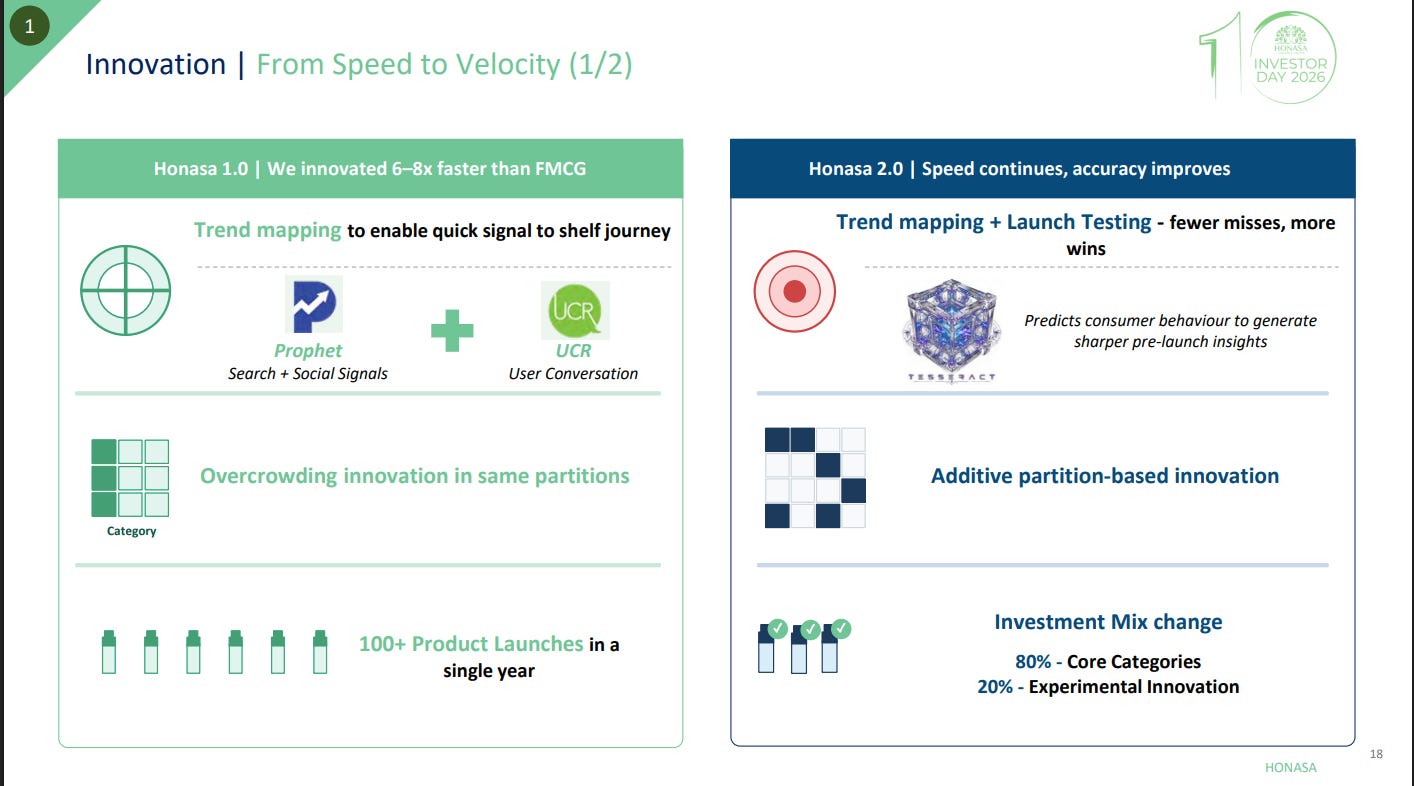
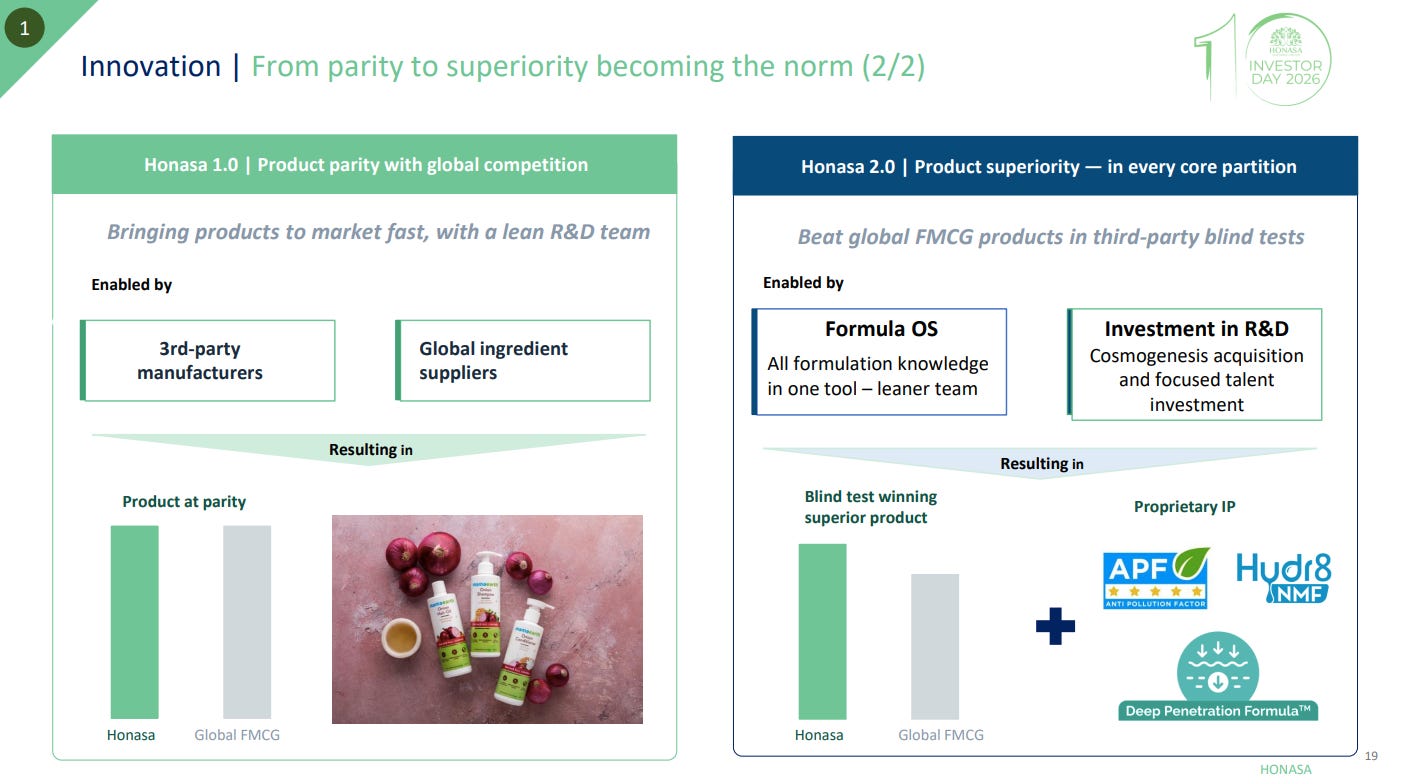
We’d treat “data is the new moat” as the most debatable part of the entire thesis. So far, the evidence that it creates a lasting advantage is thin.
Take Honasa’s AI systems. They’re meant to predict which products and marketing messages will work before the company spends real money on them. But the report itself shows that the products selected by the AI succeeded less than 5% of the time. In another case study, AI-driven recommendations improved conversion rates from 88% to 90%. Useful, perhaps, but hardly game-changing.
There’s also a more fundamental problem. The richest data about today’s customer—what they searched for, what they skipped, what they bought late at night—doesn’t belong to the brands. It belongs to the quick commerce platforms.
So if data really is the next moat, there’s a good chance it’s being built on the platform side, not the brand side.
Does any of it actually pay?
All of this — new products, acquisitions, ten-minute shelves — costs money. So it’s fair to ask whether the reset is profitable or merely expensive.
It’s hard to say. For now, margins are under pressure, but much of that seems cyclical rather than structural.
A big reason is higher input costs. Prices of key raw materials like palm oil and crude-based derivatives have risen. Palm oil, in particular, has become more expensive because Indonesia—the world’s largest exporter—has been using more of its own production to make biodiesel instead of exporting it. Since India imports a large share of its palm oil from Indonesia, lower exports mean higher prices for FMCG companies here.
The sector has also had to deal with one-off disruptions such as GST rate changes, which temporarily affected demand and inventory across the distribution chain as retailers adjusted purchases.
So while margins look weak today, much of the pressure appears to come from temporary cost and policy headwinds, not necessarily from a permanent deterioration in the economics of the business.
But, unlike the cost pressures if there’s one way the moat reset could eventually show up in the numbers, it’s through premiumisation.
The new customer doesn’t only want made-for-me products; they also want to trade up—the nicer face wash, the fancier coffee, the premium single-serve. Quick commerce is the ideal place to sell exactly that. It’s where discovery happens, where the basket skews upmarket, and where—by the companies’ own account—the channel earns better margins because it pushes a richer mix of premium products.
Ironically, the same platform squeezing brands on listing fees is also giving them their best chance to sell premium products in the first place.
For now, premium products are the clearest sign that the new customer is willing to spend more.
The bigger question is whether the market believes this shift will create value. So far, it seems unconvinced. FMCG valuations have fallen close to the lower end of their historical range, and the sector’s long-standing premium over the broader market has narrowed.
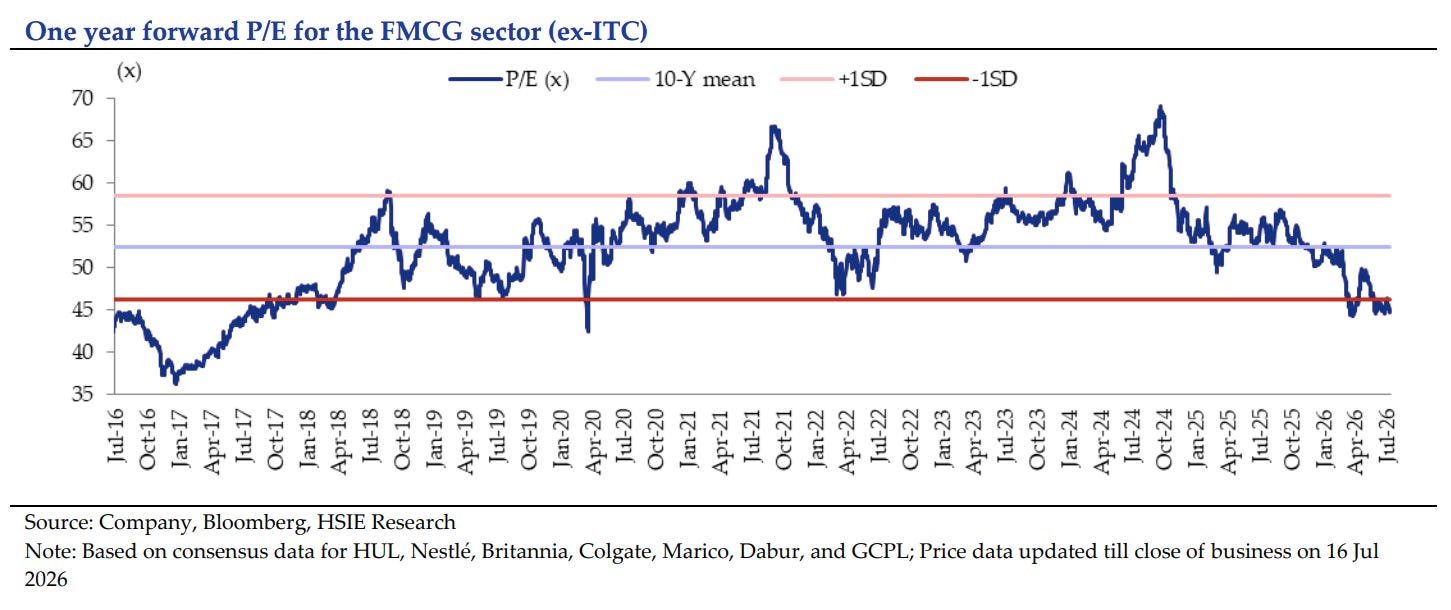
Read gloomily, that’s possible the market pricing in eroding moats. But if you look a little closer, there are two names still trading at a premium — Nestlé and Marico. They are precisely the ones the report rates highest on adapting to the new customer. Perhaps the market isn’t sitting around waiting for a moat reset to arrive; it’s already sorting the companies winning the new cohort of customers from the ones that aren’t, and paying up for the winners.

A temperature check on India’s trade moves
Earlier in July, Prime Minister Modi embarked on a three-nation Asia-Pacific tour. In Indonesia, he and President Prabowo signed multiple cooperation documents, three of them on critical minerals and steel. In Australia, he pushed for an early conclusion of the India-Australia Comprehensive Economic Cooperation Agreement (CECA). New Zealand was the third destination.
During this time, Indian and Canadian trade negotiators wrapped up the third round of talks for a trade deal that both sides want closed before the year is out.
A thread runs through the deals with Indonesia, Australia and Canada. India needs nickel, lithium, cobalt, potash, and rare earths — the raw materials of its energy transition, its defence ambitions, and its dream of becoming a serious manufacturer. Indonesia, Australia, and Canada have them. And, of course, this is happening in the wake of increasing trade weaponization by the two biggest superpowers of the world.
But trade deals are more complicated than shopping lists.
Two months ago, on our podcast series Subtext, we sat down with Ajay Srivastava, founder of the Global Trade Research Initiative and a veteran of the Indian Trade Service. He’s been in the rooms where these deals get made, line by line, tariff by tariff. What he told us offers a useful framework for understanding what these new deals might actually deliver — and what India has to offer in return.
We’ll be using the frameworks from that episode to look at the potential that the deals hold.
The world that made these deals urgent
First, let’s look at the world that made these deals urgent.
India has signed twenty regional or free trade agreements in its history. Nine of them have come in the past five years alone, covering the EU, the UK, the UAE, EFTA, Oman, and New Zealand. It is one of the more remarkable stretches of trade diplomacy by any large developing country. But the urgency comes from a world that has become deeply unpredictable.
Ajay Srivastava’s reading of the past year is blunt. After Trump imposed sweeping tariffs on America’s trading partners using emergency powers, one major economy after another caved.
Then, in February 2026, the US Supreme Court struck down those emergency tariffs entirely, ruling that the president had no authority to impose them. The Trump administration pivoted within hours to a flat 10% tariff on all imports under a different legal provision. Suddenly, every country that had surrendered was paying the same tariff as those that hadn’t. Malaysia even declared its deal with the US “null and void“.
And the pressure hasn’t stopped. The US Trade Representative has since launched two sweeping Section 301 investigations, which is widely seen as the legal groundwork for a new, permanent tariff architecture. The WTO’s fourteenth ministerial conference in Cameroon couldn’t even produce a final declaration. The e-commerce moratorium — a commitment not to tax digital transmissions that had held since 1998 — lapsed for the first time.
Srivastava puts it simply: except for the US, every country honours its trade agreements. Once you negotiate a deal, you are assured of a certain tariff — zero, five, ten percent — and you can predict it. In a world where American trade policy changes by the week and the WTO has no enforcement power, bilateral FTAs become the only reliable source of tariff certainty. That’s the strategic logic behind India’s sprint.
But he also adds a provocation. FTAs only help at the margins: they lower the tariff, smooth the paperwork, give your exporters a slight edge. But they don’t create competitiveness. The real question is what Srivastava calls complementarity — whether the two sides make fundamentally different things, so that trade benefits both without destroying either’s domestic industry.
That’s the lens we want to apply to the three deals India is chasing right now.
Three countries, one mineral hunger
Here’s something worth noting first. Indonesia, Australia, and Canada are not major trade partners for India. India’s total merchandise trade crossed a trillion dollars in FY26. China alone accounted for over $150 billion of that. The US accounted for $140 billion. Indonesia ($30 billion), Australia ($24 billion), and Canada ($8 billion) together add up to about $60 billion — less than half of India-China trade. These are firmly second-tier partners, and their share of trade with India was even smaller 5 years ago.
India’s trade diplomacy has historically been oriented around the big blocs — the US, the EU, ASEAN as a group, the Gulf. These three countries, individually, didn’t make the cut.
What’s changed is minerals. The energy transition, the push to build batteries and EVs domestically, the semiconductor ambition: all of it requires raw materials India doesn’t have.
Indonesia holds the world’s largest nickel reserves — 62 million metric tons — and accounts for more than half of global nickel production. Australia is the world’s largest exporter of lithium and ranks in the global top five for cobalt, rare earths, tantalum, and zircon. Canada has significant deposits of potash, nickel, cobalt, lithium, and uranium. Between them, these three countries hold a large share of the raw materials India needs for batteries, EVs, solar panels, steel, defence hardware, and semiconductor packaging.
India currently gets 60-70% of its lithium from China and ~40% of its rare earths. Every deal India signs with a non-Chinese supplier is a supply-chain diversification play.
Beyond this, the specifics vary by country, and so does the texture of each relationship.
Indonesia
Let’s start with Indonesia. In 2024, bilateral trade stood at about $30 billion, but India exported just $6 billion while importing nearly $24 billion.
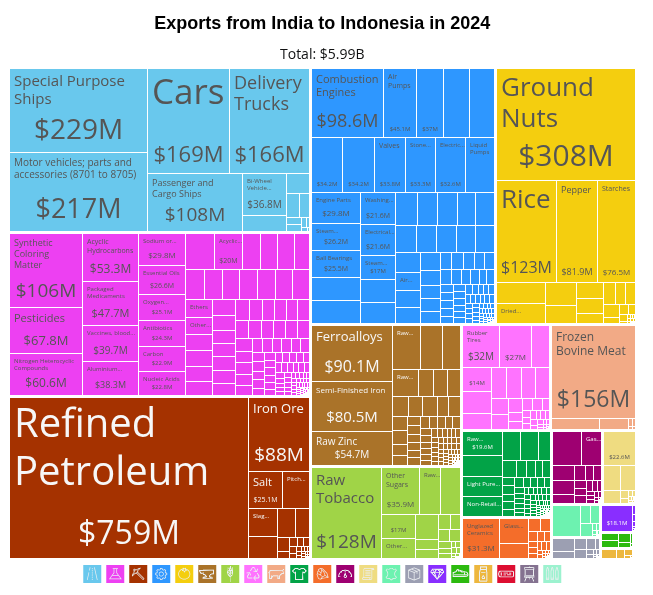
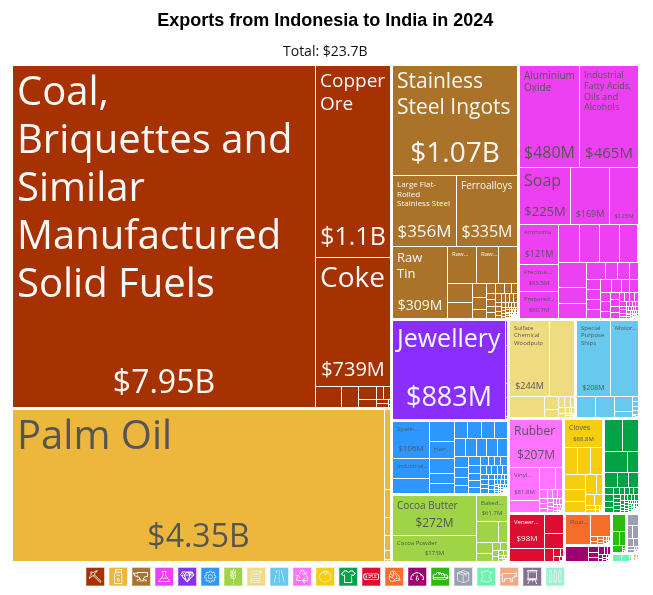
The deficit of roughly $18 billion is driven almost entirely by two commodities: coal ($8 billion) and palm oil ($4.4 billion). India needs Indonesian coal for its power plants and Indonesian palm oil for its food processing industry. India’s exports to Indonesia are small-scale and fragmented: refined petroleum, agricultural products like groundnuts, some commercial vehicles and auto parts.
Trade experts have pointed out that Indian companies have focused almost entirely on selling products to Indonesia rather than investing in Indonesian manufacturing to integrate supply chains. Without that deeper integration, the export gap has been impossible to close.
In our visit to Jakarta, 3 of the 12 MoUs signed were minerals-related. That included a major joint venture between Steel Authority of India and Krakatau Steel — a major flip from the history of us shying away from investing in Indonesia.
But Indonesia has a blunt ban on the export of raw nickel ore. It wants the processing, the smelting, the value addition to happen on Indonesian soil. India can’t just buy nickel the way it buys Indonesian coal. We have to invest in Indonesian processing capacity, build joint ventures, and set up factories.
Australia
Meanwhile, Australia may look different on paper, but, much like Indonesia, reality hasn’t met expectations.
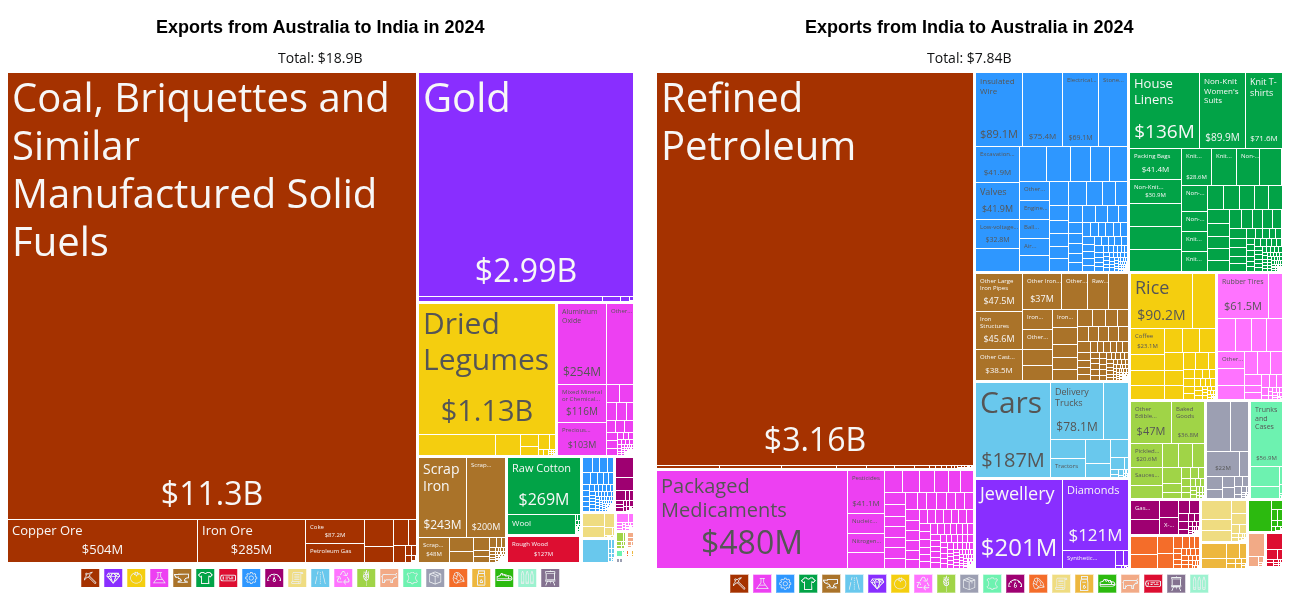
The two countries signed an interim trade deal in 2022, and it was supposed to be the start of something bigger. Bilateral trade did grow since then, but over the last year, merchandise trade actually declined. In FY26, Indian exports to Australia fell by 15% and imports from Australia dropped 11%.
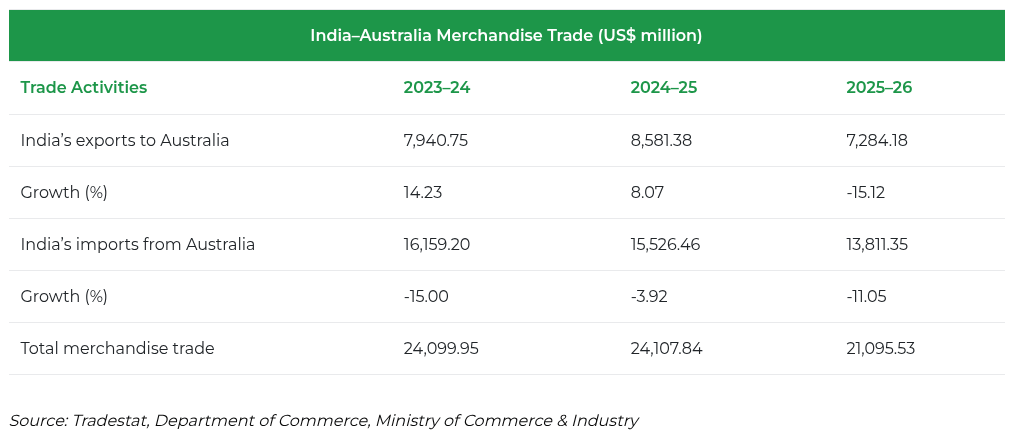
The broader deal, the CECA, has been negotiated on and off since 2011 and remains stuck on domestic political sensitivities. India’s dairy lobby resists concessions on Australian dairy and wine, while Australia hesitates on visa access that India demands for its IT professionals.
Where things are moving, though, is, again, minerals.
The two countries have set up a Critical Minerals Investment Partnership, which has identified five target projects — two lithium, three cobalt — for detailed due diligence. Most notably, at the July summit in Melbourne, India and Australia finally agreed to operationalize commercial uranium exports to India, even though we’ve had an agreement on nuclear energy with them for 12 years.
The complementarity is cleaner here than with Indonesia. Australia supplies minerals, coal, LNG, and education services. Historically, India has exported pharmaceuticals, IT services, textiles, and refined petroleum to Australia. While India has historically had a trade deficit with Australia, neither side undercuts the other’s domestic industry for this deficit to harm us. But the CECA deadlock is a reminder that complementarity on paper doesn’t automatically translate into a signed deal.
Canada
Canada is the smallest of the three in trade terms, but the diplomatic context underlying the relationship raises the stakes significantly. India-Canada relations have been in crisis for a few years over the Nijjar affair, in the wake of which India expelled Canadian diplomats, Canada recalled its own, and trade talks froze entirely.
But that ice has thawed. Now, Prime Minister Carney is calling the proposed deal a “game changer”. The complementarity case is straightforward: Canada has potash, which is a key input in fertilizer. And India is one of the world’s largest consumers of fertiliser. Canada is also a powerhouse in critical resources, with reserves of nickel, cobalt, and uranium. India’s biggest exports are pharma, textiles, and IT services.
The deal, if it gets done, would be as much a symbol of diplomatic normalisation as it is a trade agreement.
What does India bring to the table?
In each of these partnerships, the other side’s offering is tangible and in demand. These are the building blocks of the twenty-first-century industrial economy. Countries that have them hold real leverage.
What India offers beyond what we already export to these countries is different in kind.
One of the key anchors on our side is defence. For instance, with Indonesia, we signed a deal that includes $600 million worth of defence goods. Chief among them is our Brahmos missile, which has become a popular export for us lately, with the Philippines becoming the first customer in 2022. It also includes air-to-air missiles. One reason for this defence push is to hedge against the growing influence of China, who has repeatedly encroached on Indonesian waters, which also serve as trade routes.
Similarly, with Australia, trade talks have been dominated less by conventional goods and services, and more by defence and national security needs. Defence manufacturing was held as a priority sector in our July meeting at Melbourne.
On top of this, the promise of being a reliable partner in a world where China’s dominance over critical mineral supply chains makes everyone nervous. India has also removed import duties on 41 critical minerals to sweeten the deal.
There is, of course, market access to 1.4 billion consumers in one of the world’s fastest-growing economies. The standard categories of services, pharma, refined petroleum and auto parts, which have made up most exports to Australia and Canada, still exist.
However, Ajay Srivastava’s provocation about India’s industrial strength lingers.
India’s product profile, he argues, hasn’t changed much since the 1990s. We were competitive in labour-intensive goods like garments, textiles, leather, and low-end engineering. And then, we stopped developing new products. The categories that emerged after liberalisation — synthetic garments, sportswear, electronics, advanced chemicals — are those where India barely competes globally.
A deal works when both sides can actually sell into the other’s market. India is opening its doors to Australian lithium and Canadian potash, but what are we sending back? The deficits with Indonesia and Australia aren’t accidents. It reflects the possibility that India needs these countries’ commodities more than they need Indian manufactured goods.
What comes next
In a world where the US is unreliable, the WTO is fractured, and every country is scrambling to lock in predictable trade terms, signing deals with resource-rich partners is exactly what you’d want to do. The critical minerals thread connecting Indonesia, Australia, and Canada is a reliable way of avoiding dependence on a historic geopolitical rival of ours.
But, as we’ve covered before, the old FTAs with ASEAN and South Korea taught a hard lesson: a deal without product strength just widens your deficit. Whether this round turns out differently depends less on the tariff schedules and more on whether India can build the industrial depth to make these partnerships genuinely two-way.
Tidbits
[1] The Reserve Bank of India has released draft rules to completely overhaul and simplify the country’s foreign investment framework. The new policies aim to reduce compliance burdens and make it easier for foreign investors to fund Indian companies.
Source: RBI Press Release
[2] Swedish furniture giant IKEA is exploring an entry into India’s booming quick commerce platforms to boost its online sales. The retailer is also planning to expand its physical stores beyond major metros as it heavily increases its investments in the country by 2030.
Source: Financial Express
[3] To boost green fuel production, India utilized 3.9 million tonnes of government rice and 6.8 million tonnes of maize for ethanol blending by June 2026. This massive procurement supports the government’s push to mix 20% ethanol into petrol to reduce reliance on imported oil.
Source: The Hindu BusinessLine
[4] Ships carrying essential fertilisers are stranded at major Indian ports due to severe congestion, limited railway availability, and shipping disruptions in the Middle East. This delay is raising critical supply concerns for farmers during the peak Kharif crop sowing season.
Source: The Economic Times
[5] Ozempic-maker Novo Nordisk has sued rival Eli Lilly for false advertising, claiming Lilly’s ads deceptively state its weight-loss drugs are superior. The lawsuit alleges Eli Lilly intentionally compared high doses of its drug Zepbound to outdated, lower doses of Novo’s medications.
Source: Livemint
- This edition of the newsletter was written by Kashish & Manie.
Suyash Singh on the madness of the space business
Space is hard, a cliché that becomes reality when you try to build hardware that operates in a vacuum, extreme radiation, and wild thermal cycles with zero tolerance for failure. For Earth observation companies, this difficulty is compounded by a business reality: satellite imagery is essentially a data business hampered by inconsistent supply due to cloud cover. To make sense of all this, we spoke to Suyash Singh, Co-founder and CEO of GalaxEye, who is attempting to solve this by building India’s first OptoSAR satellite. Our conversation dives deep into the technical hurdles of synchronizing optical and SAR sensors traveling at seven kilometers per second, the realities of miniaturizing radars for drones as a frugal testing ground, how the IN-SPACe reorganization catalyzed the Indian private space ecosystem, and what it is actually like to book a launch slot with SpaceX.

You can also listen to the full conversation on Spotify and Apple Podcasts. Watch the full podcast episode below, where Suyash breaks down the technical hurdles of space hardware and the economics of Earth observation.
Points & Figures by Zerodha
We’re always chasing the day’s biggest stories. But every now and then, we come across a dataset that deserves a closer look than a Daily Brief allows.
That’s what Points & Figures is for.
It’s where we step back from the news cycle and use data visualisations to tell stories about the Indian economy, financial markets, and investing. Our latest edition traces how India’s power landscape is transforming, using electricity generation, capacity, and emissions data to reveal why simply building solar panels isn’t enough to dethrone coal.

What we’re reading
Our team at Markets is always reading, often much more than what might be considered healthy. So, we thought it would be nice to have an outlet to put out what we’re reading that isn’t part of our normal cycle of content.
So we’re kickstarting “What We’re Reading”, where every weekend, our team outlines the interesting things we’ve read in the past week. This will include articles and even books that really gave us food for thought.
Subscribe to Aftermarket Report, a newsletter where we do a quick daily wrap-up of what happened in the markets—both in India and globally.
Join us on WhatsApp, where we share interesting soundbites from concalls, articles, and everything else we come across throughout the day. You’ll also get notified the moment a new video or article drops so that you can read or watch it right away.
Thank you for reading. Do share this with your friends and make them as smart as you are 😉
Second article was especially useful and detailed and provided a mine of information on what we buy from whom . Thanks a lot . Keep up the great work .
This got me thinking if consumer data is increasingly concentrated with platforms rather than brands does ai really become a moat for FMCG companies or just another cost of staying relevant? If platforms own customer relationships where does the real competitive advantage end up?