

Our goal with The Daily Brief is to simplify the biggest stories in the Indian markets and help you understand what they mean. We won’t just tell you what happened; we’ll tell you why and how too. We do this show in both formats: video and audio. This piece curates the stories that we talk about.
You can listen to the podcast on Spotify, Apple Podcasts, or wherever you get your podcasts and watch the videos on YouTube. You can also watch The Daily Brief in Hindi.
In today’s edition of The Daily Brief:
Indian cement meets both new bridges and broken roads
Why did profits diverge dramatically across India's top three cement makers—UltraTech, Ambuja, and Shree Cement—despite all three operating against healthy 7–8% industry demand and facing the same West Asia fuel shock? While UltraTech comfortably grew profits by successfully converting acquired B/C-grade brands into premium A-category pricing, Ambuja deliberately sacrificed low-margin non-trade volumes to push trade sales to 78% of its mix. Conversely, Shree Cement was hit hardest after West Asia supply disruptions forced it to swap clean pet coke for ash-heavy coal. This switch compromised its clinker quality, forcing more output into lower-margin bulk non-trade channels and shrinking net profits by 17% despite a 17% surge in volume.
How America’s R&D shrink hurts the whole world
How does a proposed multi-billion-dollar cut to US federal research funding threaten economic productivity in developing nations like India far more than in developed economies? A study by the Federal Reserve Bank of Dallas reveals that US public R&D acts as "one of the world's largest unintended development programs," where a 1% increase in US R&D capital stock boosts total factor productivity in emerging markets by up to 1.8% over 12–15 years. Because non-defence R&D diffuses globally through open scientific data, technology embodied in imported capital goods, and technological leapfrogging, proposed US cuts to civilian science alongside a pivot toward classified defence spending threaten to sever a vital driver of foreign productivity.
Just a quick heads-up before we dive in. The Shiprocket IPO is open now. We wrote about them earlier, you can read the full story on Shiprocket here.
What separated cement giants this quarter
Cement sales are evidence of a building going up, a road being laid, or a bridge taking shape. That makes cement one of the more honest windows into actual construction activity in the economy.
This quarter, we looked at India’s three largest cement makers: UltraTech, Ambuja and Shree Cement. All three made the same underlying bet: what you sell matters almost as much as how much you sell. They also faced the same external shock, as the war in West Asia pushed up fuel and freight costs.
Yet their results moved in very different directions. UltraTech’s profit grew comfortably, while profits at Ambuja and Shree Cement fell.
So we looked at what was happening across the three companies, despite them facing broadly the same disruptions.
Selling less, for more
For all three companies, selling more cement was only part of the story. What mattered just as much was what kind of cement they sold, who bought it, and how much they could charge for it.
For context, there are two broad ways to sell cement. Trade sales go through retail dealers, usually in bags, to people building their own homes. These buyers tend to trust brand names and are willing to pay a little more for them. Non-trade sales go directly to large buyers, where price is usually the bigger consideration. Think contractors, government agencies or EPC companies building large projects.
But trade versus non-trade is really part of a broader game of getting customers to pay more for every tonne you sell. UltraTech approached that through its brand. Before the quarter began, UltraTech had completely rebranded the Kesoram and India Cements plants it acquired. These were earlier priced like B- or C-category brands, which typically sell at a discount to premium brands like UltraTech. After the rebranding, UltraTech could charge its own higher prices. What changed this quarter was that the strategy kept working. In simple terms, customers continued to buy UltraTech Cement even after the price went up.
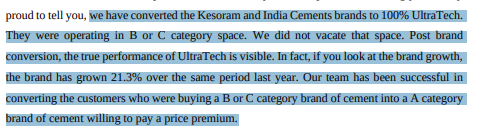
Ambuja pushed the same idea through its sales mix. Trade sales rose from 74% to 78% of total sales, while premium products now make up 34% of everything it sells through trade. To get there, it deliberately cut lower-margin non-trade volumes by 21% year on year, choosing to sell less cement overall so that the cement it did sell earned more money per tonne.
Shree, on the other hand, wants to get back to a 70:30 split between trade and non-trade sales, a mix it has spent years building. But this quarter, its mix actually moved the wrong way.

This is really a continuation of what we saw in Q4 FY26. UltraTech was already getting more out of its acquired plants after rebranding them. Ambuja’s trade share was moving up toward 74%, while Shree’s had fallen to a multi-quarter low.
Q1 only pushed those differences further. Cement demand itself was not the problem. UltraTech said industry demand grew 7–8% during the quarter, and all three companies described demand as healthy or stable.
The war made cement more expensive, just not equally
The West Asia tensions did not really hurt cement demand but made cement more expensive to produce. But even that hit showed up very differently across the three companies, depending on what fuel they had, how much they had stocked up, and what they could do to offset the higher costs.
Shree was hit the hardest. Cement plants need huge amounts of heat to make clinker, the hard intermediate material that is later ground and blended into cement. That heat usually comes from fuels like coal and pet coke. Pet coke is often preferred because it produces more heat and leaves behind less ash.
But pet coke shipments Shree had already contracted for did not arrive. So it had to switch heavily to coal. Pet coke’s share of its fuel mix fell from 54% to just 9%, while coal jumped from 32% to 81%.
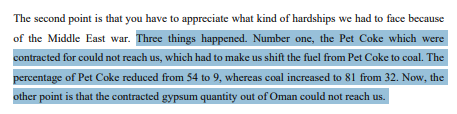
That switch affected more than just its fuel bill. Coal leaves behind more ash, which increased impurities in the kiln output. That limited how much cheaper blending material like fly ash or slag Shree could use in the final cement mix.
The result was more plain cement with less blending. That tends to be sold more through non-trade channels to large bulk buyers, where margins are usually lower.

And yet Shree is also the most confident that the worst is already behind it. Management expects things to improve in Q2, though that depends on something it obviously cannot control: calm holding in the Middle East and, in its own words, calm holding in the mind of the US President.

Ambuja also felt the war immediately. Management said it added about ₹110 to the cost of every tonne of cement it sold. But Ambuja found enough savings elsewhere to more than absorb that hit. It used more cheaper blending material, lowered power costs, and got more cement out of the same amount of clinker.
In fact, even after that extra ₹110, Ambuja’s overall cost was still ₹206 per tonne lower than a year ago. So the war made one part of its cost base worse, but the business as a whole still became cheaper to run.

UltraTech was in a different position because it never ran short of fuel. It did not have to change what it produced or push more cement into the lower-priced bulk market. It also used the quarter to build a one-month clinker and three-month coal buffer.
That does not mean UltraTech escapes higher costs. It mostly means the bill arrives later. Management expects costs to rise by ₹130–140 per tonne in Q2. But there is an important wrinkle here: UltraTech’s CFO also said this increase is not entirely because of the war. Costs normally rise in the July–September quarter anyway because of monsoon maintenance and lower plant activity.

There is one place where the war’s impact is much more direct: diesel. Industrial diesel went from about ₹80 a litre before the conflict to more than ₹150 during it.
UltraTech is already trying to reduce that exposure. This quarter, it started using electric trucks for mining and clinker transport. It also cut the average distance its trucks travel from 367 km to 360 km, with every kilometre trimmed saving roughly ₹2.5–3 per tonne.
So the war raised costs for everyone, but there was no single moment when the bill landed. Shree felt it through a fuel shortage that changed what it could produce. Ambuja took the hit but found enough savings elsewhere to offset it. UltraTech had enough fuel to push much of the pain into the next quarter. Same shock, very different quarter.
The profit number doesn’t tell the whole story
So far, we’ve looked at what these companies sold and what it cost them to make it. Put those two together, and you get to profits. But even there, the headline number can be misleading.
On an operating basis, Ambuja had a genuinely good quarter. Its cost per tonne fell, and its profit margin improved meaningfully. So, by the metrics management can actually control, Ambuja delivered.
And yet its net profit fell 34% year on year, for two reasons. First, it deliberately made and sold less cement. That meant less money coming in overall, even though it earned more on each tonne it sold.
Second, Ambuja now has Sanghi, Penna and Orient fully included in its accounts. That gives it a much larger base of plants and machinery, so the depreciation charge it records every quarter has gone up too. Put those together and the 34% fall makes sense.
UltraTech, on the other hand, is seeing the opposite play out. After the India Cements acquisition, the numbers look messy at first because of consolidation effects. But if you strip that out, the plants they bought are actually doing better than before. Operating profit per tonne has moved up from about ₹386 to ₹603 over the past few quarters. In simple terms, the assets they acquired are now earning more per tonne than they used to.
Shree’s case is different because there is no acquisition effect to blame. Its India volumes grew 17% year on year, which looks strong at first. But the price it earned on each tonne barely improved. The reason goes back to the fuel problem. Because Shree had to use more coal, it ended up producing more plain cement that gets sold to large buyers at lower prices.
So even though it sold much more cement, it did not make much more on each tonne. Across the full business, including the UAE, profit still fell about 17% year on year.
Conclusion
All three managements are effectively betting on the same outcome, that West Asia calms down and Q2 costs behave. But they disagree on timing, and that disagreement, not any one company’s specific guess, is the real story heading into next quarter.
There’s a quieter trend sitting underneath all of this. Every one of these companies spent Q1 preparing for the next shock, not just recovering from this one. Ambuja built up its fuel stock specifically to protect Q2. UltraTech put electric trucks on the road and cut its own dependence on diesel for good. Shree is banking on its old trade mix coming back once conditions settle down. None of that shows up in this quarter’s numbers. All of it is aimed at the next few.

What happens to the world when America’s R&D shrinks?
For decades, the United States government has been the single largest public funder of basic and applied research anywhere in the world. The National Institutes of Health (NIH), the National Science Foundation (NSF), NASA, the Department of Energ (DoE), the Department of Defence (DoD) — between them, these agencies have bankrolled the research behind everything from the internet and GPS to mRNA vaccines and the green revolution in agriculture.
But that system is now under threat. The Trump administration’s FY2027 budget request proposes cutting the NSF’s billion budget by more than half. This is despite their own Congress rejecting similar proposals for FY2026, or even proposing smaller cuts. But grants have already been cancelled or delayed, and federal science agencies lost roughly a fifth of their staff in 2025.
The domestic debate is about whether this weakens American competitiveness. But a new working paper from the Federal Reserve Bank of Dallas raises a different question: what happens to everyone else?
Why is this question worth asking? After all, isn’t American R&D meant to primarily benefit American industry?
Well, that’s the intention. But R&D spending is a curious thing. Its benefits are often heavily appropriated by the competitors of the company undertaking such an effort. R&D efforts are always highly risky, and if successful, their rewards, while outsized, come much, much later. But in the meantime, these efforts often create a lot of knowledge that other companies can make use of.
More so if the R&D is undertaken by public institutions that don’t have an immediate profit motive — because then that knowledge likely remains nearly free of cost.
The researchers study 69 foreign economies over 1980–2019, including India. The outcome they measure is total factor productivity (TFP), which refers to the output left over after you account for measured labour and capital inputs. Think of it as a proxy for how well an economy converts its resources into output: better technology, better organisation, better know-how.
The paper reconstructs every major change in US R&D appropriations across all five public agencies we mentioned above. They classify which changes were driven by politics, geopolitics, or scientific ambition rather than by the current state of the economy. By isolating away the responses to short-run cyclical economic conditions (like a depression), the authors can more credibly claim that what they’re measuring is the causal effect of American public R&D on foreign productivity.
The findings
So, what’s the headline finding?
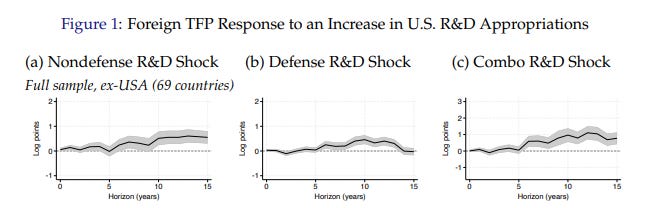
When US public R&D appropriations rise by an amount equal to 1% of the federal R&D capital stock, the average TFP across those 69 foreign economies gradually rises by about 1%, peaking roughly 12 years after the shock. This is a level change in productivity, not an annual growth rate. It builds slowly and persists.
But it’s the more nuanced findings that are more interesting.
When the authors split their sample into developed and developing countries, the estimated productivity response to an R&D shock peaks at roughly 1.8% in the 40 emerging economies. Among the original OECD economies (excluding the US), the peak is about 0.5%, and it eventually fades to zero. The non-OECD response is more than three times as large and far more persistent.
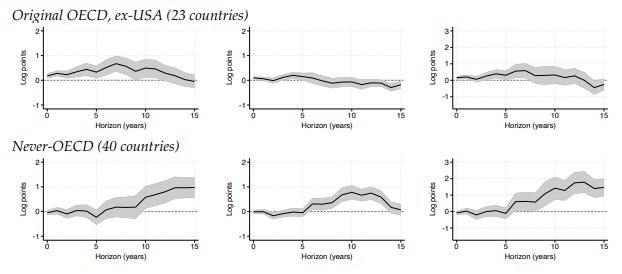
In other words, poorer countries seem to benefit more than richer ones from American R&D.
This can be a little counter-intuitive. One may think that you would need domestic research infrastructure to make use of someone else’s discovery. A country with excellent laboratories and many scientists should ideally be best placed to absorb an American breakthrough, like Germany, Japan or China.
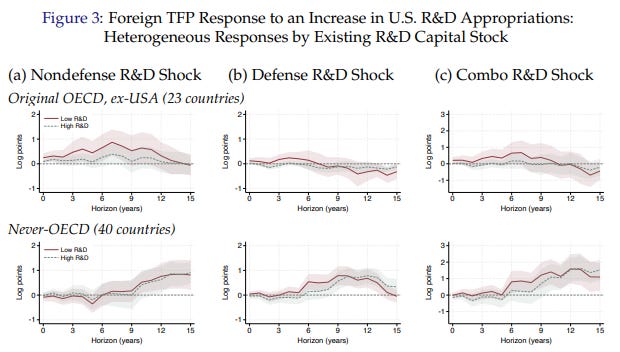
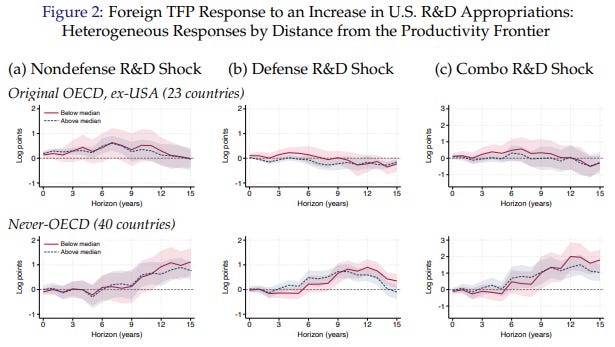
The paper finds the opposite, though. Countries with less research infrastructure, fewer scientists, and less existing intellectual property see larger or earlier productivity gains from US public R&D shocks. Even within the OECD itself, the below-median R&D countries drive the entire TFP response to R&D in sectors other than defense. Among non-OECD countries, the ones with less R&D infrastructure see productivity gains kick in sooner, though both groups eventually reach similar peaks.
The authors check for whether this is just a measurement artefact. You see, different countries use different vintages of the UN’s System of National Accounts, and in some older versions R&D investment isn’t separated from the productivity residual, which could mechanically inflate the TFP response.
But when they restrict the non-OECD sample to countries using modern accounting standards that properly separate R&D from the productivity residual, the response is actually larger than for countries on older standards.
Defence versus non-defence
Much of the US’ R&D efforts are directed towards defence. It is, of course, well-known that the US has a strong intertwining between its military and industry.
Which is why it is also worth splitting defence and non-defence R&D to see what happens. A stealth aircraft coating developed under a classified Pentagon contract stays behind security clearances for decades; the research that led to CRISPR gene editing, funded partly by NIH and NSF grants, was published openly and is now used in laboratories across the world.
Plus, defence R&D skews toward development of specific weapons systems (which is often highly classified) rather than fundamental research. Non-defence R&D, in contrast, produces published papers, new agricultural techniques, pharmaceuticals, industrial software, and tradable products that can become widely available.
The authors find that the foreign TFP response to non-defence R&D shocks peaks higher and persists far longer than the response to defence shocks. For non-OECD countries, the nondefence response rises sharply after about nine years, reaching roughly 1% by the end of the 15-year horizon. The defence response peaks earlier, around 0.8% after ten years, but then fades.
So, what channels are actually carrying American research to the rest of the world? The authors don’t have concrete answers here, but there are some plausible mechanisms.
First, openly accessible scientific content. For instance, when the Human Genome Project, which was funded largely by the NIH, published its results freely in 2003, it seeded genomics research worldwide. Any university with an internet connection could build on it. Papers, datasets, and methods from US-funded research created a foundation that foreign researchers and firms can apply without reproducing the original work.
Normally, the assumption is that making use of such open-source science requires having your own advanced labs and scientists to understand and apply it. But the paper’s findings actually challenge this idea. Because poorer countries with virtually no domestic R&D infrastructure see huge productivity gains, the authors suggest that U.S. R&D must be diffusing through channels that bypass the need for domestic R&D capacity entirely.
That’s where the second channel — knowledge embodied in traded goods — comes in. When an American agency funds research that eventually leads to a better CNC machine, and an Indian factory buys that machine, the factory becomes more mechanised, and therefore productive. But nobody in the factory needed to particularly understand the engineering.
However, the obvious callout here is that an emerging market like India becomes dependent on these imports. It has little domestic capacity of its own to make those machines. This isn’t always a bad thing: at least initially, developing nations do have to rely more heavily on imports of capital goods even to industrialise.
The last channel is leapfrogging. Economies further from the frontier have less legacy capital to discard, so they face lower transition costs when adopting new technology. For instance, much of Sub-Saharan Africa moved straight to mobile phones without first building out landline networks. Countries without established electricity grids are deploying solar with battery storage directly. When the US develops a new generation of technology, countries without sunk costs in the previous generation can adopt it faster.
Spillover benefits
The global social returns to US public nondefence R&D are roughly 1.8 to 2.2 times the domestic returns, depending on when you measure GDP shares. Put differently, the United States captures somewhere between 45% and 57% of the total productivity benefit of its own nondefence R&D investments.
America doesn’t “lose“ the foreign share, either, since knowledge used in Brazil or India doesn’t prevent an American firm from using it too.
A different paper by the same institution estimates that the domestic social returns to US nondefence government R&D run between 140% and 210%. The worldwide returns, meanwhile, could be even higher. As the authors put it — in what may be the paper’s most provocative line — US public R&D is plausibly among the world’s largest unintended development programmes.
There is one natural worry that surfaces in all this. Maybe when the US ramps up research spending, it simply pulls scientists and funding away from other countries. If American R&D crowds out foreign R&D, the productivity gains might be offset by weakened domestic innovation elsewhere.
The authors test for this directly. Among 23 OECD economies with usable R&D investment data, increases in US public R&D modestly incentivize more foreign private-sector and university R&D rather than displacing it. Foreign private R&D capital, in fact, is found to rise gradually. Government-performed R&D abroad shows no significant response in either direction. There is no evidence of the US poaching foreign scientists en masse.
What happens when that programme shrinks?
Now, what happens to the world when you alter a programme like this?
The FY27 White House budget has proposed to raise defence R&D authority from roughly $83 billion to $217 billion while cutting nondefence R&D from about $89 billion to $67 billion. A budget that shifts the mix toward classified, defence-oriented work and away from open civilian science would, based on this paper’s findings, shrink the channel through which American R&D has historically raised productivity abroad.
At the same time, official development assistance, or aid, fell 23% in real terms in 2025 — the largest annual decline on record. American aid fell nearly 57%.
All of this tracks generally with the US turning inward and inching away from globalisation. It is kickstarting trade wars just so that it can reshore manufacturing within its borders. The Trump administration has repeatedly accused developing nations of “ripping off America and its taxpayers”. At the same time, it is preparing for those trade wars to potentially turn into a real war.
The uncomfortable implication of this paper is that the countries estimated to gain most from open American science may be least able to replace it if that source weakens. No country can duplicate every laboratory and body of expertise. Even India’s Economic Survey warns that insulation alone cannot produce resilience. The goal is domestic capability without severing global connections, but the global connections are fraying just as the domestic capability remains thin.
Tidbits:
1. ₹20,000 Crore Credit Guarantee Plan Misses the Mark
Banks have disbursed a mere 17% of the funds allocated under the ₹20,000 crore credit guarantee scheme. Loan sanctions remain sluggish as lenders continue to exercise extreme caution when dealing with smaller borrowers.
Source: The Economic Times
2. RPSG Group to Acquire ReNew Solar Assets for ₹4,859 Crore
The RP-Sanjiv Goenka (RPSG) Group is acquiring a 1.4 GW operational solar portfolio from ReNew Solar Power to rapidly scale its footprint. This massive deal will significantly accelerate the conglomerate’s ambition to build a 10 GW renewable energy platform over the next few years.
Source: Financial Express
3. Tractor Sales Hit Record High in July Despite Monsoon Risks
Domestic tractor sales unexpectedly surged to a record high in July, defying widespread concerns over a weak monsoon and the looming threat of El Niño. The strong demand suggests underlying resilience in the rural economy and robust agricultural support.
Source: Business Standard
4. BSE Replaces Wipro in Nifty 50 Index Rebalance
In the latest semi-annual Nifty 50 index reshuffle, the Bombay Stock Exchange (BSE) will be added to the benchmark, replacing IT major Wipro. This major rejig reflects shifting market valuations and is expected to drive significant passive fund flows into the exchange’s stock.
Source: ET Now
5. Ethanol-Blended Diesel Fails Crucial Safety Tests
Plans to blend ethanol with diesel have hit a major roadblock as the mixture failed key safety tests due to a sharp, dangerous drop in its flash point. This technical hurdle raises severe fire risk concerns, forcing oil companies to rethink their strategy for blending renewables into commercial diesel.
Source: The Economic Times
6. Unemployment Rate Rises to 4-Quarter High of 5.4%
India’s urban unemployment rate climbed to a four-quarter high of 5.4% in the first quarter, signalling ongoing stress in the job market. The data highlights a slowdown in urban job creation, particularly impacting younger job seekers, despite overall economic growth.
Source: Financial Express
- This edition of the newsletter was written by Vignesh and Bhuvan
Beyond Today’s Brief
There’s always more happening at Markets by Zerodha.
The Chatter: What is driving SBI’s expansion into new corporate lending segments like M&A financing? How is Delhivery expanding its freight yields while steering clear of quick-commerce last-mile delivery? And can Titan, Hitachi Energy, and Apollo Micro Systems navigate commodity and geopolitical headwinds to sustain their growth momentum?
Points & Figures: What do India’s factories tell us about the trade-off between jobs, capital and value creation? Why are large factories generating most of the value while contract labour takes a growing share of employment? And what does it take to build a deeper industrial base?
Aftermarket Report: Why did renewed crude oil concerns and Strait of Hormuz uncertainties drag Nifty back below the 24,500 mark? How do continuous two-sided auctions, order books, and aggressor trades actually drive stock price movements under the hood? And how did Zydus Lifesciences rally over 6% to lead top gainers despite reporting a 36% drop in quarterly net profit?
Watch Tharun on YouTube: If you’re interested in what’s actually happening with AI and how you can use it to make better money decisions, check out Tharun’s new YouTube channel.
Join us on WhatsApp, where we share interesting soundbites from concalls, articles, and everything else we come across throughout the day. You’ll also get notified the moment a new video or article drops so that you can read or watch it right away.
Thank you for reading. Do share this with your friends and make them as smart as you are 😉