

Our goal with The Daily Brief is to simplify the biggest stories in the Indian markets and help you understand what they mean. We won’t just tell you what happened; we’ll tell you why and how too. We do this show in both formats: video and audio. This piece curates the stories that we talk about.
You can listen to the podcast on Spotify, Apple Podcasts, or wherever you get your podcasts and watch the videos on YouTube. You can also watch The Daily Brief in Hindi.
In today’s edition of The Daily Brief:
India’s airlines try to fix their radar
India’s airlines are pursuing very different survival strategies, from aggressive expansion and long-term turnarounds to debt restructuring, as they navigate an industry where sustained profitability remains elusive.A front-running case and some funny phone calls
A recent SEBI order uncovers how brokers front-ran LIC’s trades by simply overhearing dealing desk conversations, exposing how weak operational controls, not sophisticated hacking, can enable market abuse.
If you’re new to investing or have recently opened your account with us, we are hosting a Varsity Live session for you, where we’ll do an interactive walkthrough of all our platforms and show you how to make the most of your Zerodha account.
Date: Friday, 31st July | English session: 11:00 AM | Hindi session: 4:30 PM
India’s airlines try to fix their radar
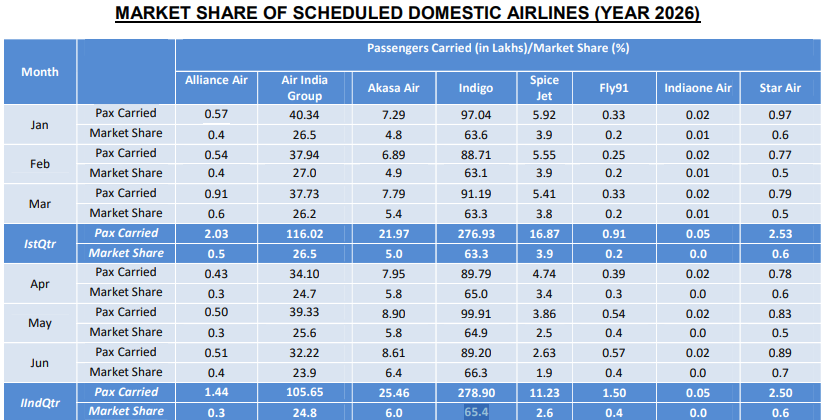
We have been covering Indigo’s results every quarter, and this time was no different. Even though they roughly carry two of every three domestic passengers in India, they still ended up losing money last quarter. They reported a net loss of about ₹238 crore for Q1 FY27, even as they hold nearly 65% share of the domestic market.
The history of the aviation industry is littered with bankruptcies. Kingfisher grounded itself in 2012. Jet Airways shut down in 2019 after years of unpaid dues to lessors and staff.
So, if the strongest airline is bleeding, it’s worth looking at the rest of the field today, which is hardly short on drama.
One private airline has been adding aircraft despite losses that continue to grow. One listed airline is watching its lessors file paperwork with the regulator to take back their planes. And one decade-old turnaround just got handed a longer clock by its own chairman. And on top of that, India’s largest airport operator was involved in a rumor that entailed its own entry into the airline business.
That’s what we’ll be making sense of today.
The high-flying Akasa Air
We’ll start with the one growing the fastest. Akasa Air is nearly four years old and still losing money every year, but it is showing no signs of stopping.

In November 2021, Akasa had initially placed an order for 72 Boeing 737 MAX aircraft. Then, it added four more in June 2023, and in January 2024 placed a follow-on order for 150 more, bringing the total order count to 226. These are all binding orders, where Boeing has to build and deliver the plane, and Akasa has agreed to pay for it.
Only a fraction of those planes have actually landed though: the fleet size only reached 40 aircraft as recently as July 2026. Akasa aims to get the remaining 186 aircraft by 2032.
While the airline is still losing money, it requires a massive amount of capital from somewhere to fund the growth it has planned. It raised fresh equity from Premji Invest, Claypond Capital and funds managed by 360 ONE Asset recently. The family estate of legendary investor Rakesh Jhunjhunwala also committed additional capital.
The math for climbing out of the loss column was laid out by chief financial officer Ankur Goel, who said Indian airline capacity is growing about 6% a year while demand is growing around 15%. If demand keeps outpacing capacity, airlines may get room to improve load factors and fares. It could, as per Goel, help revenue per seat rise enough to cover operating costs and make Akasa operationally profitable.
But so far, that’s easier said than done. Akasa’s standalone net loss widened from ₹1,670 crore in FY24 to roughly ₹1,983 crore in FY25 even as unit costs and revenue per seat both improved. Of course, over time, this will only get harder as aircraft depreciation has to be factored in. The profit also depends on the costs of fuel imported from abroad, on which front Indian airlines faced a severe crunch this quarter.
Why is SpiceJet still grounded?
Now, we move on to an airline whose best days are well behind it.
SpiceJet is a listed company. But unfortunately, they still haven’t filed their results in: not just for Q1 FY27, but also, somehow, Q4 FY26.

This was not the first time they have delayed filing quarterly results. How do we know this? Well, there is a penalty for the delay in filing, and Spicejet had been fined ₹271,400 by SEBI for a delay of 93 days in submission of audited financial results for the quarter ended March 2022. We get to see something like this very rarely.
Obviously, SpiceJet faces the uphill, almost-impossible task of turning around. But its biggest problem isn’t that, but rather an active, dated dispute.
The DGCA’s public filings show four IDERA requests dated 13 July 2026 covering four SpiceJet aircraft. IDERA stands for “Irrevocable Deregistration and Export Request Authorisation”. It’s essentially a pre-approved right for the lessor that guarantees that, if the airline defaults, the lessor doesn’t need to fight a fresh legal battle, it can go straight to the regulator and ask for the plane back. Airlines sign this document upfront, as part of the lease deal itself, well before any trouble starts.
SpiceJet says the four planes have sat grounded for a long stretch over engine problems. They kept paying rent on these planes the whole time they sat idle doing nothing. So when the lessors moved to take them back, the airline didn’t fight it. Losing four planes that weren’t flying anyone, but were still costing money every month, is a saving for SpiceJet, not a loss.
Filing an IDERA used to be the easy part. Actually getting the plane back was the fight.
In our primer on how aircraft leasing works in India, we had mentioned that the industry is globally governed by the Cape Town Convention. India signed it back in 2008, but never fully wrote it into domestic law. So that effectively meant courts did come into the picture. Claims by lessors on the aircraft of defaulted airlines had to be sorted case by case, sometimes for years. Lessors ran into exactly this problem during the Jet Airways and Go First collapses.
A new law in 2025, the Protection of Interests in Aircraft Objects Act, gave the Cape Town Convention direct legal force in India, so DGCA can now act on an IDERA request on its own without needing to fight it out in court first.
The same law also set a hard two-month deadline, but only for airlines going through insolvency, requiring the aircraft returned or the default fixed within that window. That specific rule doesn’t apply here, because SpiceJet isn’t (yet) in insolvency.
SpiceJet’s financial results provide broader context for the dispute, showing continuing losses and a large grounded fleet rather than a lack of demand. The most recent same-source snapshot available is from its investor presentation of Q1 FY26, showing 56 aircraft in the fleet with only 21 operational — meaning 35 were grounded. Those numbers for July 2026 are, of course, not available.
In Q3 FY26, SpiceJet reported a consolidated net loss of ₹261.38 crore, attributed to grounded fleet costs, higher fuel prices, rupee depreciation and a one-time labour law impact, even as domestic market share rose to 4.3% from 1.9% three months before. SpiceJet has also worked through multiple lessor settlements, including a $121.18 million lease-dues restructuring with Carlyle Aviation Partners.
Can Tata’s decade-long bet pay off?
Now, we come to the airline closest to IndiGo in competition, going through a long-standing turnaround itself.
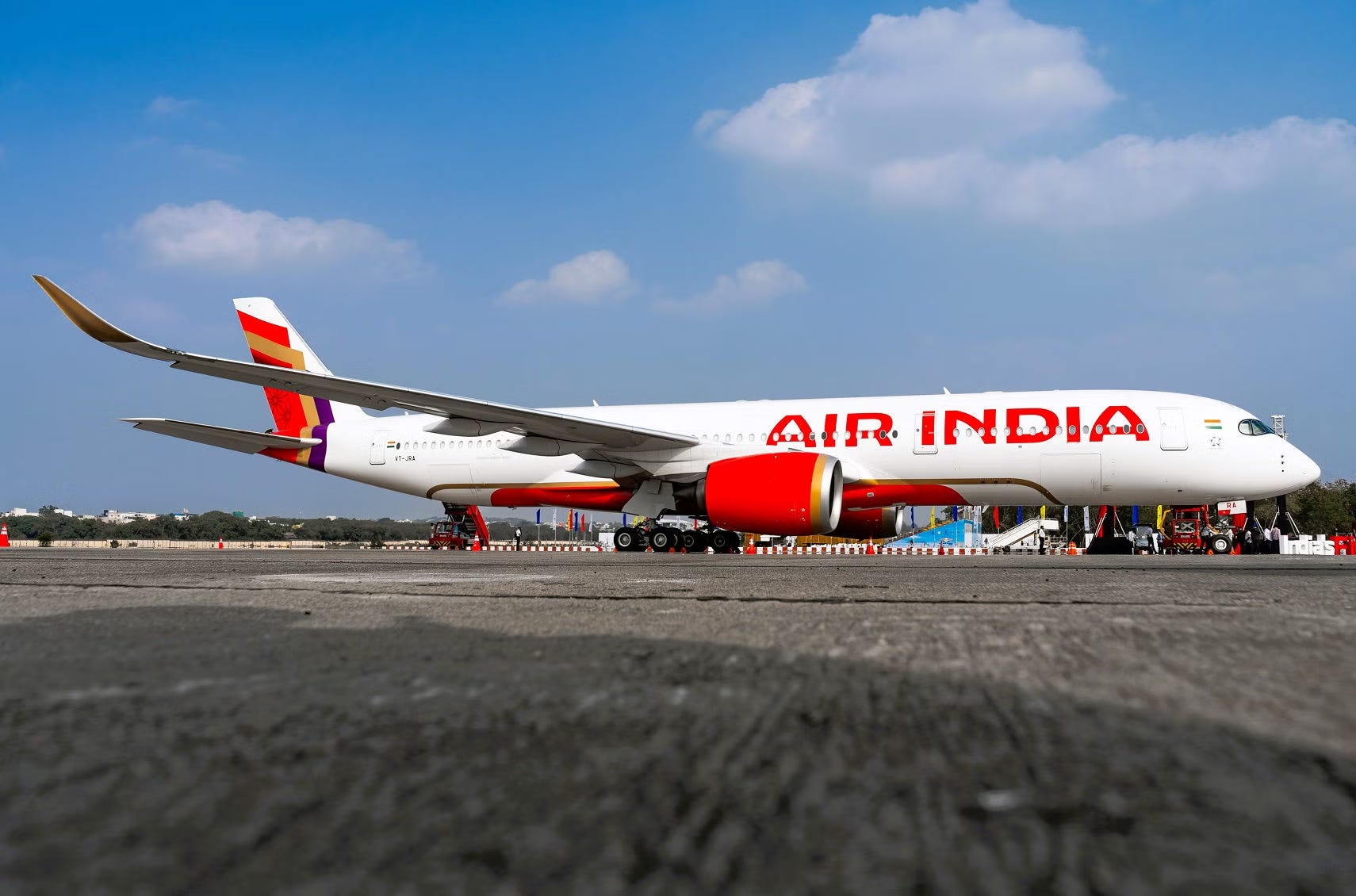
Air India was acquired by Tata Sons in 2022. Since then, Tata has merged Air India with Vistara and merged Air India Express with the group’s other budget carrier, leaving two brands instead of four. Air India now handles full-service and international flying, while Air India Express covers low-cost and shorter-haul routes.
They have a large order book. Air India placed firm orders for 220 aircraft with Boeing in 2023, and added 30 more in January 2026, taking its Boeing order alone to 250 aircraft, on top of a separate Airbus order that now runs to 350 aircraft after 100 more were added in December 2024. Its mainline fleet stood at 185 aircraft as of 18 June 2026, not counting Air India Express. Air India financed its first A350-900 through GIFT City, which India is trying to convert into a global aircraft leasing hub that can compete with Ireland and Singapore.
The turnaround has a longer runway than originally promised. N Chandrasekaran, who chairs both Tata Sons and Air India, wrote in his message to shareholders that Air India’s transformation should be seen as a five-to-ten-year journey, given the airline’s condition at takeover, prolonged supply-chain disruption, and the scale of rebuilding a technical workforce from scratch.
Interestingly, in 2022, Air India had launched a 5-year transformation program called Vihaan.AI. It aimed to reach 30% market share by 2027, while putting the airline on a path to sustained profitability. However, this month, while IndiGo reached an all-time high of 66.3% domestic market share, Air India slipped from 27% in February to 23.9%.
It is certainly not going to be an easy job to come back into Air India’s past glory days. Air India and Air India Express together posted a combined net loss of ₹22,238 crore for the year ended March 2026, more than double the ₹10,859 crore loss the year before.
Davids, meet Goliath
Beyond all this, one more name seems to be circling Indian aviation.
Last week, Adani Airport Holdings had written to the government seeking relaxation of the rule capping an airport operator’s stake in a scheduled airline at 10%. With the relaxation of this change, an Adani subsidiary would have been allowed to open its own airline: the letter naming Adani Defence & Aerospace as the group entity evaluating airline entry. Reuters separately reported that Adani was deciding between a new airline launch or a stake in an existing one.
But, the next day, Adani Enterprises, the flagship entity of the Adani Group, denied these rumors in an exchange filing, calling the reports “entirely baseless and factually incorrect“. It was “not evaluating any proposal to enter the airline business”.

Cross-ownership between airport operators and flag carriers is rare, but not unusual. But in most cases where this exists, the government is the owner. The Doha airport’s operations and commercial functions are managed by MATAR, a corporate subsidiary of Qatar Airways, under agreement with Qatar’s civil aviation authority. Temasek Holdings, the Singapore government’s investment arm, owns both the Changi Airport and Singapore Airlines.
Conclusion
Each of these carriers, IndiGo included, is relying on a different source of financial patience. Akasa has private investors and lessor financing betting the unit economics turn before the losses do. SpiceJet is trying to restore grounded aircraft and settle creditor claims while it keeps raising fresh capital. Air India’s bet is really Tata Sons’ patience, a conglomerate absorbing a decade of losses on the promise of a flag carrier the chairman says the country deserves.
And Adani, despite denying any plan to enter the airline business, already runs a large piece of Indian aviation from the ground up. It operates eight airports including Mumbai and Ahmedabad, so it sits closer to the industry than a company with no scheduled flights might suggest.
Indian aviation has always run on someone else’s magnanimity, whether that’s family capital, institutional investors, a state-backed conglomerate, or a large infrastructure group. But, much like the margins in this business, patience can run thin in an industry where existence is purgatorial.

A front-running case and some funny phone calls
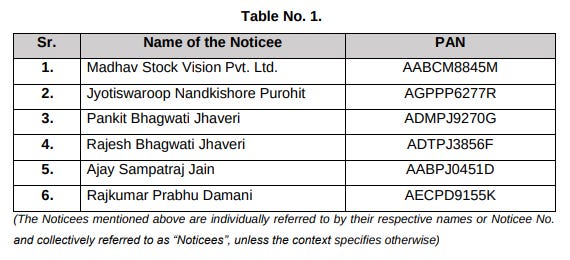
Last week, SEBI issued a final order against a Mumbai-based stockbroker called Madhav Stock Vision Pvt. Ltd. (MSV) and five individuals connected to it. They have been accused of front-running trades of the LIC — the country’s largest institutional investor, managing the savings of over 30 crore policyholders — for 3.5 years.
For those unfamiliar, front-running is when a market participant (like a broker) uses non-public, confidential knowledge of a transaction that they know is coming but hasn’t taken place yet. If you somehow get to know LIC is about to buy a massive block of, say, Bajaj Auto shares, you buy first, wait for LIC’s order to move the market, and sell into the rally. The difference is your profit.
It’s a form of market manipulation, and therefore illegal. And it’s a direct tax on the institution whose orders are being exploited.
Front-running cases come up routinely, especially against brokerages who gather information about their clients. But this one’s unique because of how the information was obtained. There was no insider at LIC leaking order details, nor was there a sophisticated cybersecurity attack or data breach.
The information was gathered in the most old-fashioned way: by sitting close enough to overhear phone calls.
Chinese walls
Before we get to the phone calls, understanding how LIC executes its trades is key to the story.
See, LIC doesn’t trade directly on the stock exchange. It routes orders through empanelled stockbrokers, which are authorised to receive LIC’s buy and sell instructions and execute them on the exchange. LIC would send an email to the broker with the order details: which stock, how many shares, the limit price. The broker’s dealer would then call LIC’s dealer to confirm, and punch the order into the trading terminal.
Now, three of LIC’s empanelled brokers: Bhagwandas Gordhandas Financial (BGF), Jamnadas Virji Shares (JVS), and Santosh Kumar Kejriwal Securities (SKS), all operated their dealing desks from the same office in the same building in Malad, Mumbai.
Two of the people at BGFPL’s desk were Jyotiswaroop Purohit and Pankit Jhaveri. Their job was to place LIC’s orders through BGF. But because the other brokers’ desks were right next to them, they could also hear what the Jamnadas and Santosh Kumar dealers were discussing with LIC’s dealers. They had a window into LIC’s exact order flow across multiple brokers, which they shouldn’t have had.
And even if they did, they shouldn’t have used it to their advantage. But they did. That’s where Madhav Stock Vision (MSV), a brokerage with no connection to LIC, enters the picture.
Purohit and Jhaveri would pick up the phone and call Rajesh Jhaveri, a dealer at Madhav Stock. Sometimes they’d call Ajay Jain, one of MSV’s directors. The message they relayed was what they weren’t supposed to leak: that LIC is about to buy X shares of Y stock at Z price. MSV would buy first in its proprietary account, wait for LIC’s order to hit the market, and sell when the price bumps up. On days when LIC was selling, they’d reverse the sequence by selling first, waiting for LIC’s sell order to push the price down, then buying back cheaper.
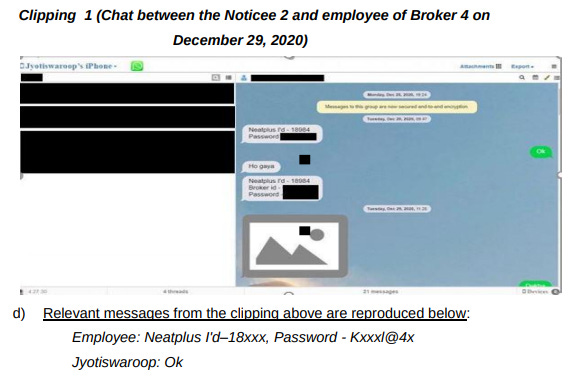
A fourth broker, Kaushik Shah Shares and Securities (KSS), was also involved in the early period. LIC used to send order details to KSS by email. An employee of the firm shared his trading terminal credentials (login ID, broker ID, and password) with Purohit over WhatsApp. SEBI’s order reproduces the chat. This gave Purohit direct access to the order emails LIC was sending to yet another broker.
“Tell me, mother”
The evidence SEBI gathered is remarkably granular, and, in parts, hilarious.
The investigation was triggered by SEBI’s internal alert system, which flagged suspicious patterns in Madhav Stock’s trading. Search and seizure operations were conducted at the noticees’ premises in December 2023. What SEBI found included call data records, recorded phone conversations, WhatsApp chats, bank statements, and statements under oath.
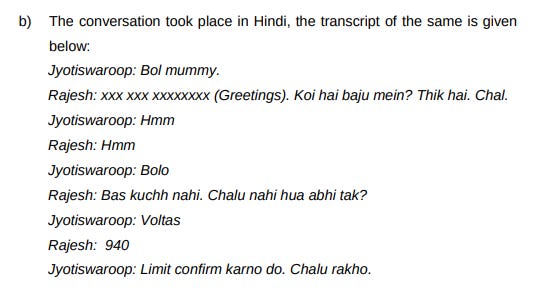
One such call transcript would probably elicit laughter from Hindi speakers. Purohit calls Rajesh Jhaveri at MSV. The call opens with Purohit saying “Bol mummy“ (“tell me, mother”), where he’s pretending to talk to his mother because someone is sitting next to him. Once they ensured that the coast was clear and no one could hear them, both of them get down to (dirty) business.
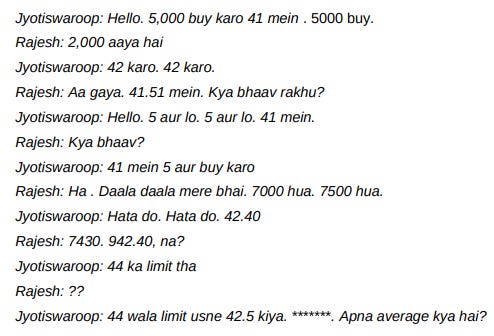
Purohit tells Rajesh that the other broker’s dealer has received an email from LIC to buy Voltas shares. He waits for that dealer to call LIC’s dealer to confirm the limit price. As the confirmation call happens — literally at the same time, within earshot, since Purohit could overhear the other brokers — Purohit relays the exact details to Rajesh. While the email limit was ₹944, it’s just been revised down to ₹942.50 on the phone call. Rajesh starts buying.
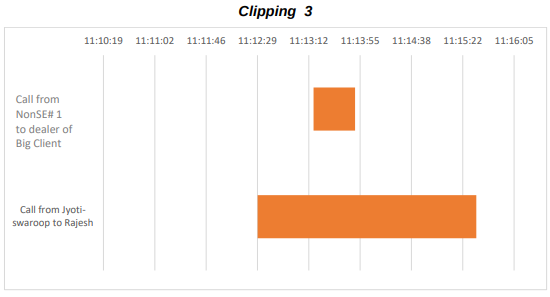
SEBI’s order includes a timeline showing the call between the other broker’s dealer and LIC’s dealer, and the call between Purohit and Rajesh, simultaneously. Purohit was eavesdropping on one conversation in real time while dictating trades on the other.
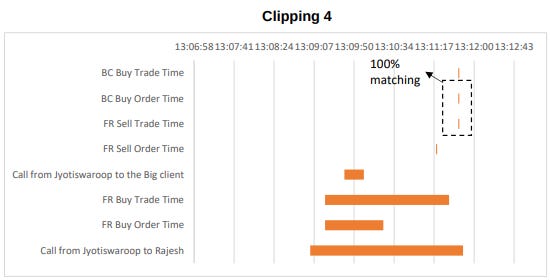
In another instance, in April 2021, LIC wanted to buy 12,800 shares of Bajaj Auto at ₹3,515 through Bhagwandas. Purohit had executed the order himself, so he knew the details directly. He called Rajesh at 1:09 PM and told him the terms of the trade. Rajesh immediately started buying 3,000 shares at an average price of ₹3,505.86.
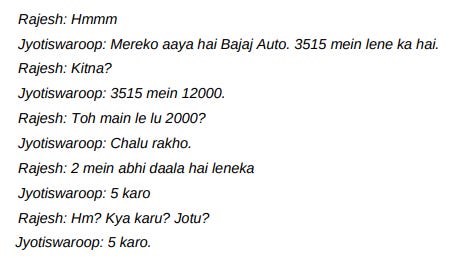
Then Purohit, still on the call with Rajesh, dialled LIC’s institutional dealing desk to confirm the order. Rajesh could hear that call too, and constantly confirmed the limit to Purohit on each block of the trade he executed.
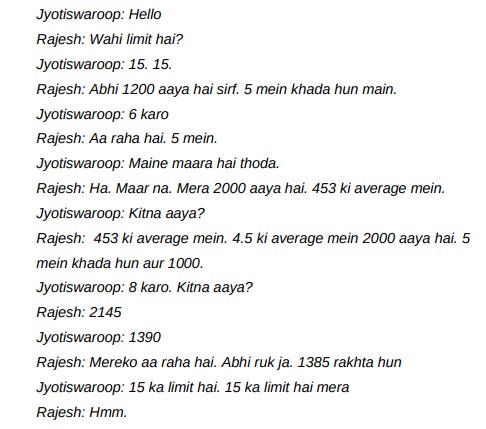
Once the limit was confirmed, LIC’s order of 12,000 shares hit the market at 1:11 PM at an average of ₹3,513.48. MSVPL’s sell order of 3,000 shares at ₹3,513.85 matched with LIC’s buy order to the extent of 100%. The profit on that single trade was ₹23,986. The entire sequence from the tip to the buy to the sell happened in under three minutes while Purohit and Rajesh were on the same phone call.
The 75-25 split
The profits from these trades accrued in Madhav Stock’s proprietary trading account. But the people running the scheme needed to distribute the money. As per Rajesh Jhaveri’s statement made under oath, 75% of the profits went to Purohit and Pankit Jhaveri (the two information carriers at Bhagwandas), and 25% went to Rajesh Jhaveri himself.
If the profit arrangement was straightforward, the method of distribution was less so. Madhav Stock’s directors, Ajay Jain and Rajkumar Damani, showed family members of the participants as employees of the firm and paid them monthly “salaries“ through bank transfers. SEBI found regular monthly payments from MSV’s bank account to Rajesh Jhaveri and to the accounts of family members of Purohit, Pankit Jhaveri, and Rajesh.
SEBI’s order reproduces a recorded conversation between Rajesh and director Rajkumar Damani negotiating exactly this. And yet again, for Hindi speakers, this exchange is laugh-out loud. There are sections of the transcript that SEBI has starred out, perhaps because you may be able to fill in the blanks with some Hindi expletives 🙂
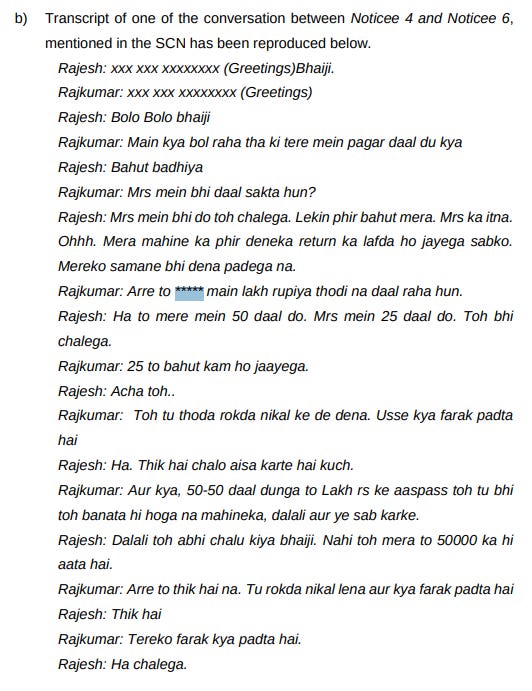
Rajesh calls Damani, who asks if he should put Rajesh on the payroll. They settle on ₹50,000 per month for Rajesh and ₹25,000–50,000 for his wife. Damani does the maths in Hindi: “If I put 50-50 thousand, it’ll be 6 lakhs for the year. It won’t attract much tax.” They agree, and Damani “starts his payroll” from July.
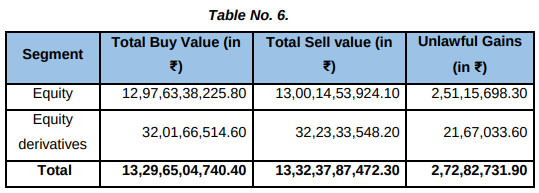
Over the full investigation period, from April 2020 to December 2023, SEBI identified nearly 1,700 instances of front-running in the equity cash segment, spread across 754 trading days. The gross traded value of these front-run trades was about ₹2,600 crore. But the total profit was modest: ₹2.51 crore, or roughly ₹1,500 per instance. This was a low-margin, high-frequency operation, relying on the sheer volume of LIC’s order flow.
Admit a little, dispute a little
After SEBI raided their premises in December 2023, the noticees cooperated. They gave detailed statements under oath. They tried to settle — filing three separate settlement applications with SEBI. The first two were returned because the investigation was still ongoing. The third was withdrawn because the settlement terms SEBI proposed were, in the noticees’ words, “beyond the means available“.
Interestingly, before the show cause notice was even issued, the accused deposited ₹2.73 crore — the full amount SEBI had calculated as unlawful gains — into an interest-bearing account with a lien marked in SEBI’s favour. By the time the SCN was issued in April 2025, the account had grown to ₹3 crore.
Their legal defence was carefully calibrated. All six noticees admitted that the equity cash segment trades “may have been executed in a manner which, when viewed in hindsight... are construed as front running.” But they drew a line at the futures and options segment, arguing that their F&O trades showed no timing correlation with LIC’s orders and were purely intraday activity. This partial defence worked: SEBI’s adjudicating officer accepted the argument and excluded ₹21.67 lakh of F&O profits from the disgorgement amount.
Madhav Stock, the corporate entity, tried a more ambitious defence. It argued that a company can’t be held liable when the front-running was carried out by individual employees acting on their own. The directors claimed they had no knowledge of the scheme. SEBI rejected this comprehensively, since all trades made full use of Madhav Stock’s trading infrastructure.
The final penalty
All six noticees were banned from the securities market for one year. They had to disgorge over ₹2.5 crore, plus 12% simple interest from December 2023 to April 2025. Each of them also had to pay a penalty of ₹5 lakh each, which is the statutory minimum under Section 15HA of the SEBI Act. The maximum penalty could have been ₹25 crore or three times the profits. SEBI went with the floor, citing the noticees’ cooperation, clean prior record, voluntary deposit, and candid admissions.
This isn’t the first time LIC’s trades have been front-run. In 2023, SEBI barred five entities, including an LIC employee, in a separate front-running case involving ₹2.44 crore in illegal gains. In 2024, SEBI confirmed the ban. The methods differ, but the target is the same: LIC’s massive order flow.
This was genuinely a unique case. The dealing desks at the building in Malad weren’t separated by walls, or access controls, or any physical barrier. They were separated by a few feet of office space. Anyone sitting at one desk could hear what was being said at the next.
Tidbits
1. New Bill Aims to Speed Up MSME Payments. The Indian government has introduced an amendment to mandate that central public sector units clear payments to small businesses strictly through certified discounting platforms. The bill also establishes specific timelines to drastically cut down on delayed payments and speed up dispute resolution for struggling MSMEs.
Source: Livemint
2. Zepto Halves IPO Valuation After Investor Pushback. Quick commerce startup Zepto has slashed its targeted IPO valuation to $3 billion less than half of its previous $7 billion private valuation. The massive price cut comes after large domestic mutual funds and institutional investors pushed back, arguing against pricing the grocery delivery app like a larger, full-scale food delivery firm.
Source: Financial Express
3. India Wastes 8,100 GWh of Solar Power Amid Grid Issues. Between April and June, India was forced to hold back over 8,100 gigawatt-hours of generated solar power because the national power grid couldn’t absorb it. This massive loss of clean energy, equivalent to 1.5 days of the country’s total power consumption, highlights severe bottlenecks in India’s electricity transmission infrastructure.
Source: Reuters
4. Government Imposes Stock Limits on Sugar Dealers. To prevent artificial scarcity and control rising prices ahead of the festival season, the government has ordered sugar dealers to hold no more than 4,000 quintals of stock at any time. Dealers are also barred from holding any stock for more than 30 days to stop hoarding and speculative trading.
Source: Business Standard
5. India Sees Highest Q1 Smartphone Exports by Value. Driven largely by a massive surge in Apple iPhone shipments, India recorded its highest-ever first-quarter smartphone exports by value this year. This milestone underscores the country’s rapid rise as a major electronics manufacturing hub and a viable alternative to China in global supply chains.
Source: Business Standard
- This edition of the newsletter was written by Vignesh & Manie
Beyond Today’s Brief
There’s always more happening at Markets by Zerodha.
The Chatter: Why is BEL betting big on Project Kusha? Why is HUL turning cautious on demand? And what does L&T see in India’s private capex cycle?
Aftermarket Report: How did Indian markets brush aside weak global cues? And why did IT stocks lead yesterday's rally?
Subtext: Sagar Lele breaks down how professional analysts read quarterly results and separate the signal from the noise.
Points & Figures: Is India getting healthier? Why are Indians eating less rice and dal, but more packaged food?
Join us on WhatsApp, where we share interesting soundbites from concalls, articles, and everything else we come across throughout the day. You’ll also get notified the moment a new video or article drops so that you can read or watch it right away.
Thank you for reading. Do share this with your friends and make them as smart as you are 😉