

Our goal with The Daily Brief is to simplify the biggest stories in the Indian markets and help you understand what they mean. We won’t just tell you what happened; we’ll tell you why and how too. We do this show in both formats: video and audio. This piece curates the stories that we talk about.
You can listen to the podcast on Spotify, Apple Podcasts, or wherever you get your podcasts and watch the videos on YouTube. You can also watch The Daily Brief in Hindi.
Rainmatter Originals is our new series profiling entrepreneurs who are taking the long road and doing things differently. We’re kicking things off with the story of Shashi and Akshayakalpa—and the sweat, patience, and organic farming vision behind building a different kind of company.
Watch the full story: The Akshayakalpa Story
In today’s edition of The Daily Brief:
Story: A 40-year old battle over India’s minerals hits a climax
Why did the Centre pass the MMDR Amendment Bill, 2026? By stripping states of mineral taxing powers, the law neutralizes a 2024 Supreme Court ruling and shields mining giants from massive retroactive liabilities. Yet while the Centre aims for a uniform, investment-friendly tax regime, the move triggers a major constitutional clash with states—all without solving core bottlenecks like poor geological data, weak infrastructure, and delayed clearances.
Chart: How China became the world’s factory
While India jumped straight to building a services economy like IT, China created an unmatched industrial ecosystem powered by cheap land, subsidized credit, and strategic WTO integration. Despite India’s recent push to boost electronics exports through infrastructure and subsidies, complex regulations and a highly fragmented manufacturing base still leave an enormous gap.
We’re trying out something new
With each episode, instead of two stories, we’re trying one longer story. Along with that, we will have one chart created by our team, and some extra tidbits. We’d love to hear feedback and suggestions from you on what you feel about this format.
A 40-year old battle over India’s minerals hits a climax
Last week, the Lok Sabha passed the Mines and Minerals Development and Regulation (or MMDR) Amendment Bill, 2026. This may have been business-as-usual, but it was passed in just about ten minutes. There was basically no debate — it was introduced through voice vote while opposition members were protesting other political issues. The Rajya Sabha cleared it a day later.
The passing of the Bill has left many people, particularly the leaders of state governments, unhappy. They have accused the Bill of being in opposition to federalism, one of the key tenets of India’s Constitution, by taking away the independence of India’s individual states. They plan to challenge it in court.
What did the Bill do that created so much uproar? At its core, it took away states’ ability to tax their own mineral resources. States no longer have any power to levy taxes, cesses, or any other charges on minerals, except only under conditions the Centre prescribes. Moreover, any unpaid dues from past state-level mineral taxes have been forgiven. Only amounts already collected are safe from reversal.
This swing of financial power of Centre and States is not new to India. This particular case is the climax of a nearly 40-year-long legal and political battle. It has ping-ponged between the Supreme Court and Parliament, put thousands of crores of rupees’ worth at risk, and now sits at the heart of a clash between India’s mineral sovereignty and federalism.
Royalty or tax?
So, without further ado, let’s roll the clock back all the way to 1989.
Back then, India Cements held a mining lease in Tamil Nadu. Under the central MMDR Act of 1957, it paid a royalty to the state government for every tonne of mineral it extracted. The royalty rates are fixed by the Centre. This is a standard practice where you pay the landowner (in this case, the government) for the right to dig.
But the Tamil Nadu government had gone a step further. It levied a cess on top of that royalty. There was a state law that allowed them to charge 45 paise per rupee of land revenue. This land revenue was calculated based on the royalty rates.
India Cement challenged this, arguing that they were effectively being double-taxed for the minerals they dug up. After all, the royalty itself was based on the quantity of minerals extracted, so any cess calculated on that royalty was, ultimately, a tax on minerals. And under the Constitution, the Centre, not the states, controlled mineral taxation through the MMDR Act.
A seven-judge bench of the Supreme Court agreed with India Cement. It ruled that the cess be removed. But in doing so, the judges wrote something fateful in their order: “royalty is a tax“.
Now, remember, this is not the same as treating royalty as a contractual fee for using land. You pay royalties or rent because you’ve agreed to a lease. But by declaring royalty itself to be a tax, the Court had effectively killed states’ power to charge anything at all on top of centrally fixed royalties. Even private landowners can charge royalty, but only a government can charge a tax. The two are fundamentally different things.
That is the debate at the heart of this saga: how is a royalty different from a tax?
The law of the land
State governments felt slighted by the fact that they couldn’t benefit from the minerals within their own borders. But they didn’t sit still, either. They were determined to find a new way to extract those benefits. So, several mineral-rich states passed new local laws that targeted the land that bore minerals, rather than the minerals themselves.
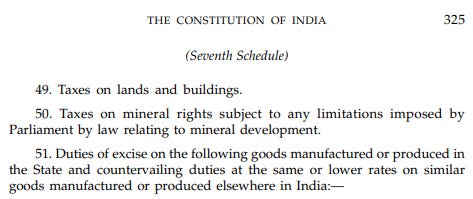
Why could they do this? Well, land is exclusively a state subject under the Indian Constitution. There is a rule (Entry 49) that gives states full power to put taxes on land and buildings. That would, of course, also apply to land that contained lots of minerals, even if the monetary value of that land was based on the minerals themselves.
Mining companies saw through this immediately. For instance, in 1999, SAIL filed a case against the state of Bihar, arguing that a tax on land that was calculated on the basis of the minerals underneath was, yet again, just a tax on minerals. The Mineral Area Development Authority, or MADA, representing the states’ position, argued back: “royalty is not a tax”, and if it’s not a tax, then states can levy their own charges.
Lots of similar disputes mushroomed across various states in India. The issue bounced between courts for years, creating a legal fog that left neither states nor companies knowing where they stood. But all of them had caught the eye of the Supreme Court.
One such important case was in 2004, between a company named Kesoram Industries and the state of West Bengal. This was where the story flipped on its head.
In that case, a bench of five judges made a shocking claim. It said the seven judges in 1989 had actually meant to write that a “cess on royalty is a tax,” but had accidentally written “royalty is a tax“. In short, they implied that a typo was the cause of all this disarray.
But that would only go on to cause more chaos.
You see, the five-judge bench was saying the seven-judge bench hadn’t really meant what it wrote. Yet, the India Cements judgement still stood, simply because it came from a larger Supreme Court bench. That being said, the Kesoram “correction“ also stood, because no higher bench had reviewed it. Courts across the country were left navigating the whirlwind of this paradox.
In 2011, the Supreme Court referred the whole mess to a nine-judge bench, but that didn’t speed things up much. All said and done, the SAIL case remained unresolved for nearly 25 years.
But then, in July 2024, the nine-judge bench finally made a majority decision that royalty is indeed not a tax. States do have the power to levy taxes on mineral rights and mineral-bearing land. India Cement was wrong, and the five-judge bench in Kesoram had been right about the outcome, even if its “typo” reasoning was unusual.
The decision went even further. It made this ruling retrospective from 2005 — meaning that any unpaid dues between 2005 and 2024 would now be valid despite any legal fog existing at the time. The court gave mining companies 12 years, starting April 1, 2026, to pay up, with no interest or penalties for the period before the judgment.
Whose balance sheet is it anyway?
For state governments, especially mineral-rich ones, the stakes were existential until 2024.
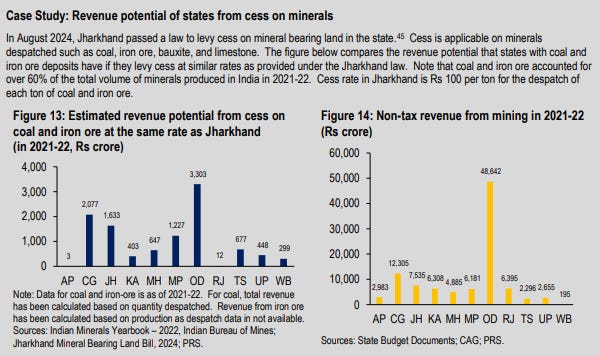
In Odisha, mining revenue, most of which is royalties, makes up more than a fifth of all state revenues (tax and non-tax). In Jharkhand, that same share is 13%. In both states, mineral receipts as a whole have generally accounted for over 75% of just the non-tax revenues. However, on the day of the 2024 judgement, neither Odisha nor Jharkhand had a mineral tax. The financial potential that judgement gave them was immense.
On the other hand, mining companies began staring at some unexpected items in their bill.
For example, just before the 2024 judgment created arrears dating back to 2005, Tata Steel disclosed a whopping ₹17,350 crore in contingent liabilities. JSW Steel, meanwhile, had ₹4,690 crore. Public-sector companies like Coal India faced an estimated ₹70,000-80,000 crore in total arrears. Karnataka’s proposed retrospective tax under the MADA judgment prompted NMDC alone to flag a ~₹15,800 crore contingent liability.
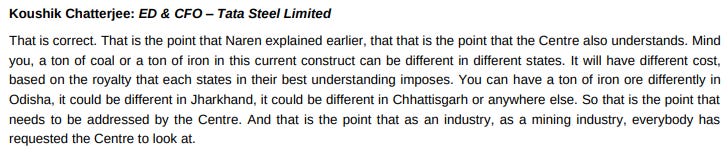
These companies had been lobbying aggressively for relief ever since the judgment. In fact, Tata Steel even highlighted in its Q1 FY25 earnings call that India’s mining sector is one of the most heavily taxed in the world. The Federation of Indian Mining Industries said that the decision could cripple the mining industry.
A centralized regime
That’s where the MMDR Amendment Bill comes in.
The Bill makes a small change to the existing Act, which earlier only restricted states from taxing mineral rights. The law now also included “mineral bearing lands”, side-stepping the workaround that states relied on for so long. On top of that, the law wiped out unpaid dues created by the 2024 judgement.
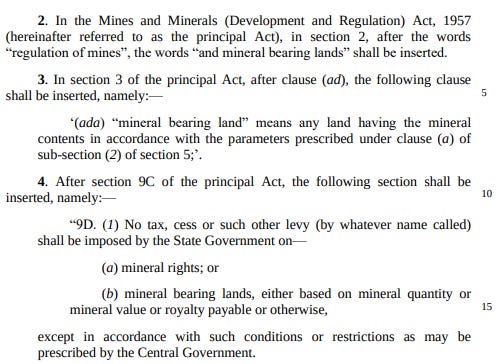
The Centre’s stated reasoning is straightforward. The Statement of Objects and Reasons for the Bill says uneven state levies have created a heavy, unpredictable tax burden on mining. It has created different rates across states, retrospective impositions, and multiple overlapping charges. This makes mining commercially unviable, discourages extraction, and keeps India dependent on mineral imports.
This isn’t an unreasonable argument by any means. India is 100% import-dependent for lithium, cobalt, and nickel: the three minerals most central to its battery manufacturing ambitions. Over 80% of our lithium imports come from China. Our critical mineral import bill has more than doubled between FY21 and FY24. A uniform, predictable fiscal regime may, in theory, make it easier to attract private mining investment.
Additionally, if states have too much power over mineral taxation, they can use that to undercut each other to attract mining investment. This can create a race to the bottom and create lots of wasteful investment.
Now, there’s a promise that any shortfall in state revenue will be made up. This isn’t the first time the Centre has made such a claim. In fact, just after the India Cements judgment in 1989, the Centre increased royalty rates to compensate states for the revenue they’d lost. It also enacted the Cess and Other Taxes on Minerals (Validation) Act, 1992 to validate state taxes collected before the 1989 ruling.
But with the current bill, there’s a legal problem the Centre can’t easily explain away, one that we’ve already touched on here.
Since Independence, land has exclusively been a state subject under the Constitution. The 2024 judgment explicitly said that Parliament’s power to impose limits on state taxation under Entry 50 of the State List does not extend to states’ power to tax land under Entry 49. By bringing “mineral-bearing lands” under central control, the Bill may be overstepping the very constitutional limits India set for itself.
Then, there’s the retrospective taxation problem.
The Bill wipes out arrears that the Supreme Court’s own order had allowed states to collect. In 1993, the Supreme Court said that the Parliament can change the law retrospectively to alter the basis of a judgment — but it cannot simply declare a judgment invalid. Meanwhile, companies that already paid their dues don’t get refunds, while those that delayed get a clean slate. That’s a hard position to defend in court.
Will any of this actually fix mining?
Let’s assume that the Bill survives all these legal challenges. Let’s say a uniform fiscal regime indeed brings down the cost of mining in India. But will that be enough to make India self-sufficient in minerals?
Well, the answer is very likely no, simply because taxation isn’t the only problem, or even the biggest one.
You see, well before tax even comes into the picture, there’s the question of how India allocates mining rights. We covered this in detail earlier this year.
In short: India has created a system where the government is the sole gatekeeper to exploration, but consistently fails to produce well-explored blocks for auction. The Geological Survey of India and other state entities are not designed to run the kind of high-risk, capital-intensive drilling campaigns that create investable mining projects. Private miners aren’t allowed to explore independently, and when they do win auction bids, they’re often bidding on blocks with barely any reliable data about what’s actually underground.
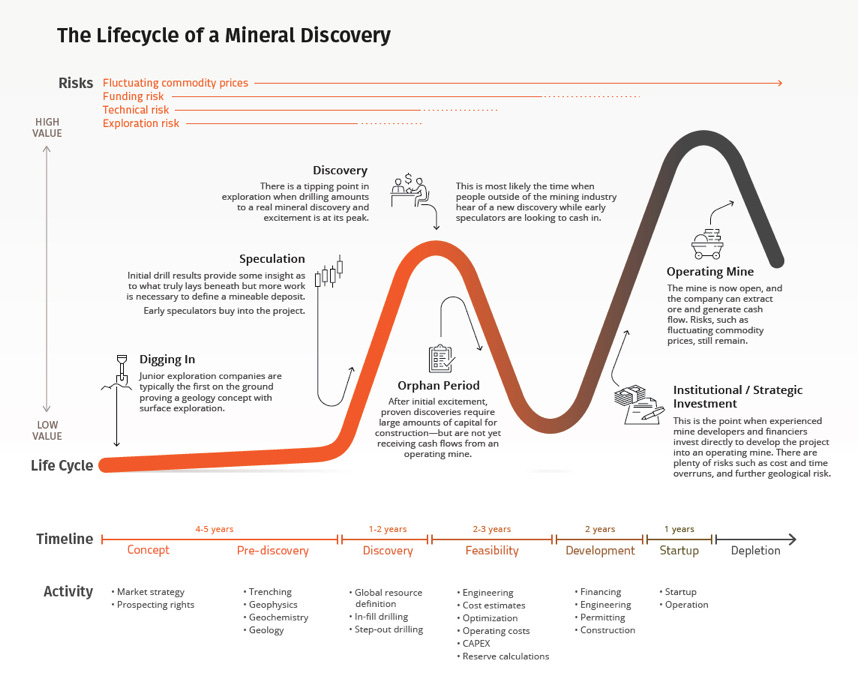
This lack of information is also the reason why the news is filled with headlines of cancelled auctions. In 2024, India cancelled auctions for 14 blocks of critical minerals because no bids were received. The sixth round of critical mineral auctions saw 11 blocks cancelled for the same reason. Since 2023, 14 out of 81 blocks received no bids at all, and 33 had insufficient qualified bidders.
Infrastructure is another gap. Remote mineral-rich regions often lack the roads, rail links, power supply, and water access that mining operations need. Environmental clearances add years to timelines. And India’s own overseas critical minerals push, which includes acquiring lithium brine blocks in Argentina, prospecting in Australia and Chile, is hitting delays and stiff competition.
So even with a perfectly uniform tax regime, the pipeline of actual mining projects remains thin. Reducing states’ taxes doesn’t create geological data. It doesn’t speed up clearances. It doesn’t build roads to remote deposits. And there are other problems of policy unpredictability beyond this which bottles investment.
The tax landscape for mining in India was certainly quite fragmented and unpredictable. But the way the MMDR Amendment Bill solves it raises its own questions. A law that overrides a Supreme Court resolution, strips mineral-rich states of their most important revenue source, and delegates the terms of any future state taxation entirely to the Centre is not the kind of thing that settles easily.
There have been calls for a structured consultation process involving mineral-producing states, modelled on the GST Council. Whether the Centre takes that suggestion or whether the states take the fight to court will tell us whether India can build a mining regime that works for both sovereignty and federalism at once.

How China became the world’s factory
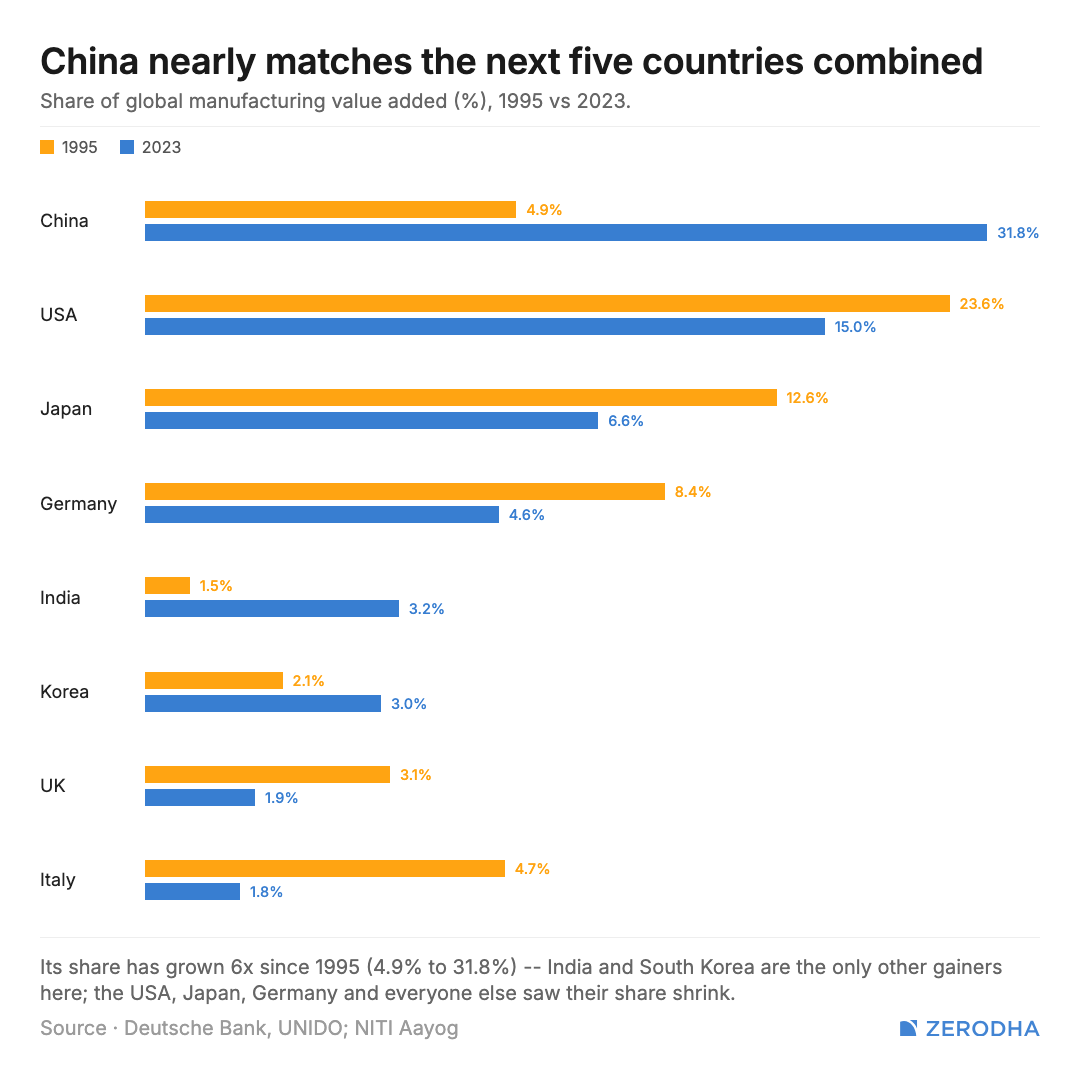
In 1995, the US accounted for nearly a quarter of global manufacturing value added. By 2023, its share had fallen to 15%, while China’s had risen from just 4.9% to 31.8%.
From the late 1970s, China steadily opened its economy and built special economic zones and large industrial clusters. Cheap land, subsidised credit, reliable infrastructure and government support made it easier for factories to scale. Its entry into the WTO brought better access to global markets, while foreign investment helped build capabilities in electronics, machinery and other high-value industries.
India also improved its share, from 1.5% to 3.2%, but its rise was slower. Unlike China, India moved more quickly from agriculture towards services such as IT, finance and telecom, without building manufacturing at the same scale. Infrastructure bottlenecks, fragmented small businesses, complex regulations and the absence of globally dominant export clusters also held it back.
Recent improvements in roads, ports, taxation and production incentives are helping. Electronics exports, particularly mobile phones, have grown sharply. But the chart shows the size of the gap: India has made progress, while China built an entire manufacturing ecosystem.
- This edition of the newsletter was written by Manie.
Tidbits
[1] Former smartphone giant BlackBerry has reinvented itself, with its QNX software now powering more than 275 million vehicles globally. The company is expanding into robotics, industrial systems, and physical AI, pushing its software royalty backlog to nearly $1 billion.
Source: Firstpost
[2] Stripe is nearing an agreement to acquire AI model marketplace OpenRouter for more than $7 billion. The deal would give Stripe a bigger role in how developers access, select, route, and pay for AI models.
Source: Bloomberg
[3] The Central Electricity Regulatory Commission has permitted renewable power developers to retain grid connectivity after missing project deadlines by paying milestone extension charges. Companies can secure additional time by paying daily penalties ranging from ₹1,000 to ₹3,000 per megawatt, preventing automatic disconnection from the transmission network.
Source: Business Standard
[4] Chief Economic Adviser V. Anantha Nageswaran has argued for restoring lower-ethanol E10 petrol alongside E20 to address concerns around older vehicles. He said a choice of blends could protect the existing vehicle fleet while retrofit programmes catch up.
Source: Reuters
[5] China’s ByteDance has signed an agreement with the Motion Picture Association to strengthen intellectual property safeguards for its AI image and video generators. The agreement follows complaints that its tools could generate copyrighted characters and celebrity likenesses without authorization, with both sides agreeing to work on stronger safeguards.
Source: Business Standard
[6] Diageo has agreed to reformulate some of its top-selling whisky and rum brands in India within three months following an FSSAI crackdown over added flavours. The spirits giant will stop adding whisky or rum flavourings to the beverages and introduce clearer front-of-pack labelling during the transition to satisfy the regulator.
Source: The Economic Times
[7] The Indian government has approved 31 new proposals under the Electronics Component Manufacturing Scheme, entailing a combined investment of approx ₹7,900 crore. This latest tranche takes the total number of approved projects to 106, pushing the overall proposed investments under the scheme past the ₹69,000 crore mark.
Source: ThePrint
[8] Alphabet’s Google has won a bankruptcy auction with a $10 million bid for the internal business data of defunct Spirit Airlines, intended for product development and AI training. Subject to bankruptcy-court approval, the dataset which excludes customer information and will undergo de-identification before the sale is finalized.
Source: The Hindu
Beyond Today’s Brief
There’s always more happening at Markets by Zerodha.
Aftermarket Report: Why did Nifty slip toward 24,150 as selling pressure intensified? And how are surging oil prices, El Niño concerns, and rising bond yields weighing on market sentiment?
Subtext: A deep dive into the Impossible Trinity—why central banks cannot simultaneously maintain independent monetary policy, exchange rate stability, and free capital flows, and how the RBI navigates this classic trilemma.
Join us on WhatsApp, where we share interesting soundbites from concalls, articles, and everything else we come across throughout the day. You’ll also get notified the moment a new video or article drops so that you can read or watch it right away.
Thank you for reading. Do share this with your friends and make them as smart as you are 😉
While I get the reasons why centre will push with the minerals amendment act despite all qualms of the states, here's the state position I can't understand
1. Its only in a handful of states where Mineral revenue receipts contribute meaningfully to its overall revenue
2. Bigger states like Rajasthan and UP are not only deprived of mineral production, but they're least minerals endowed.
Now why would states with lower mineral endowment not use this as a method to make terms equal against each other?
On principle, federalism; but in reality?
"This isn’t an unreasonable argument by any means. India is 100% import-dependent for lithium, cobalt, and nickel: the three minerals most central to its battery manufacturing ambitions. Over 80% of our lithium imports come from China. Our critical mineral import bill has more than doubled between FY21 and FY24. A uniform, predictable fiscal regime may, in theory, make it easier to attract private mining investment."
No Indian state (except J&K that does not have statehood) has any meaningful deposits of lithium, nickel or cobalt discovered so far. This is the most lame argument to centralisation.