

Our goal with The Daily Brief is to simplify the biggest stories in the Indian markets and help you understand what they mean. We won’t just tell you what happened; we’ll tell you why and how too. We do this show in both formats: video and audio. This piece curates the stories that we talk about.
You can listen to the podcast on Spotify, Apple Podcasts, or wherever you get your podcasts and watch the videos on YouTube. You can also watch The Daily Brief in Hindi.
In today’s edition of The Daily Brief:
1. A self-purge inside the world’s largest nickel player
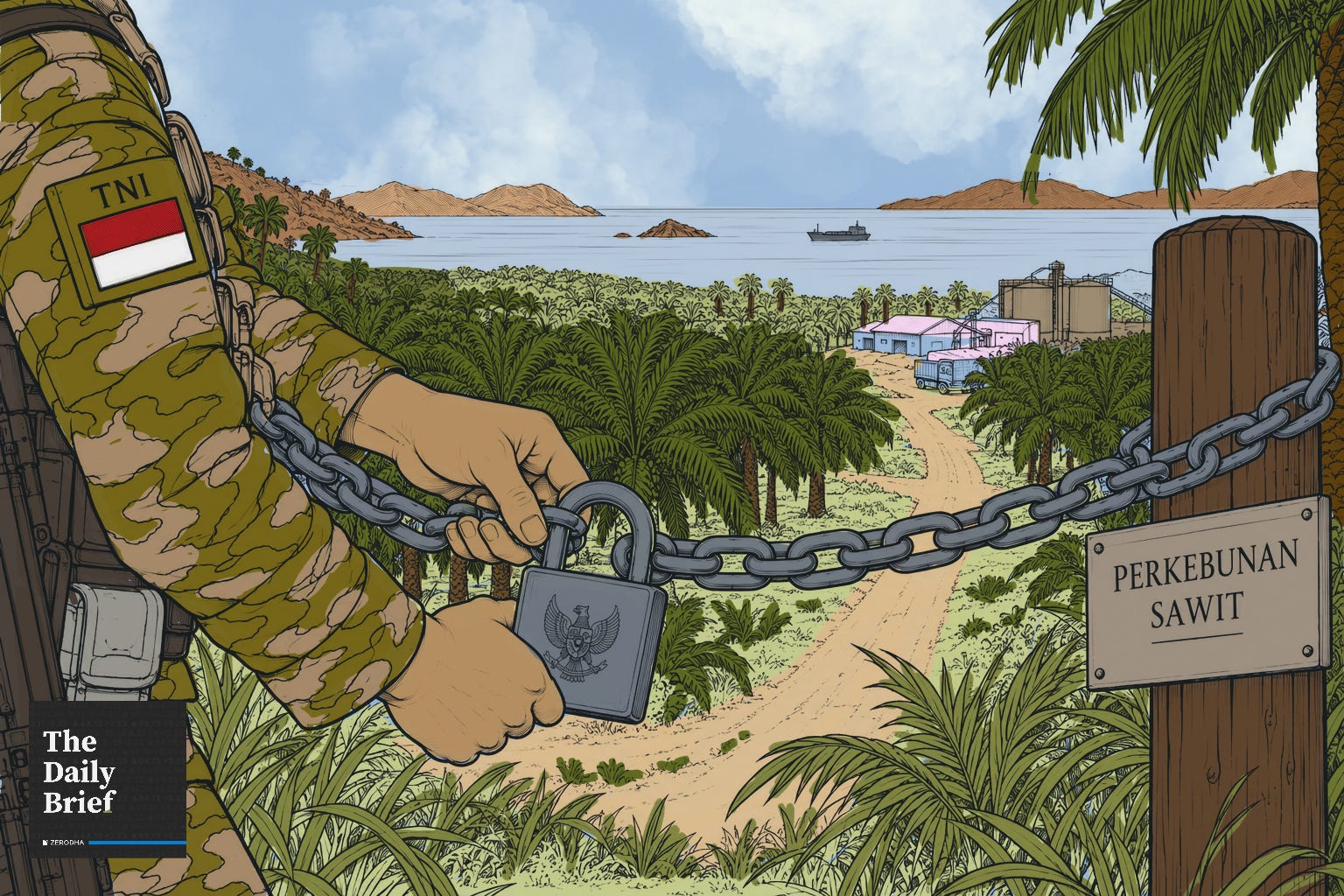
Indonesia has launched an aggressive nationalisation campaign, seizing nearly 6 million hectares of palm oil plantations and cutting mining quotas for thermal coal and nickel. To curb tax leakage and under-invoicing, President Prabowo raised low-grade nickel royalties to 30% and shifted commodity exports under state entities like Danantara and Agrinas. These moves pushed LME nickel prices above $17,900 per tonne while straining ties with Chinese processors. For India, the policy shift threatens critical imports of palm oil, thermal coal, and ferronickel for steelmaking.
2. What’s wrong with the sardines market?
A 46% decline in Moroccan sardine landings—caused by overfishing and warming ocean waters—led Morocco to ban raw sardine exports for 12 months, squeezing European processors. In contrast, India’s Kerala region recorded a decade-high catch of 1.68 lakh tonnes in 2025 due to monsoon upwellings, though an oversupply of undersized juveniles crashed local prices. With an impending El Niño threatening future breeding seasons, extreme ecological unpredictability remains the primary risk for global sardine supply chains.
A self-purge inside the world’s largest nickel player
Something is happening in Indonesia.
The country has launched one of the most aggressive nationalisation campaigns in recent memory. The government has taken over nearly six million hectares of palm oil plantations, created a state-owned export monopoly for its biggest commodities, and collected billions of dollars in fines from companies it accuses of having looted the country’s natural wealth.
In early 2026, Indonesia slashed its nickel ore mining quotas from 379 million tonnes to 250 million tonnes. It then hiked royalties on low-grade nickel ore from 17% to 30%, while introducing new taxes and licensing requirements on many other minerals.
Indonesia is the world’s largest producer of palm oil and nickel, and among the top 3 producers of both tin and coal. Such a large crackdown will inevitably move the global markets for these commodities. This includes India, as we are heavily dependent on the country for palm oil, thermal coal and nickel.
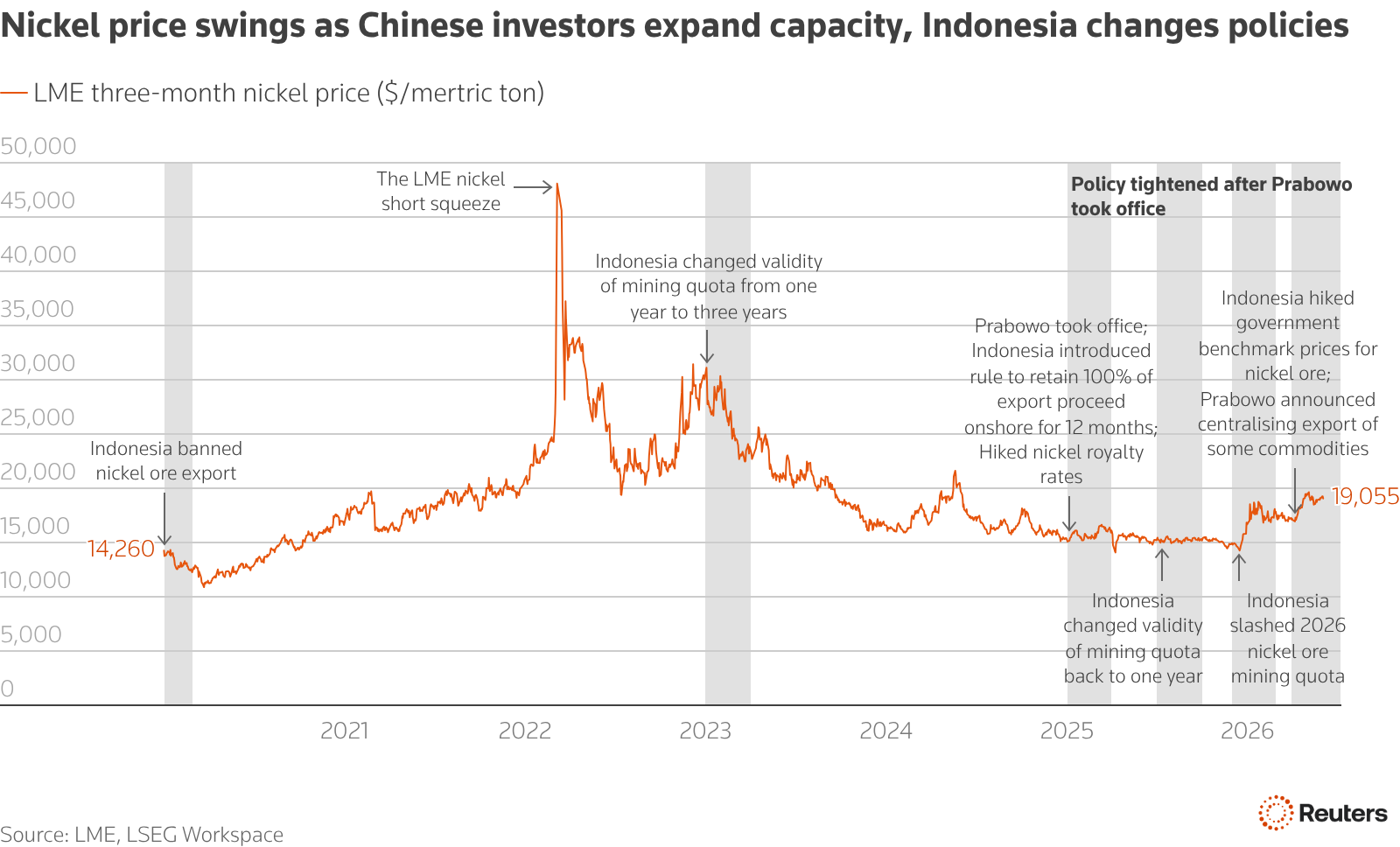
The response from the industry was immediate. Chinese firms, which dominate Indonesia’s nickel processing, began scaling back production. Nickel prices on the London Metal Exchange surged past $17,900 per tonne. In a letter to Prabowo, the China Chamber of Commerce in Indonesia argued that their firms faced “excessively stringent regulation” and alleged extortion by authorities.
So, why is Indonesia going through all of this, and why now? And how much of this is reform, how much is revenue desperation, and how much is power consolidation?
Indonesia’s resource nationalism
All of this doesn’t fully come out of the blue, but has some history behind it.
Indonesia is one of the most commodity-rich countries in the world. But, you see, much like other developing nations, it has always had a singular frustration: the country kept exporting raw materials cheaply and importing finished goods at high prices. It enjoyed very little benefit of the profit that would arise out of value addition on its own raw materials.
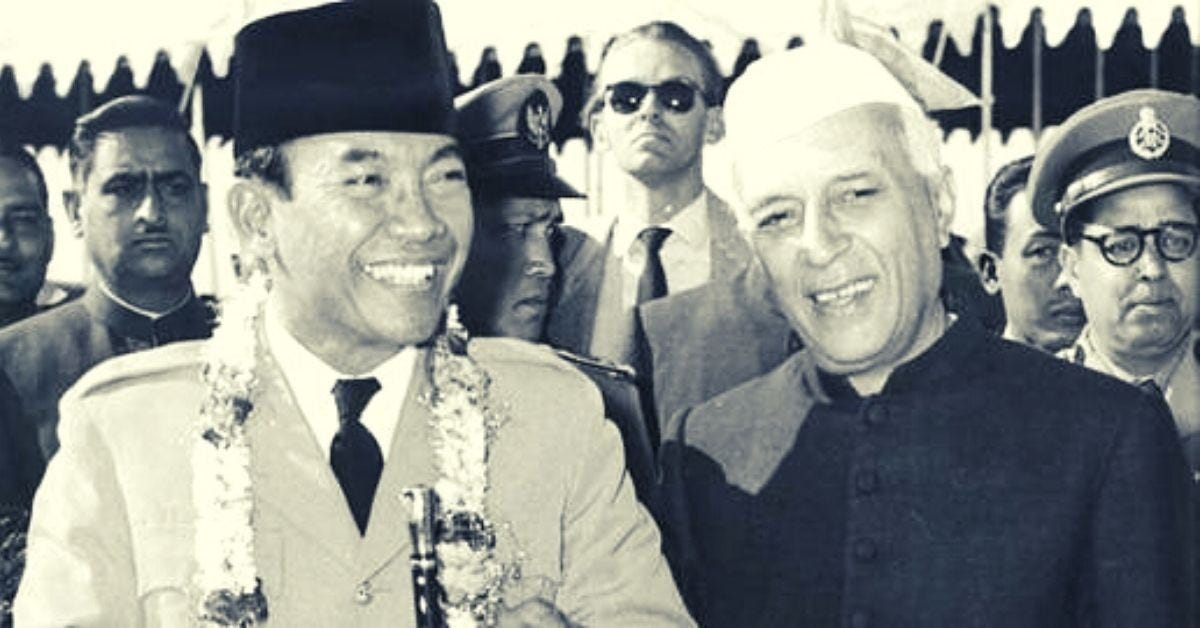
This frustration existed for a reason, though. Until its independence in 1945, Indonesia was a colony of the Dutch, who would only take raw materials for their own finished goods. This was a common worry at the time among post-colonial countries, including India. So, Indonesia’s founding President Sukarno undertook a large-scale nationalization of Dutch-owned plantations and companies.
But Indonesia’s version of the struggle to localize this value addition became unusually intense. One big reason for this is the deep entanglement of the military.
The roots go back to the 1970s oil crisis which sent oil prices soaring. Indonesia’s leading state oil company Pertamina, which was headed by Lieutenant-General Ibnu Sutowo, reaped huge benefits with those prices. Those revenues were channeled into social welfare programs, but they were also used to fund further military interests and political patronage. In fact, generals often received special mining concessions and were promoted to leadership positions in state-owned firms.
Eventually, this resource nationalism only got stronger. Indonesia forced foreign giants to divest 51% or more of their business to national entities. In 2012, the Constitutional Court dissolved BP Migas, Indonesia’s independent oil and gas regulator, ruling that it favoured foreign companies.
The nickel gambit
This same impulse drove Indonesia’s most famous recent act of resource nationalism: the nickel export ban.
For years, Indonesia exported raw ore to be processed elsewhere, mostly in China. Then, in 2014, it introduced a partial export ban on unprocessed minerals, meant to force companies to build processing infrastructure inside Indonesia. Several Western mining MNCs pulled out. This eventually turned into a full export ban in 2020.
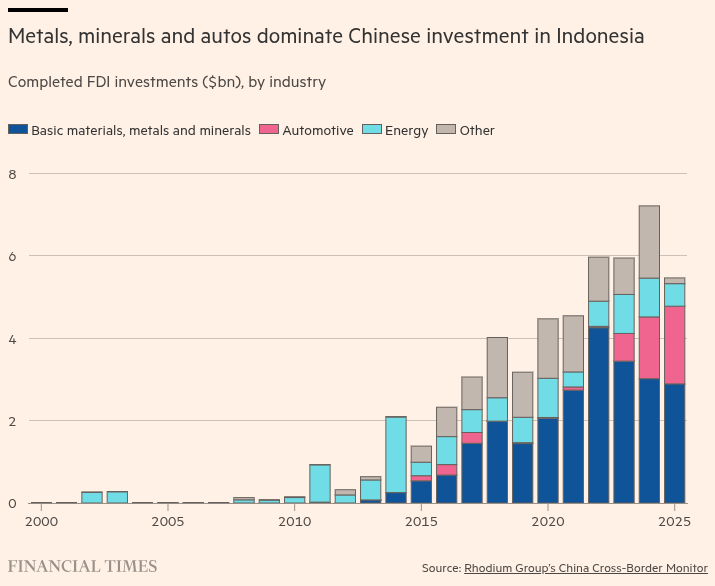
But another actor smelled an opportunity there. Chinese state-backed firms are building smelters and processing facilities in Indonesia at a pace no one had anticipated. Even when Indonesia imposed the full ban in 2020, an infrastructure buildout was already underway with Chinese capital.
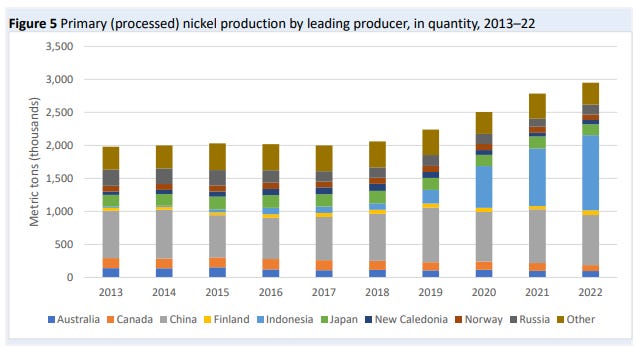
Indonesia’s nickel exports jumped ten-fold between 2017 and 2023, from ~$3 billion to $33.5 billion. By the first half of 2025, nickel exports reached $16.5 billion, overtaking coal as Indonesia’s most valuable export. Indonesia’s share of global processed nickel leapt from being negligible in 2013 to ~40% by 2024. Indonesia also became the largest producer of stainless steel, which needs nickel.
By most conventional measures, the nickel ban worked spectacularly. It was the most crucial first step towards Indonesia’s own EV ambitions.
But the success came with a catch.
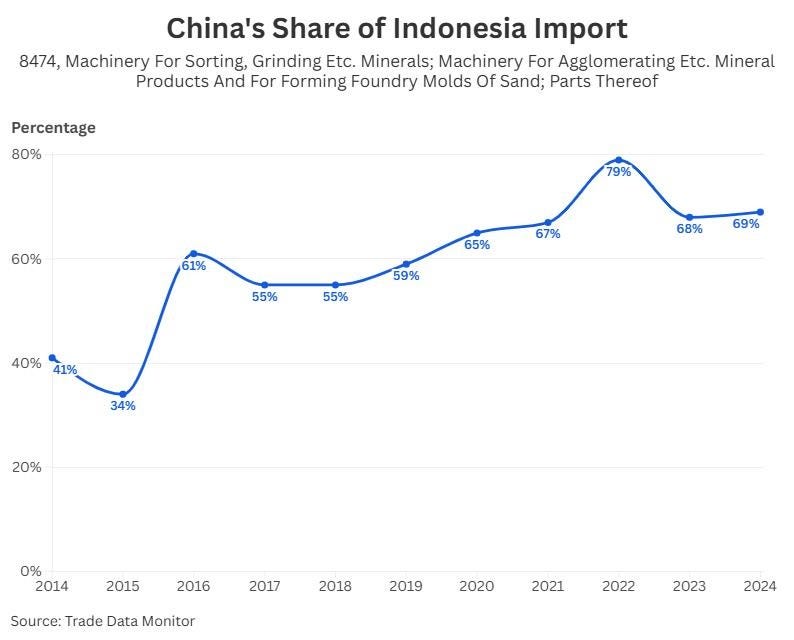
Most of Indonesia’s nickel refining capacity is now controlled by Chinese companies. Over $30 billion in investment flowed in, financed by state-owned Chinese banks and built alongside dedicated coal power plants. The processing happens in Indonesia, but ~75% of the direct profits flow to foreign shareholders, while the environmental costs of deforestation, carbon-intensive smelting, and toxic waste are borne locally.
Indonesia had climbed the value chain, but now finds itself overly dependent on a single foreign partner. That has created a new pain point in China-Indonesia relations.
Leaks in the system
But localisation is only half the problem.
Even where Indonesia has managed to bring much of the investment in-house, the money that should reach the state coffers from there simply doesn’t.
Transfer pricing
One reason for that is that firms in Indonesia undertake a practice called transfer pricing.
Imagine a company A situated in Indonesia that sells nickel. It has an offshore subsidiary in a tax-friendly region like Singapore. Company B, which is located in China, wants to buy a unit of nickel at the market price of $100. How A sells that nickel is not directly to B, but by first selling it to the offshore unit at a highly-suppressed price (say $30). That way, A is able to avoid domestic taxes on that sale entirely, ultimately hurting state tax revenues.
If government speeches are to be believed, due to transfer pricing and under-invoicing, Indonesia lost as much as $908 billion over 3 decades. It is a staggering figure, though difficult to verify.
Corruption
If that wasn’t enough, blatant corruption is also rampant in Indonesia.
For instance, investigations found that ~5.6 million metric tons of nickel ore were smuggled to China between 2020 and mid-2023. Many analysts and traders suspect that it was misclassified as iron ore on customs declarations.
Then, in 2023, a major nickel-smelting firm was prosecuted for bribing the governor of Maluku to secure an extraction license. In April 2026, the attorney general arrested the active chairman of the National Ombudsman, on charges of accepting bribes from a nickel firm.
The widespread nature of this corruption also explains why Indonesia has such a large informal mining sector. In tin alone, the state estimated it was losing 80% of its total tin output to illegal mining and cross-border smuggling.
Part of this corruption stems, ironically, from how Indonesia historically pursued resource nationalism. With selective concessions, Indonesia created a class of military elites and business oligarchs to whom much of Indonesia’s resource wealth accrued.
This is the context in which Prabowo’s crackdown exists.
The big squeeze
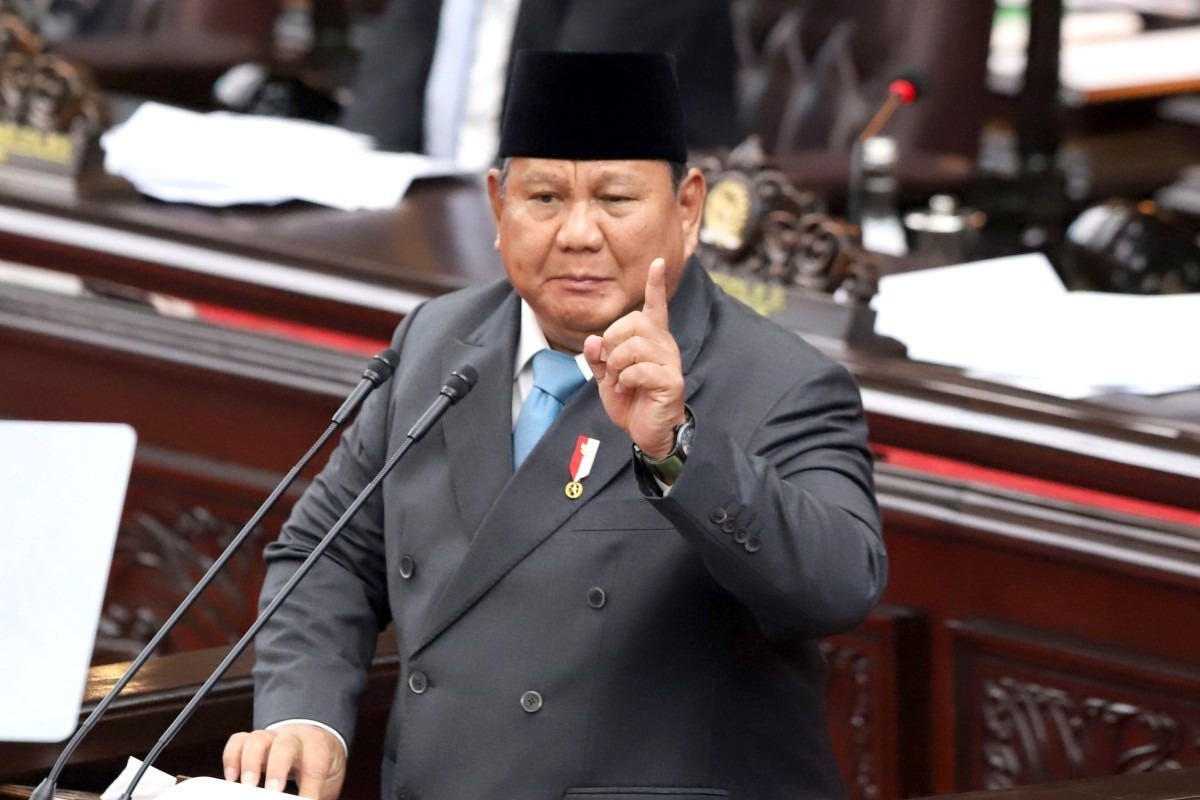
Since late-2024, Prabowo, who himself was a former military general, has made multiple interventions at a frightening pace under the promise of using Indonesia’s natural wealth in the service of its majority instead of just a narrow set of people.

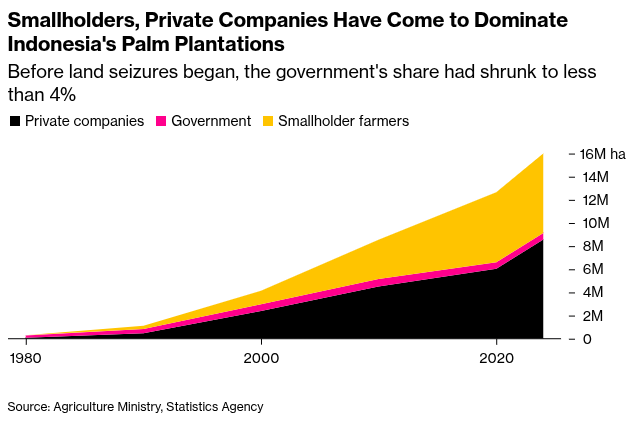
The most dramatic such move has been the forest task force. It is a military-backed operation that has seized nearly 6 million hectares of oil palm plantations and over 10,000 hectares of mining concessions. Fines worth hundreds of millions of dollars have also been collected.
Much of this seized land has been transferred to Agrinas, a state-owned company created in early 2025 that has, almost overnight, become the world’s largest palm oil grower by land area. Agrinas is run largely by retired military officers and forces local farmers into restrictive revenue-sharing arrangements where the state keeps 40-45% of proceeds. Harvest payments have been delayed by over 30 days, and many farmers are walking away.
Prabowo has said another few million hectares could be seized. This would mean that more than half of Indonesia’s ~17 million hectares of palm oil plantations are, in the government’s telling, operating informally.
In nickel, Indonesia has changed licensing rules in such a way that mining firms must now re-apply for approved extraction limits every single year rather than once every three years. In the Halmahera island of the country, where the world’s biggest nickel mine is located, soldiers conducted a televised raid last year merely because the mine operator had violated a forestry permit.
Indonesia has also aggressively pursued cuts in production quotas, ideally to create an artificial scarcity which would push up nickel prices, and hence state revenues. For instance, the Halmahera mine received a quota cut. In coal, the state has slashed mining quotas for 2026, aiming to bring national production down to 600 million metric tons from 790 million last year. In many ways, this was also the strategy OPEC followed for crude oil.
In May 2026, the government announced that all exports of palm oil, coal, and ferroalloys would be channeled through a subsidiary of the country’s sovereign wealth fund, Danantara. It is meant to be a state-controlled commodity trading monopoly whose stated goal is to combat under-invoicing. But critics ask a simpler question: if the problem is dodgy invoicing, why not reform customs and taxes?
Prabowo has also announced Icomex, a new Indonesian commodities exchange launching in Jan 2027 which is designed to wrest pricing power from the London Metal Exchange and the Shanghai Futures Exchange.
All of this is happening against economic stress. The rupiah hit a record low against the dollar in June 2026. This year, Indonesia may be servicing its largest debt servicing bill, spending 19% of state revenues on interest payments. Danantara itself has been asked to remit $6.8 billion to shore up the state budget. The crackdown is also a desperate search for revenue as much as it’s politically-driven.
Global ripples
Undoubtedly, the implications of this crackdown have had their impact globally. India isn’t exempt from these effects, either.
For one, we import over 60% of our edible oil, and palm oil from Indonesia and Malaysia makes up the lion’s share. Our kitchen budgets could acutely feel disruptions to Indonesian palm oil production. In fact, we already are, but due to a different reason altogether: Indonesia is diverting much of its palm oil away from exports and towards its own biodiesel production. We’ve been here before in April 2022, when Indonesia’s wholesale ban on palm oil exports hurt our import bill.
Then, there’s coal, which, along with cooking oil, drives most of our trade deficit with Indonesia. We are the second largest buyer of Indonesian thermal coal. That being said, our import dependence for coal as a whole has been reducing, with our import-based power plants increasing their share of domestic coal use to 50% this year. This has provided a healthy cushion.
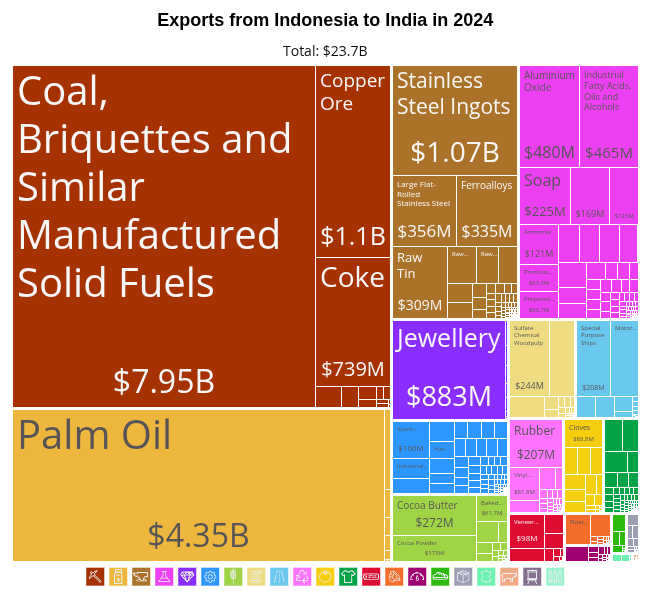
Lastly, there’s nickel, for which India is nearly wholly import-dependent. India imports more than 80% of its ferronickel, a critical alloy for steel manufacturing, from Indonesia, creating an immediate risk for our steel industry. Plus, Indian EV battery manufacturers will likely see an inflated bill of materials.
And remember, most of Indonesia’s nickel refining capacity is controlled by Chinese companies. So Indian steelmakers are exposed not just to Jakarta’s regulatory upheaval, but to the escalating Indonesia-China dispute, which won’t just increase supply chain costs, but also put us in messy geopolitical crosshairs.
Interestingly, in the midst of all this, India and Indonesia concluded one round of trade talks and signed a few deals on critical minerals, defence and agriculture.
Conclusion
Every country has had their own version of localisation of supply chains. In that sense, Indonesia’s story is a familiar one. But it is the context within which it’s happening that is different.
The current approach to localisation is faster, broader, and very coercive. The tools being used look a lot like the ones that created those problems in the first place. Selective concessions built the oligarchic system he says he’s dismantling. With the rupiah at record lows and debt servicing consuming a fifth of revenues, the line between reform and revenue extraction is almost impossible to draw.
Indonesia is certainly not wrong to want more from its resources. But it’s doing everything at once: military-backed seizures, monopolies, a new commodities exchange, quotas and taxes. How different this attempt at resource nationalism will be from the ones in the past is still up for debate.

Fishy business in the sardines market
Sardines are suddenly having a moment in America. For years, they were the slightly embarrassing tin sitting at the back of the supermarket shelf. Now they are showing up on restaurant menus, in social-media recipes and in brightly designed cans, marketed as an affordable source of protein.

The timing is awkward. Just as sardines are becoming fashionable in America, some popular canned-sardine brands are becoming harder to find in US stores.
That does not mean the world is running out of sardines. “Sardines” is a trade term used for several different species, caught from different fish stocks around the world. That makes the story more complicated than it first appears.
At the centre of it is a country in North Africa - Morocco.
Why Morocco matters
“Landings” simply means the fish brought ashore. They are not a count of how many fish remain in the sea. So this drop does not, by itself, prove that the sardine stock declined by 46%. It could also reflect where the fish were found, how much fishing took place and how the fishery was managed.
But the economic impact is clear. Far less fish reached Moroccan ports, processors and buyers.
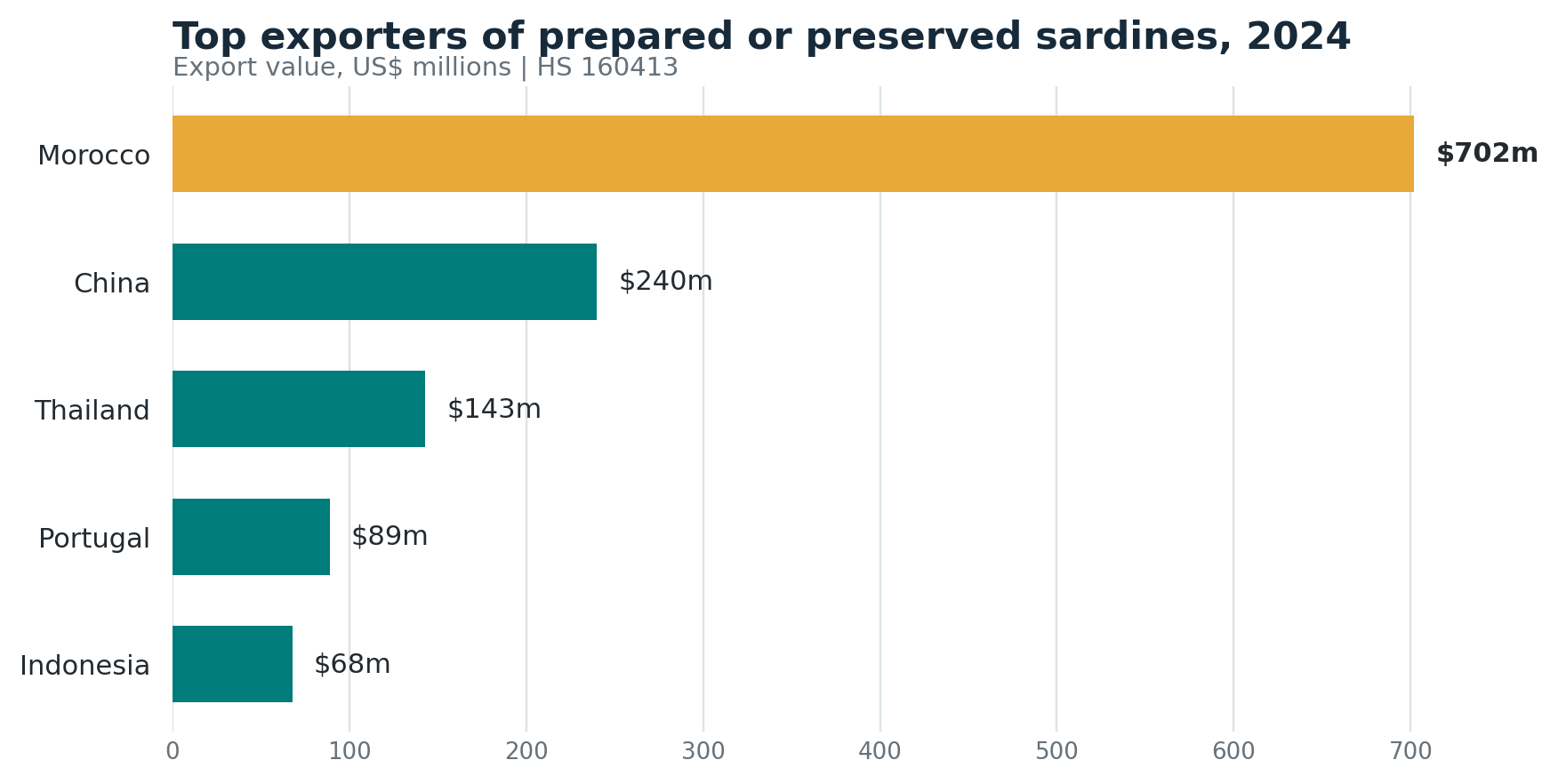
Morocco’s importance becomes clearer when we look at trade. In 2024, it exported $700 million worth of prepared or preserved sardines. That made it the largest exporter in this specific customs category, including the US.
Because landings were falling, Morocco suspended exports of fresh, refrigerated and frozen sardines for 12 months from 1 February 2026. Canned sardines were not covered by the ban.
The idea was to keep domestic supplies and prices stable, while ensuring that Moroccan processors continued to get enough fish. But the raw fish could no longer be shipped abroad. Only processed, canned sardines could be exported.
That matters for buyers outside Morocco. In the first ten months of 2025, Morocco supplied roughly 94% of Spain’s frozen-sardine imports from outside the European Union. The ban would therefore hit Spanish processors and its canned-sardine industry, which rely on imported raw fish.
So why did this happen?
Why did Moroccan landings fall? The evidence points to two pressures: fishing and the environment. Neither gives us the complete explanation.
On the fishing side, a 2026 stock assessment concluded that sardine stocks in central and southern Moroccan waters were overexploited. Morocco’s National Institute of Fisheries Research has separately reported that different fishing zones were overexploited between 2023 and 2024. Overfishing leaves fewer fish to reproduce and replenish the stock, making future catches more vulnerable.
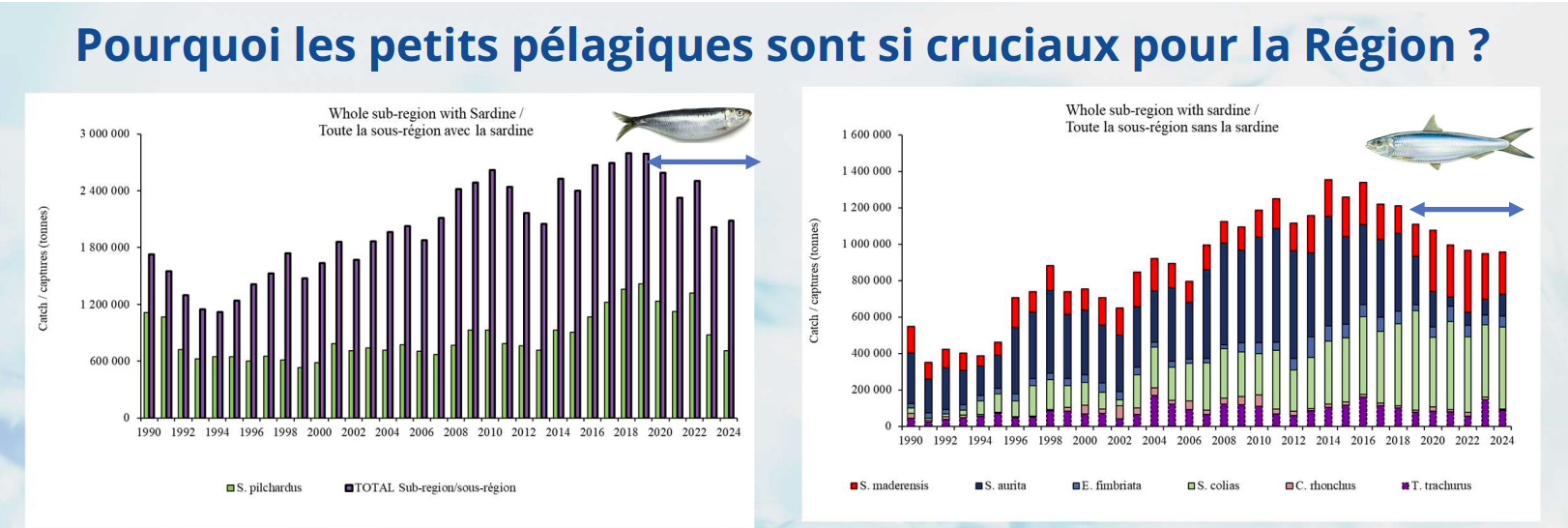
Climate, however, still matters.
Sardines eat plankton. The waters off Morocco are usually very productive because of a process called upwelling. Winds push warm surface water away from the coast, allowing colder, nutrient-rich water from below to rise. Those nutrients help plankton grow, giving sardines plenty to eat.
When the sea becomes warmer or upwelling weakens, the amount of plankton can change. Sardines may grow more slowly, remain smaller, reproduce less successfully or move elsewhere in search of better conditions. A similar shortage was already being felt in French markets, where suppliers blamed warmer water, reduced plankton and fishing pressure.
Fishing and climate can both be affecting the sardine population. Managers cannot control the sea, but they can control how much is caught, when fishing happens and whether young fish are protected.
The question is not which one is solely responsible. It is whether the fishery is healthy enough to withstand both pressures at the same time.
India’s sardines tell a different story
India’s oil sardine is a different fish, found in a different ocean. In 2025, India landed 2.53 lakh tonnes of oil sardines, making it the country’s third-largest marine resource by landings. Kerala accounted for 1.68 lakh tonnes, its highest oil-sardine catch in a decade.
That abundance may not last. The Central Marine Fisheries Research Institute has warned that oil-sardine landings could fall sharply in 2027 if a projected El Niño brings unusually warm conditions to the northern Indian Ocean during the fish’s breeding season. Another outlook says El Niño is strengthening and puts the chance of it becoming very strong at more than 90%.
But a forecast is not a guarantee. It points to a serious risk, not a certain crash.
The timing is important. Oil sardines spawn between roughly May and September. Warmer water, weaker upwelling and less food can affect their ability to mature and the survival of young fish. When the sardine landings in 2015 fell, there was an analysis done. It found a statistically significant link between El Niño conditions and lower landings. But it also said excessive fishing played a role.
Kerala’s swings show why these forecasts matter. Oil-sardine landings crossed 4 lakh tonnes in 2012 but fell to about 3,500 tonnes by 2021. In 2024, the problem was different: Kerala saw an unusual surge in young sardines, averaging around 10 cm in size. Researchers linked this to stronger monsoon rainfall and nutrient-rich upwelling, which increased plankton and helped more sardine larvae survive.
But the sudden increase in young fish created its own problem. Too many of them were competing for food, so they remained small and gained less weight. The glut pushed sardine prices down, and Kerala temporarily suspended fishing for juvenile sardines.
The real risk is volatility
This is why the sardine problem is not simply about scarcity. In Morocco, lower landings and an export restriction are squeezing buyers of raw fish. In Kerala, an oversupply of young sardines has pushed prices down and could affect the fishery’s future.
For fishers, processors and retailers, the bigger problem is unpredictability. Kerala’s experience—a boom, a collapse and then a surge of juvenile fish—shows how quickly supply can change, leaving businesses little time to adjust their contracts, factory schedules or prices.
- This edition of the newsletter was written by Manie & Kulsum.
Tidbits
1. Tata Motors secures regulatory approvals for proposed €3.8 billion Iveco Group acquisition
Tata Motors has received clearance from the European Central Bank and other regulators for its proposed €3.8 billion (approximately ₹40,000 crore) acquisition of Italian commercial vehicle manufacturer Iveco Group. The ECB approval clears a key hurdle for the tender offer, bringing the Indian automaker closer to expanding its footprint in the European commercial transport sector.
Source: The Economic Times
2. UpGrad acquires Unacademy for over $200 million in steep valuation reset
Edtech platform upGrad has completed the acquisition of Unacademy for slightly more than $200 million, marking a massive markdown from Unacademy’s peak $3.4 billion valuation. The consolidation reflects ongoing funding constraints and a broader market correction within India’s online education sector as companies prioritise profitability over aggressive expansion.
Source: The Hindu BusinessLine
3. Reliance Consumer Products enters ice cream market with ₹10 entry price
Reliance Consumer Products has launched Bombay Creamery, with cones, cups, tubs, bars, and sticks starting at ₹10. The brand is initially available in western India and will be rolled out nationally as Reliance expands further into packaged consumer goods.
Source: The Economic Times
4. HFCL secures ₹2,329 crore telecommunications export contract
Domestic telecom equipment maker HFCL has secured its largest-ever single export order, valued at ₹2,329 crore, to supply high-fibre-count optical fibre cables to an international customer over three years. The contract strengthens its global optical-fibre business and aligns with India’s broader push to establish itself as a manufacturing hub for critical network infrastructure.
Source: The Economic Times
5. Mahanadi Coalfields files draft papers for IPO as Coal India plans stake sale
Mahanadi Coalfields, a subsidiary of state-owned Coal India, has filed a draft red herring prospectus for an initial public offering. The offering will consist entirely of an offer-for-sale of up to 66.18 crore shares by Coal India, representing about a 10% stake, with the mining unit itself receiving no proceeds from the transaction.
Source: ET Now
Beyond Today’s Brief
There’s always more happening at Markets by Zerodha.
The Chatter: How is Milky Mist leveraging IoT logistics and reverse freight to cut transport costs by up to 20%? What is driving Bluestone's confidence in smaller cities as consumers pivot toward 14-carat and lightweight jewellery? How did Leap India's palletisation model boost a beverage maker's daily truck throughput by 500%? Plus, updates from Avanti Feeds and Precision Camshafts
Aftermarket Report: Why did rising global bond yields and climbing oil prices drag Nifty decisively below 24,000? What key factors prompted Japan Credit Rating Agency to upgrade India's sovereign credit rating to A-? How are escalating U.S.-Iran hostilities holding crude oil near $90 per barrel? And why did Dell shares jump as AI workloads drive a massive revenue surge?
Join us on WhatsApp, where we share interesting soundbites from concalls, articles, and everything else we come across throughout the day. You’ll also get notified the moment a new video or article drops so that you can read or watch it right away.
Thank you for reading. Do share this with your friends and make them as smart as you are 😉
Can we have episode on how GDP is calculated using the new methodology?
Thanks, it was very informative